SLIDE 1
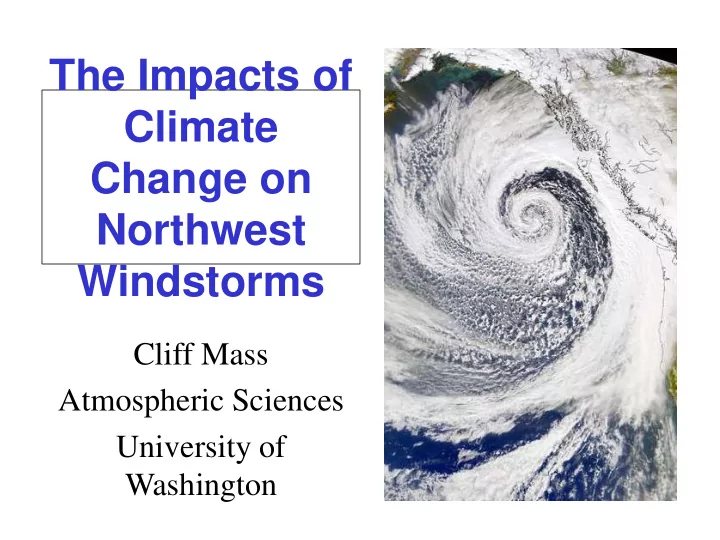
The Impacts of Climate Change on Northwest Windstorms
Cliff Mass Atmospheric Sciences University of Washington
SLIDE 2 1993 Inauguration Day Storm
Although the Pacific Northwest does not experience tropical storms or hurricanes, we do experience very strong Pacific cyclones, with winds equal to category two
SLIDE 3
Native Americans knew about NW windstorms and had several legends regarding their origin. The Thunderbird
SLIDE 4 The force of southerly storms was evident to every eye; large and extensive woods being laid flat by their power, the branches forming one long line to the North West, intermingled with the roots of innumerable trees, which have been torn from their beds and helped to mark the furious course of their tempests.
John Meares, 1788, off of Cape Flattery of the Olympics
Peninsula
SLIDE 5 Early Settlers
- As European settlers learned that
Northwest windstorms were a force to be reckoned with.
- In 1875, Seattle pioneer Arthur
Denny noted "a strong gale, which threw down considerable timber and
light structures, such as sheds and
Arthur Denny
Seattle
SLIDE 6
Big Trees: NW Storm Force Multiplier
A minor windstorm Easter Sunday, April 97
SLIDE 7
Compared to this…
SLIDE 8 Most Northwest Windstorms are Produced by Midlatitude Cyclones with low central pressures
- A cyclone is an area of low pressure around which air circulates in a
counterclockwise direction (in the northern hemisphere)
SLIDE 9 Midlatitude Cyclones
- The lower the central pressure the stronger the
winds.
- Typical winter low 990-1000 hPa. Moderate
windstorms 980-990 hPa. Strong ones, 950- 980hPa
- Deep lows have strong pressure gradients, which
result in the strong winds.
SLIDE 10
Weather Satellites Imagery of Our Storms Reveal The Huge Scale of Our Major Storms
SLIDE 11
Tropical Cyclones: Much Smaller
SLIDE 12
Chanukah Eve Storm: 18-h forecast for 10 PM December 14, 2006 L Pressure Pattern Associated with the Chanukah Eve Storm Of December 15, 2006
SLIDE 13
The Most Extreme Northwest Windstorm: The Columbus Day Windstorm of 12 October 1962
SLIDE 14
Began as Typhoon Frieda and then moved northward and transformed into a midlatitude cyclone.
SLIDE 15
SLIDE 16 Columbus Day Storm
- The most damaging windstorm to strike the Pacific
Northwest in 150 years.
- An area from northern California to southern British
Columbia experienced hurricane-force winds, massive treefalls, and power outages.
- In Oregon and Washington, 46 died and 317 required
hospitalization as a result of the storm.
SLIDE 17
SLIDE 18
Max Winds (mph) Columbus Day Storm 1962
SLIDE 19
Columbus Day 1962: At Cape Blanco there were 150 mph with gusts to 179! Strongest winds on bluffs and windward slopes of coastal orography
SLIDE 20
More Recent Storms
SLIDE 21
Inauguration Day Storm January 20, 1993
SLIDE 22
The first major windstorm to be highly skillfully forecast….
SLIDE 23 Winds of over 100 mph were
- bserved at exposed sites in
the coastal mountains and the Cascades, with speeds exceeding 80 mph along the coast and in the interior of western Washington.
SLIDE 24
Chanukah Eve Storm of Dec. 2006
SLIDE 25
- Winds gusted to 90 mph along the coast, 80
mph in the eastern Strait of Juan de Fuca, and 70 mph over the Puget Sound lowlands.
- In the Cascades, winds reached 100 mph at
Sunrise on Mt. Rainier and 113 mph at Chinook Pass.
SLIDE 26 Pacific Cyclone Key Facts
- Each year, typically get several storms with
winds gusting to 30-50 mph.
- Every year, a storm reaching roughly 50-70
mph.
- Every ten years, 70-90 mph
- Every 30-50 years, 90+ in exposed locations.
SLIDE 27
A Winter Season Phenomenon
SLIDE 28 Northwest Windstorms and Global Warming
- Will there be more of them?
- Will they become more intense?
The Inauguration Day Storm 1993
SLIDE 29 Northwest Windstorms
- The best science suggests that there will not be
an increasing trend.
- But first, what has been the trend over the past
half-century?
SLIDE 30 Seattle City Light sponsored study
- Started with global climate models
- Used regional, high-resolution models to look at
local impacts.
SLIDE 31 Number of times above 90 percentile for 1970-2000 (DJF)
Just
Washington Coast
SLIDE 32
Seattle
SLIDE 33
SLIDE 34 Why SHOULD we expect Northwest windstorms to change?
- Their energy source is the jet stream and the
strong horizontal temperature gradients associated with it.
- Most global climate models suggest that the
temperature gradients will weaken at low levels as the Arctic heats up more than the poles.
- But the temperature gradient increases in upper
troposphere.
SLIDE 35
Hurricanes hitting the Northwest under Global Warming?
Forget it, even a warmed eastern Pacific will be far too cold.
SLIDE 36
Observed Trend at Sea-Tac
SLIDE 37
Damaging Winds Can Also Be Produced in other Ways Gaps in Our Terran Produce Strong Wins.
SLIDE 38 Enumclaw and nearby foothills locations can experience severe windstorms…while calm winds
December 24, 1983 Winds over 118 mph
SLIDE 39
December 24, 1983
SLIDE 40
SLIDE 41
Why Enumclaw?
SLIDE 42
Enumclaw Windstorm Pressure Pattern
December 24, 1983
SLIDE 43
Fraser River Gap Windstorms
December 28, 1990
SLIDE 44 Max Winds, 28
Gusts above 90 mph
Fraser River NE Gap Flow
SLIDE 45
SLIDE 46 What will Global Warming Do to Strong Gap Winds?
- Probably weaken them
- Cold air in the interior of the continent results
in higher pressure that can help drive gap winds
- Global warming is lessening the severity of the
cold air in the interior.
- Less strong offshore flow in gaps during
winter.
SLIDE 47
Cold Wave Trends
The U.S. Environmental Protection Agency did a study of the trend of cold wave days from 1948 to 2015
SLIDE 48 An Aside: Forecasting of Northwest Windstorms is MUCH Better
- Better forecast models
- Satellite data around the
globe
more.
- Before ~1993 we got most
- wrong. Today, most
correct days in advance.
SLIDE 49
Forecasts Need to Be Used Better in Construction
SLIDE 50
Seattle WindWatch
SLIDE 51 Bottom Line
- There is no reason to expect increased extreme
winds over the region under global warming.
- Weather forecasting skill has improved, which
can be useful for protecting construction and buildings in place.