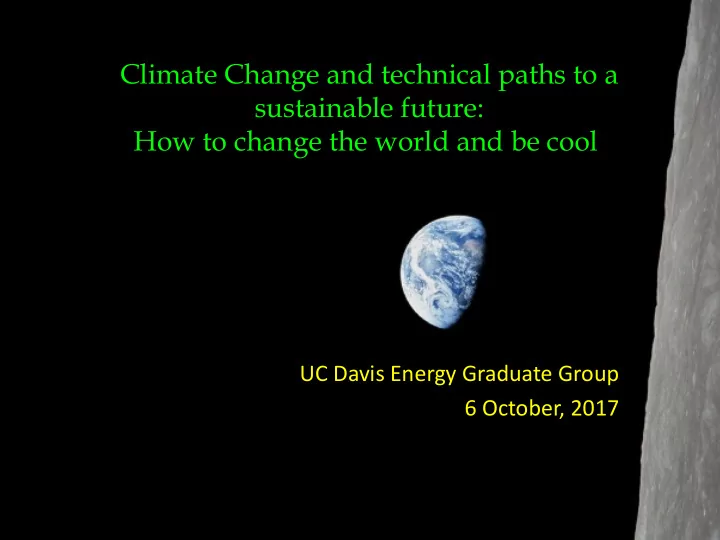
SLIDE 1
UC Davis Energy Graduate Group 6 October, 2017
Climate Change and technical paths to a sustainable future: How to change the world and be cool
SLIDE 2
- The risks of climate change: new data
Outline of talk
- The rapidly changing landscape of energy
SLIDE 3
- The risks of climate change: new data
Outline of talk
SLIDE 4 4
Global average temperature increased by 1º C since 1970
1℃ 1℃ rise si since 1975 1975
Between 2001- 2013
SLIDE 5 5
Nature Climate Change (2016) doi:10.1038/nclimate2938
Black line: prediction
models
SLIDE 6 6
Why did the climate models miss the energy plateau? Predicting climate change on a 10-year time frame is difficult. (e.g. details of an el Niño and la Niña
SLIDE 7
Argo Float used to measure sea temperature (0 – 2 km deep)
4 year operation, surfaces every 10 days to transmit data
Deep Ocean thermal mixing also fluctuates
SLIDE 8
3847 Argo Floats (April, 2015)
Global Heat Content anomaly 0 - 2,000 m depth (2006 -2014)
- D. Roemmich, et al., Nature Climate Change 5, 240 – 245 (2015)
Energy is still conserved! The heat went into heating the oceans.
SLIDE 9
Are the glaciers melting? Is the sea level rising?
SLIDE 10
Are the glaciers melting? Is the sea level rising?
YES
SLIDE 11 Chen, Wilson, Blankenship, Tapley, Nature Geoscience 2, 859 - 862 (2009)
Accelerated Antarctic ice loss from satellite gravity measurements (Apr. 2002 – Jan. 2009) In the last interglacial period (129,000 to 116,000 years ago), the average temperature was only ~ 1° C warmer than today. Geological records: the sea level was 6 - 9 meters higher than
believe would take 1000s of years. We now fear seas could rise 5 meters in < 100 years.
SLIDE 12 12
500 1,000 1,500 2,000 2,500 3,000 1750 1800 1850 1900 1950 2000 2050 2100 Cummulative worldwide GHG emissions (GtCO2 eq.)
We are at ~ 490 ppm CO2 equivalent today. The U.N. goal is 450 ppm to keep temperature rise to 1º C increase from today’s
- temperature. We will go over 550 and may go over 600 ppm.
“If you don’t change direction, you will end up where you are heading.” Lao-Tze (老子)
2,900 GtCO2 3/4 of GHG emissions
the last 65 years.
SLIDE 13
~ 30% of GHG emissions is from agriculture, land use and forestry. There is a big opportunity to use CRISPER-Cas systems + high- throughput manipulation of microbial and plant genes to increase productivity, restore soil fertility and sequester carbon.
Mostly agriculture and land use
SLIDE 14
- The risks of climate change: new data
Outline of talk
- The rapidly changing landscape of energy
SLIDE 15 15
Wind energy: $32 - $62 /MWh Solar utility energy: $46 - $61 /MWh Gas Combined Cycle:$48 - $78/MWh
Lazard Levelized Cost of Energy Analysis Version 10.0 (2016) (unsubsidized costs)
SLIDE 16 16
Renewable energy costs (L.C.O.E.) at the best sites around the world is likely to achieve 3 ¢/kWh by 2020. Costs may continue to decline to 2 ¢/kWh by 2030
SLIDE 17 17
Energy Storag e Micro-grid management and grid integration HV transmission Advanced sensors, short- term generation forecasting Sustation Flexible AC Transmission
Layered real time monitoring and control
Outage detection and management
Distributed generation, demand-side management Machine Learning can be used to manage electricity distribution, learn patterns of energy use, improve weather predictions and more.
SLIDE 18 18
Energy Storage
SLIDE 19 19
Progress in Batteries and other forms
Pump water when the wind blows or the sun shines
SLIDE 20
600 MW solar energy 300 MW pumped storage (@ $1.30/W)
Chile Solar farm and pumped storage
SLIDE 21
Thermal storage: Two 5 M gallon cold water tanks, one 2.3-million-gallon hot water tank Stanford Energy System Innovations (SESI) project
SLIDE 22 22
The cost of lithium ion batteries for electric vehicles are expected to drop to 10% of the 2006 price.
Tesla Giga Factory projection
2005 2015 2025
$1500 $1000 $500 $150
SLIDE 23 23
Maximum theoretical energy density
Yi and I are seeking a new generation of lithium metal - batteries that may increase the energy density and charging rate 4x. Yi Cui Materials Science Department, Stanford University
SLIDE 24
Silicon Anode manufacturing tool
(achieving world record results)
SLIDE 25
Nanoscale Interfacial Materials Design
Guangyuan Zheng, … Steven Chu, Yi Cui . Nature Nanotechnology 9, 618 (2014).
SLIDE 26 Guangyuan Zheng, Steven Chu, Yi Cui . Nature Nanotechnology 9, 618 (2014).
Interconnected Hollow Carbon Sphere Fabrication
SLIDE 27 Guangyuan Zheng, Steven Chu, Yi Cui . Nature Nanotechnology 9, 618 (2014).
1 M LiTFSI in DOL:DME w/ 2% LiNO3 CE: 99% CE: 98.5% CE: 97.5%
SLIDE 28 http://fortune.com/2017/01/11/chinas-tesla-electric-cars/
2015 and 2016 forecasts of electric vehicles sales
500% increase in sales estimate in 1 year By 2032, 100 million EVs on the road? By 2040, EVs may be 35% of car sales ~ 35 - 40 million EVs/year
SLIDE 29 29
The gasoline-powered internal combustion engine rapidly replace horse powered vehicles.
New York, 5th Avenue, ~1890s Detroit, circa 1920 The ~160,000 horses in New York in 1880 were producing 3 - 4 millions pounds of horse manure and 40,000 gallons urine a day.
Automobile technology ultimately proved to be superior, but required a
- il-gasoline supply chain, paved roads, and other infrastructure.
A serious environmental pollution issue hastened the transition.
SLIDE 30 30
Air pollution
SLIDE 31
Particulate matter PM2.5 (diameter < 2.5 µm) is especially deadly.
1.4 x increase in lung cancer per 10 μg/m3 of PM2.5 (The Lancet Oncology 14, 813 - 822 (2013) The average air in Beijing is ~ 100 µg/m3. Risk of getting lung cancer may be (1.4)10 ~ 29 x higher.
SLIDE 32
Nanofiber filtration: 98% filtration of PM2.5 with 30% light transmission
Transparent air filter for high-efficiency PM2.5 capture, Chong Liu, Po-Chun Hsu, … Yi Cui, Nature (2015)
Prof Yi Cui and I have started a company to quickly commercialize the production of the filter material that can be used in home and building filters, face masks, coal plants, and vehicle exhaust systems.
SLIDE 33
+ + + + +
A lesson in static electricity
The particle is attracted to where the electric field is strongest
SLIDE 34 34
Clean electricity at 2 – 3 ¢/kWh
- pens up exciting opportunities
in electrochemistry
SLIDE 35
Atomic weight ratio: Li/Li2CO3 = 7/ 73.9 = 5.28 ⇒ $100,000 / tonne of lithium metal
SLIDE 36
Trends for Lithium demand
SLIDE 37
~ 20M EVs by 2030?
100,000,000 EVs will be sold by 2032. Assuming 30 kWh/EV (30 kg Li2CO3) demand by will be 600,000 metric tons/year.
SLIDE 38 Lithium Lithium Resour urces
Location Li Amount Conc. Price Process
Mineral (Spodumene) 16.7 MT 1-4% 6-8 $/kg
Smash, Elution (concentrated chemical, energy- consuming)
Brines 26.9 MT 0.017-0.15% 2-3 $/kg
Evaporation (Slow, Weather dependence)
Sea Water 231,000 MT ~1.7 *10-5 % (177 ppb) ~80 $/kg ?
Adsorption
9,000 times more Li
From: Camille Grosjean et. al., Renewable and Sustainable Energy Reviews 16 (2012) 1735– 1744
SLIDE 39 Brine
Location Brines Sea Water Conc. Li/Na molar 0.017-0.15% 1/1790 -1/202 ~1.7 *10-5 1/1.86×104
1/247 1/1996 ~100% ~95%
Li Extraction from salt water (Chong Liu, Yi Cui, et al.)
SLIDE 40 Jun Li
Hemoglobin protein in red blood cell carries oxygen to
- cells. Diffusion of O2 from
the lungs to cells is due to the gradient in O2 concentration. CO2 is carried by carbonic anhydrase, another protein. Alveolus: 200 µm in diameter
Artificial Alveolus for Highly Efficient Oxygen Reduction and Evolution Jun Li … Steven Chu and Yi Cui (to be submitted)
SLIDE 41
CO2 reduction to H2 and CO
“Near world-record CO2 reduction activity performance even with multiple times lower catalyst loading.”
SLIDE 42 Capture using structured materials such as MOFs (metal-organic frameworks.) (< $30/ton of C02)
CO2 capture by
captures SOx, NOx, Hg
The goal of these companies is to reduce the cost of carbon capture from $70/ton of CO2 to less than $30/ton.
SLIDE 43 43
100% renewable energy will require carbon recycling
liquid hydro- carbon
H2: Need @ $1.50/kg Today @ $5/kg
O2
Carbon- Neutral Energy
Electrochemical Biochemical Thermochemical Photochemical
Captured CO2 CO, H2
SLIDE 44 44
How much does it cost to ship oil any where in the world? Answer: $0.02/gallon of gasoline. Oil tankers as transcontinental energy “transmission lines”
SLIDE 45 Earthrise from Apollo 8 (December 24, 1968) "We came all this way to explore the moon and the most important thing is that we discovered the Earth.” Bill Anders, Apollo 8 Astronaut
45
SLIDE 46 Ju-Chin Chu 朱汝瑾
Brooklyn Polytechnic Edith Ju-hwa Chu 朱汝華
Tsinghua Univ. Ching Chen Li 李靜貞
SLIDE 47
SLIDE 48
- My older brother (Gilbert) went to Princeton, has
a Ph.D. in physics form MIT, and an M.D./Ph.D. in medicine from Harvard/MIT. He is Professor
- f Oncology and Biochemistry at Stanford.
I was not only ugly, I was the academic black sheep of my family.
- My younger brother (Morgan) has five degrees
including a Ph.D. at the age of 22 from UCLA, an MSL from Yale at 23 and a JD from Harvard at 24. He is one of the most famous patent litigators in the U.S., and was President of the Board of Overseers of Harvard, 2014 -2015.
SLIDE 49
Getting a Nobel Prize leveled the playing field in my family. At Stanford when the Nobel Prize was announced.(49 yrs old)
SLIDE 50
- Mario Molina (Chemistry 1972)
- Kary Mullis
(MCB 1973)
- John Mather (Chemistry 1974)
- Tom Cech
(Chemistry 1975)
(Physics 1976)
Future Nobel Laureates who were Ph.D. students at Berkeley in the 1970s
SLIDE 51
My advisor and I dropped the test of quantum electrodynamics (QED) to test the Weinberg– Salam-Glashow theory unifying electro- magnetic and weak nuclear forces. The laser I designed was much better than any commercial laser.
SLIDE 52
When I left Gene’s group, I knew how to build lasers.
With a beginning graduate student, I used my start-up money to build the laser used for her Ph.D. thesis.
SLIDE 53
SLIDE 54
Me at 40 (First year at Stanford)
SLIDE 55
Laser Manipulation of DNA
Polystyrene sphere DNA Cover slip Microscope slide Microscope objective Water
SC, Science 253, 861 (1991)
SLIDE 56 Optical manipulation of DNA (1989)
Steve Quake Stanford Steve Kron (U. of Chicago)
SLIDE 57 Director of Lawrence Berkeley National Laboratory, Professor of Physics, Molecular and Cell Biology (2004 – 2008)
SLIDE 58
January 2009 – April 2013