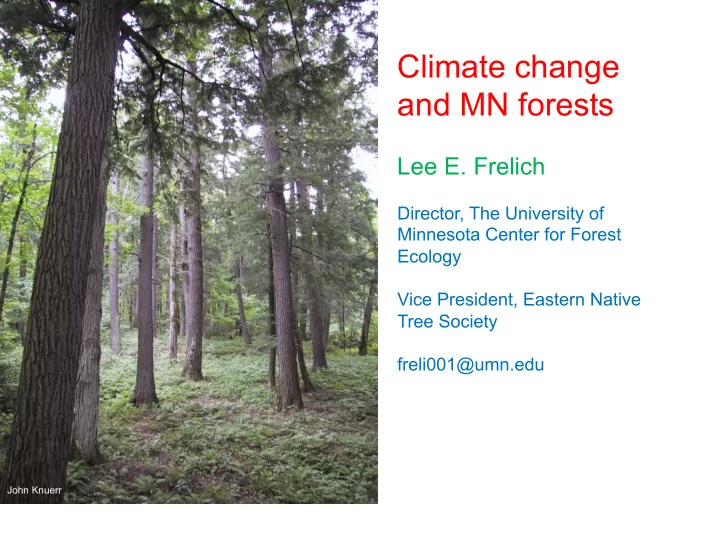
Climate change and MN forests Lee E. Frelich Director, The - - PowerPoint PPT Presentation

climate change and mn forests
SMART_READER_LITE
LIVE PREVIEW

Climate change and MN forests Lee E. Frelich Director, The - - PowerPoint PPT Presentation

Dave Hansen Univ. of MN Climate change and MN forests Lee E. Frelich Director, The University of Minnesota Center for Forest Ecology Vice President, Eastern Native Tree Society freli001@umn.edu John Knuerr Minnesota will likely have the


slide-1
SLIDE 1

Climate change and MN forests

Lee E. Frelich

Director, The University of Minnesota Center for Forest Ecology Vice President, Eastern Native Tree Society freli001@umn.edu

Dave Hansen

  • Univ. of MN

John Knuerr

slide-2
SLIDE 2

Minnesota will likely have the summer climate

  • f NB and KS by the end of

the century. This will cause northward range shifts of ca 300 miles for most tree species

slide-3
SLIDE 3

Balsam ¡fir ¡abundance: ¡ ¡ Current ¡FIA ¡compared ¡to ¡ ¡ predic8ons ¡for ¡high ¡ ¡ emissions ¡scenario ¡

Source: ¡USDA ¡Climate ¡and ¡Tree ¡Atlas ¡

Current FIA abundance Predicted high scenario

slide-4
SLIDE 4

Forest cover of central North America (green)

DeFries, R., M. Hansen, J.R.G. Townshend, A.C. Janetos, and T.R. Loveland (2000), 1 Kilometer Tree Cover Continuous Fields, 1.0, Department of Geography, University of Maryland, College Park, Maryland, 1992-1993.

It is possible that the prairie-forest-border will move 300 miles to the north and east by 2100, deforesting an area 2X the size of California

slide-5
SLIDE 5

Boreal (spruce-fir-jack pine) forests of the north will be replaced by:

  • Red maple & other hard-

woods on deeper soils

  • Oak savanna on shallow
  • r sandy soils

Biome map of Minnesota by MNDOT

slide-6
SLIDE 6

The BWCAW today

Photos: Minneapolis Star Tribune, Lee Frelich

slide-7
SLIDE 7

And the BWCAW tomorrow

The Prairie Enthusiasts Molly McGovern

Photos: Ben Kimball, Prairie Enthusiasts, Paul Ojanen

slide-8
SLIDE 8

Peter Mirejovsky U.S. Endangered Species Program Ruth Sullivan

Winners

Losers

U.S. Fish and Wildlife Service Parks Canada

slide-9
SLIDE 9

Warmer climate,

Longer growing season

More frequent and longer droughts Warmer and drier soil Lower soil nutrient status Exotic earthworms spread faster More deer More fires More wind storms Pests and diseases spread faster N deposition CO2 fertilization Kill seedlings and prevent reproduction Kill adult trees and lack of replacement

Savannification

Frelich and Reich 2010 Frontiers in Ecology and The Environment

Several factors will reinforce the impacts

  • f warmer temperatures
slide-10
SLIDE 10

More drought = trees under stress and forest dieback Minnesota North Shore 2010. Photo: Dave Hansen

Photo: Dave Hansen

slide-11
SLIDE 11
slide-12
SLIDE 12

Native insects play a major role in forest change Benign native insects can have outbreaks in a warmer climate. For example, mountain pine beetle in British Columbia—a native insect that caused massive tree mortality over 30 million acres of lodgepole pine forest, and could threaten jack pine in MN

slide-13
SLIDE 13

Wind plus fire = major forest transformation

Nick ¡Fisichelli ¡and ¡Roy ¡Rich, ¡Cavity ¡Lake ¡Burn, ¡Seagull ¡Lake, ¡July ¡2007. ¡ ¡ ¡ Photo: ¡Dave ¡Hansen, ¡University ¡of ¡MN ¡

slide-14
SLIDE 14

Deer causing ‘Savannification’

  • f forest--increasing deer

density in Sylvania Wilderness from 1990 to 2006

1990 2006

slide-15
SLIDE 15

Base of balsam fir, stage 5 earthworm invasion BWCAW, July 2011.

Photo: Doug Wallace

slide-16
SLIDE 16

Layne Kennedy

Lee Frelich and clones at work during Ham Lake Fire, Seagull Lake, May 6, 2007

We are observing these changes in the forest now