
SLIDE 1
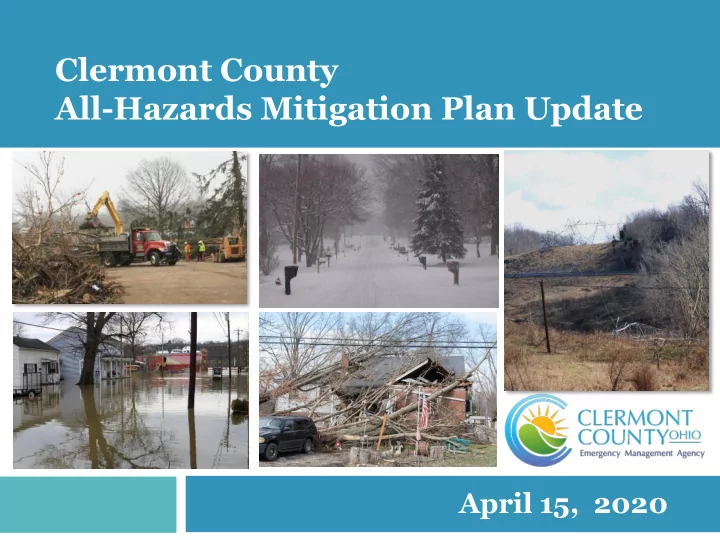
Clermont County All-Hazards Mitigation Plan Update April 15, 2020 - - PowerPoint PPT Presentation
Clermont County All-Hazards Mitigation Plan Update April 15, 2020 Purpose Protect lives and property through the identification of hazards and the development of mitigation strategies to reduce or eliminate risk Required by 44 Code of
Protect lives and property through the identification of hazards and the
development of mitigation strategies to reduce or eliminate risk
Required by 44 Code of Federal Regulations, Part 201. 3 and The Robert
Every county, village and city must have a Hazard Mitigation Plan Plan must be updated every 5 years Eligibility requirement for pre/post-disaster mitigation grants
July 2017
Applied for Pre-Disaster Assistance Grant
August 2018
Received Pre-Disaster Assistance Grant
Oct. 11, 2018
Kick-Off meeting with Core Planning Team (#1)
Nov. 15, 2018
Core Planning Meeting (#2) & Public Meeting (#1)
Jan. 23, 2019
Core Planning Meeting (#3) & Public Meeting (#2)
July 24, 2019
Draft Plan release & 30 day public comment period
July 31, 2019
Core Planning Meeting (#4)
October 17, 2019
Ohio EMA completed 1st Review
November 17, 2019
Ohio EMA completed 2nd Review
January 8, 2020
FEMA completed 1st Review
January 21, 2020
Final Draft submitted to FEMA
March 2, 2020
FEMA Approved Plan
April 15, 2020
Presentation to Board of County Commissioners
~ 1 Year
All Cities and Villages must adopt Plan
1 Introduction Provides background on jurisdictions and the county’s features 2 History and Demographics Provides historical context, communication and utility contacts, and demographic information for the county and the villages 3 Planning Process Describes the planning process used to develop the Plan 4 Hazard Risk Assessment Provides a hazard vulnerability assessment for each hazard including: description of events, locations affected, probability of an event occurring and consequences (number of injuries/fatalities; property damage; crop damage) 5 Hazard Mitigation Provides the hazard prioritization, goals, and detailed mitigation actions 6 Schedule and Maintenance Discuss the Plan annual review and 5 year plan update requirements Appendices Appendix A: Historical Hazard Events Appendix B: Hazard Mitigation Action – Matrix Scoring Spreadsheet Appendix C: Critical Facilities List Appendix D: Sources Appendix E: FEMA Flood Maps Appendix F: Meeting Documentation
Building Code Enforcement Emergency Management Fire Departments Floodplain Administrator GIS Parks and Recreation Planning/Community Development Public Information Office Engineer / Service Road Departments Storm water Management Elected Officials Cities, Townships, & Villages Hospital Gas, Electric & Propane Utilities Water/Waste Water Utilities Waste Haulers Cable/Satellite Providers Telephone & Internet Providers Local Businesses Faith-based and Non-profit partners Ohio EMA ODNR OSU Extension Farm Service Admin USDA USACE General Public
1.
Severe Storms
2.
Tornadoes
3.
Flooding
4.
Utility Failure
5.
Hazardous Materials Accident
6.
Winter Storms
7.
Landslides
8.
Dam Failure
9.
Invasive Species
All-Hazards
Develop/update back-up power capabilities at critical facilities
Update continuity of operation plans (COOP)
Provide disaster preparedness education and outreach
Update emergency operation plans (EOP)
Maintain all-hazard outdoor warning sirens
Continue code enforcement (e.g. fire, building, zoning, floodplain management)
Severe Storms
Public education on having multiple means of receiving alerts/warnings
Update plans for timely debris clearance following severe storms
Maintain National Weather Service StormReady certification
Tornadoes
Promote Ohio Safe Room Rebate Program
Identify temporary storm safe locations
Flooding
Improve storm water management systems
Identify and study poor draining areas to control flooding
Repair or replace ditching and culverts to control flooding
Continue to identify and study riverbank stabilization opportunities
Provide guidance to property owners on acquisition/flood proofing
Encourage residents to purchase flood insurance
Utility Failure
Tree trimming along utility lines
Winter Weather
Public education on winter weather safety
Hazardous Materials Accidents
Develop wellhead protection plan
Continue annual LEPC exercises
Maintain LEPC and Tier II reporting
Update commodity flow study
Public outreach regarding disposal of household hazardous waste
Landslides
Develop map of landslide prone areas
Enforce slide-prone area ordinances to limit fill/dumping
Enforce draining control regulations
Implement sanitary system codes
Provide mitigation guidance to property owners
Implement restraining structures to hold soil in place
Implement debris flow measures
Implement grading to increase slope stability
Consider vegetation placement and management plans to increase soil stability
Consider placement of utilities outside of landslide prone areas
Dam Failure
Coordination with ODNR to implement Dam Safety Program
Encourage dam owners to develop/update emergency action plans
Encourage dam owners to be prepared to respond should their dam fail
Public education regarding downstream risks
Coordinate with local communities to ensure they understand the risk
William H. Harsha Lake Dam Stonelick Lake Dam
Invasive Species
Public education on hazard identification, behavior, and quarantine procedures
Public education on the importance of not importing/exporting firewood
Work with agricultural producers to monitor/minimize nutrient runoff to prevent harmful algal blooms
Asian Longhorn Beetle Emerald Ash Borer Stink Bug Gypsy Moth Harmful Algal Blooms
Terrorism
Encourage critical infrastructure to implement protective measures
Coordinate with LE to ensure safety at large public gatherings
Provide active aggressor guidance
Extreme Temperatures
Provide guidance for vulnerable populations
Provide guidance on utility assistance programs
Drought
Encourage property owners to install water reduction equipment
Develop water storage plans, water use ordinances, contingency plans, and water delivery system plans
Encourage farmers to purchase crop insurance
Wildfire
Public education on smoking hazards and risk of recreational fires
Public education on extreme fire danger and red flag warnings
Earthquakes
Use community outreach activities to foster awareness of earthquake mitigation actions
Work with the insurance industry to increase public awareness of the importance of earthquake insurance
Plan becomes effective with the first adoption and FEMA approval EMA will coordinate with Cities and Villages to adopt Plan EMA will coordinate with Townships to adopt Plan All communities will be eligible for disaster mitigation funds Plan will be reviewed annually during a regular LEPC meeting A comprehensive plan update will begin in 2023