
SLIDE 1
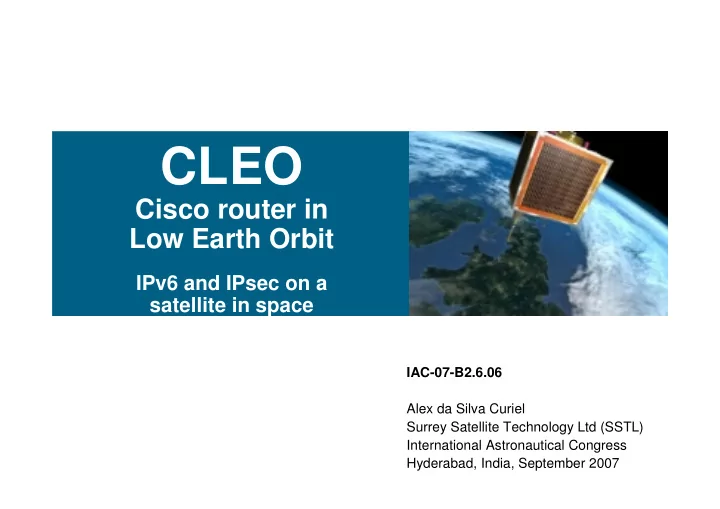
CLEO
Cisco router in Low Earth Orbit
IPv6 and IPsec on a satellite in space
IAC-07-B2.6.06 Alex da Silva Curiel Surrey Satellite Technology Ltd (SSTL) International Astronautical Congress Hyderabad, India, September 2007
CLEO Cisco router in Low Earth Orbit IPv6 and IPsec on a - - PowerPoint PPT Presentation
CLEO Cisco router in Low Earth Orbit IPv6 and IPsec on a satellite in space IAC-07-B2.6.06 Alex da Silva Curiel Surrey Satellite Technology Ltd (SSTL) International Astronautical Congress Hyderabad, India, September 2007 Executive summary
IPv6 and IPsec on a satellite in space
IAC-07-B2.6.06 Alex da Silva Curiel Surrey Satellite Technology Ltd (SSTL) International Astronautical Congress Hyderabad, India, September 2007
CLEO – Cisco router in Low Earth Orbit
2
launched with other satellites into low Earth
use of Internet Protocol (IP). IP works for satellite and payload communication and control.
and validated by international collaboration and demonstration at Vandenberg Air Force Base, June 2004.
router, 2007.
CLEO – Cisco router in Low Earth Orbit
3
Images shared by other organisations are used with thanks.
CLEO – Cisco router in Low Earth Orbit
4
Surrey Satellite Technology Ltd (SSTL) build and help operate an international constellation of small sensor satellites.
fires in California, 28 October 2003 (UK-DMC)
Government co-operation: Algeria, Nigeria, Turkey, United Kingdom, and China. Each government finances a ground station in its country and a satellite. Ground stations are networked
The satellites share a sun- synchronous orbital plane for rapid daily large-area imaging (640km swath width with 32m resolution). Can observe effects
www.dmcii.com
CLEO – Cisco router in Low Earth Orbit
5
Five satellites launched so far. Similar base designs and subsystems, with custom modifications for each country.
27 September 2003
Satellites launched from Plesetsk in Siberia
launches: November 2002: AlSAT-1 (Algeria) September 2003: UK-DMC, NigeriaSAT-1 and BilSat (Turkey) October 2005: Beijing-1 (China) Satellites and ground stations in each country use Internet Protocol (IP) to
ground stations via UDP-based file transfer. SSTL migrated from AX.25, as used on previous missions. Use of IP makes a natural fit with Cisco’s IP router onboard UK-DMC satellite.
CLEO – Cisco router in Low Earth Orbit
6
Palm Island Resort, Dubai, 14 Dec 2003 (UK-DMC) Three Gorges Dam, China, July 2004 (UK-DMC)
www.dmcii.com
CLEO – Cisco router in Low Earth Orbit
7
In this false-color image, dry land is red. Flooded and damaged land is shown as brown. www.dmcii.com Small part of an image taken by the Nigerian DMC satellite on Friday 2 September, for the US Geological Survey. DMC is working as part of the United Nations International Charter for Space and Major Disasters. Imagery delivered by using Internet Protocol – all IPv4.
CLEO – Cisco router in Low Earth Orbit
8
NASA JPL gives DERA’s STRV-1b an IPv4 address (1996). NASA Goddard flies IPv4 stack on SSTL’s UoSAT-12* (2000). This encourages SSTL to adopt IPv4. Cabletron router on Russian module of ISS. NASA uses IPv4 in shuttle experiments, e.g. VoIP with Cisco SoftPhone tested from Atlantis (Feb 2001). These culminated in CANDOS,* tested onboard Columbia (Jan 2003). NASA gets SpaceDev to launch CHIPSat (Jan 2003). SSTL adopts IP with DMC (AlSAT-1 launched Nov 2002, UK- DMC et al. Sep 2003, Beijing-1 Oct 2005). Cisco and SSTL fit CLEO mobile access router on UK-DMC satellite, alongside imaging payloads. CLEO used to test IPv6 and IPSec. MidSTAR-1* and SSTL’s CFESat launch (March 2007).
*Keith Hogie’s team at NASA Goddard was instrumental in use of IP in these projects.
CLEO – Cisco router in Low Earth Orbit
9
A Cisco 3251 Mobile Access Router (MAR). The MAR is a commercial off-the-shelf (COTS) product family – 3251 and 3220 series. Runs Cisco’s IOS (Internetwork Operating System) router code – version 12.2(11)YQ. The 3251 MAR features:
(serial, Ethernet, power supply, WiFi, etc.) The CLEO MAR is an experimental secondary payload on the UK-DMC satellite. Local environment and high-speed downlink used by UK-DMC satellite dictate use of serial interface card to connect with existing 8.1Mbps serial links used
CLEO – Cisco router in Low Earth Orbit
10
Satellite: each DMC satellite has multiple onboard computers. For housekeeping (the On Board Computer, OBC), for image capture and packetised transmission (the Solid State Data Recorders, SSDRs), for redundancy and survival. Interconnected by IP over 8.1Mbps serial links for data and slower CANbus for backup control; really a custom-built LAN.
8.1Mbps downlink
9600bps uplink
ground station LAN Cisco 2621
Cisco MAR 3251 on UK-DMC
CLEO: Cisco router was able to fit into UK-DMC satellite’s onboard network by connecting to OBC and SSDRs using common serial interfaces. Ground: SSTL’s design for its ground station LANs uses IP. Satellites communicate with PCs on LAN via S-band radio space- ground link. IP over 8.1Mbps serial stream from downlink commercial modem goes into a rack-mounted Cisco 2621 router, which forwards IP packets onto the LAN. SSTL’s ground station LAN is connected to and an integral part of SSTL’s corporate IP network.
CLEO – Cisco router in Low Earth Orbit
11
IPv6 and IPsec are now being tested onboard CLEO. First to test IPv6 onboard a satellite, 29 March 2007.
IPv6 – CLEO, ground Cisco routers and PIX firewalls are IPv6-capable,
although SSTL and UK-DMC payloads rely only on IPv4.
IPsec – CLEO and ground station routers can use this to secure
unencrypted ground-space link by tunnelling IP traffic through the router. (ssh to CLEO and a passworded web interface were configured in 2004.) Separate frame-relay/HDLC subinterfaces are used to the satellite:
(IPv6 IPsec is in a more recent code release, and was not flown.) Set up a number of test scenarios. (Could also use SNMP and MIBs to show that a satellite payload can be managed just as you would manage a terrestrial network asset.)
CLEO – Cisco router in Low Earth Orbit
12
Future IPv6+HAIPE, other security methods
2007 IPv4+IPsec is tested to CLEO IPv4 with IPsec IPv4 and ssh 2004 VMOC tested CLEO with IPv4 in space IPv6 and ssh 2007 IPv6 is tested to CLEO CLEO, the Cisco router in Low Earth Orbit, is able to show three of these steps. IPv6 with IPsec Future IPv6+IPsec together (post-CLEO)
CLEO – Cisco router in Low Earth Orbit
13
IPv4 public Internet
Cisco MAR 3251 on UK-DMC
8.1Mbps from satellite 9600bps to satellite
Mobile IP Foreign Agent: Cisco 2621 router in SSTL ground station Mobile IP Home Agent: Cisco 3640 router at NASA Glenn
VPN network
IPv4 and IPv6 between router and endhost between CLEO and 2621
Mobile IPv4 tunnel Home Agent / Foreign Agent tunnel IPv4 traffic
IPv4 mobile routing CLEO can be accessed directly or via Mobile IP. Imagery is downloaded directly.
IPv4 and IPv6
CLEO – Cisco router in Low Earth Orbit
14
Mobile IPv6 code for the mobile access router came out after launch.
IPv4 public Internet
Cisco MAR 3251 on UK-DMC
8.1Mbps from satellite 9600bps to satellite
Mobile IP Foreign Agent: Cisco 2621 router in SSTL ground station Mobile IP Home Agent: Cisco 3640 router at NASA Glenn
VPN network
IPv6 carried in 6-over-4 tunnel Mobile IPv4 tunnel HA / FA tunnel IPv6 traffic
IPv6 tunnelled through IPv4 Mobile IP
IPv4 and IPv6 between router and endhost IPv4 and IPv6 between CLEO and 2621
CLEO – Cisco router in Low Earth Orbit
15
IPv4 public Internet
Cisco MAR 3251 on UK-DMC
8.1Mbps from satellite 9600bps to satellite
Mobile IP Foreign Agent: Cisco 2621 router in SSTL ground station Mobile IP Home Agent: Cisco 3640 router at NASA Glenn
VPN network
IPv4 and IPv6 between router and endhost IPv4 and IPv6 between CLEO and 2621
IPv6 traffic IPv6 in 6-over-4 tunnel
IPv6 direct static routing
IPv6 is run natively across the space link, in parallel with IPv4.
CLEO – Cisco router in Low Earth Orbit
16
IPv4 public Internet
Cisco MAR 3251 on UK-DMC
8.1Mbps from satellite 9600bps to satellite
Mobile IP Foreign Agent: Cisco 2621 router in SSTL ground station Mobile IP Home Agent: Cisco 3640 router at NASA Glenn
VPN network
IPv4 and IPv6 between router and endhost between CLEO and 2621
IPSec (IPv4) IPv6 carried in 6-over-4 tunnel IPv6 traffic IPv6 carried in 6-over-4 tunnel
IPv4 and IPv6
IPv6 in IPv4 IPsec IPv6 IPsec code for the mobile access router was released
space link.
CLEO – Cisco router in Low Earth Orbit
17
Because the US DoD says IPv6 is mandatory. NASA’s Constellation project moving to IPv6. Available IPv4 address space is running out
IPv6 advantages:
dynamic routing for MANET.
CLEO – Cisco router in Low Earth Orbit
18
As a secondary experimental payload, CLEO spends most of its time turned off. CLEO is only active when tested during passes over ground stations, or when used to transfer data between SSDRs. The mobile router is a commercial product, not a space instrument. CLEO does not contain any special instrumentation for the space
SSTL does have some additional thermal and power draw instrumentation around the CLEO assembly motherboard. Available satellite power is a constraint – CLEO is powered up for around ten minutes at a time during a daytime sunlit pass to communicate with ground station using high-speed 8.1Mbps
UK-DMC power budget is only ~30W. Onboard software will not be upgraded – no plans to ever upload 6MB router IOS software over many passes via 9600bps uplink.
CLEO – Cisco router in Low Earth Orbit
19
CLEO remains operational. IPv6 and IPsec are currently being tested. Collaboration between SSTL, NASA and Cisco is now leading to delay-tolerant networking work. As a secondary experimental payload, use of CLEO is on a best-effort basis, balanced against the other demands on the UK-DMC satellite. When not being tested, CLEO is simply switched off to save power. CLEO has spent four years in orbit. Testing of CLEO has been carried out for over two years. CLEO has been powered up for use on more than ninety
CLEO – Cisco router in Low Earth Orbit
20
http://www.ee.surrey.ac.uk/Personal/L.Wood/cleo/