Ad-nominal modification: existential implication, uncertainty about - - PDF document

ad nominal modification existential implication
SMART_READER_LITE
LIVE PREVIEW

Ad-nominal modification: existential implication, uncertainty about - - PDF document

Modification of DPs by epistemic adverbs Cleo Condoravdi, 1 , 6 Mary Dalrymple, 2 , 6 Dag Haug, 3 , 6 Adam Przepirkowski 4 , 5 , 6 1 Stanford University 2 University of Oxford 3 University of Oslo 4 University of Warsaw 5 Polish Academy of


slide-1
SLIDE 1

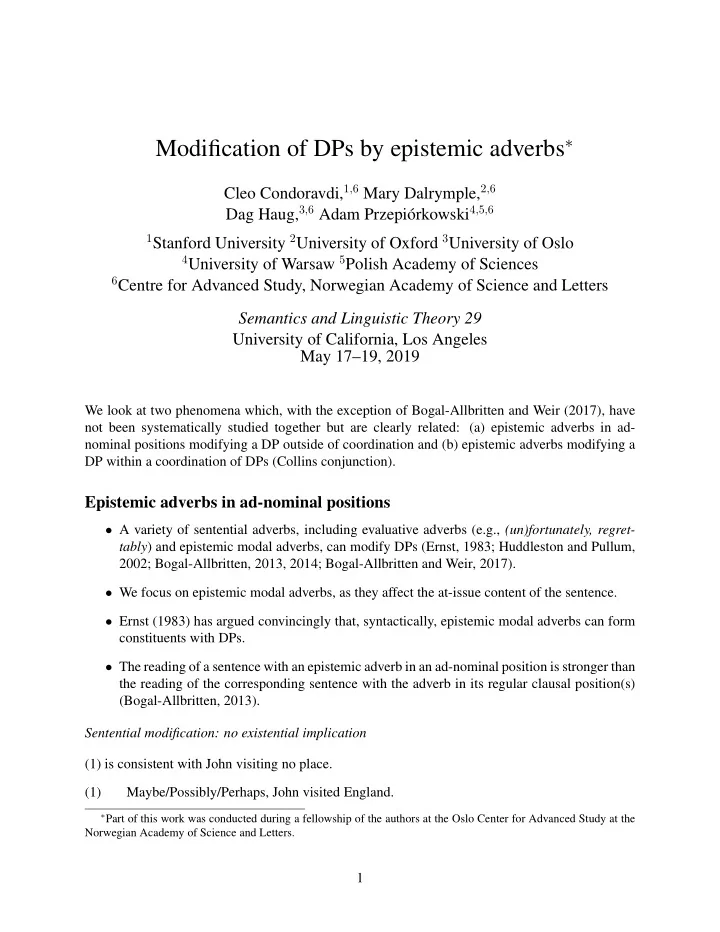
Modification of DPs by epistemic adverbs∗

Cleo Condoravdi,1,6 Mary Dalrymple,2,6 Dag Haug,3,6 Adam Przepiórkowski4,5,6

1Stanford University 2University of Oxford 3University of Oslo 4University of Warsaw 5Polish Academy of Sciences 6Centre for Advanced Study, Norwegian Academy of Science and Letters

Semantics and Linguistic Theory 29 University of California, Los Angeles May 17–19, 2019

We look at two phenomena which, with the exception of Bogal-Allbritten and Weir (2017), have not been systematically studied together but are clearly related: (a) epistemic adverbs in ad- nominal positions modifying a DP outside of coordination and (b) epistemic adverbs modifying a DP within a coordination of DPs (Collins conjunction).

Epistemic adverbs in ad-nominal positions

  • A variety of sentential adverbs, including evaluative adverbs (e.g., (un)fortunately, regret-

tably) and epistemic modal adverbs, can modify DPs (Ernst, 1983; Huddleston and Pullum, 2002; Bogal-Allbritten, 2013, 2014; Bogal-Allbritten and Weir, 2017).

  • We focus on epistemic modal adverbs, as they affect the at-issue content of the sentence.
  • Ernst (1983) has argued convincingly that, syntactically, epistemic modal adverbs can form

constituents with DPs.

  • The reading of a sentence with an epistemic adverb in an ad-nominal position is stronger than

the reading of the corresponding sentence with the adverb in its regular clausal position(s) (Bogal-Allbritten, 2013). Sentential modification: no existential implication (1) is consistent with John visiting no place. (1) Maybe/Possibly/Perhaps, John visited England.

∗Part of this work was conducted during a fellowship of the authors at the Oslo Center for Advanced Study at the

Norwegian Academy of Science and Letters.

1

slide-2
SLIDE 2

Ad-nominal modification: existential implication, uncertainty about the witness In (2)–(4) the examples in (a) give rise to the implications in (b) and (c). (2) a. John visited maybe England. b. John visited some place. c. The place John visited may have been England. (3) a. He got advice from perhaps a nurse. b. He got advice from someone. c. The person he got advice from might have been a nurse. (4) a. They put their stamp of approval on perhaps the worst proposal ever submitted to the committee. b. They put their stamp of approval on a proposal. c. The proposal they put their stamp of approval on might have been the worst proposal ever submitted to the committee. Existential implication is an entailment

  • Bogal-Allbritten (2013) argues that epistemic adverbs in ad-nominal positions give rise to

an existential entailment.

  • In the context of (5), use of the epistemic adverb is felicitous both in the ad-nominal and the

regular clausal position.

  • By contrast, in the context of (6), the epistemic adverb is infelicitous in the ad-nominal

position because the existential entailment conflicts with the contextually given information. (5) Context: Mary visited Amherst yesterday and she ate at Athena’s pizza. You can’t remem- ber whether Athena’s or Antonio’s has the most expensive pizza. You say: a. Mary ate [DP possibly [DP the most expensive pizza in Amherst]]. b. Mary [VP possibly [VP ate the most expensive pizza in Amherst]]. (6) Context: Mary visited Amherst yesterday and planned to eat a pizza lunch at Athena’s, which you know makes the most expensive pizza in Amherst. You know that Mary antici- pated having to skip lunch, however, so perhaps she didn’t eat anything. a. #Mary ate [DP possibly [DP the most expensive pizza in Amherst]]. b. Mary [VP possibly [VP ate the most expensive pizza in Amherst]]. Pragmatic implications

  • Pragmatic inference based on an utterance of (2a): if John visited a place other than England,

the speaker does not know, or is not in a position to say, what it is.

  • A felicitous use of a possibility epistemic modal conveys that the speaker’s epistemic state

allows for more possibilities that the stated one. 2

slide-3
SLIDE 3
  • Given the existential entailment associated with the ad-nominal position of the adverb, based
  • n an utterance of (2a) in the right context, the speaker’s epistemic state is inferred to be

partitioned into worlds in which John visited England and worlds in which John visited some place that was not England.

Collins conjunction

  • Sentential adverbs can appear within a coordination of DPs (Collins, 1988; Munn, 1993;

Landman, 2004; Križ and Schmitt, 2012; Vicente, 2013; Schein, 2017; Bogal-Allbritten and Weir, 2017).

  • No consensus in the litarature about what kind of uncertainty epistemic adverbs communi-

cate in Collins conjunctions. (7) John and perhaps (also) Mary went to the store. (8) John, Bill and maybe Mary went to the store. (9) Perhaps John, maybe Mary, and certainly Bill went to the store. (10) Last year Mary hiked Mt. Tom and possibly the tallest mountain in Ireland. Weak reading: no existential implication (11) a. John and perhaps (also) Mary went to the store. b. John went to the store. c. Perhaps Mary also went to the store. d. John or John and Mary went to the store. (12) a. Mary hiked Mt. Tom and possibly the tallest mountain in Ireland last year. b. Mary hiked Mt. Tom last year. c. Mary possibly also hiked the tallest mountain in Ireland last year. d. Last year Mary hiked Mt. Tom or Mt. Tom and the tallest mountain in Ireland. Strong reading: existential implication (13) a. John and perhaps (also) Mary went to the store. b. John and some other person went to the store. c. Perhaps that other person was Mary. (14) a. Mary hiked Mt. Tom and possibly the tallest mountain in Ireland last year. b. Mary hiked Mt. Tom and some other mountain last year. c. That other mountain was possibly the tallest mountain in Ireland. Different views on strong vs. weak reading

  • Collins (1988), Landman (2004), Križ and Schmitt (2012), Vicente (2013), Schein (2017)

recognize only a weak reading: A and possibly B V’d implies A V’d or A and B V’d.

  • Munn (1993) and Bogal-Allbritten and Weir (2017) recognize a strong reading in addition:

A and possibly B V’d implies A and someone who might have been B V’d. 3

slide-4
SLIDE 4
  • Collins (1988) argues against deriving the strong reading semantically.
  • Schein (2017) argues against the possibility of a strong reading even in contexts that would

support it: A and possibly B V’d implies Only A V’d or A and B V’d. Open questions

  • What does the epistemic adverb modify? What is its semantic scope?
  • Are Collins conjunctions structurally ambiguous?
  • What does and conjoin?
  • Are Collins conjunctions semantically ambiguous?
  • Is there a distinction between ad-nominal modifiers outside of coordination and in Collins

conjunction?

  • If Collins conjunctions just have a weak reading, like Collins himself and the other propo-

nents of a weak semantics have argued for, how does that square with the strong reading of ad-nominal modifiers outside of coordination? Bogal-Allbritten and Weir (2017): structural and semantic ambiguity

  • Bogal-Allbritten and Weir (2017) analyze Collins conjunctions as semantically ambiguous.
  • The strong reading arises as with ad-nominal modifiers outside of coordination; on the strong

reading and coordinates DPs.

  • Following Bogal-Allbritten (2013), they propose that the modified DP is a covert relative

and that the adverb modifies a copular structure: – perhaps the worst proposal ever submitted to the committee ≈ what may be the worst proposal ever submitted to the committee – Mt. Tom and possibly the tallest mountain in Ireland ≈ Mt. Tom and what may be the tallest mountain in Ireland

  • The weak reading is special to Collins conjunctions and results from an elliptical clausal

structure where and coordinates sentences and the epistemic adverb attaches to the second clause: – ...and possibly the tallest mountain in Ireland ≈ and she possibly hiked the tallest mountain in Ireland

  • On both readings, the modal adverb has sentential scope.
  • Baseline for ad-nominal modification is the strong reading; conjunction gives rise to weak

reading via sentential coordination and ellipsis. 4

slide-5
SLIDE 5

This talk: No structural or semantic ambiguity

  • Baseline for ad-nominal modifiers is the weak reading. This is what the semantics delivers.
  • When the existential implication arises, it is because the event structure entails a particular

dependent or because the context supports it.

  • In Collins conjunctions and coordinates DPs.
  • Depending on their syntactic position, semantically, modal adverbs can take sentential or

sub-sentential scope. Weak readings without conjunction

  • The examples in (15) do not have natural paraphrases with existential entailment (‘something

which may be a knife’, ‘something which may be thunder and lightning’).

  • There is no coordination, which could license ellipsis and thereby clausal scope for the

epistemic adverb. (15) a. Their analysis of the crime scene suggested that a scuffle occurred in the bedroom with perhaps a knife. b. Outside of possibly Murphy there is not much high-end talent in the Hurricanes prospect pool. c. Wednesday and Thursday will be a mixture of sunny spells and heavy showers with possibly some thunder and lightning. Weak reading without conjunction reduction

  • On Bogal-Allbritten and Weir’s analysis, examples like (16) with a cumulative reading ought

to get only the strong reading.

  • However, (16) clearly has a weak reading, given in (17). This reading cannot be derived

from clausal ellipsis. (16) Joe, Sue and maybe Bill (between them) ate the 5 pizzas we brought to the party. (17) The 5 pizzas we brought to the party were eaten by Joe and Sue or by Joe, Sue, and Bill. Infelicity with both

  • Collins’ argument against encoding a strong reading into the semantics: if the semantics of

(18a) made available a strong reading, that would guarantee that the presupposition of both is satisfied, and hence (18a) would be felicitous. (18) a. # John and maybe Mary both went to the store. b. John and someone who may have been Mary both went to the store. 5

slide-6
SLIDE 6

Analysis

  • We want the modal adverbs to have sub-sentential scope but still target expressions of propo-

sitional type.

  • We will use event semantics in order to have arguments and modifiers compose via thematic

roles.

  • Using events will allow the epistemic adverb to combine with a DP and have semantic scope

just over the thematic role linking the DP to the verb, rather than over the entire predication.

  • This implies that ultimately the uncertainty conveyed by the use of the ad-nominal epistemic

adverb is about the relevant thematic role.

  • If the event is of a type that entails a particular thematic role, an existential implication will

arise.

  • Within conjunction, the modal will take scope over the specification of a DP meaning as

constituting a part of the entity that is the value of a thematic role.

  • For all this to work, we need a flexible system of semantic composition.

A little bit of background on glue semantics

  • Our analysis is couched within glue semantics (Dalrymple, 1999; Gotham, 2018), which

allows a flexible approach to semantic composition, where a functor can ‘ignore’ unsaturated positions in its arguments.

  • In glue semantics, syntax does not specify a semantic composition tree directly, but only

types.

  • Base types are of the form en and tn, where n is a syntactic index and e and t are type

constructors corresponding to Montague’s type e and t.

  • Complex types are formed with linear implication ⊸ (corresponding to lambda abstraction).
  • These types can be assembled in a linear logic proof of tr (where r is the index of the root)

and the meanings are assembled accordingly.

  • The two proof rules of (the relevant fragment of) linear logic are implication introduction

and elimination.

  • Implication elimination corresponds to functional application (19).

(19) λx.jump(x) : e1 ⊸ t2 john : e1 jump(john) : t2

  • Implication introduction allows a number of important flexible composition techniques, in-

cluding (temporarily) skipping an unsaturated argument to deal with quantifiers in object position (20), and type raising (21). 6

slide-7
SLIDE 7

(20) λxλy.see(x, y) : e1 ⊸ e2 ⊸ t3 [x : e1] λy.see(x, y) : e2 ⊸ t3 λP.∀x.P(x) : (e2 ⊸ t3) ⊸ t3 ∀y.see(x, y) : t3 λx.∀y.see(x, y) : e1 ⊸ t3 john : e1 ∀y.see(john, y) : t3 (21) john : e1 [λx.P(x) : e1 ⊸ t2] P(john) : t2 λP.P(john) : (e1 ⊸ t2) ⊸ t2 Coupling glue semantics with event semantics

  • A standard assumption in neo-Davidsonian event semantics is that thematic roles (and prepo-

sitions) turn DPs into modifiers of verbal projections.

  • We will assume DP-internal functional heads for thematic roles, along the lines of Champol-

lion (2015).

  • Since we are not dealing with irreducibly quantificational DPs, we can assume that modifiers

combine with event predicates intersectively.1

  • Semantically, thematic roles are functions from events to individuals.

Sample meanings and semantic derivations (extensional)

  • We start with the lowest type possible for a DP, using a choice function analysis for indefi-

nites.

  • (24) is how the glue composition will go for (22).
  • The index on types is determined by the syntactic structure where the given expression ap-

pears and the types determine what can compose with what. (22) John1 saw2 a nurse3. (23) John john e1 a nurse f(nurse) e3 see λe.see(e) v2 ⊸ t2 theme λe.λx.th(e) = x v2 ⊸ e3 ⊸ t3 agent λe.λx.ag(e) = x v2 ⊸ e1 ⊸ t1 intersect-th λP.λQ.λe.P(e) ∧ Q(e) (v2 ⊸ t3) ⊸ (v2 ⊸ t2) ⊸ v2 ⊸ t2 intersect-ag λP.λQ.λe.P(e) ∧ Q(e) (v2 ⊸ t1) ⊸ (v2 ⊸ t2) ⊸ v2 ⊸ t2

1To deal with quantificational DPs we would adopt the Champollion machinery, by making verbs generalized

quantifiers over events and lift thematic roles.

7

slide-8
SLIDE 8

(24)

λe.ag(e) = john ∧ see(e) ∧ th(e) = f(nurse) λe.see(e) ∧ th(e) = f(nurse) λQ.λe.Q(e) ∧ th(e) = f(nurse) λe.th(e) = f(nurse) f(nurse) nurse a theme intersect-th see λQ.λe.ag(e) = john ∧ Q(e) λe.ag(e) = john John agent intersect-ag

Conjunction

  • In a coordinate structure of DPs, and operates on DP meanings.
  • Given the meaning of and, DPs are type raised.
  • We assume that conjunction is binary and that A, B and C = A and B and C.

(25) a. John and a nurse met.

  • b. #John met.

(26) John λP.P(john) a nurse λP.P(f(nurse)) and λQ1.λQ2.λP.Q1(λy.y ⊑ ⊕P) ∧ Q2(λy.y ⊑ ⊕P) (27)

λe.meet(e) ∧ john ⊑ ag(e) ∧ f(nurse) ⊑ ag(e) meet λQ.λe.f(nurse) ⊑ ag(e) ∧ john ⊑ ag(e) λe.f(nurse) ⊑ ag(e) ∧ john ⊑ ag(e) λP.f(nurse) ⊑ ⊕P ∧ john ⊑ ⊕P λQ2.λP.f(nurse) ⊑ ⊕P ∧ Q2(λy.y ⊑ ⊕P) a nurse and John agent intersect-agent

  • On our analysis, the contribution of and results in an asymmetry between non-conjoined and

conjoined DPs: a non-conjoined DP exhausts its corresponding thematic role, but conjoined DPs need not exhaust the thematic role.

  • The infelicity of (25b) is accounted for.

8

slide-9
SLIDE 9
  • On the other hand, since our analysis requires group formation through and to be unbounded,

the semantics of (25a) allows for someone else, in addition to John and the given nurse, to have participated in the meeting.

  • We have to assume that, one way or another, implicit exhaustification negates non-weaker

alternatives, resulting in the strengthened meaning that excludes any other individuals from being part of the agent of the meeting event.

  • Exhaustification could be part of closing off the list of conjuncts in a conjunction. Consider,

for instance, Zimmermann’s (2000) closure condition on a list of possibilities, which derives the exhaustivity of disjunction.

  • If we are to attribute the effect to exhaustification, the crucial question is how the alterna-

tives are determined, since what needs to be excluded are conjunctions with a longer list of conjuncts.

Intensionalizing the system

  • We introduce world variables and delay saturation of the world variable and do normal ex-

tensional composition.

  • Intensional operators will then have to bind off several world variables. We can implement

this by first introducing an operator, bind, that identifies world variables.

  • Modal adverbs will need to target something of type s ⊸ t.
  • In the case of ad-nominal modification outside of conjunction, the adverb will modify a DP

after it has combined with a thematic role (or preposition).

  • Within a conjunction it will modify a DP that has been type raised before the entire conjunct

combines with a thematic role. Sample meanings and semantic derivations (intensional) (28) John1 saw2 perhaps a nurse3 . (29) John λw.john s1 ⊸ e1 a nurse λw.f(nursew) s3 ⊸ e3 see λw.λe. seew(e) s2 ⊸ v2 ⊸ t2 theme λw.λe.λx.thw(e) = x s3 ⊸ v2 ⊸ e3 ⊸ t3 agent λw.λe.λx.agw(e) = x s1 ⊸ v2 ⊸ e1 ⊸ t1 intersect-th λP.λQ.λe.P(e) ∧ Q(e) (v2 ⊸ t3) ⊸ (v2 ⊸ t2) ⊸ v2 ⊸ t2 intersect-ag λP.λQ.λe.P(e) ∧ Q(e) (v2 ⊸ t1) ⊸ (v2 ⊸ t2) ⊸ v2 ⊸ t2 perhaps λp.λw.Rwp (s3 ⊸ t3) ⊸ s3 ⊸ t3 bind λP.λw.P(w)(w) ∀x.∀y.(sy ⊸ sx ⊸ ty) ⊸ sy ⊸ ty In (30) is a semantic derivation for see perhaps a nurse (w′′ and w′ will be eventually identified by bind applying at the root level, not shown here); bind under perhaps does not contribute any meaning of the modal adverb, it simply identifies two world variables: 9

slide-10
SLIDE 10

(30)

λw′′.λw′.λe.seew′′(e) ∧ Rw′λw.thw(e) = f(nursew) see λQ.λw′.λe.Q(e) ∧ Rw′λw.thw(e) = f(nursew) λw′.λe.Rw′λw.thw(e) = f(nursew) λw.λe.thw(e) = f(nursew) λw′.λw.λe.thw(e) = f(nursew′) λw′.f(nursew′) nurse a theme bind perhaps intersect-th

(31) a. They put their stamp of approval on perhaps the worst proposal ever submitted to the committee. b. We put our stamp of approval on perhaps the worst proposal ever submitted to the committee.

  • The semantic derivation for approve perhaps the worst proposal ever submitted to the com-

mittee, shown in (32), is exactly parallel to the one in (30).

  • The speaker can be inferred to know which proposal was approved but be uncertain about

which among the proposals submitted to the committee was the worst one (e.g., (31b)), or to know which proposal was the worst one but be uncertain about which proposal was approved (e.g., (31a)).

  • In general, the speaker can also be inferred to be uncertain about both and just convey the

possibility that the proposal approved and the worst proposal were the same. (32)

λw′′.λw′.λe.approvew′′(e) ∧ Rw′λw.thw(e) = ιx.proposalw(x) approve λQ.λw′.λe.Q(e) ∧ Rw′λw.thw(e) = ιx.proposalw(x) λw′.λe.Rw′λw.thw(e) = ιx.proposalw(x) λw.λe.thw(e) = ιx.proposalw(x) λw′.λw.λe.thw(e) = ιx.proposalw′(x) λw′.ιx.proposalw′(x) proposal the theme bind perhaps intersect-th

10

slide-11
SLIDE 11

Prepositions can also introduce thematic roles and compose with a DP to produce a meaning the modal adverbial can then apply to: (33)

λw′.λe.Rw′λw.instrw(e) = f(knifew) λw.λe.instrw(e) = f(knifew) λw′.λw.λe.instrw(e) = f(knifew′) λw′.f(knifew′) knife a with bind perhaps

  • When perhaps scopes over the DP the uncertainty is about the identity of some thematic

role, whereas the event is indepently asserted to exist

  • When the type of event entails the existence of a participant bearing a thematic role, then

that thematic role is inferred to be defined across the epistemic state of the speaker.

  • In that case, the uncertainty is about what (kind of) individual bears the relevant thematic

role: the stated one or someone/thing else (e.g., (34)).

  • When the type of event doea not entail the existence of a participant bearing a thematic role,

then that thematic role is inferred to be defined in some worlds of the epistemic state of the speaker and undefined in others.

  • In that case, the uncertainty is about whether any individual bears the relevant thematic role:

the stated one or noone/thing (e.g., (35)). (34) John stabbed Bill with possibly a knife. uncertainty about the kind of instrument used in the stabbing (35) John and Bill fought with possibly a knife. uncertainty about whether a weapon was used in the fight Analysis of Collins conjunction

  • Within a conjunction the modal adverb will compose directly with the modified DP
  • Given the meaning of and, within a conjunction the DP will be type raised and hence of the

type that the adverb can combine with.

  • The thematic role is filled in once the entire conjunction is assembled.

(36) John and perhaps Mary left. 11

slide-12
SLIDE 12

(37)

λw′.λe.leavew′(e) ∧ john ⊑ agw′(e) ∧ ∧Rw′(λw.mary ⊑ agw(e)) leave . . . λw′.λP.Rw′(λw.mary ⊑ ⊕Pw) ∧ john ⊑ ⊕Pw′ λw′.λQ2.λP.Rw′(λw.mary ⊑ ⊕Pw) ∧ Q2(λy.y ⊑ ⊕Pw′) λw′.λP.Rw′(λw.Pw(mary)) Mary perhaps and John agent

  • In general, in Collins conjunctions the weak reading is predicted to arise : A and possibly B

V’d implies A V’d or A and B V’d.

  • The strong reading can arise if the context supports it.
  • This account of Collins conjunction needs to be supplemented with an account of the ex-

haustivity of conjunction in general.

  • Unlike with ad-nominal modification outside of conjunction, one of the conjuncts can always

provide a value for a given thematic role.

  • The strong reading is predicted to arise due to the verbal predicate in a special case: when

the predicate is collective and the unmodalized conjunct is singular, as in (38) (from Schein (2017)), which, on our analysis, is equivalent to (39), not (40).

  • The naturally occurring (41) and (42) show that collective predicates can support strong

readings. (38) Biff and possibly Tiff met. (39) Biff and somebody else, possibly Tiff, met. (40) # Biff met or possibly Biff and Tiff met. (41) Ed Dickson and perhaps the recently-met with Terrelle Pryor can combine to fill Jimmy Graham’s shoes. (42)

  • L. jourdaniana is thought to have been a cross breed between a Lophophora and possibly

Turbinicarpus. Conclusion

  • We have provided a unified analyis of ad-nominal modifiers outside of coordination and in

Collins conjunctions.

  • The analysis explains the generally strong reading of ad-nominal modifiers outside of coor-

dination and the generally weak reading in Collins conjunctions. 12

slide-13
SLIDE 13

References

Bogal-Allbritten, Elizabeth. 2013. Modification of DPs by Epistemic Modal Adverbs. In Maria Aloni, Michael Franke and Floris Roelofsen (eds.), Proceedings of the Nineteenth Amsterdam Colloquium, pages 51–58, Institute for Logic, Language, and Information, University of Amsterdam, Amsterdam. Bogal-Allbritten, Elizabeth. 2014. Interpreting DP-Modifying Modal Adverbs, handout of talk presented at SALT 2014. Bogal-Allbritten, Elizabeth and Weir, Andrew. 2017. Sentential and Possibly Subsentential Modification: The Ambiguity of Collins Conjunctions. In Andrew Lamont and Katerina Tetzloff (eds.), Proceedings of NELS 47, pages 89–102. Champollion, Lucas. 2015. The interaction of compositional semantics and event semantics. Linguistics and Philosophy 38, 31–66. Collins, Chris. 1988. Part I: Conjunction Adverbs, unpublished manuscript, MIT. Dalrymple, Mary (ed.). 1999. Semantics and Syntax in Lexical Functional Grammar: The Resource Logic

  • Approach. Cambridge, MA: The MIT Press.

Ernst, Thomas. 1983. Towards an Integrated Theory of Adverb Position in English. Ph. D.thesis, Indiana University. Gotham, Matthew. 2018. Making Logical Form type-logical: Glue semantics for Minimalist syntax. Lin- guistics and Philosophy 41(5), 511–556. Huddleston, Rodney and Pullum, Geoffrey K. 2002. The Cambridge Grammar of the English Language. Cambridge, UK: Cambridge University Press. Križ, Manuel and Schmitt, Viola. 2012. Adverbial Conjunctions: Exposition of a Problem, unpublished manuscript. Landman, Fred. 2004. Indefinites and the Type of Sets. Explorations in Semantics, No. 3, Oxford: Blackwell Publishing. Munn, Alan Boag. 1993. Topics in the Syntax and Semantics of Coordinate Structures. Ph. D.thesis, Univer- sity of Maryland. Schein, Barry. 2017. ‘And’: Conjunction Reduction Redux. Cambridge, MA: The MIT Press. Vicente, Luis. 2013. In Search of a Missing Clause, handout of a talk given at Universität Potsdam. Zimmermann, Thomas Ede. 2000. Free choice disjunction and epistemic possibility. Natural Language Semantics 8(4), 255–290.

13