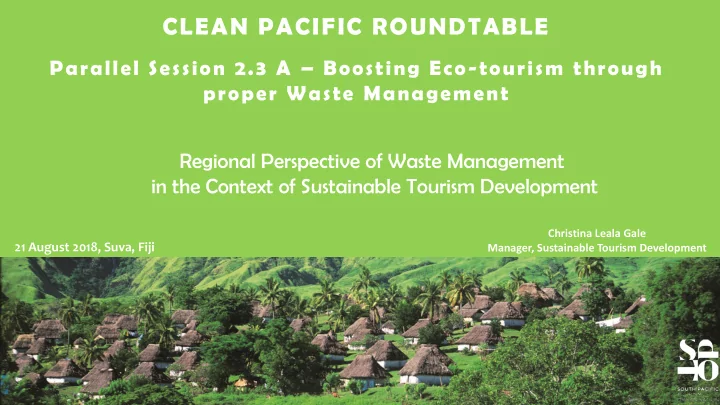
CLEAN PACIFIC ROUNDTABLE Parallel Session 2.3 A Boosting Eco-tourism - - PowerPoint PPT Presentation

clean pacific roundtable
SMART_READER_LITE
LIVE PREVIEW

CLEAN PACIFIC ROUNDTABLE Parallel Session 2.3 A Boosting Eco-tourism - - PowerPoint PPT Presentation

CLEAN PACIFIC ROUNDTABLE Parallel Session 2.3 A Boosting Eco-tourism through proper Waste Management Regional Perspective of Waste Management in the Context of Sustainable Tourism Development Christina Leala Gale 21 August 2018, Suva, Fiji


slide-1
SLIDE 1

CLEAN PACIFIC ROUNDTABLE

Parallel Session 2.3 A – Boosting Eco-tourism through proper Waste Management Regional Perspective of Waste Management in the Context of Sustainable Tourism Development

21 August 2018, Suva, Fiji Christina Leala Gale Manager, Sustainable Tourism Development
slide-2
SLIDE 2

PRESENTATION OUTLINE

 B rief on S outh P acif ic Tourism Organisation  Tourism Trends and P erformance  Future grow th  Vision for Sustainable Tourism  S napshot of Tourism sector w aste management initiativ es  Challenges and Opportunities  Way Forw ard

slide-3
SLIDE 3

SPTO MEMBER COUNTRIES

slide-4
SLIDE 4

 The Pacific is more than the 3S – (Sun, Sea

and Sand) perception

 Our greatest tourism assets in the Pacific are:

OUR LAND, OCEAN, PEOPLE and CULTURE

 Our Natural and Cultural Diversity remain our

point of difference

slide-5
SLIDE 5

Our islands, environment and culture are yours to discover, experience, respect!

PACIFIC TOURISM

slide-6
SLIDE 6

ABOUT SPTO

  • Intergovernmental body mandated for marketing and

developing tourism in the Pacific.

  • Vision: “Inspire Sustainable Growth and Empower Pacific People”
  • Partners/Strategic Alliances:
  • National Tourism Offices, CROP, PIPSO, PT&I network, Cruise Lines

International Association (CLIA) Sustainable Travel International (STI), CTA, WHO, UNE, UNDP, NGOs etc.

  • CROP agency with Private Sector Members
  • 17 PI governments + China (development partner)
  • Core areas of focus: Marketing, Research and Statistics and

Sustainable Tourism Development

slide-7
SLIDE 7
  • Align SPTO’s regional sustainable tourism

programmes with the: SDGs, the Pacific Tourism Strategy 2015-2019 and national priorities & plans of its members through:

  • Technical advisory support
  • Policy support
  • Awareness, education & capacity building
  • Advocacy and
  • Resource mobilisation

SPTO’S SUSTAINABLE TOURISM FOCUS

slide-8
SLIDE 8

GLOBAL TOURISM TRENDS and PERFORMANCE

slide-9
SLIDE 9 Europe 671 Million (51%) Asia Pacific 324 Million (24%) Americas 207 Million (16%) Africa 62 Million (5%) Middle East 58 Million (4%)

INTERNATIONAL TOURIST ARRIVALS 2017

slide-10
SLIDE 10

TOURISM PERFORMANCE IN THE PACIFIC

slide-11
SLIDE 11

SNAPSHOT OF PACIFIC TOURISM PERFORMANCE

  • Pacific air arrivals increased from 1.7 m
(2012) to 2.1 m (2017)
  • Est 1 million are cruise visitors
  • Approx. 0.17% destination share of Global
arrivals
  • 3.3% Av annual regional growth over last
six years (2012-2017).
  • 50.3% - Aust (29.4%) and NZ (20.9%)
  • 49.7% - Other Markets (Europe, USA,
Japan, China)
  • By purpose of visit:
  • 1. Leisure/Holiday (Cooks, Fiji, Van)
  • 2. Business (PNG etc) and
  • 3. Visiting Friends & Relatives (VFR) (Samoa &
Tonga) Source: NTOs, NSOs & SPTO Notes:(F) Forecast
  • 1
1 2 3 4 5 6 500000 1000000 1500000 2000000 2500000 2012 2013 2014 2015 2016 2017 2018F % Tourist Arrivals Arrivals Growth (%)
slide-12
SLIDE 12 Destination 2012 2013 2014 2015 2016 2017(p) Fiji 660590 657706 692630 754835 792320 842884 French Polynesia 168978 164393 180602 183831 192495 198956 PNG 167149 184321 191442 198685 197632 142943 Samoa 134687 124673 131719 136104 145176 155098 Cook Islands 122384 121158 121458 125132 146473 161362 Palau 118754 105066 140784 161931 138416 122726 New Caledonia 112204 107753 107187 114072 115676 120697 Vanuatu 108161 110109 108811 89952 95117 109063 Tonga 47457 48188 50436 53731 59130 62434 FSM 38263 42109 35440 30240 29485 30060 Timor Leste 34902 44146 48986 61037 71680 119432 Solomon Islands 23925 24431 20070 21623 23192 25700 American Samoa 22580 20846 21603 20335 20050 19987 Niue 5047 7047 7408 7707 8918 9805 Kiribati 4907 5868 5111 4353 5018 5663 Marshall Islands 4590 4342 4876 6311 5332 5202 Tuvalu 1019 1302 1416 2402 2465 2530 Nauru 3038 3002 Total 1,775,597 1,773,458 1,869,979 1,958,499 2,072,435 2,137,538 39.4% 47.2% 13.4% Source: NTOs, NSOs & SPTO. Data in red are SPTO estimates based on averages of the past four months.

ANNUAL VISITOR ARRIVAL BY DESTINATION: 2012-2017

slide-13
SLIDE 13 Major Source Markets, % share, 2017 America Samoa 0.9% Cook Islands 7.5% FSM 1.4% Fiji 39.4% French Polynesia 9.3% Kiribati 0.3% Marshall Islands 0.2% Nauru 0.1% New Caledonia 5.6% Niue 0.5% Palau 5.7% PNG 6.7% Samoa 7.3% Solomon Islands 1.2% [CATEGORY NAME] [PERCENTA GE] Tonga 2.9% Tuvalu 0.1% Vanuatu 5.1% PICs % Share, 2017 AUSTRALI A 29.5% NZ 20.8% USA 10% UK 1.5% EUROPE 8.9% CHINA 6.7% JAPAN 3.7% OTHER ASIA 8.9% PACIFIC ISLANDS 7.5% [CATEGORY NAME] [PERCENT AGE]

PICs & MAJOR SOURCE MARKETS % SHARE 2017

slide-14
SLIDE 14

PICs TOURISM ECONOMIC CONTRIBUTION

Source: NTO’s NSOs, World Tourism Travel Council, ADB & SPTO Estimates Latest year on available employment data Number of Tourism Employees (1) Number of Total employment (2) Tourism Employment as % of total Employment Tourism Earnings as % of GDP (2017 Estimates) America Samoa 2011 18,028 0.0 3.3 Cook Islands 2014 2386 6,938 34.4 69.1 FSM 2014 1802 6,938 26.0 25.9 Fiji 2017 42300 303,647 13.9 40.3 French Polynesia 2016 10500 126,300 8.3 11.8 Kiribati 2017 462 28,158 1.6 5.5 Marshall Islands 2014 605 12,600 4.8 5.3 Nauru 2017 0.0 2.8 New Caledonia 2017 4615 119,500 4.9 2.4 Niue 2014 226 700 32.3 41.0 Palau 2014 1172 6,000 19.5 6.7 PNG 2016 21000 2,344,733 0.9 2.3 Samoa 2016 4080 45,161 9.0 20.4 Solomon Islands 2017 6400 208,016 3.1 10.4 Timor Leste 2014 2586 263,000 1.0 5.7 Tonga 2017 6400 33,422 19.1 18.2 Tuvalu 2014 87 3,869 2.2 6.9 Vanuatu 2017 11000 42,295 26.0 46.1 Total 115,621 3,569,305
slide-15
SLIDE 15

FUTURE GROWTH

slide-16
SLIDE 16
slide-17
SLIDE 17

POSITIVE FORECAST FOR PICs

(SPTO, WB & PATA)

  • Forecasted economic contribution is 4.9 US$ bn by 2019 (SPTO)
  • Double tourist arrivals by 2040 to 3 million (World Bank)
  • Annual growth rate of 3% per annum in tourist arrivals (World

Bank)

  • Additional 127,600 jobs to the region by 2040 (World Bank)
  • Booming economies of Asian countries- China outbound 700

mil in 2017 (PATA)

  • Growing middle class with increased personal wealth and

disposable income (PATA)

slide-18
SLIDE 18

TRAVELERS’ VALUES ARE CHANGING

Aspirations and core values of travelers are changing, they are seeking:

 environmentally responsible  culturally rich and off-the-beaten track experiences  desire to give back to communities

 True authentic and unique experiences with a “WOW” factor

slide-19
SLIDE 19

Increased pressure on local resources and vulnerable environment:

  • Marine litter/water pollution
  • Health safety – Sanitation
  • Pressure on land fills and waste disposal services
  • Detrimental to destination wealth and health

IMPLICATIONS OF FUTURE GROWTH

slide-20
SLIDE 20

VISION FOR SUSTAINABLE TOURISM

slide-21
SLIDE 21

is defined as:

"Tourism that takes full account of its current and future economic, social and environmental impacts, addressing the needs of visitors, the industry, the environment and host communities”

– UN World Tourism Organization

SUSTAINABLE TOURISM

slide-22
SLIDE 22

Pacific Tourism Strategy

Marketing the Region Sustainable Tourism Planning Investment and Product Development Air Access and Route Development HRD and Training Research and Statistics Cruise Ship Sector Development

REGIONAL TOURISM PRIORITIES

slide-23
SLIDE 23

TRIPLE BOTTOM LINE OF SUSTAINABILITY

Economic Environmental Social/Cultural Equitable Viable Bearable
slide-24
SLIDE 24

SDG TARGETS MOST RELEVANT TO TOURISM IN PACIFIC SIDS

Target 8.9 “to devise and implement policies to promote sustainable tourism that creates jobs and promotes local culture and products” Target 12.b “Develop and implement tools to monitor sustainable development impacts for sustainable tourism which creates jobs, promotes local culture and products” 14.7 “by 2030 increase the economic benefits to SIDS and LDCs from the sustainable use of marine resources including through the sustainable management of fisheries, aquaculture and tourism”

slide-25
SLIDE 25

BUSINESS CASE FOR SUSTAINABILITY

  • Gaining competitive

advantage by being a leader in the sector

  • Customer loyalty
  • Regulatory compliance
  • Risk management
  • Increased brand value
  • Stabilized utility prices and

availability

  • Creation of a positive

business culture

  • Investor requirements
slide-26
SLIDE 26

HIGHLIGHTS OF TOURISM SECTOR-LED WASTE MANAGEMENT INITIATIVES

slide-27
SLIDE 27

Tourism has contributed through a range of initiatives:

  • Reuse – plastic bottles reused for

mangrove seedling, donating used resources to communities

  • Reduce – Linen reuse policy, green

procurement

  • Recycle – wine bottles into sand/cement
  • Refuse – plastic bag ban on sites
slide-28
SLIDE 28
  • Minimum Standards and accreditation

programs

  • Clean up campaigns
  • Awareness and education
  • Investment in green practices
  • Staff Training
  • Awards and recognition
  • SPTO Pacific Sustainability Monitoring Program
slide-29
SLIDE 29

Monitoring Waste Production in Hotels

slide-30
SLIDE 30 PROBLEM BENEFICIARIES KEY STEPS INDICATORS OUTCOMES LONG TERM CHANGE Vulnerability Lack of data Lack of tools & motivation Accommodation providers in Fiji & Samoa Motivate enterprises Develop a data collection tool Train enterprises to use tool Collate data Impact reporting # businesses trained # businesses collecting data # businesses improving impacts # impact reports produced Training of 50 businesses in Fiji & 50 in Samoa Destination & regional data collation & reporting Roadmap for project expansion Improved data collection at scale Heightened awareness of SCP Improved decision making Improved SCP practices
slide-31
SLIDE 31
  • Total waste sent to landfill
  • Total waste sorted
  • Total volume of plastic bottles sorted
  • Total food waste composted or used for feed
  • Led to introduction of new procedures and

appreciation of waste management efforts

WASTE MANAGEMENT INDICATORS

slide-32
SLIDE 32

BARRIERS TO WASTE MANAGEMENT IN THE TOURISM SECTOR

slide-33
SLIDE 33
  • Cost of waste disposal impacting small businesses
  • Unreliable or non-existent collection services
  • Disposal process unclear after sorting process at hotels
  • Access to and high cost of eco-friendly chemicals and

equipment

  • Lack of local recycling facilities (cost a disincentive to

recycling)

  • Policies not addressing the root problem (plastic bag levy vs

banning plastic bags)

  • Efforts dampened by public behaviour

BARRIERS TO SECTOR EFFORTS

slide-34
SLIDE 34
  • Pacific Sustainability Monitoring Program – expansion to subsectors
including transport, tours, restaurants, attraction sites etc and replication to the region.
  • Pacific Sustainable Tourism Network
  • Knowledge sharing platform
  • Online forum
  • Open to ALL partners supporting sustainable tourism development
efforts
  • Pacific Tourism Green Leaders Program
  • Regional Awards and Recognition Programs
  • UNWTO-SPTO research project on Product Development and

Carrying Capacities

  • Public-Private Partnerships – recycling facilities, access to green
technology, monitoring, capacity building

OPPORTUNITIES FOR IMPROVING WASTE MANAGEMENT IN THE TOURISM SECTOR

slide-35
SLIDE 35 35

WAY FORWARD

PROPER WASTE MANAGEMENT FOR THE FUTURE OF PACIFIC TOURISM

slide-36
SLIDE 36
  • Stronger inter-sectoral collaboration at

regional and national levels

  • Improve sustainable waste

management options and recycling facilities

  • Circular Economy approach, How can

we take action?

  • Push for private sector commitment to

environmental and social responsibility

  • Explore and support opportunities for

eco-tourism – joint partnerships

  • Strengthen monitoring, data collection

and reporting systems

slide-37
SLIDE 37
  • Establish national sustainable

tourism networks and link to the Pacific Sustainable Tourism Network

  • Strengthen the necessary policy

and regulative frameworks e.g. legislations, standards and guidelines

  • Consider reasonable waste

disposal and handling costs

  • Pacific tourism to focus on High

Yield, Low Volume approaches

slide-38
SLIDE 38

THANK YOU Contact:

cgale@spto.org

w w w . s o u t h p a c i f i c i s l a n d s . t r a v e l