Classifiers for Sensory Data (e.g. tanh( ) ) Key Signal to Symbol - - PowerPoint PPT Presentation

classifiers for sensory data
SMART_READER_LITE
LIVE PREVIEW

Classifiers for Sensory Data (e.g. tanh( ) ) Key Signal to Symbol - - PowerPoint PPT Presentation

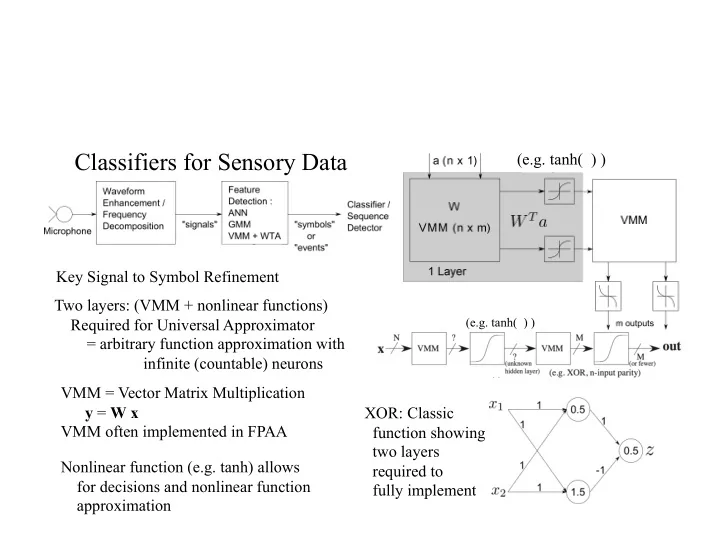
Classifiers for Sensory Data (e.g. tanh( ) ) Key Signal to Symbol Refinement Two layers: (VMM + nonlinear functions) (e.g. tanh( ) ) Required for Universal Approximator = arbitrary function approximation with infinite (countable) neurons


slide-1
SLIDE 1

Key Signal to Symbol Refinement VMM = Vector Matrix Multiplication y = W x VMM often implemented in FPAA Two layers: (VMM + nonlinear functions) Required for Universal Approximator = arbitrary function approximation with infinite (countable) neurons

Classifiers for Sensory Data

XOR: Classic function showing two layers required to fully implement Nonlinear function (e.g. tanh) allows for decisions and nonlinear function approximation (e.g. tanh( ) )

(e.g. tanh( ) )

slide-2
SLIDE 2

VMM in FPAA Routing Fabric (Computing in memory)

[Chawla, et. al, CICC 2004]

FG VMM

Analog (VMM): ~10-20MMAC/µW ~50-100 fJ / MAC Digital ~ 10MMAC/mW @ yield

slide-3
SLIDE 3

VMM + k-WTA: Experimental Measurements of a Universal Approximator

[Ramakrishnan, et. al, 2013] Also 3-Parity, 4-Parity

WTA: biologically inspired, good framework for further bio-inspired computing Measured XOR Scatter Plot 1 single VMM + n-WTA layer = universal approximator [Maass, et. al, 2000]

slide-4
SLIDE 4

Classifiers Equivalences with VMM+WTA

Invariance:

  • Constant Weight Offsets
  • Constant Weight Scaling
  • Constant Input Offsets

Only requires 1 quadrant mult Equivalence:

  • VQ
  • SOM
  • GMM
slide-5
SLIDE 5

Measured XOR Classifier: Different CABs

slide-6
SLIDE 6

SoC FPAA: Computing

slide-7
SLIDE 7

Experiment Session

Perform the 2-input VMM + WTA block for the XOR problem When you start your classifier, the weights might not be quite right. You should change these weights until you get the resulting function and take note of these differences