Classifiers Classifier methods Table of n slots Install entries - - PowerPoint PPT Presentation

classifiers classifier methods
SMART_READER_LITE
LIVE PREVIEW

Classifiers Classifier methods Table of n slots Install entries - - PowerPoint PPT Presentation

ns v2 Workshop Outline 1. Topology Generation, the nodes and the links Kannan Varadhan 2. OTcl and C++: The Duality USC/Information Sciences Institute 3. Routing h kannan@catarina.usc.edu i Unicast Multicast Network Dynamics 18


slide-1
SLIDE 1

ns v2 Workshop

Kannan Varadhan USC/Information Sciences Institute

hkannan@catarina.usc.edu i

18 September, 1997

The work of K. Varadhan and the VINT project at USC/ISI is supported by the Defense Advanced Research Projects Agency (DARPA) under contract number ABT63-96-C-0054. Any opinions, findings, and conclusions or recommendations expressed in this material are those of the author(s) and do not necessarily reflect the views of the DARPA. Outline 1

Outline

  • 1. Topology Generation, the nodes and the links
  • 2. OTcl and C++: The Duality
  • 3. Routing
Unicast Multicast Network Dynamics
  • 4. Multicast Transport
  • 5. Issues of Scale
  • 6. Programming and Simulation Debugging

Outline 2

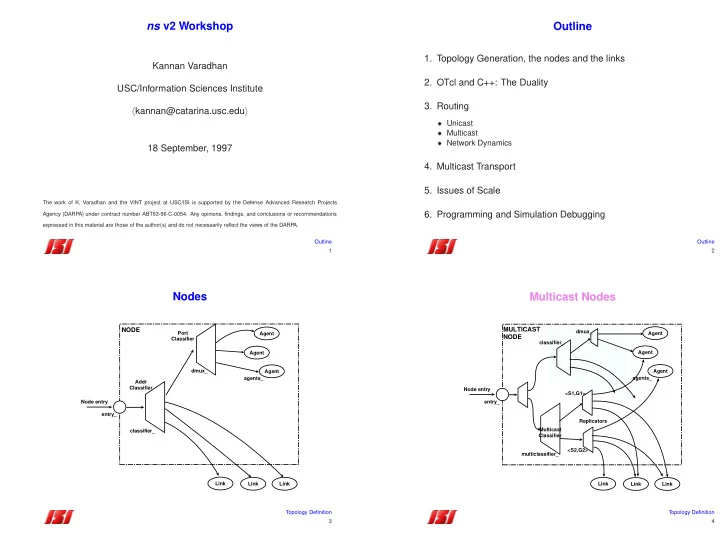
Nodes

Link Link Link Node entry Addr Classifier Port Classifier

NODE

Agent Agent Agent dmux_ classifier_ agents_ entry_ Topology Definition 3

Multicast Nodes

Link Link Link Node entry

MULTICAST NODE

Agent Agent Agent dmux_ classifier_ agents_ entry_ Multicast Classifier multiclassifier_ Replicators <S1,G1> <S2,G2> Topology Definition 4

slide-2
SLIDE 2

Classifiers

Table of

n slots

Each slot can point to a TclObject When a packet is received — classify() identifies the slot to forward the packet to If slot is invalid, the classifier calls no-slot{} Many different types of classifiers

Address Classifiers parse address in packet MultiPath Classifier returns next slot number to use Replicator uses classifier as a table

Topology Definition 5

Classifier methods

Install entries into classifier

– install{} – installNext{}

Query entries in classifier

– elements{} returns current list of elements inserted – slot{} returns handle of object in the specified slot

Delete entry in a particular slot

– clear{}

classify() internal method: receives a packet, and returns a slot number for that packet.

Topology Definition 6

Links

head_ enqT_ drophead_ deqT_ queue_ link_ ttl_

Link

drpT_

Topology Definition 7

Connectors

Connectors receive incoming packets, and (usually) transmit them to their target_ Many different types of connectors:

Queue holds a certain number of packets. Packets exceeding their queue-size are sent to the queue’s drop-target. LinkDelay models delay/bandwidth of the link for detailed simulations. TTLChecker decrements TTLs on each packet, drops the packet if the TTL becomes zero. DynaLink transmit packets if the link is up, drop packet otherwise Other tracing related objects

Topology Definition 8

slide-3
SLIDE 3

Connector methods

Add tracing or monitoring:

– trace – attach-monitors – init-monitor

Topology Definition 9

Topology Generation Resources

At

http://netweb.usc.edu/daniel/research/sims/

ntg by Steve Hotz

hhotz@isi.edu i

GT-ITM by Ellen Zegura

hewz@cc.gatech.edu i,

Ken Calvert

hcalvert@cc.gatech.edu i

TIERS by Matthew Doar

hmdoar@nexen.comi

rtg by Liming Wei

hlwei@cisco.com i,

Lee Breslau

hbreslau@parc.xerox.com i

Topology Definition 10

Topology Generation

Type of Graph Edge Models ntg

n-level hierarchy

user configurable probability distributions GT-ITM flat random,

n-level

hierarchies, transit-stub networks many different edge models TIERS 3-level hierarchy Minimum spanning tree + random placement rtg flat random waxman

Topology Definition 11

OTcl and C++: The Duality

User’s Simulation Script ns

OTcl C++

OTcl Linkage 12

slide-4
SLIDE 4

OTcl Linkage

C++ OTcl class Tcl C++ methods to access the OTcl interpreter

class TclCommand Basic script to provide limited global commands to the interpreter

class EmbeddedTcl Container for Tcl scripts that are pre-loaded at startup class TclObject Root of basic object hierarchy in ns class TclClass C++ class to set up the TclObject hierarchy

class InstVar internal class to bind C++ member variables to OTcl instance variables OTcl Linkage 13

C++ Methods to Access OTcl

The class Tcl – Obtain a handle – Invoke OTcl procedures – Retrieve the result from the interpreter – On invocation, pass a result string to the interpreter – Return Success/Failure return codes

OTcl Linkage 14

class Tcl: C++ Methods to access OTcl

Tcl& tcl = Tcl::instance(); /* obtain a handle to the interpreter */ if (argc == 2) { /* cmd: foo now */ if (strcmp(argv[1], "now") == 0) { tcl.resultf("%g", clock()); /* pass back the result */ return TCL_OK; /* return success code to interpreter */ } tcl.result("command not understood"); /* alternate way of passing result */ return TCL_ERROR; } else if (argc == 3) { /* cmd: foo now

hcallback i */

if (strcmp(argv[1], "now") != 0) { tcl.error("command not understood"); /* alternate way to return error */ } char *callback = arv[2]; tcl.eval(callback); /* invoke an OTcl procedure */ tcl.evalc("puts hello, world"); /* another variant */ char* timestr = tcl.result(); /* callback result from the interpreter */ clock() = atof(timestr); } else { Interp* ti = tcl.interp(); /* access the interpreter directly */ ... /* . . . to do whatever */

OTcl Linkage 15

class TclCommand

Defines simple commands that execute in global interpreter context For example, ns-version

OTcl Linkage 16

slide-5
SLIDE 5

class EmbeddedTcl: Adding new OTcl code into ns

container for scripts pre-loaded at startup

– ~Tcl/tcl-object.tcl – ~ns/tcl/lib/ns-lib.tcl – scripts recursively sourced by ~ns/tcl/lib/ns-lib.tcl

~Tcl/tcl-object.tcl activated by Tcl::init() ~ns/tcl/lib/ns-lib.tcl activated by Tcl AppInit()

OTcl Linkage 17

class TclObject

Basic object hierarchy in ns Hierarchy mirrored in C++ and OTcl For example:

set srm [new Agent/SRM/Adaptive] $srm set packetSize_ 1024 $srm traffic-source $s0

OTcl Linkage 18

class TclObject: Hierarchy and Shadowing

Agent/SRM _o52 _o52 TclObject TclObject Agent Agent/SRM/ Adaptive SRM shadow

  • bject

SRM object C++ class hierarchy and Object OTcl class hierarchy and Object Agent SRMAgent ASRMAgent OTcl Linkage 19

class TclObject: Creation/Deletion Mechanisms

global procedure new{}

TclObject constructor create C++ shadow object C++ TclObject constructor return Object Constructor invoke parent constructor complete initialisation and return parent constructor invoke parent constructor complete initialisation and return parent constructor invoke parent constructor bind member variables and return

  • bject constructor

invoke parent constructor bind member variables and return OTcl instance procedures C++ methods

global procedure delete{}

OTcl Linkage 20

slide-6
SLIDE 6

class TclObject: Binding Variables

makes identical C++ member variables to OTcl instance variables Syntax

ASRMAgent::ASRMAgent() { bind("pdistance_", &pdistance_); /* real variable */ ... }

Initialisation through OTcl class variables

Agent/SRM/Adaptive set pdistance_ 15.0 Agent/SRM set pdistance_ 10.0 ...

Other methods: bind() (integers), bind time() (time variables), bind bw() (bandwidth variables), bind bool() (boolean variables)

OTcl Linkage 21

Examples of Specify Bound variables

$object set bwvar 1.5m $object set bwvar 1.5mb $object set bwvar 1500k $object set bwvar 1500kb $object set bwvar .1875MB $object set bwvar 187.5kB $object set bwvar 1.5e6 $object set timevar 1500m $object set timevar 1.5 $object set timevar 1.5e9n $object set timevar 1500e9p $object set boolvar t ;# set to true $object set boolvar true $object set boolvar 1 ;# or any non-zero value $object set boolvar false ;# set to false $object set boolvar junk $object set boolvar 0

OTcl Linkage 22

class TclObject: command() methods

shadow object is accessed by a cmd{} procedure, called “instproc- like” For example, distance?{} is an “instance procedure” of an Adaptive SRM agent

int ASRMAgent::command(int argc, const char*const*argv)(1) { Tcl& tcl = Tcl::instance(); if (argc == 3) { if (strcmp(argv[1], "distance?") == 0)(2) { int sender = atoi(argv[2]); SRMinfo* sp = get_state(sender); tcl.tesultf("%f", sp->distance_); return TCL_OK;(3) } } return (SRMAgent::command(argc, argv));(4) }

OTcl Linkage 23

class TclObject: command() methods: call sequence

Usage:

$srm distance? ;# instproc-like usage

  • r

$srm cmd distance? ;# explicit usage

TclObject:: command() match "distance?"

Y N

process and return invoke parent’s command() method $srm distance? No such procedure TclObject:: unknown{} $srm cmd distance? C++ methods OTcl instance procedures? OTcl Linkage 24

slide-7
SLIDE 7

class TclClass

Programmer defines C++ hierarchy that is mirrored in OTcl

TclObject NsObject Agent SRMAgent ASRMAgent TclObject Agent Agent/SRM Agent/SRM/ Adaptive

?

C++ Class hierarchy OTcl Class hierarchy

not all classes are mirrored exactly

OTcl Linkage 25

Class TclClass: Definition

For example, Adaptive SRM agent class in C++ is mirrored into Agent/SRM/Adaptive

static class AdaptiveSRMAgentClass : public TclClass(1) { public: AdaptiveSRMAgentClass() : TclClass("Agent/SRM/Adaptive")(2) {} TclObject* create(int /*argc*/, const char*const* /*argv*/)(3) { return (new AdaptiveSRMAgent())(4); } } AdaptiveSRMAgentInstance(5);

OTcl Linkage 26

Class TclClass: Mechanism

static initialisation by compiler

Object constructor invoke TclClass constructor TclClass constructor build list of TclClass instances

run time activation at startup

Tcl_AppInit() invoke bind() TclObject::register{} construct class hierarchy TclClass::bind() invoke register{}; define create-shadow{} and delete-shadow{} OTcl Linkage 27

class Instvar

One object per bound variable created by TclObject::bind() call Constructor activity

  • 1. point to C++ member variable
  • 2. create instance variable for interpreted object
  • 3. enable trap read/writes to instance variable using Tcl TraceVar()

OTcl Linkage 28

slide-8
SLIDE 8

OTcl Linkage Summary

Class Tcl

– primitives to access the interpreter

Class TclObject: root object for mirrored hierarchies

– Unifies interpreted and compiled hierarchy – Provide seamless access to ns objects in compiled code and interpreted scripts

Class TclClass: class that sets up the interpreted hierarchy

– establish interpreted hierarchy – shadowing methods

OTcl Linkage 29

Unicast Routing

Compute the forwarding tables at each node in topology specify

$ns rtproto

hprotocoli hnodelisti

– run protocol on nodes listed – protocol : static, session, DV default: static – nodelist : default: entire topology

Tailor behaviour

$ns cost $n1 $n2 5

– assign costs to links default: cost = 1

Unicast Routing 30

Centralized Unicast Routing

Route computation is external to simulation execution Supported strategies

– Static Routing: Routes precomputed prior to start of simulation – Session Routing: Static + Routes recomputed on topology change

Dijkstra’s All-pairs SPF algorithm

Unicast Routing 31

Detailed Unicast Routing

Route computation is part of simulation execution Currently implemented protocols Distributed Bellman-Ford (DV) routing

– advertInterval =

2s: update interval

– Split-horizon w/poison reverse advertisments – triggered updates on topology change, or new route entries

Possible options such as equal cost multi-path routing

Unicast Routing 32

slide-9
SLIDE 9

Class Architecture

RouteLogic Node rtObject rtProto DIRECT rtProto DV rtProto rtPeer Node Node rtPeer rtPeer Unicast Routing 33

class RouteLogic

Route Configuration

register{} invoked by rtproto{} configure{} invokes $rtproto init-all compute-routes{} centralised route compute algorithm

Query Node

n 1’s nexthop to Node n 2

[$ns get-routelogic] lookup $n1 $n2

Reconfiguration on Topology Changes

[$ns get-routelogic] notify

Unicast Routing 34

Dynamic Routing: class rtObject

Route Controller init-all{} Creates rtObject at each node in argument add-proto{} Adds

hprotocol i agent to hnodei

lookup{} Returns nexthop for

hdesti handle, -1 if none

available compute-routes{} compute and install best route to destinations; invoke send-updates{}, flag-multicast{} intf-changed{} notify protocol agents; recompute-routes dump-routes{} to

hfilehandle i specified

Unicast Routing 35

Dynamic Routing: class Agent/rtProto/DV

Route Protocol Agent init-all{} create protocol agent at each node in argument compute-routes{} invoked on startup and after topology change; compute best route in protocol; possibly set rtsChanged intf-changed{} called after topology change on incident node send-updates{} whenever routes at node change

Unicast Routing 36

slide-10
SLIDE 10

Equal Cost Multi-Path Routes

Node set multiPath_ 1

Link Link Link Node entry Addr Classifier Port Classifier

NODE

MultiPath Classifier MultiPath Classifier Unicast Routing 37

Asymetric Path Routing

1 2 n 2 n 1

2 2 3 $ns cost $n1 $r1 2 $ns cost $n2 $r2 2 $ns cost $r2 $n2 3

Unicast Routing 38

Multicast Routing: Configuration

Simulator NumberInterfaces_ 1 ;# for some multicast routing protocols Simulator EnableMcast_ 1 set ns [new Simulator] Node expandaddr ;# if #nodes > 128 # allocate nodes $ns mrtproto protocol nodelist set group [Node allocaddr] $node join-group $agent $group $node leave-group $agent $group

Multicast Routing 39

Multicast Node Definition

Link Link Link Node entry

MULTICAST NODE

Agent Agent Agent dmux_ classifier_ agents_ entry_ Multicast Classifier multiclassifier_ Replicators <S1,G1> <S2,G2> Multicast Routing 40

slide-11
SLIDE 11

Multicast Routing Protocols Implemented

Valid protocols currently implemented: Centralised protocols: 1. CtrMcast Centralised Multicast (Sparse Mode Protocol) 2. DM Dense Mode Detailed protocols: 1. dynamicDM Dynamic Dense Mode 2. pimDM PIM Dense Mode

Multicast Routing 41

Centralised Multicast Configuration

Sparse Mode implementation of multicast

$ctrmcastcomp compute-mroutes $ctrmcastcomp switch-treetype $group

Defaults to creating a shared tree.

Multicast Routing 42

Centralised Dense Mode Configuration

computes parent-child relationships prior to start of simulation Can study membership dynamics No response to topology changes Only one configuration parameter

DM set PruneTimeout newValue ;# default

: s:

Multicast Routing 43

Dynamic Dense Mode Configuration

Extension of static dense mode As before, computes parent child relationships at start of simulation Also recomputes whenever topology changes, or unicast route updates are received Configuration parameters are:

dynamicDM set PruneTimout newValue ;# default

: s:

dynamicDM set ReportRouteTimeout newvalue ;# default

s:

Multicast Routing 44

slide-12
SLIDE 12

PIM Dense Mode Configuration

Extension of static dense mode does not compute parent child relationships Configuration parameters are:

pimDM set PruneTimout newValue ;# default

: s:

Multicast Routing 45

Other protocol work in progress

Detailed PIM Sparse mode and Dense mode

Multicast Routing 46

Multicast Classes

Node McastProtocol dynamicDM McastProtocol pimDM McastProtocol CtrMcast McastProtocol DM McastProtoArbiter CtrRPComp CtrMcastComp mcastproto_ Node Node CtrMcast CtrMcast Node protocols Agent Agent Agent ctrrpcomp

Multicast Routing 47

Network Dynamics

The ability to make elements of topology fail/recover. Model of failure and recovery — Exponential, Deterministic, Trace driven, Manual (or one-shot) Operates on single link — i.e. takes link “down” or “up” Operation on single node possible, translated into operation on collection of links incident on node

Network Dynamics 48

slide-13
SLIDE 13

Specification

Create an instance of

hmodel i

$ns rtmodel

hmodeli hparametersi hnode|linki

Command returns the handle of the model created Perform

hoperation i at htimei on hnode|link i;

$ns rtmodel-at

htimei hoperationi hnode|linki

return handle to newly created instance of model. Delete route model specified by

hhandlei

$ns rtmodel-delete

hhandlei

Network Dynamics 49

Models and Configuration

  • 1. Exponential
  • [startTime], upInterval, downInterval, [endTime]
  • 2. Deterministic
  • [startTime], upInterval, downInterval, [endTime]
  • 3. Trace (based)
  • fileName
  • 4. Manual (or one-shot)
  • peration, time

Network Dynamics 50

Defining your Own Model

Derive model from the base class, rtModel 1. set-parms{} process model parameters 2. set-first-event{} specify the first event 3. up{}, down{} specify next action — Use class rtQueue to schedule events. — Instance of queue in rtModel class variable, rtq_

Network Dynamics 51

class rtQueue

Internal class to synchronise topology change activity insq{} Given

htimei, hobject i,

and an instance procedure for that object and arguments, will invoke instance procedure of object at specified time. insq-i{} identical to insq{}, except

htimei specifies increment

when the procedure will be executed runq{} executed procedures for the specified time; finish by invoking notify{} for each object delq{} remove event for object at specified time

Network Dynamics 52

slide-14
SLIDE 14

Interface to Unicast Routing

Multicast Routing Unicast Routing Network Dynamics Network Dynamics 53

Interface to Unicast Routing

rtQueue::runq rtModel::up Link::up rtModel::notify Node:: intf-changed rtObject:: intf-changed rtProto::notify RouteLogic:: notify rtProto:: compute-all CtrMcastComp:: notify Network Dynamics 54

Deficiencies in the Network Dynamics API

Link centric Node failure not consistent with an operation model API cannot specify clusters/clouds

Network Dynamics 55

Multicast Transport

Currently, SRM and RTP implemented goals of implementation: programmability in particular, for SRM: programming timers, session message handling, loss recovery and for RTP , mostly programmed in OTcl, with minimalpacket related statistics counters in C++

Multicast Transport 56

slide-15
SLIDE 15

Simple SRM configuration

set ns [new Simulator] ;# preamble initialization $ns enableMcast set node [$ns node] ;# agent to reside on this node set group [$ns allocaddr] ;# multicast group for this agent set srm [new Agent/SRM] $srm set dst_ $group ;# configure the SRM agent $ns attach-agent $node $srm $srm set fid_ 1 ;# optional configuration $srm log [open srmStats.tr w] ;# log statistics in this file $srm trace [open srmEvents.tr w] ;# trace events for this agent set packetSize 210 # configure the traffic generator and traffic source set s0 [new Agent/CBR/UDP] ;# attach traffic generator to application $s0 attach-traffic $exp0 $srm(0) traffic-source $s0 ;# attach application to SRM agent $srm(0) set packetSize_ $packetSize ;# to generate repair packets of appropriate size $srm start $srm start-source

Multicast Transport 57

Class Hierarchies

Agent/SRM Agent/SRM/ Adaptive Agent/SRM/ Deterministic Agent/SRM/ Probabilistic SRM SRM/request SRM/repair SRM/session SRM/request/ Adaptive SRM/repair/ Adaptive SRM/session/ logScaled Multicast Transport 58

Loss Detection

Triggered by receipt of data or control messages

$agent request

hsenderi hlist of messagesi

Actual loss recovery occurs in OTcl through special purpose loss recovery objects

Multicast Transport 59

Loss Recovery

Each loss is handled by separate “SRM” object. Nodes schedule “request” or “repair” objects following a data loss Each loss recovery object handles its own scheduling and messaging activity

Multicast Transport 60

slide-16
SLIDE 16

Session messages

One session message handling object per agent Responsible for sending periodic session messages Session message interval controlled by class variable, sessionDelay_ Two types of session functions implemented:

  • 1. SRM/Session uses default fixed interval session message sending
  • 2. SRM/Session/logScaled uses

to send next advertisement.

Multicast Transport 61

Statistics

  • 1. Agent—response to Data Loss: Detection and Recovery
  • 2. Loss Object—Per Loss recovery Statistics

Multicast Transport 62

Tracing

Per event tracing by loss recovery objects Sample trace file is:

3.5543 n 1 m <1:1> r 0 Q DETECT 3.5543 n 1 m <1:1> r 1 Q INTERVALS C1 2.0 C2 0.0 d 0.0105 i 1 3.5543 n 1 m <1:1> r 1 Q NTIMER at 3.57527 ... 3.5753 n 1 m <1:1> r 2 Q NACK IGNORE-BACKOFF 3.59627 3.5828 n 3 m <1:1> r 0 Q DETECT 3.5828 n 3 m <1:1> r 1 Q NTIMER at 3.6468 3.5854 n 0 m <1:1> r 0 P NACK from 257 3.5854 n 0 m <1:1> r 1 P RTIMER at 3.59586 3.5886 n 2 m <1:1> r 2 Q NTIMER at 3.67262 3.5886 n 2 m <1:1> r 2 Q NACK IGNORE-BACKOFF 3.63062 3.5959 n 0 m <1:1> r 1 P SENDREP ...

Multicast Transport 63

RTP

Session/RTP tracks incoming data, and sends periodic delivery reports. Agent/CBR/RTP sends data to the group at a specified rate.

Multicast Transport 64

slide-17
SLIDE 17

Multicast Transport Starter Kit

Code and Documentation: SRM and RTP Multiple flavours of multicast

includes Dense mode, Sparse mode, centralised multicast, session level multicast

Multiple flavours of unicast and network dynamics

Ability to study the problem under dynamic topologies, including partition scenarios

Multiple physical layers including broadcast and wireless LANs building a catalog of canonical topologies Examples in ~ns/tcl/ex test suite in development

Multicast Transport 65

Multicast Transport: Other types

Structured hierarchy mechanisms

– Exists Multicast and Network Dynamics – Exists Some of the possible timer mechanisms – Exists Different loss models – Requires building different modules for request/repair – Requires defining the hierarchy and mechanisms – Expect mostly work in OTcl

Route Support

– Pointers to files for various models of implementation – Exists Multicast and Dynamics – Exists Loss Models – Requires modifying some network layer code – Expect Some minor work in C++, Lots of “plumbing” in OTcl

Multicast Congestion Control

Multicast Transport 66

Current NS Scaling

NS is currently memory limited for large simulations. To scale, we’re taking two approaches: tuning/monitoring detailed simulations (to reduce memory usage) abstract simulations (to remove “unimportant” details)

Scaling Considerations 67

Detailed Simulations: Limits

Some large topology configurations are in the distribution: ~ns/tcl/ex/newmcast/cmcast-150.tcl 150 nodes, 2200 links Centralised multicast simulation; Uses 53MB 2420 nodes, 2465 links static unicast routing; path computation algorithms; Uses 800MB 500 nodes, 815 links sparse multicast group of 80 members; studying scalable session messsages

Scaling Considerations 68

slide-18
SLIDE 18

Detailed Simulations: Object Sizes

Rough estimates of memory per object Simulator 268KB Node 2 Multicast Capable Node 6 duplex-link 9 duplex-link w. interfaces 14

Scaling Considerations 69

Hints to reduce memory usage

avoid trace-all use arrays [$a(1), $a(2). . . ] instead of vars [$a1, $a2]

  • ther hints at

http://www-mash.cs.berkeley.edu/ns/ns-debugging.html

Scaling Considerations 70

Further Memory Debugging

purify

– Use purify 3.2 if possible – purify 4.0.2 may cause ns to crash. Try using flags: -staticchecking=false -force-rebuild – Typical call syntax for purify is:

purify -staticchecking=false -force-reuild -collector=

hldi g++ -o ns .

Gray Watson

hgray@letters.com i’s dmalloc library

At

http://www.letters.com/dmalloc – Link into ns, and analyse memory usage

Scaling Considerations 71

Sample Dmalloc Summary

Sample summary:

size count gross function 172114 6358277 total 84 16510 1386840 ra=0x8064846 subtotal 42634 1000426 TclObject::bind(char const *, int *) 18 12 216 " 19 522 9918 " ... 32 30263 968416 StringCreate subtotal 30158 742472 NewVar 24 30077 721848 " 27 1 27 " ...

Scaling Considerations 72

slide-19
SLIDE 19

Additional Debugging Hints

Instructions are at:

http://www-mash.cs.berkeley.edu/ns/ns-debugging.html

None of this impacts order of magnitude improvements Beyond this, Session Level Simulations. . .

Scaling Considerations 73

Abstract or Session-level Simulations

Why Session-level Packet Distribution? — Scaling

before - 150 nodes, 2180 links, ~53 MB after

  • 2000 nodes, 8108 links, ~40 MB

When to use Session-level Packet Distribution?

– multicast simulations – low source rate (lower than the bottlenect link) – little cross-traffic – e.g., SRM sessions

Caveat: Work in Progress

Session 74

Tradeoff: Accuracy

ignores queuing delay within the routers

Session 75

Abstractions

Nodes are compacted, only store node id and port id i.e., no classifiers, replicators, route tables, etc Links only store bw/delay attributes i.e., no queues, delay elements, tracing, classifiers, etc Links get translated into a virtual end-to-end mesh. . . sorta

Session 76

slide-20
SLIDE 20

Configuration

set ns [new SessionSim] ;# note difference in simulator # configuration of topology and multicast as usual # configuration source agent as usual set srcAgent [new Agent/CBR] $srcAgent set dst_ dst $ns attach-agent $node $srcAgent set sessionHelper [$ns create-session $node $srcAgent]

Session 77

Internal Realisation of a Session

S R1 R2 R3 Loss Module Loss Module Delay Module Replicator Delay Module Delay Module Session 78

Realising Loss

$node join-group $receiver $group $sessionHelper insert-loss $lossModule $receiver $sessionHelper insert-depended-loss $receiver $srcAgent $group

S R1 R2 R3 R4

Location of loss impacts translation into virtual mesh

Session 79

Realisation and Comparisons

Comparison of Multicast trees

Lossy Link 2 1 3 Source 2 Source 3 Lossy Links 1

Session 80

slide-21
SLIDE 21

Abstract Simulation Summary

Almost identical configuration Lots of Work still in progress

– Loss Dependency – Queueing approximation models – Calibrating Error – Mixed simulations

Completed but not yet checked in:

– Early versions of Loss Dependency completed

Session 81

Debugging in ns: Overview

Correctness — tcldebugger — gdb Coexistence of gdb and tcldebugger Support in the Simulator

Debugging 82

Tcl debugger

Don Libes

hlibes@nist.gov i’s Tcl debugger, written in Tcl

At

http://expect.nist.gov/tcl-debug/

single stepping through lines of code supports break points based on procedures, or with arbitrary regular expressions

Debugging 83

Tcl debugger

Can also trap to debugger from the script, place debug 1 at the appropriate location works with in user’s simulation scripts works even through (or in) embeddedTcl code examine and set data or code using Tcl-ish commands

Debugging 84

slide-22
SLIDE 22

Co-existence Semi-seamless Debugging

(gdb) run Starting program: /nfs/prot/kannan/PhD/simulators/ns/ns-2/ns ... ^C Program received signal SIGINT, Interrupt. 0x102218 in write () (gdb) call Tcl::instance().eval("debug 1") 15: lappend auto_path $dbg_library dbg15.3> w *0: application 15: lappend auto_path /usr/local/lib/dbg dbg15.4> Simulator info instances _o1 dbg15.5> _o1 now dbg15.6> # and other fun stuff dbg15.7> c (gdb) where #0 0x102218 in write () #1 0xda684 in FileOutputProc () ... (gdb) c

Debugging 85

$ns gen-map output

% $ns gen-map Node _o6(id 0) classifier__o7(Classifier/Addr) dmux_(NULL_OBJECT) Link _o11, fromNode_ _o6(id 0) -> toNode_ _o8(id 1) Components (in order) head first _o10 Queue/DropTail _o12 DelayLink _o14 TTLChecker

  • Node _o8(id 1)

classifier__o9(Classifier/Addr) dmux_(NULL_OBJECT) Link _o16, fromNode_ _o8(id 1) -> toNode_ _o6(id 0) Components (in order) head first _o15 Queue/DropTail _o17 DelayLink _o19 TTLChecker

  • %

Debugging 86