Classical arguments that for us is a PP complement of easy The - - PowerPoint PPT Presentation

classical arguments that for us is a pp complement of easy
SMART_READER_LITE
LIVE PREVIEW

Classical arguments that for us is a PP complement of easy The - - PowerPoint PPT Presentation

Classical arguments that for us is a PP complement of easy The following arguments are the principle bases for the claim that tough predicates select the control complement structure, along with a brief indication of why these arguments fail to


slide-1
SLIDE 1

Classical arguments that for us is a PP complement of easy

The following arguments are the principle bases for the claim that tough predicates select the control complement structure, along with a brief indication of why these arguments fail to establish the point.

3

Argument 1

There are semantic/pragmatic restrictions on the post-for NP that can easily be imposed if this NP is an argument of the tough predicate, but not if it’s the subject of a clausal complement.

4

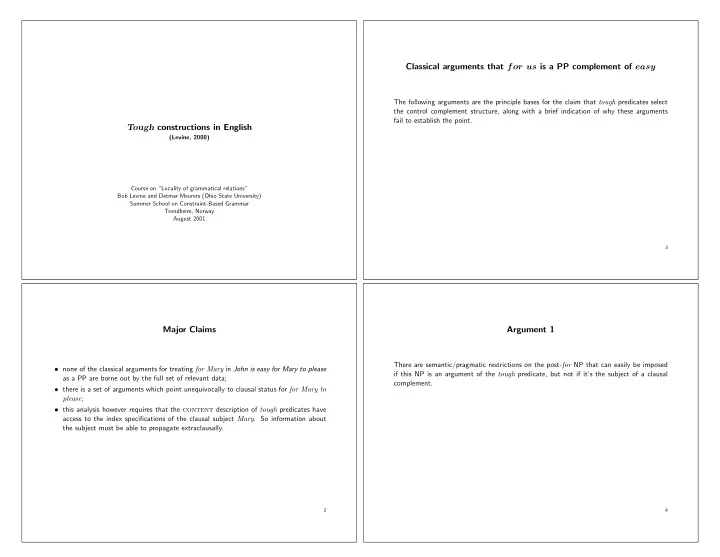
Tough constructions in English

(Levine, 2000) Course on “Locality of grammatical relations” Bob Levine and Detmar Meurers (Ohio State University) Summer School on Constraint-Based Grammar Trondheim, Norway August 2001

Major Claims

  • none of the classical arguments for treating for Mary in John is easy for Mary to please

as a PP are borne out by the full set of relevant data;

  • there is a set of arguments which point unequivocally to clausal status for for Mary to

please;

  • this analysis however requires that the content description of tough predicates have

access to the index specifications of the clausal subject Mary. So information about the subject must be able to propagate extraclausally.

2

slide-2
SLIDE 2

Argument 4

The for + NP sequence following the tough predicate can apparently undergo topicalization (Chomsky, 1973), e.g.: (3) a. It is easy for us to learn Latin.

  • b. For us, it is easy to learn Latin.

Lasnik and Fiengo (1974): (4) a. John is easy for Bill to please.

  • b. For Bill, John is easy to please.

Seemingly well-motivated conclusion: this displaceable sequence must be a constituent.

7

Why Argument 4 fails

The evidence is actually quite clear that these ‘fronted’ PPs not only need not be topicalized constituents, but cannot be.

  • Worth shows the same pattern as in (3), (4) but does not tolerate ‘in situ for NP;
  • Too/enough missing object constructions pattern parallel to (3), (4) but must have

clausal complement structure;

  • the French difficile construction patterns parallel to (3), (4) but does not tolerate ‘in

situ’ pour NP;

  • The distribution of ‘displaced’ for NP in English tough parallels that in the worth

construction and adverbial PP distribution generally, but does not parallel the topicalization possibilities of uncontroversial PP[for].

8

Argument 2

Truly clausal infinitivals can be involved in extraposition relations with respect the VP that these infinitivals appear as subjects of: (1) a. It is surprising for a woman to act that way.

  • b. For a woman to act that way is surprising.

On the other hand, tough infinitivals with for NP strings cannot: (2) a. It would be tough for a woman to act that way.

  • b. * For a woman to act that way would be tough.

Therefore such tough infinitivals are not clausal.

5

Argument 3

The stress pattern of Robin is easy (for us) to please is exactly what would be predicted by the operation of the Nuclear Stress Rule from SPE if there were no cycle on the complement

  • f easy, i. e., if (for us) to please were nonclausal. Thus phonological evidence is taken to

provide independent confirmation of the syntactically supported PP VP analysis.

6

slide-3
SLIDE 3

What too/enough constructions tell us

(11) a. This parki is too small for us to have a proper picnic in (iti).

  • b. This box is small enough for us to hide (iti) inside the piano.

(12) a. The park you describe sounds too small for there to have been a riot in.

  • b. Like many politicians, Robin was too stupid for there to have been any point in

arguing with.

  • Neither control nor raising is possible; therefore clausal structure.

(13) a. For Billj, [this problem]i is too abstract [vp[cont|arg1 j] to solve ti.]

  • b. [This problem]i is too abstract [vp[cont|arg1 j] to solve ti, for Billj].

(data from Lasnik and Fiengo, 1974, p. 538)

11

(14) a. *For there, the park you describe sounds too small to have been a riot in.

  • b. *The park you describe sounds too small to have been a riot in, for there.

(15) S PP for NP:1 S ... VP ... A VP[SUBJ NP:

1]

... t ...

12

What worth tells us

(5) a. John isn’t worth talking to (*him).

  • b. For John, Mary isn’t worth talking to.
  • c. Mary isn’t worth talking to, for John.
  • d. *Mary isn’t worth for John talking to.

(6) a. Robin isn’t worth (you) getting so upset about.

  • b. Leslie isn’t worth your spending so much time resenting.

(7) I can’t get over (

you

your

  • ) having driven so dangerously this morning.

(8) a. For you Robin isn’t worth talking to.

  • b. Robin, for you, isn’t worth talking to.
  • c. Robin isn’t, for you, worth talking to.
  • d. Robin isn’t worth talking to you, for you.

9

(9) a. Certainly, Robin is a spy.

  • b. Robin certainly is a spy.
  • c. Robin is certainly a spy.
  • d. Robin is a spy, certainly.

(10) S PP for NP:1 S ... VP ... A VP[SUBJ NP:

1]

... t ...

10

slide-4
SLIDE 4

What tough constructions themselves tell us

(20) a. For me, Robin is easy to please. b. Robin, for me, is easy to please. c. Robin is, for me, easy to please. d. Robin is easy to please, for me. (21) a. I am worried about Robin. b. About Robin, I am worried.

  • c. *?? I about Robin am worried.
  • d. *?? I am about Robin worried.

(22) a. Lesliei is waiting for Sandy [VP[SUBJ|INDEX i] before leaving]. b. * Leslie, for Sandy, is waiting before leaving. c. * Leslie is, for Sandy, waiting before leaving. d. * Leslie is waiting before leaving, for Sandy. where in the second through fourth examples, the assumed reading is nonbenefactive.

15

Why the clausal analysis is preferable to the control analysis

  • An argument from the comparative construction
  • An argument from extraposition
  • An argument from discontinuous nominal dependencies
  • An argument from parasitic gaps

Moral of the story: where it is possible to distinguish X PP[ for] VP from X S[inf], tough complement structure parallels the latter, not the former.

16

What difficile tells us

Major properties of difficile: (i) There can be no post–adjective pour complement in this construction: (16) * Ce

This

livre

book

est

is

facile

easy

pour

for

Jean–Jaques

Jean–Jaques

` a

to

lire.

read.

(ii) Yet it is possible to use the MO difficile construction to translate This book is easy for Jean–Jaques to read. Although no pour PP is possible as a complement to the adjectival head, both preposed and postposed PPs are possible: (17) a. Pour Jean–Jaques, ce livre est facile ` a lire.

  • b. Ce livre est facile `

a lire, pour Jean–Jaques.

  • c. This book is easy for Jean–Jaques to read.’

13

(18) Il

It

est

is

difficile

easy

pour

` a

  • for

Marie

Marie

de

to

contenter

make happy

Jean.

Jean ‘It is easy for Marie to make Jean happy.’

(19) S PP pour NP:1 S ... VP ... A VP[SUBJ NP:

1]

... t ...

14

slide-5
SLIDE 5

b. S AP [How easy

i ]j

S V do NP you VP VP V think S Robin [will be

j ] for us

S to please

i

(28) a. Robin would be better for us to hire.

  • b. How much better to hire would Robin be, for us?
  • c. How much better would Robin be (,d’ya think,) for us to hire?

(29) How easy would Robin be(,d’ya think,) [for us to please]?

19

The argument from NP-internal selectional dependencies

(30) John would be a good person for you to hire. (31) a. John is a person such that your hiring John would be good.

  • b. # John is a person such that someone hiring John would be good for you.

Conclusion: the structure here must be [A N [for [. . . ]]]. Given: (32) John is an easy person for us to please. (33) John is a person such that we and us pleasing John are in the easy-relation.

20

The argument from comparatives

(23) Robin would be easier for us to bribe with favors than for you to coerce with threats. (24) a. Robin would good for you to hire.

  • b. Robini would be [ap [a good][pp for you] [vp to hire

i ]] (i.e., it would be good

for you if someone were to hire Robin

  • c. Robini would be [ap [a good][s for [s [you] [vp to hire

i ]]]] (i.e., it would be

good in general if you were to hire Robin) (25) a. Robin would be better for you to hire immediately than for us to get into drawn-out negotiations with. (Sole reading: Robin is a person such that it would be better in general if you were to hire her immediately than it would be if we were to get into drawn-out negotiations with her.)

  • b. Robin would be [ap [a better] [s for [s you to hire

immediately] than [s for [s us to get into drawn-out negotiations with ]]

17

The argument from extraposition

(26) How easy do you think Robin will be for us to please? (27) a. S AP [How easy

i ]j

S V do NP you VP VP V think S Robin will be

j

S for us to please

i 18

slide-6
SLIDE 6

Semantic interpretation in a clausal analysis

Guyanese Creole (Winford, 1993, p. 335 & pp. 340–341) (38) I wuda gud fu mi fu i laas all i moni.

‘It would have been good for me for him to lose all his money.’

(39) I haad fu

am

∗i

  • fu laas all dat moni.

‘It’s hard on him to lose all that money.’

23

(40) a. Jan iizi fi pliiz.

‘Jan’s easy to please.’

  • b. Dem piiz-de haad fi shel.

‘Those peas are hard to shell.’

  • c. Taiga na bin iizi fi kech.

‘Jaguars weren’t easy to catch.’

(41) a. Savi haad fu

  • i

∗am

  • fuul. ‘Savii ’s hard for her/himj to fool.’
  • b. Jan iizi fu
8 < :

Mieri i ∗am

9 = ;j biit. ‘Johni ’s easy for
  • Mary

him/her

  • to beat.’

24

The argument from parasitic gaps

(34) a. These books proved tough for critics of to praise sincerely. b. That hypothesis was easy for opponents of to poke holes in . c. Certainly it’s the kind of policy that would be logical for opponents of to pretend to like . (35) a. This policy had cost opponents a lot of effort to block successfully. b. This cake will take chefs a lot of time to get the ingredients for . (36) a. * Such hypothesesi take critics of

i a long time to refute i.

  • b. * This policyi cost [opponents of

i ] a lot of credibility to attack i publically. 21

(37)

S 3NP [LOC 2 1 ]] that hypothesis VP V[SUBJ 3 ] was AP[SUBJ 3 ] A easy S [INHER|SLASH {2}] COMP for S [INHER|SLASH {2}] NP [INHER|SLASH{2}]

  • pponents of t

VP [INHER|SLASH {2}] to poke holes in [NP/NPt] 22

slide-7
SLIDE 7

(44) AP

  • cont

6

  • A
2 6 6 6 6 6 6 6 6 6 6 6 6 6 4

subj

D

1 2

E

comps

*

S

2 6 6 4

inf subject|index

3

inher|slash

n

5 2

  • 3
7 7 5

:4

+

cont

6

2 6 4

rel tough pivot

3

psoa-arg 4

3 7 5 3 7 7 7 7 7 7 7 7 7 7 7 7 7 5

tough S

2 6 6 6 4

inf subject|index

3

cont

4

slash

  • 5
  • 3
7 7 7 5

COMP for S

NP:3

John

VP

h

inher|SLASH

n

5 2

  • i

to please (45) Robin is easy for nobody to please. (46)

2 6 6 6 4

det no restind

2 6 4

index

2

restr

  • reln person
  • instance 2
3 7 5 3 7 7 7 5

27

A final wrinkle

(47)

2 6 6 6 6 6 6 6 6 6 6 6 6 6 6 6 6 4

tough-class-adjective loc

2 6 6 6 6 6 6 4

cat

h

subj

D

4 5

E i

comps

*

S

2 6 6 4

inf head|subject

6 7vol

nonloc|inher|slash

n

9 5

  • 3
7 7 5 3 7 7 5

:8

+

cont

2 6 4

tough-reln pivot

7

psoa-arg

8

3 7 5 3 7 7 7 7 7 7 7 7 7 7 7 7 7 7 7 7 5

28

The semantics of English tough

  • The syntactic evidence from GC and Standard English make it clear that the data

strongly suggest the clausal analysis of tough rather than the control analysis is correct;

  • but this analysis in turn entails that information about the subject of the embedded

infinitival tough complement clause be available to a selecting head, and indeed GC provides an existence proof that such extraclausal propagation of information about ‘buried’ subjects exists, whatever the mechanism involved turns out to be;

  • the most conservative approach to this mechanism might be the subject feature used

by Kiss and Meurers in work already discussed, but this feature is not understood to contain index information. What is wanted in fact seems to be something more like the agr feature argued for on completely independent morphosyntactic grounds in Kathol (1999), which explicitly included both case specification (like Meurer’s subject feature needed for remote case assignment in certain German infinitival clauses) and a value for index (required for tough on the analysis just presented). I will in fact assume that these two features are the same feature, but will use the name

25

subject as a pointer to the clausal status of the tough complement that I’ve argued for in the preceding. The Meurer/Kathol feature is in fact the key to reconciling the clausal syntax of tough complementation with the semantic accessibility of the buried subject index. (42)

2 6 6 6 4

verb head|subject

1:2

subj

  • 1
  • comps

3

3 7 7 7 5

(43)

2 6 6 6 6 6 6 6 6 6 6 6 6 6 6 6 4

loc

2 6 6 6 6 6 6 6 6 6 6 6 6 6 6 6 4

cat

"head tough-class-adjective

subj

D

4 5

E #

comps

*

S

2 6 6 4

inf head|subject

6 7

nonloc|inher|slash

n

9 5

  • 3
7 7 5

:8

+

cont

2 6 4

tough-reln pivot

7

psoa-arg 8

3 7 5 3 7 7 7 7 7 7 7 7 7 7 7 7 7 7 7 5 3 7 7 7 7 7 7 7 7 7 7 7 7 7 7 7 5

26

slide-8
SLIDE 8

References

Chomsky, Noam (1973). Conditions on Transformations. In S. A. Anderson and P. Kiparsky (Eds.), A Festschrift for Morris Halle. New York: Holt, Rinehart and Winston. Kathol, Andreas (1999). Agreement and the syntax–morphology interface in HPSG. In

  • R. Levine and G. M. Green (Eds.), Studies in Contemporary Phrase Structure Grammar,
  • pp. 223–274. Cambridge: Cambridge University Press.

Lasnik, Howard and Fiengo, Robert (1974). Complement object deletion. Linguistic Inquiry 5, 535–571. Levine, Robert D. (2000). ‘Tough’ complementation and the extraclausal propagation of argument descriptions. In D. Flickinger and A. Kathol (Eds.), On-line proceedings of the 7th International Conference on Head-Driven Phrase Structure Grammar, pp. 214–228. CSLI Publications, Stanford, CA. http://cslipublications.stanford.edu/HPSG/HPSG00/ hpsg00-toc.html. Winford, Donald (1993). Predication in Carribean English Creoles. Amsterdam: John Benjamins.

29