Class 1: Class 1: What is Introduction Introduction Computer - - PDF document

class 1 class 1
SMART_READER_LITE
LIVE PREVIEW

Class 1: Class 1: What is Introduction Introduction Computer - - PDF document

Class 1: Class 1: What is Introduction Introduction Computer Science ? CS150 Spring 2009 University of Virginia Computer Science Westley Weimer http://www.cs.virginia.edu/cs150 #2 The note on the inflected line is Let AB and CD be the two


slide-1
SLIDE 1

Westley Weimer http://www.cs.virginia.edu/cs150 CS150 Spring 2009 University of Virginia Computer Science

Class 1: Class 1: Introduction Introduction

#2

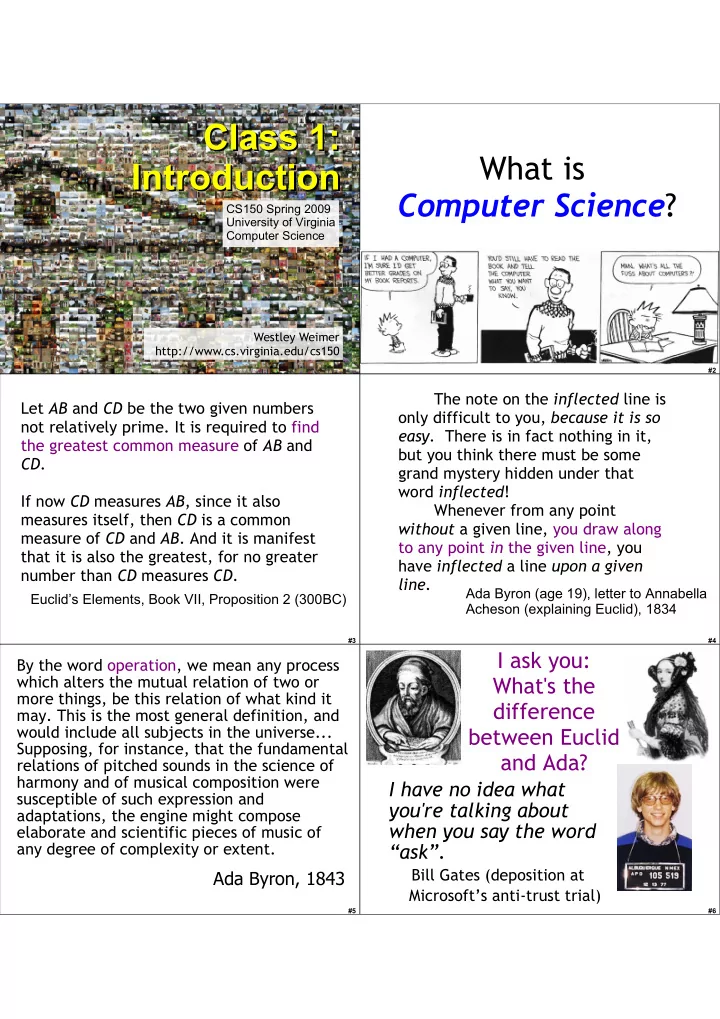
What is Computer Science?

#3

Let AB and CD be the two given numbers not relatively prime. It is required to find the greatest common measure of AB and CD. If now CD measures AB, since it also measures itself, then CD is a common measure of CD and AB. And it is manifest that it is also the greatest, for no greater number than CD measures CD.

Euclid’s Elements, Book VII, Proposition 2 (300BC)

#4

The note on the inflected line is

  • nly difficult to you, because it is so
  • easy. There is in fact nothing in it,

but you think there must be some grand mystery hidden under that word inflected! Whenever from any point without a given line, you draw along to any point in the given line, you have inflected a line upon a given line.

Ada Byron (age 19), letter to Annabella Acheson (explaining Euclid), 1834

#5

By the word operation, we mean any process which alters the mutual relation of two or more things, be this relation of what kind it

  • may. This is the most general definition, and

would include all subjects in the universe... Supposing, for instance, that the fundamental relations of pitched sounds in the science of harmony and of musical composition were susceptible of such expression and adaptations, the engine might compose elaborate and scientific pieces of music of any degree of complexity or extent.

Ada Byron, 1843

#6

I ask you: What's the difference between Euclid and Ada?

I have no idea what you're talking about when you say the word “ask”.

Bill Gates (deposition at Microsoft’s anti-trust trial)

slide-2
SLIDE 2

#7

Today's Class

  • Ada and Euclid
  • Engineering and Science
  • Moore's Law and Computing Power
  • The Liberal Arts
  • Course Expectations
  • Recursive Definitions and Languages
  • Nuclear Weapons
  • Formal Languages and Systems

#8

Geometry vs. Computer Science

  • Geometry (mathematics) is about

declarative knowledge: “what is”

If now CD measures AB, since it also measures itself, then CD is a common measure of CD and AB

  • Computer Science is about imperative

knowledge: “how to” Computer Science has little to do with beige (or spiffy black) boxes called “computers” and is not a real science.

#9

Computer Science

“How to” knowledge:

  • Ways of describing information

processes (computations)

  • Ways of predicting properties of

information processes Language Logic

#10

Science, Engineering or Other?

#11

Science?

  • Science involves understanding nature

through observation

– About real things like bowling balls, black holes, antimatter, electrons, comets, etc.

  • Math and Computer Science are about

fake things like numbers, graphs, functions, lists, etc.

– Computer Science is a useful tool for doing real science, but is not a real science

#12

Engineering?

“Engineering is design under constraint… Engineering is synthetic

  • it strives to create what can be,

but it is constrained by nature, by cost, by concerns of safety, reliability, environmental impact, manufacturability, maintainability and many other such 'ilities.' ...”

William Wulf and George Fisher, 2002

slide-3
SLIDE 3

#13

Liberal Arts Trivia: Music

  • Q. What is the name of a musical scale with

twelve pitches, each a semitone or half step apart? Such a scale is nondiatonic, consisting entirely of half-step intervals and having no tonic due to the symmetry or equal spacing of its tone.

#14

Liberal Arts Trivia: Psychology

  • Say the color each word is printed in:
  • Green Red Blue
  • Purple Blue Purple
  • Blue Purple Red
  • Green Purple Green
  • Q. Name the effect that refers to the fact

that naming the color of the first group of words is easier and quicker than the second.

#15

Let's Start With Classic Computers

#16

Apollo Guidance Computer, 1969

1 Cubic Foot Why did they need to fit the guidance computer in the rocket?

#17

Measuring Computers

  • 1 bit = smallest unit of information

– True or False – 0 or 1 – If we start with 2 possible choices, and get 1 bit, we can eliminate one of the choices

#18

How much power?

  • Apollo Computer: 61440 bits of changeable memory
  • Lab machines have 1 GB (RAM)

– 1 Gigabyte = 1024 Megabytes, 1 Megabyte = 1024 Kilobytes, 1 Kilobyte = 1024 Bytes, 1 Byte = 8 bits > (* 1024 1024 1024 8) 8589934592

~ 8.6 Billion bits

> (round (/ (* 1024 1024 1024 8) 61440)) 139810

If Apollo Guidance Computer power is 1 inch, you have 2.2 miles! You have 139 810 times more power than AGC

You will understand this notation soon…but don’t worry if you don’t now

slide-4
SLIDE 4

10,000,000 20,000,000 30,000,000 40,000,000 50,000,000 60,000,000 70,000,000 80,000,000 1969 1972 1975 1978 1981 1984 1987 1990 1993 1996 1999 2002 2005 2008

Computing Power 1969-present (in Apollo Control Computer Units)

Moore’s “Law”: computing power roughly doubles every 18 months!

#20

Constraints Computer Scientists Face

  • Not like those for engineers:

– Cost, weight, physics, etc. – If today's ~20 Million times what people had in 1969 isn’t enough for you, wait until 2011 and you will have ~80 Million times…

  • More like those for Musicians and Poets:

– Imagination and Creativity – Complexity of what we can understand

#21

So, what is computer science?

  • Science

– No: it's about fake things like numbers, not about observing and understanding nature

  • Engineering

– No: we don’t have to deal with engineering- type constraints

  • Liberal Art

#22

Liberal Arts: ~1100 AD

  • Illiberal Arts

– arts for the non-free: pursued for economic reasons

  • Liberal Arts

– arts for the free: pursued for intrinsic reasons

#23

The Liberal Arts

Trivium (3 roads)

language

Quadrivium (4 roads)

numbers

Grammar

study of meaning in written expression

Rhetoric

Comprehension

  • f discourse

Logic

argument for discovering truth

Arithmetic Geometry

quantification

  • f space

Music

numbers in time

Astronomy

We will see all of these in this class!

#24

Course Expectations

slide-5
SLIDE 5

#25

Course Roadmap Computer Science from Euclid and Ada to Quantum Computing and the World Wide Web

1st Class PS 7-9 Lecture PS 1-6 Liberal Arts (Intellectual) Illiberal Arts ($$$$)

#26

Like Drinking from a Firehose Like Drinking from a Firehose

It may hurt a little bit, and a lot of water will go It may hurt a little bit, and a lot of water will go by you, but you won’t go away thirsty! by you, but you won’t go away thirsty!

Don’t be overwhelmed! You will do fine.

#27

Books

Computational Thinking

A Whirlwind Introduction to the Third Millennial Liberal Art from Ada and Euclid to Quantum Computing and the World Wide Web

“GEB”

A new book written for this course by Professor David Evans (UVA) Bonuses for helping us improve it:

  • Less pretentious title (?)
  • More exciting cover
  • Notice any mistakes
  • Improve the writing or presentation

“Course Book”

#28

Help Available

  • Me: Westley Weimer (call me “Wes”)

– Office Hours will be posted (after your surveys) – Always available via email and forum, if I don’t reply in 24 hours, send again and complain

  • Teaching Assistants: Zak Fry, Paul DiOrio, ???

– Structured lab hours in OLS 001. W 7-8, W 8-9 – Staffed lab hours in Small Hall – Officse hours TBA (after your surveys)

  • Web site: http://www.cs.virginia.edu/cs150

– Everything goes on the web, you should visit it often

  • Your classmates (read the course pledge

carefully!)

#29

What I Expect of You

  • 1. Everything on the Course Pledge

– You should actually read it not just sign it (you will lose points on the problem sets if your submission reveals that you didn’t read it!)

  • 2. You are a “Jeffersonian Student”

1.Believe knowledge is powerful 2.Interested in lots of things, ahead of your time 3.Want to use what you learn to do good things 4.Care more about what you learn than grades and degree requirements

#30

Background Expected

  • Language:

– Reasonable reading and writing in English – Understanding of subject, verb and object

  • Math:

– Numbers, add, subtract, multiply, divide – Exponentiation, logarithms (we will review)

  • Logic: and, or, not
  • Computer Literacy: read email, browse

web

If I ever appear to expect anything else, stop me!

slide-6
SLIDE 6

#31

Many of you have fancy phones

#32

No ringing: you will look foolish

#33

A Course for Everyone!

  • CLAS, SEAS, Commerce, Arch, etc.
  • 1st, 2nd, 3rd, 4th, 5th Years, Community

Scholars, Faculty

  • No background expected … but challenging

even for students with lots of previous CS courses

  • Computer Science (future-) majors … but

worthwhile even if you don’t take another CS course

#34

First Assignment

  • Read Course Book Chapters 1-3 by tomorrow
  • Problem Set 0 (“Managing Mars with

Automatic Adjudication”) is due Midnight this Thursday

– It is very short

  • Due before CLAS drop deadline

– If the class is too crowded for you, or if you can't make the structured office hours (W 7-8 or 8-9), or if PS0 is too confusing, drop CS150 now and take it later – If you are in the class now and you drop it now but plan to take it later, I will write you a note to skip you past the waitlist later

#35

First Main Theme: Recursive Definitions

#36

What is the longest word in the English language?

Can you think of one longer than “boustrophedon” ? From Greek βουστροφηδόν ("ox-turning"—that is, turning like

  • xen in ploughing), it is an ancient

way of writing manuscripts and

  • ther inscriptions.

Ancient Greek boustrophedon inscription, Gortyn code, Crete, 5th c. B.C

slide-7
SLIDE 7

#37

According to Guinness floccipoccinihilipilification

the act of rendering useless

#38

Making Longer Words

antifloccipoccinihilipilification

the act of rendering not useless

antiantifloccipoccinihilipilification

the act of rendering useless

#39

Language is Recursive

No matter what word you think is the longest word, I can always make up a longer one!

word ::= anti-word

If you have a word, you can always make up a new word by adding anti in

  • front. Since the result is a word, you

can make a longer new word by adding anti- in front again.

#40

Recursive Definitions

  • We can define things in terms of (smaller

versions of) themselves

  • Recursive definitions are different from

circular definitions: they eventually end with something real word ::= anti-word word ::= floccipoccinihilipilification

#41

Recursive Definitions

Allow us to express infinitely many things starting with a few. This is powerful! We will see lots of examples in this course.

#42

Liberal Arts Trivia: Astronomy

  • Q. What is the name given to highly

magnetized rotating neutron stars that emit a beam of electromagnetic radiation? The radiation can only be observed when the beam of emission is pointing towards the Earth, yielding a “lighthouse effect”.

slide-8
SLIDE 8

#43

Liberal Arts Trivia: Literature

  • Q. This French author's works touched on

topics such as solidarity, the absurd, and

  • totalitarianism. His works include L'Étranger,

L'Homme révolté, and Caligula. In 1957 he became the second-youngest recipient of the Nobel Prize for Literature and the first African-born writer to win it.

#44

Megabytes vs. Megatons

  • A brief diversion back to Moore's Law
  • Computing: 30,000,000 times increase in

power since 1969

  • Nuclear weapons?

#45

Tsar Bomba 50 Megaton explosion, island in Arctic Sea, 1961

#46

If Nuclear Weapons followed Moore’s Law...

  • 30M * 50 Megatons = 1.5 Teratons
  • 1 Megaton TNT

= 4.184 * 1015 Joules

  • 1.5 Teratons TNT = 6.3 * 1021 Joules
  • Energy from Sun to Earth

= 4 x 10¹⁸ Joules/ Year

  • One bomb today would equal all the energy

to reach the Earth from the Sun since 400 AD

#47

Actual Nuclear Weapons

10000 20000 30000 40000 50000 60000 1940 1950 1960 1970 1980 1990 2000 2010 2020

Hiroshima (12kt), Nagasaki (20kt) First H-Bomb (10Mt) Tsar Bomba (largest ever) B83 (1.2Mt), largest in currently active arsenal

#48

If it takes 60 seconds to compute a photomosaic for Problem Set 1 today on a typical PC, estimate how long it will take CS150 students in 2012 to compute the same photomosaic? How long will it take in 2015?

> (/ (* (- 2012 2009) 12) 18) 2 > (/ 60 (* 2 2)) 15 > (/ (* (- 2015 2009) 12) 18) 4 > (/ 60 (* 2 2 2 2)) 15/4 > (exact->inexact (/ 60 (* 2 2 2 2))) 3.75

Difference in years * 12 = number of months Number of months / 18 = number of doublings according to Moore’s Law 60 seconds today, 2 doublings by 2012 15 seconds in 2012 60 seconds today, 4 doublings by 2015 3.75 seconds in 2015

Reality check: Moore’s “law” is just an “observation”. We’ll see one reason later today why it won’t continue forever.

slide-9
SLIDE 9

Formal Systems and Languages

MU!

#50

Are there any non-recursive natural languages? What would happen to a society that spoke one? Not for humans at least. They would run out of original things to say. Chimps and Dolphins are able to learn non- recursive “languages” (some linguists argue they are not really “languages”), but only humans can learn recursive languages (as

far as we know).

#51

Running out of Ideas

“It has all been said before.” Eventually true for a non-recursive language. Never true for a non-trivial recursive language. There is always something original left to say!

#52

Production Systems

  • A Post Production System is one way of

defining a language.

  • Set of symbols

– Primitives

  • Set of rules for manipulating symbols

– Hofstadter: Rules of Production, Rules of Inference – Also: Rules of Combination

#53

The MIU System

  • Symbols: M, I, U
  • Rules of Production:

– Rule I: If you have a string ending in I, you can add a U at the end. – Rule II: Suppose you have Mx. Then you may add Mxx to your collection. – Rule III: If III occurs in one of the strings in your collection you may make a new string with U in place of III. – Rule IV: If UU occurs inside one of your strings, you can drop it.

#54

MIU System Example

Start with MUI, produce MIU

Rules of Production: Rule I: If you have a string ending in I, you can add a U at the end. Rule II: Suppose you have Mx. Then you may add Mxx to your collection. Rule III: If III occurs in one of the strings in your collection you may make a new string with U in place of III. Rule IV: If UU occurs inside one of your strings, you can drop it.

slide-10
SLIDE 10

#55

Any Questions?

  • Read Chapters 1-3 for next class
  • PS0 due Thursday at midnight!

– Read lab guide before structured office hours tomorrow ...