City of Park Ridge October 12, 2015 Stormwater Utility Presentation - - PowerPoint PPT Presentation

city of park ridge
SMART_READER_LITE
LIVE PREVIEW

City of Park Ridge October 12, 2015 Stormwater Utility Presentation - - PowerPoint PPT Presentation

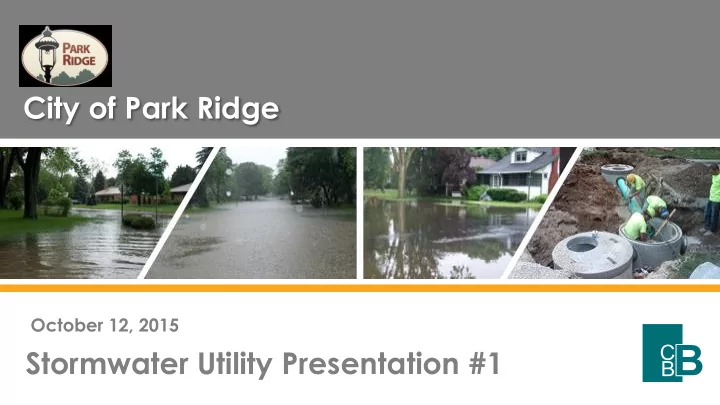
City of Park Ridge October 12, 2015 Stormwater Utility Presentation #1 Purpose of Tonights Presentation Explanation of a Stormwater Utility (SWU) Provide preliminary results and fee estimates Summarize feedback from Open House


slide-1
SLIDE 1

City of Park Ridge

October 12, 2015

Stormwater Utility Presentation #1

slide-2
SLIDE 2

Sewer Separation Evaluation

Purpose of Tonight’s Presentation

  • Explanation of a Stormwater Utility (SWU)
  • Provide preliminary results and fee estimates
  • Summarize feedback from Open House

Stormwater Utility Feasibility Study

slide-3
SLIDE 3

Sewer Separation Evaluation

Study Process – Public Involvement

  • 1. Open House #1 (8/31/15)
  • Explain SWU concept, need, and preliminary fees by zoning class
  • Answer resident questions
  • 2. City Council Update Presentation (10/12/15)
  • Incorporate feedback from Open House
  • Formalize preliminary results and anticipated fees
  • Opportunity for resident input to Council
  • 3. City Council Final Presentation
  • Present final study report
  • Council to decide whether to establish Stormwater Utility

Stormwater Utility Feasibility Study

slide-4
SLIDE 4

Sewer Separation Evaluation

What is a Stormwater Utility?

  • A Stormwater Utility (SWU) is a fee charged to all parcels in

the City based on their contribution of stormwater runoff into the sewer system

  • More runoff = Greater chance of flooding
  • What is an “impervious area”?
  • Those surfaces that prevent stormwater from infiltrating into the soil

Stormwater Utility Feasibility Study

Sidewalk/Driveways/Patios Building Roofs Parking Lots

slide-5
SLIDE 5

Sewer Separation Evaluation

How is a Stormwater Utility Equitable?

  • An SWU is a fair and equitable method of funding

stormwater projects

  • The fee charged to each parcel is based on the runoff it

generates, as defined by its impervious area

  • More impervious area = bigger contribution to the sewer

system = higher stormwater fee

  • All properties, including tax exempt properties, are

assessed a fee

Stormwater Utility Feasibility Study

slide-6
SLIDE 6

Sewer Separation Evaluation

Why is a Stormwater Utility Being Considered?

  • Many expensive infrastructure projects need to be built to

address flooding problems throughout the City

  • City needs to establish a dedicated funding source to pay

for stormwater projects

Stormwater Utility Feasibility Study

slide-7
SLIDE 7

Sewer Separation Evaluation

Why is a Dedicated Funding Source Necessary?

  • Paying for projects through the City’s General Fund

means competing with other priorities such as police, fire, public works, capital improvements, etc.

  • Increasing the Sewer and Water fees is not equitable

since it is not based on impervious coverage

  • Increasing property taxes is not equitable because many

tax-exempt properties would not be included

Stormwater Utility Feasibility Study

slide-8
SLIDE 8

Sewer Separation Evaluation

What would a Stormwater Utility Pay For?

  • SWU’s can be used to fund anything related to the

stormwater system

  • Stormwater Infrastructure projects
  • Repair/replacement of sewer mains
  • Costs to maintain the existing system, including City personnel
  • Street sweeping
  • Administrative costs for permits, studies, etc.
  • At this time, planning has assumed the SWU funds would

be used for design and construction of new infrastructure projects

  • Limits the funds necessary to be collected

Stormwater Utility Feasibility Study

slide-9
SLIDE 9

Sewer Separation Evaluation

How are the fees determined?

  • A conceptual outline of a Stormwater Master Plan has

been developed

  • Projects from Citywide Sewer Study still under discussion ($21 million)
  • Northwest Park, Mayfield Estates
  • Green Infrastructure projects ($3 million)
  • Examples could include adding green elements to “traditional” street projects such as

developing a green alley program

  • Stormwater Storage projects ($12 million)
  • Examples could include relief sewer and underground storage projects, or detention

basins where open space is available

  • Evaluation and Design Engineering of Projects over life of SWU ($4 million)
  • Costs are estimated for the Stormwater Plan
  • Total estimated cost (in 2015 dollars) is $40 million

Stormwater Utility Feasibility Study

slide-10
SLIDE 10

Sewer Separation Evaluation

How are the fees determined?

  • Multiple funding scenarios are evaluated (by Speer Financial)
  • Timing/scheduling of projects is developed
  • Municipal Bonds are used to fund projects
  • SWU fees used to pay back bonds
  • Multiple bonding scenarios are considered
  • Total program cost is determined
  • Including cost of projects and debt service

Stormwater Utility Feasibility Study

slide-11
SLIDE 11

Sewer Separation Evaluation

How are the fees determined?

  • Next, the impervious area of an average residential

property in each zoning class (R-1, R-2, etc) is determined

Stormwater Utility Feasibility Study

Typical Residential Lot Pervious Area Impervious Area

  • R-3 Zoning has smallest average impervious area, and is

defined as an Equivalent Residential Unit (ERU)

  • 1 ERU = approximately 2,800 square feet
slide-12
SLIDE 12

Sewer Separation Evaluation

How are the fees determined?

  • The ERU is determined for each Zoning Classification
  • R-1 residential = 1.4 ERU (1.4x the average impervious area)
  • R-2 residential = 1.1 ERU (1.1x the average impervious area)
  • R-3 residential = 1 ERU (1x the average impervious area)
  • R-4 residential = 3 ERU (3x the average impervious area)
  • R-5 residential = 8 ERU (8x the average impervious area)
  • Non-residential = 4 ERU (4x the average impervious area)
  • Before a SWU fee would be implemented, the actual

impervious area for every parcel would be determined so that fees are not based on the average

Stormwater Utility Feasibility Study

slide-13
SLIDE 13

Sewer Separation Evaluation

How are the fees determined?

  • Every parcel in the City is given an ERU value
  • The total ERU for the City is added up
  • Park Ridge has approximately 18,000 ERU
  • In simple terms, the total cost of the stormwater program is

divided by the number of ERUs to establish the cost per ERU

1 ERU Cost = Total Program Cost / Total ERUs / # of Years

  • The fee for each parcel will be based on its individual

impervious area

Stormwater Utility Feasibility Study

slide-14
SLIDE 14

Sewer Separation Evaluation

What will it cost?

  • The SWU Feasibility study is in the preliminary stage
  • Preliminary fees are based on average impervious area, not actual
  • Any changes to the list of projects or assumed costs for the program would affect the

calculated fees

  • The preliminary rate for 1 ERU is $11 per month
  • Therefore, the preliminary AVERGAGE fees

by zoning type are:

  • R-1 = 1.4 ERU = $15 per month
  • R-2 = 1.1 ERU = $12 per month
  • R-3 = 1 ERU = $11 per month
  • R-4 = 3 ERU = $33 per month
  • R-5 = 8 ERU = $88 per month
  • Non-residential will vary significantly

Stormwater Utility Feasibility Study

R-2 R-1 R-4 NR

slide-15
SLIDE 15

Sewer Separation Evaluation

Other SWU Examples:

Stormwater Utility Feasibility Study

Community Impervious Area (ft2) of 1 ERU Monthly Fee Park Ridge (proposed) 2,800 $11 Rolling Meadows 3,604 $3.90 Highland Park 2,765 $7.00 Downers Grove 3,300 $9.72 Winnetka 3,400 $21.80

slide-16
SLIDE 16

Sewer Separation Evaluation

Example Calculations

  • Example #1 – R-1 Residential (1900 Block of Fenton)

Stormwater Utility Feasibility Study

  • Total Parcel Area = 11,800 ft2
  • Pervious Area = 7,886 ft2
  • Impervious Area = 3,914 ft2

1 ERU = 2,800 ft2 Example ERU = 3,914 / 2,800 = 1.4 ERU

Preliminary SWU Fee = 1.4 x $11 = $15.40/month

slide-17
SLIDE 17

Sewer Separation Evaluation

Example Calculations

  • Example #1 – R-2 Residential (300 Block N. Delphia)

Stormwater Utility Feasibility Study

  • Total Parcel Area = 6,620 ft2
  • Pervious Area = 3,250 ft2
  • Impervious Area = 3,370 ft2

1 ERU = 2,800 ft2 Example ERU = 3,370 / 2,800 = 1.2 ERU

Preliminary SWU Fee = 1.2 x $11 = $13.20/month

slide-18
SLIDE 18

Sewer Separation Evaluation

Example Calculations

  • Example #2 – Non-residential – Church Property

Stormwater Utility Feasibility Study

  • Total Parcel Area = 28,000 ft2
  • Pervious Area = 15,123 ft2
  • Impervious Area = 12,877 ft2

1 ERU = 2,800 ft2 Example ERU = 12,877 / 2,800 = 4.6 ERU

Preliminary SWU Fee = 4.6 x $11 = $50.60/month

slide-19
SLIDE 19

Sewer Separation Evaluation

Example Calculations

  • Example #2 – Non-residential – School Property

Stormwater Utility Feasibility Study

  • Total Parcel Area = 438,555 ft2
  • Pervious Area = 326,106 ft2
  • Impervious Area = 112,449 ft2

1 ERU = 2,800 ft2 Example ERU = 112,449 / 2,800 = 40.2 ERU

Preliminary SWU Fee = 40.2 x $11 = $442/month

slide-20
SLIDE 20

Sewer Separation Evaluation

Example Calculations

  • Example #2 – Non-residential – Commercial Property

Stormwater Utility Feasibility Study

  • Total Parcel Area = 206,820 ft2
  • Pervious Area = 34,598 ft2
  • Impervious Area = 172,222 ft2

1 ERU = 2,800 ft2 Example ERU = 172,222 / 2,800 = 61.5 ERU

Preliminary SWU Fee = 61.5 x $11 = $676/month

slide-21
SLIDE 21

Sewer Separation Evaluation

Example Calculations

  • Example #2 – Non-residential – Commercial Property

Stormwater Utility Feasibility Study

  • Total Parcel Area = 29,069 ft2
  • Pervious Area = 7,361 ft2
  • Impervious Area = 21,708 ft2

1 ERU = 2,800 ft2 Example ERU = 21,708 / 2,800 = 7.8 ERU

Preliminary SWU Fee = 7.8 x $11 = $86/month

slide-22
SLIDE 22

Sewer Separation Evaluation

Credits and Incentives

  • Most SWU programs include provisions for credits and

incentives

  • Incentive = one time rebate
  • Credit = permanent (or semi-permanent) reduction of SWU fee

Stormwater Utility Feasibility Study

slide-23
SLIDE 23

Sewer Separation Evaluation

Credits and Incentives - Examples

  • Incentives
  • Typically used to encourage residents and businesses to construct small

projects, such as:

  • Rain Barrels
  • Rain Gardens
  • Permeable Pavement
  • Typically set up as one-time rebate to avoid issues of long-term maintenance

and inspection requirements

  • Common Incentive Amounts (per property):

Stormwater Utility Feasibility Study

Rain Barrels - $25 Rain Gardens - $200-300 Permeable Paving - $200-300

slide-24
SLIDE 24

Sewer Separation Evaluation

Credits and Incentives - Examples

  • Credits
  • Used to encourage large property
  • wners to construct stormwater

projects, such as:

  • Stormwater Detention

Basins/Vaults

  • Infiltration Basins

Stormwater Utility Feasibility Study

Detention Basin

  • Typically set up as recurring fee reduction for a fixed period of time.
  • Property owner would need to regularly reapply for credit and prove that the

stormwater project is still functioning

  • Minimizes burden on City for inspections
  • Some SWU programs will credit a portion of construction cost; some only

the monthly SWU fee.

  • Details of credit program to be developed for final presentation and report.

Detention Vault

slide-25
SLIDE 25

Sewer Separation Evaluation

Park Ridge SWU Summary

Stormwater Utility Feasibility Study

  • The SWU fee would apply to all properties and be based on the

amount of impervious area

  • A preliminary Stormwater Master Plan has been outlined and

estimated to cost approximately $40 million

  • An “Equivalent Residential Unit” (ERU) is equal to 2,800 ft2

impervious area

  • Each property will be assigned an ERU value
  • Fees will be approximately $11 per ERU
  • A credit/incentive program will be developed to offset fees
slide-26
SLIDE 26

Sewer Separation Evaluation

Next Steps

Stormwater Utility Feasibility Study

  • Develop full database of impervious areas per parcel
  • Prepare specific recommendations for credit program
  • Review City Ordinances and develop new language as needed

to implement SWU

  • Establish preferred billing mechanism
  • Prepare final report and presentation
slide-27
SLIDE 27

Sewer Separation Evaluation

Questions?

Stormwater Utility Feasibility Study