Citation Style: Chicago Notes & Bibliography Onl nline Cit - - PowerPoint PPT Presentation

citation style chicago notes bibliography onl nline cit
SMART_READER_LITE
LIVE PREVIEW

Citation Style: Chicago Notes & Bibliography Onl nline Cit - - PowerPoint PPT Presentation

Citation Style: Chicago Notes & Bibliography Onl nline Cit itatio ion Gui uides http://library.concordia.ca/help/citing/ Citation Style Guides Help you avoid plagiarism by acknowledging sources Citations provide enough details to


slide-1
SLIDE 1

Citation Style: Chicago Notes & Bibliography

slide-2
SLIDE 2

Onl nline Cit itatio ion Gui uides http://library.concordia.ca/help/citing/

slide-3
SLIDE 3

Citation Style Guides

  • Help you avoid plagiarism by

acknowledging sources

  • Citations provide enough details to

track down original source

  • Each style contains the same basic

information

  • Information is formatted differently

with each style Chicago Manual Style– is commonly used in the Humanities and Social Sciences

slide-4
SLIDE 4

Citation Elements

Each citation should contain enough information for a reader to track it back to the original source:

  • Creator
  • Title
  • Where and when it was first published
slide-5
SLIDE 5

In In you

  • ur Chi

hicago Not

  • tes & Bib

ibli liography pa paper

  • Use Notes whenever you directly quote a source and when you

paraphrase AND

  • Provide a full Bibliography at the end of your paper: this will be

labeled Bibliography

  • Chicago also has guidelines for how you should format your paper
slide-6
SLIDE 6

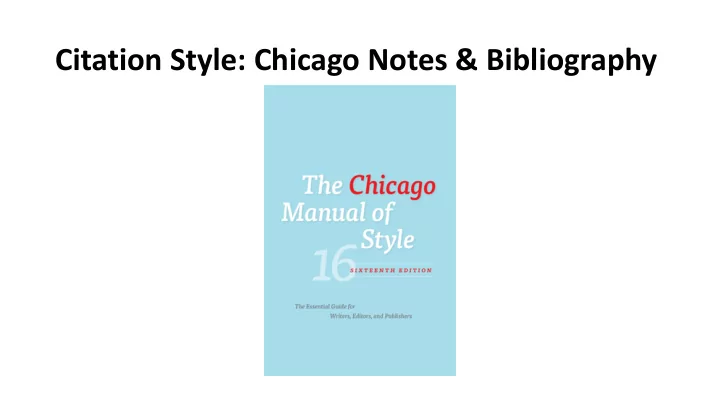
Chicago is a print book and an e-book! The library has copies.

slide-7
SLIDE 7

Chicago Manual of Style

  • Chicago Quick Guide Online:

http://www.chicagomanualofstyle.org/tools_citationguide.html

  • Click on Notes and Bibliography tab to see examples for most typical format

for notes and entries in a bibliography

  • Full ebook version: http://clues.concordia.ca/record=e1000563~S0
  • Refer to Chapter 14 – Documentation I: Notes and Bibliography
slide-8
SLIDE 8

Bibliography

  • The list of sources used in creating a research paper, a book, etc.
  • A method of giving credit to the authors from whom information

was taken

  • A resource for other researchers who can use it to get information

about the topic

  • Goes at the end of your paper
slide-9
SLIDE 9

For example

Let’s say your research topic is: Aboriginal constitutions and self-government development in Canada. You find a great article in Academic Search Complete:

Alcantara, Christopher, and Greg Whitfield. “Aboriginal Self- government Through Constitutional Design: A Survey of Fourteen Aboriginal Constitutions in Canada.” Journal of Canadian Studies 44, no. 2 (2010): 122-145.

slide-10
SLIDE 10

Chicago Author-Date In-Text Citation: Quoting

  • Place quotation marks around other people’s exact words (“. . .”)
  • Don’t rephrase or reorganize the quoted words
  • Indicate the source of the quotation using a standard method (e.g.

Chicago)

Tip: if copying an exact passage while researching, use quotation marks

slide-11
SLIDE 11

Chicago Author-Date In-Text Citation: Quoting

Use Quotation marks and add a footnote

slide-12
SLIDE 12

Chicago Notes & Bibliography: Quoting

Add the footnote to the end of your quotation and then add the Note citation to the bottom of the page

slide-13
SLIDE 13

Chicago Notes & Bibliography: Quoting

Once you have written a full footnote, there is no need to repeat all the information again. If you quote again from the same source, shorten the footnote to just include the author(s), article or book title before any subtitles and the page you took the quote from.

slide-14
SLIDE 14

Chicago Notes & Bibliography: Quoting

Every main footnote entry, also needs a corresponding Bibliography entry, these entries are listed in alphabetical order by author’s last name and if the entry is more than one line, all subsequent lines are indented. IMPORTANT: Bibliography entries and Notes look similar but have slightly different formatting, pay attention to the examples and guide

slide-15
SLIDE 15

Chicago Notes & Bibliography: Paraphrasing

  • Write other people’s ideas in your own words
  • Using synonyms or changing the word order is not sufficient
  • Indicate the source of the quotation using a standard method (Chicago)

Tip: read the passage, close the book, write it in your own words

slide-16
SLIDE 16

In-Text Citation: Paraphrasing

The main idea:

Aboriginal communities have specific requirements to prove citizenship

So, you write… The text is completely different, but it’s the same idea and you give credit.

slide-17
SLIDE 17

Chicago Notes and Bibliography

  • This style uses Footnotes and a bibliography

entry 1. Phil Bellfy, ed., Honor the Earth: Indigenous Responses to Environmental Degradation in the Great Lakes (East Lansing, Michigan: Ziibi Press, 2014) 102-103. Bellfy, Phil, ed. Honor the earth: Indigenous Responses to Environmental Degradation in the Great Lakes. Michigan: Ziibi Press, 2014.

slide-18
SLIDE 18

Chicago - Titles

  • Titles and subtitles are capitalized headline-style.
  • In headline style, the first and last words of title and subtitle and all other

major words are capitalized.

  • Journal article titles should be in quotations marks
  • Journal article title: “From First Nations to Self-Government: A Political Legacy
  • f Indigenous Nations in the United States.”
  • Journal titles and Book titles should be in italics
  • Book title: Speaking with Authority: the Emergence of the Vocabulary of First

Nations’ Self-government.

slide-19
SLIDE 19

CHICAGO/Notes & Bib- Books (Print)

NOTES

  • 1. Michael Posluns, Speaking with Authority: the Emergence of the

Vocabulary of First Nations’ Self-government. (New York: Routledge, 2007).

  • 2. Posluns, “Speaking with Authority”, 47-48.

BIBLIOGRAPHY ENTRY Posluns, Michael. Speaking with Authority: the Emergence of the Vocabulary of First Nations’ Self-government. New York: Routledge, 2007.

slide-20
SLIDE 20

CHICAGO/ Notes & Bib – ebooks without DOI

NOTES

  • 2. Dan Russell, A People’s Dream: Aboriginal Self-Government in Canada.

(Vancouver, BC: UBC Press, 2000). Accessed November 23, 2015. http://clues.concordia.ca/record=b2351667.

  • 3. Russell, A People’s Dream, 107-109.

BIBLIOGRAPHY ENTRY Russell, Dan. A People’s Dream: Aboriginal Self-Government in Canada. Vancouver, BC: UBC Press, 2000. Accessed November 23, 2015. http://clues.concordia.ca/record=b2351667.

slide-21
SLIDE 21

CHICAGO/ Notes & Bib – ebooks with DOI

NOTES

  • 1. Bettina Von Lieres, and Laurence Piper, editors. Mediated Citizenship: The

Informal Politics of Speaking for Citizens in the Global South. (Basingstoke: Palgrave Macmillan, 2008), doi: 10.1057/9781137405319.

  • 2. Von Lieres and Piper, Mediated Citizenship.

BIBLIOGRAPHY ENTRY Von Lieres, Bettina, and Laurence Piper, editors. Mediated Citizenship: The Informal Politics of Speaking for Citizens in the Global South. Basingstoke: Palgrave Macmillan, 2008. doi: 10.1057/9781137405319.

slide-22
SLIDE 22

CHICAGO/Notes & Bib – Book Chapter

NOTES

  • 6. Peter Whitridge,“Invented Places: Environmental Imaginaries and the Inuit

Colonization of Labrador.” Settlement, Subsistence, and Change Among the Labrador Inuit: the Nunatsiavummiut Experience. ed. David C. Natcher, et al. (Winnipeg, MN: University of Manitoba Press, 2012) 43-60.

  • 7. Whitridge,“Invented Places,” 43-60.

BIBLIOGRAPHY ENTRY Whitridge, Peter. “Invented Places: Environmental Imaginaries and the Inuit Colonization of Labrador.” Settlement, Subsistence, and Change Among the Labrador Inuit: the Nunatsiavummiut Experience. Edited by David C. Natcher, Lawrence Felt & Andrea Procter, 43-60. Winnipeg, MN: University of Manitoba Press, 2012.

slide-23
SLIDE 23

CHICAGO/Notes & Bib – Print Journal Article

NOTES

  • 4. Tom Langford, and J. Rick Ponting, “Canadians’ Responses to Aboriginal Issues: The

Roles of Prejudice, Perceived Group Conflict and Economic Conservatism,” Canadian Review of Sociology & Anthropology 29, no. 2 (1992): 140-166.

  • 5. Langford and Ponting, “Canadians’ Responses to Aboriginal Issues”, 140-166.

BIBLIOGRAPHY ENTRY Langford, Tom., and J. Rick Ponting. “Canadians’ Responses to Aboriginal Issues: The Roles of Prejudice, Perceived Group Conflict and Economic Conservatism.” Canadian Review

  • f Sociology & Anthropology 29, no. 2 (1992): 140-166.
slide-24
SLIDE 24

CHICAGO/Notes & Bib – e-Journal Article with DOI

NOTES

  • 6. Duane Champagne, “From First Nations to Self-Government: A Political

Legacy of Indigenous Nations in the United States,” American Behavioral Scientist 51, no. 12 (2008): 1674, doi: 10.1177/0002764208318925.

  • 7. Champagne, “From First Nations to Self-Government”, 1677.

BIBLIOGRAPHY ENTRY Champagne, Duane. “From First Nations to Self-government: A Political Legacy of Indigenous Nations in the United States.” American Behavioral Scientist 51, no. 12 (2008): 1672-1693. doi: 10.1177/0002764208318925.

slide-25
SLIDE 25

CHCAGO/Notes & Bib – e-Journal article with URL

NOTES

  • 12. Duane Champagne, “From First Nations to self-Government: A Political Legacy of

Indigenous Nations in the United States.” American Behavioral Scientist 51, no. 12 (2008): 1680, http://abs.sagepub.com/content/51/12/1672.

  • 13. Champagne, “From First Nations to Self-government”, 1683.

BIBLIOGRAPHY ENTRY Champagne, Duane. “From First Nations to Self-government: A Political Legacy of Indigenous Nations in the United States.” American Behavioral Scientist 51,

  • no. 12 (2008): 1672-1693. http://abs.sagepub.com/content/51/12/1672
slide-26
SLIDE 26

Help with Citation Styles

  • Libraries’ main website
  • Help & How-to
  • Library “How to” Guides
  • Citing

http://library.concordia.ca/help/citing/

slide-27
SLIDE 27

Help with Writing

Student Success – Writing Assistance:

http://www.concordia.ca/students/success/learning-support/writing-assistance.html

SGW Campus: 1455 de Maisonneuve W., Hall-662

  • Appointments from 10:00 am daily
  • Appointments are bookable online
  • DROP-IN TIMES (without an appointment) Mondays and Thursdays from 1:00-3:00 pm and Tuesdays and

Wedensdays from 5:00 - 7:00 pm in H-662

  • To make appointments, login to MyConcordia Portal (new window) using your netname and password
  • Under "Student Services" click on "Counselling and "Development"
  • Carefully read the usage Terms and Conditions and click "Accept" if you agree
  • Click on "Peer Tutor Writing Appointments"
  • Then follow the instructions to book the appointment you want

Make an appointment AS SOON AS POSSIBLE if you need one

slide-28
SLIDE 28

Help with Citations in the Library

  • Call, Chat Online or Visit the Reference Desk
  • For hours, chat and phone numbers:

http://library.concordia.ca/help/questions/