Circular A 133 Audits for Non Profit Clients: Protecting Grant - - PowerPoint PPT Presentation

circular a 133 audits for non profit clients protecting
SMART_READER_LITE
LIVE PREVIEW

Circular A 133 Audits for Non Profit Clients: Protecting Grant - - PowerPoint PPT Presentation

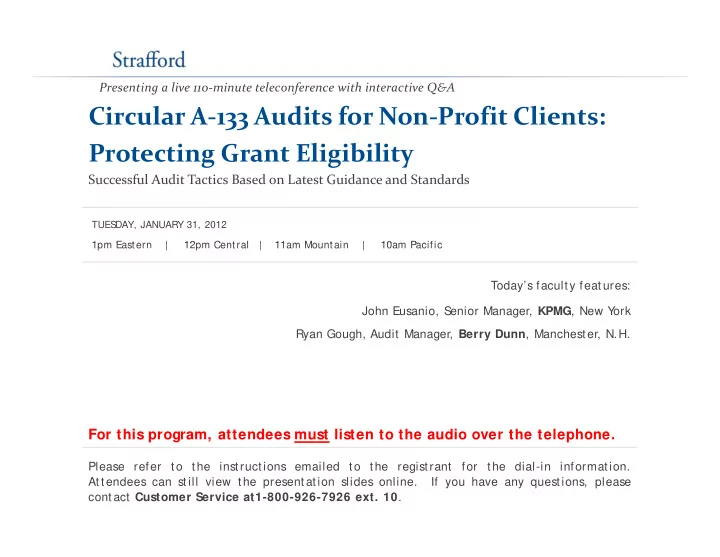
Presenting a live 110 minute teleconference with interactive Q&A Circular A 133 Audits for Non Profit Clients: Protecting Grant Eligibility Successful Audit Tactics Based on Latest Guidance and Standards TUES DAY, JANUARY 31, 2012


slide-1
SLIDE 1

Presenting a live 110‐minute teleconference with interactive Q&A

Circular A‐133 Audits for Non‐Profit Clients: Protecting Grant Eligibility

Successful Audit Tactics Based on Latest Guidance and Standards

1pm Eastern | 12pm Central | 11am Mountain | 10am Pacific TUES DAY, JANUARY 31, 2012

Today’s faculty features:

1pm Eastern | 12pm Central | 11am Mountain | 10am Pacific

John Eusanio S enior Manager KPMG New Y

  • rk

John Eusanio, S enior Manager, KPMG, New Y

  • rk

Ryan Gough, Audit Manager, Berry Dunn, Manchester, N.H.

For this program, attendees must listen to the audio over the telephone.

Please refer to the instructions emailed to the registrant for the dial-in information. Attendees can still view the presentation slides online. If you have any questions, please contact Customer Service at1-800-926-7926 ext. 10.

slide-2
SLIDE 2

Conference Materials

If you have not printed the conference materials for this program, please complete the following steps:

  • Click on the + sign next to “ Conference Materials” in the middle of the left-

hand column on your screen hand column on your screen.

  • Click on the tab labeled “ Handouts” that appears, and there you will see a

PDF of the slides for today's program.

  • Double click on the PDF and a separate page will open.

Double click on the PDF and a separate page will open.

  • Print the slides by clicking on the printer icon.
slide-3
SLIDE 3

Continuing Education Credits

FOR LIVE EVENT ONLY

Attendees must listen to the audio over the telephone. Attendees can still view the presentation slides online but there is no online audio for this program. Attendees must stay on the line for at least 100 minutes in order to qualify for a full 2 credits of CPE. Attendance is monitored as required by NAS BA. Please refer to the instructions emailed to the registrant for additional

  • information. If you have any questions, please contact Customer Service

at 1-800-926-7926 ext. 10. at 1 800 926 7926 ext. 10.

slide-4
SLIDE 4

Tips for Optimal Quality

S d Q lit S

  • und Qualit y

For this program, you must listen via the telephone by dialing 1-866-873-1442 and entering your PIN when prompted. There will be no sound over the web connection. co ect o . If you dialed in and have any difficulties during the call, press *0 for assistance. Y

  • u may also send us a chat or e-mail sound@straffordpub.com immediately so

we can address the problem. Viewing Qualit y To maximize your screen, press the F11 key on your keyboard. To exit full screen, press the F11 key again press the F11 key again.

slide-5
SLIDE 5

Circular A‐133 Audits for Non‐Profit Cli t P t ti G t Eli ibilit Clients: Protecting Grant Eligibility Seminar

  • Jan. 31, 2012

Ryan Gough, BerryDunn John Eusanio, KPMG y g , y rgough@berrydunn.com , jeusanio@kpmg.com

slide-6
SLIDE 6

Today’s Program

Review Of Circular A-133 And Related Guidance [John Eusanio] S lide 7 – S lide 29 S ingle Audits, And What To Expect From Auditors [Ryan Gough] S lide 30 – S lide 37 Experiences With, Recommendations For Circular A-133 Audits [Ryan Gough] S lide 38 – S lide 45

slide-7
SLIDE 7

REVIEW OF CIRCULAR A 133

John Eusanio, KPMG

REVIEW OF CIRCULAR A‐133 AND RELATED GUIDANCE

slide-8
SLIDE 8

Si l A di A Single Audit Act

1. S ingle Audit Act (S AA) – 1984

  • Created a single, organization-wide financial and compliance audit

for state and local entities receiving in excess of $100,000 a year in federal funds

  • The S

AA had four maj or purposes:

  • Promote efficient and effective use of audit resources
  • Establish uniform requirements for audits of federal funds

Establish uniform requirements for audits of federal funds

  • Ensure that federal funds are audited in accordance with the

S AA

  • Improve S

&L financial management of federally funded

  • Improve S

&L financial management of federally funded programs

  • The 1984 S

AA did not include colleges, universities and other not- for-profit organizations receiving federal funds. for profit organizations receiving federal funds.

8

slide-9
SLIDE 9

Si l A di A (C ) Single Audit Act (Cont.)

1. S ingle Audit Act Amendment – 1996

  • In July 1996, Congress enacted the S

ingle Audit Act amendments of 1996, which replaced the S ingle Audit Act of 1984.

  • S

treamline and improve the effectiveness of audits of federal awards and simplify reporting requirements

  • These goals were achieved, in part, by increasing the dollar threshold for

performing a single or program-specific audit and introducing risk-based program selection criteria for maj or program program selection criteria for maj or program. 2. S ingle Audit Act amendment - 2003

  • Raised the dollar threshold for requirement of a single audit to $500,000
  • r more in expenditures in an entity’s fiscal year
  • r more in expenditures in an entity s fiscal year
  • Raised the dollar threshold for OMB designation of a federal cognizant

agency from $25 million to $50 million in expenditures per entity fiscal year

  • Allowed federal agencies flexibility to exchange federal oversight agency

responsibilities

9

slide-10
SLIDE 10

A di R ibili i Auditee Responsibilities

I. Identify, in its accounts, all federal awards received and expended and the federal programs under which they were received. Federal program and award identification shall include, as applicable, the CFDA title and number, award number and year, name of the federal agency, and name of the pass-through entity. II Maintain internal control over federal programs that provides reasonable assurance II. Maintain internal control over federal programs that provides reasonable assurance that the auditee is managing federal awards in compliance with laws, regulations and the provisions of contracts or grant agreements that could have a material effect on each of its federal programs III. Comply with laws, regulations and the provisions of contracts or grant agreements related to each of its federal programs IV. Prepare appropriate financial statements, including the schedule of expenditures f f d l d

  • f federal awards

V. Ensure that the audits required are properly performed and submitted when due VI. Follow up and take corrective action on audit findings, including preparation of a summary schedule of prior audit findings and a corrective action plan summary schedule of prior audit findings and a corrective action plan

10

slide-11
SLIDE 11

A di R ibili i Auditor Responsibilities

I The auditor shall determine whether the financial statements of the I. The auditor shall determine whether the financial statements of the auditee are presented fairly in all material respects and in conformity with generally accepted accounting principles. II The auditor shall also determine whether the schedule of II. The auditor shall also determine whether the schedule of expenditures of federal awards is presented fairly in all material respects, in relation to the auditee's financial statements taken as a whole whole.

  • III. The auditor shall perform procedures to obtain an understanding of

internal control over federal programs sufficient to plan the audit to support a low assessed level of control risk for maj or programs support a low assessed level of control risk for maj or programs.

  • IV. The auditor shall determine whether the auditee has complied with

laws, regulations and the provisions of contracts or grant agreements th t h di t d t i l ff t h f it j that may have a direct and material effect on each of its maj or programs.

11

slide-12
SLIDE 12

E i i S bj T A A di Entities Subject To A‐133 Audit

  • A. An entity is subj ect to an A-133 Audit if it spends U.S

. $500,000 or more in federal awards

  • S

tates and local governments S tates and local governments

  • Non-profit organizations
  • Higher education institutions

g

  • Hospitals
  • B. Amount of federal awards expended is the basis for

determining if A-133 audit is required

12

slide-13
SLIDE 13

Determining When A Federal Award Is Expended g p

 When the expenditure/expense transaction occurs

Grants, cost‐reimbursement contracts, cooperative agreements and direct appropriations

 Generally, when the loan proceeds are disbursed (lender) or received (borrower), plus any

Loans and loan guarantees

interest subsidy, cash or administrative cost allowance received

Property, including donated surplus property

  • When the property is received. The amount considered to be expended is the fair market

value of the donated property at the time of receipt or the assessed value provided by the federal agency.

 When the disbursement is made by the pass‐through entity

Amounts passed through to sub‐recipients

13

slide-14
SLIDE 14

l l OMB 2011 Compliance Supplement

1. Updated Part 3 I, Procurement and S uspension and p , p Debarment, to include additional information on international agreements and the Buy-American Act 2. Updated Part 3 L, Reporting to: 2. Updated Part 3 L, Reporting to: a. Add Federal Funding Accountability and Transparency Act (FF ATA) b. Provide transitional guidance for moving from use of S F 269, Financial S t at us Report , and S F 272, Federal Cash Transact ions Report , to use of S F-425, Federal Financial R t Report c. Clarify 1512 reporting issue i. Using estimates okay; must make corrections g y; ii. Using lag methodology is not appropriate.

14

slide-15
SLIDE 15

OMB 2011 Compliance Supplement (Cont.)

1. Updated Part 4 to: a. Add 19 new programs (some Recovery Act-specific), delete two programs, add five new programs to clusters (some Recovery Act- specific) b. Make numerous changes to existing programs b. Make numerous changes to existing programs 2. Updated Part 5 to make numerous changes to student financial assistance 3. Updated Appendix 3, Federal Agency Cont act s for A-133 Audit s, to: a Add new table to provide contact information by federal program a. Add new table to provide contact information by federal program b. Provide up-to-date contact informat ion for each agency single audit

  • coordinator. It is also available at Federal Audit Clearinghouse Web site

at: https:/ / harvester.census.gov/ fac/ imagemgmt/ NS ACContactList.pdf . 4. Updated Appendix 7, Ot her OMB Circular A-133 Advisories, to include: a. List of Recovery Act programs not covered by Parts 4 or 5 subj ect to a single audit b Li f R A bj i l di b. List of Recovery Act programs not subj ect to single audit

15

slide-16
SLIDE 16

Federal Funding Accountability And Transparency Act (FFATA)

1. New required federal award reporting process (similar to Recovery Act 1512 reporting): www.US AS pending.gov 2. Extends to non-Recovery Act federal awards (including grants and sub-grants) and federal contracts a. Beginning 10/ 1/ 2010, prime grant awardees of federal grants of $25K or more must report “ first-tier” sub- g $ p grants of $25K or more by end of month following the month sub-award or obligation made. 3 Indication in each program section in Part 4 as to whether 3. Indication in each program section in Part 4 as to whether reporting under FF ATA applies 4. When awards contain both Recovery Act and non-Recovery Act funding an indication that FF ATA only applies to the Act funding, an indication that FF ATA only applies to the non-Recovery Act funding

16

slide-17
SLIDE 17

Federal Funding Accountability And Transparency Act (FFATA) – Required p y ( ) q Data Elements

1. Name of the entity receiving the award 2. Amount of the award 3 Information on the award including transaction type 3. Information on the award including transaction type, funding agency, NAIC system code or Catalog of Federal Domestic Assistance number, program income, and an award title descriptive of the purpose of each funding action p p p g 4. Location of the entity receiving and the primary location of performance under the award including the city, state, congressional district and country congressional district and country 5. DUNS number of the entity receiving the award and of the parent entity of the recipient, should the entity be owned by another entity by another entity

17

slide-18
SLIDE 18

Federal Funding Accountability And Transparency Act (FFATA) – Required p y ( ) q Data Elements (Cont.)

1. The names and total compensation of the five most highly compensated officers of the entity if: a In the prior fiscal year the entity received: a. In the prior fiscal year, the entity received: i. 80%

  • r more of the entity’s annual gross

revenues in federal awards

  • ii. $25 million or more of its annual gross

revenues from federal awards iii The public does not have information about

  • iii. The public does not have information about

the compensation of the senior executives from another source (S EC or IRS ).

18

slide-19
SLIDE 19

Federal Funding Accountability And Transparency Act (FFATA) – Data p y ( ) Elements Subject To Testing

1. S ub-award date 2. S ub-awardee DUNS # 3 A t f b d 3. Amount of sub-award 4. S ub-award obligation/ action date (date agreement was signed) g ) 5. Date of report submission 6. S ub-award number 7. Auditors do not need to test executive compensation.

19

slide-20
SLIDE 20

Recovery Act … It’s Not Over Until It’s Over!

1. Continued Recovery Act implications a. Maj or program determination b M f d l f ll fi di b. More federal agency follow-up on findings c. More quality control reviews d Recovery Act Transparency Board (RATB) d. Recovery Act Transparency Board (RATB) monitoring activity and looking for fraud, waste and abuse e. Much more interest in single audits by federal agencies and Congress

20

slide-21
SLIDE 21

American Recovery And Reinvestment Act Of 2009

I Effect of recovery act awards on maj or program determination I. Effect of recovery act awards on maj or program determination 1. Clusters of programs specifically listed in the supplement with a new Recovery Act CFDA number added during the current year that also has current year expenditures, should be considered a new y p , program and would not qualify as a low-risk Type A program. a. Would fail the two-year look-back rule b. R&D and S F A clusters are not subj ect to this guidance. b. R&D and S F A clusters are not subj ect to this guidance. 2. Although a Type A program otherwise meets the Circular A-133 criteria as low-risk, any program or cluster (excluding S F A) with expenditures of Recovery Act awards would not qualify as a low-risk Type A . a. Even a de minimis amount of Recovery Act expenditures would not support identifying the program as low-risk. b. S ee next slide for exception

21

slide-22
SLIDE 22

Effect Of Recovery Act Awards On Major Program Determination

However, the auditor may consider a Type A program or clustor to be low‐risk if all of the following conditions are met: (1) Program or cluster had ARRA expenditures in the prior audit period. (2) Program or cluster was audited as a major program in the prior audit period. (3) ARRA expenditures in the current audit period are less than 20% of the total program or (3) ARRA expenditures in the current audit period are less than 20% of the total program or cluster expenditure. (4) Auditor has followed sections 520(c) and 525 of OMB Circular A‐133 and determined that the program or cluster is otherwise low‐risk the program or cluster is otherwise low risk.

22

slide-23
SLIDE 23

American Recovery And Reinvestment Act Of 2009 (Cont.)

I. Effect of recovery act awards on Type B programs 1. All Type B programs and clusters with Recovery Act expenditures to be considered higher-risk expenditures to be considered higher risk 2. However, not precluded from selecting Type B programs with no Recovery Act expenditures in lieu of a Type B program or cluster with Recovery Act expenditures

23

slide-24
SLIDE 24

ARRA S R i ARRA – Sect. 1512 Reporting

1. Common findings identified in 2010 audits a. Reporting a period of time inconsistent with reporting period (best available information reporting period (best available information concept) b. Amounts reported did not agree to supporting documentation c. Amounts reported were not consistent with other financial reports financial reports d. Untimely submission of reports

24

slide-25
SLIDE 25

Late Filings And Low‐Risk Auditee Status

1. Agencies were instructed last year not to grant any extension requests from grantees. 2 Late filings of Circular A-133 audits in either of the 2. Late filings of Circular A 133 audits in either of the prior two years will preclude low-risk auditee status in the current year. 3. Compliance S upplement explains how auditor determines when Circular A-133 audits were filed for previous years.

25

slide-26
SLIDE 26

d d d 2011 Government Auditing Standards

1 Purpose of revisions 1. Purpose of revisions a. Promote modernization of auditing standards b. S treamline with standard-setters c. Address issue GAO has observed d. Respond to needs of the auditing community 2. Revisions to independence a. New framework combines rules (prohibitions) with a conceptual framework i. Generally consistent with IF AC and AICP A y b. Certain prohibitions remain i. Generally consistent with Rule 101 AICP A B d hibiti c. Beyond a prohibition i. Apply the conception framework

26

slide-27
SLIDE 27

2011 Government Auditing Standards (Cont.)

1. Changes for field work (performance) and reporting a. Considered clarity proj ect conventions b. S treamlines language to harmonize with AICP A c. Clarified additive requirements d. No new field work or requirements were added for GAGAS engagements 2. Removed duplicative requirements: a. Financial audits i. Restatements ii. Internal control deficiency definitions ii. Internal control deficiency definitions iii. Communication of significant matters iv. Consideration of fraud and illegal acts b Attestation engagements b. Attestation engagements i. Internal control deficiency definitions

27

slide-28
SLIDE 28

L ki F d Looking Forward

1. Findings working group output 2. Continued effects from Recovery Act 3 S d ti 3. S uper group recommendations 4. Changes to single audit rules? a Threshold a. Threshold b. Compliance requirements c. Timing c. Timing

28

slide-29
SLIDE 29

Other Federal Agency Efforts Relating To g y g For‐Profit Entities – A New Trend

1 Department of Energy audit guide 1. Department of Energy audit guide 2. Department of Commerce broadband technology opportunities program, program-specific guide 3 Department of Education 3. Department of Education a. Lender compliance attestation guide for lenders holding federal family education loans b Lender ser icer financial statement a dit and compliance b. Lender servicer financial statement audit and compliance attestation guide for lender servicers that service federal family education loans 4 Department of Agriculture 4. Department of Agriculture a. Rural Utilities S ervice (broadband) 5. HUD a. Extension of HUD guide to supervised mortgagees b. Modifying HUD guide; Chap. 1 revised recently

29

slide-30
SLIDE 30

SINGLE AUDITS AND WHAT

Ryan Gough, BerryDunn

SINGLE AUDITS, AND WHAT TO EXPECT FROM AUDITORS

slide-31
SLIDE 31

Agenda For This Section Agenda For This Section

  • Single audits and what to expect from your auditor

g p y – Pre-audit expectations – Audit fieldwork expectations – Post-audit expectations

GAIN CONTROL

31

slide-32
SLIDE 32

Pre-Audit Expectations

  • Initial requests and communication

– Timing of compliance audit – Request of an interim Schedule of Expenditures of Federal Awards (SEFA), including q p ( ), g Catalog of Federal Domestic Assistance (CFDA) numbers – Determination of whether the auditee is a low-risk or high-risk auditee

  • In compliance with all of the following for the previous two years:

– Single audits were performed. g p – Unqualified opinion on the SEFA – No material weaknesses were identified on the internal controls over financial reporting (i.e. Yellow Book findings). – No compliance findings p g – Reporting package and data collection form were submitted to the Federal Audit Clearinghouse by the due date. – Determination of awards to be tested

  • Auditee must have expended more than $500K in federal awards in order to

ud ee us a e e pe ded

  • e

a $500 ede a a a ds

  • de
  • qualify for an A-133 audit.
  • Type A grant: Organizations with $10M in total grant dollars and with individual

grant programs incurring expenditures greater than $300K during the fiscal year

  • Type B grant: Those grants that have expended greater than $100K but less than

GAIN CONTROL

32

$300K

slide-33
SLIDE 33

Pre-Audit Expectations (Cont.)

  • Initial requests and communication (Cont.)

– Request of selected grant agreements – Review of Office of Management and Budget (OMB) circulars, to identify the applicable 14 compliance requirements associated with selected grants

  • Part II: Compliance matrix
  • Part III: Compliance requirements
  • Part IV: Program objectives and suggested audit procedures
  • Part V: Compliance supplement for cluster programs (i.e., student financial aid

cluster)

  • Other

– Request of detail expenditures associated with selected grants – Sample selection(s) is(are) made on selected grants

  • Multiple samples are likely to be required based on frequency and compliance

requirement.

  • Internal control sample will be required, too, as auditors are required to plan for a

low- control risk associated with A-133 audits. – Inquiries with management, finance and compliance employees to gain an understanding on controls implemented to adhere to compliance. P t VI I t l t l GAIN CONTROL

33

  • Part VI: Internal controls
slide-34
SLIDE 34

Audit Fieldwork Expectations

  • Testing and more inquires

– Request of final SEFA

  • Determination if there have been any changes to SEFA received at
  • Determination if there have been any changes to SEFA received at

interim – Sample selection(s) provided – Request for supporting evidence on expenditures, reporting, procurement and other compliance requirements

  • Should be able to provide supporting documents with evidence of

proper approval – If federal funds were used for capital purchases additional testing needed: If federal funds were used for capital purchases, additional testing needed:

  • Proper inventory policies are enacted and implemented.
  • Bi-annual capital asset inventory count for proper tracking
  • If, in years when assets are sold (and which were initially purchased

with federal funds), a portion of the gain should be refunded back to the government – Communication of potential findings during testing and inquiries with management

GAIN CONTROL

34

g

slide-35
SLIDE 35

Audit Fieldwork Expectations (Cont.)

  • Finding types

– Government audit standards/Yellow Book

  • Finding related to the internal control over financial

reporting or non compliance with laws regulations reporting or non-compliance with laws, regulations, contracts or grants agreements, which could have a direct and material effect on the financial statements OMB Circular A 133 – OMB Circular A-133

  • Finding related to the internal controls over compliance
  • r non-compliance of major programs, which could have

a direct and material effect on each major program a direct and material effect on each major program

GAIN CONTROL

35

slide-36
SLIDE 36

Post-Audit Expectations

  • Reporting and communication of results

– Preparation of the A-133 reports

  • Two independent auditors’ reports

– Internal control over financial reporting and on compliance and other matters based on an audit of financial statements performed in accordance with Government Auditing Standards » No opinion is issued on the internal control over financial reporting or compliance of laws regulations contracts and grant agreements; only an compliance of laws, regulations, contracts and grant agreements; only an understanding is gained. – Compliance with requirements that could have a direct and material effect on each major program and on internal control over compliance, in accordance with OMB Circular A-133 » Opinion is issued on the compliance requirements on the auditee’s major programs. » Opinion is issued on the SEFA regarding, if it is fairly stated. » No opinion on the internal controls over compliance; only gain an understanding understanding

  • Client prepared SEFA and accompanying footnotes

– Basic footnotes » Basis of presentation » Summary of significant accounting policies

GAIN CONTROL

36

y g g p » Specific footnotes can be required regarding major programs

  • Current findings and status of prior-year findings, if any
slide-37
SLIDE 37

Post-Audit Expectations (Cont.)

  • Reporting and communication of results (Cont.)

– Preparation of the auditee’s data collection form (DCF) – Preparation of the auditee s data collection form (DCF)

  • Online submission of the financial statements and A-133

Report to the Federal Audit Clearinghouse https://harvester census gov/fac/collect/ddeindex html

  • https://harvester.census.gov/fac/collect/ddeindex.html
  • DCF should mirror the A-133 report.
  • Best practice is to prepare the DCF simultaneously with

the A-133 report

  • Certification of the DCF

– Auditor and auditee Given the availability of online resources, virtually nothing should be a surprise.

GAIN CONTROL

37

slide-38
SLIDE 38

EXPERIENCES WITH,

Ryan Gough, BerryDunn

, RECOMMENDATIONS FOR CIRCULAR A 133 AUDITS CIRCULAR A‐133 AUDITS

slide-39
SLIDE 39

Agenda For This Section Agenda For This Section

  • Experiences and recommendations for effective

p OMB Circular A-133 Audits – Evaluating internal controls Reviewing terms of awards – Reviewing terms of awards – Preparation of the Schedule of Expenditures of Federal Awards R d t ti – Records retention – Corrective actions

GAIN CONTROL

39

slide-40
SLIDE 40

Evaluating Internal Controls

  • Experiences

– No evidence of properly documented review – Lack of segregation of duties – Lack of proper procurement and bidding policies

  • Recommendations

G i d t di f P t VI d tili thi l t t d t i – Gain an understanding of Part VI and utilize this supplement to determine, develop and implement best practices for solid and efficient controls – As internal processes become more automated, with fewer procedures performed on printed documents, achievement of proper documented review can be attained by:

  • Developing regular checklists on procedures performed
  • E-mail notifications
  • Other steps
  • Other steps

– To increase segregation of duties, auditee should consider expanding employee involvement to include employees outside of the Finance Department.

GAIN CONTROL

40

– Properly implement a bidding and procurement policy

slide-41
SLIDE 41

Reviewing Grant Terms

  • Experiences

– Auditee occasionally lacks the knowledge or understanding of the compliance requirements associated with applicable grants. – Exclusion of federal pass-through money due to the auditee, assuming no federal funds were associated with the state grant

  • Recommendations

Recommendations – Gain an understanding of applicable compliance requirements by utilizing the following:

  • OMB circular Web site: www.whitehouse.gov/OMB/circulars
  • CFDA Web site: www.cfda.gov

– Gain an understanding of all agreements, federal or state

  • All grant agreements must be reviewed to determine if federal money is

indirectly received by the auditee and must be included as part of the indirectly received by the auditee and must be included as part of the A-133 testing.

  • Federal pass-through money from the state occasionally has specific

compliance or contract requirements set in the grant agreement between the state and auditee not identified or applicable at the federal

GAIN CONTROL

41

between the state and auditee, not identified or applicable at the federal level.

slide-42
SLIDE 42

Reviewing Grant Terms (Cont.)

  • Experiences

– Improper inclusion/exclusion or designation of funding – Improper inclusion/exclusion or designation of funding

  • Recommendations

– Gain an understanding of all agreements, federal or state

  • Must determine if the grant money is funded using ARRA
  • money. If so, additional compliance requirements and

reporting are required. Also must be designated as ARRA funding on the SEFA and the DCF

  • Vendor vs. grantee

GAIN CONTROL

42

slide-43
SLIDE 43

Preparing The SEFA

  • Experiences

– Auditee will prepare a SEFA using the awarded amount and not the expended amount. – Multiple-year grant expenditures are improperly stated on the SEFA. – Improper tracking of expenditures, especially associated with capital purchases purchases – Exclusion of federal pass-through money, due to the auditee assuming no federal funds were associated with the state grant

  • Recommendations

– In a one-year grant agreement where the grant period and the

  • rganization’s fiscal year coincide, it is possible for awarded money to equal
  • expended. However, this is not always the case.

– An auditee must gain an understanding regarding the terms of their grant g g g g g agreement to determine the proper grant period, when expenditures should be recorded and in what grant period to be properly reflected on the SEFA. – A SEFA must include federal or state agency, grant name, CFDA number, grant ID (state funds) and expended amounts Information is all identified

GAIN CONTROL

43

grant ID (state funds) and expended amounts. Information is all identified

  • n the grant agreement; if it is not, contact the applicable granting agency.
slide-44
SLIDE 44

Records Retention

  • Experiences

– Auditee will retain documents far past the required/best practice timeframe.

  • Recommendations

– Adopt and implement a records retention policy, if not already adopted – All grants, depending on agency or type, have different minimum requirements requirements

  • Student financial aid cluster: Typically 3 years
  • Department of Health and Human Services: Varies, but typically 3

years

  • Others, sometimes not identified

– It is a best practice to review the grant agreement or www.cfda.gov to identify records retention requirements. If the auditee feels the grant agreement or CFDA Web site is vague an – If the auditee feels the grant agreement or CFDA Web site is vague, an auditee should refer to the IRS standard requirements for particular items and base retention of the federal taxation guidelines.

  • http://berrydunn.com/resources-detail/document-retention-schedule

GAIN CONTROL

44

slide-45
SLIDE 45

Corrective Actions

  • Experiences

– Auditee has developed a far too vague or far too detailed corrective approach, or is too unsure about the existing issue to understand how to correct the finding at all.

  • Recommendations

– No one understands your organization better than you. However, in instances of non-compliance or financial reporting findings, an auditee is best suited to have discussions with the auditor. P d t d/ d t il d ti – Pros and cons to vague and/or detailed actions – Auditee is best apt to develop a corrective action that will get to the root of the finding and correct in subsequent compliance audits Auditee should follow the correct action to the best of their ability or

GAIN CONTROL

45

– Auditee should follow the correct action to the best of their ability, or the finding in question could be a finding again.