Non-Profits Receiving Grants Preparing for Audits and Protecting - - PowerPoint PPT Presentation

non profits receiving grants
SMART_READER_LITE
LIVE PREVIEW

Non-Profits Receiving Grants Preparing for Audits and Protecting - - PowerPoint PPT Presentation

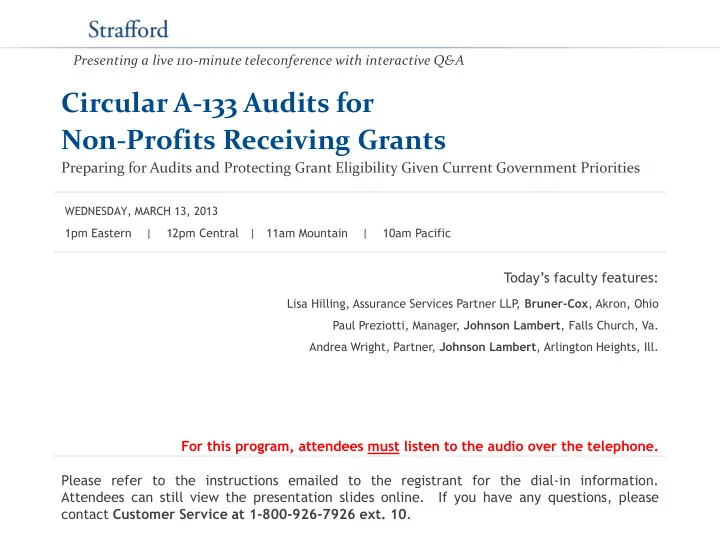
Presenting a live 110-minute teleconference with interactive Q&A Circular A-133 Audits for Non-Profits Receiving Grants Preparing for Audits and Protecting Grant Eligibility Given Current Government Priorities WEDNESDAY, MARCH 13, 2013 1pm


slide-1
SLIDE 1

Circular A-133 Audits for Non-Profits Receiving Grants

Preparing for Audits and Protecting Grant Eligibility Given Current Government Priorities

Today’s faculty features:

1pm Eastern | 12pm Central | 11am Mountain | 10am Pacific

Please refer to the instructions emailed to the registrant for the dial-in information. Attendees can still view the presentation slides online. If you have any questions, please contact Customer Service at 1-800-926-7926 ext. 10.

WEDNESDAY, MARCH 13, 2013

Presenting a live 110-minute teleconference with interactive Q&A

Lisa Hilling, Assurance Services Partner LLP , Bruner-Cox, Akron, Ohio Paul Preziotti, Manager, Johnson Lambert, Falls Church, Va. Andrea Wright, Partner, Johnson Lambert, Arlington Heights, Ill.

For this program, attendees must listen to the audio over the telephone.

slide-2
SLIDE 2

Tips for Optimal Quality

Sound Quality Call in on the telephone by dialing 1-866-570-7602 and enter your PIN when prompted. If you have any difficulties during the call, press *0 for assistance. You may also send us a chat or e-mail sound@straffordpub.com immediately so we can address the problem. Viewing Quality To maximize your screen, press the F11 key on your keyboard. To exit full screen, press the F11 key again.

slide-3
SLIDE 3

Continuing Education Credits

Attendees must stay on the line throughout the program, including the Q & A session, in order to qualify for full continuing education credits. Strafford is required to monitor attendance. Record verification codes presented throughout the seminar. If you have not printed out the “Official Record of Attendance,” please print it now (see “Handouts” tab in “Conference Materials” box on left-hand side of your computer screen). To earn Continuing Education credits, you must write down the verification codes in the corresponding spaces found on the Official Record of Attendance form. Please refer to the instructions emailed to the registrant for additional

  • information. If you have any questions, please contact Customer Service

at 1-800-926-7926 ext. 10.

FOR LIVE EVENT ONLY

slide-4
SLIDE 4

Program Materials

If you have not printed the conference materials for this program, please complete the following steps:

  • Click on the + sign next to “Conference Materials” in the middle of the left-

hand column on your screen.

  • Click on the tab labeled “Handouts” that appears, and there you will see a

PDF of the slides and the Official Record of Attendance for today's program.

  • Double-click on the PDF and a separate page will open.
  • Print the slides by clicking on the printer icon.
slide-5
SLIDE 5

Circular A-133 Audits for Non-Profits Receiving Grants Seminar

Angela Wright, Johnson Lambert awright@johnsonlambert.com March 13, 2013 Paul Preziotti, Johnson Lambert ppreziotti@johnsonlambert.com Lisa Hilling, Bruner-Cox LLP lisa.hilling@brunercox.com

slide-6
SLIDE 6

Today’s Program

Overview Of Circular A-133, Related Laws And Guidance [Andrea Wright and Paul Preziotti] Experiences With Single Audits [Lisa Hilling, Andrea Wright and Paul Preziotti] Leading Issues For Auditees To Anticipate [Paul Preziotti, Andrea Wright and Lisa Hilling] Slide 8 – Slide 23 Slide 24 – Slide 37 Slide 38 – Slide 40

slide-7
SLIDE 7

Notice

ANY TAX ADVICE IN THIS COMMUNICATION IS NOT INTENDED OR WRITTEN BY THE SPEAKERS’ FIRMS TO BE USED, AND CANNOT BE USED, BY A CLIENT OR ANY OTHER PERSON OR ENTITY FOR THE PURPOSE OF (i) AVOIDING PENALTIES THAT MAY BE IMPOSED ON ANY TAXPAYER OR (ii) PROMOTING, MARKETING OR RECOMMENDING TO ANOTHER PARTY ANY MATTERS ADDRESSED HEREIN.

You (and your employees, representatives, or agents) may disclose to any and all persons, without limitation, the tax treatment or tax structure, or both, of any transaction described in the associated materials we provide to you, including, but not limited to, any tax opinions, memoranda, or other tax analyses contained in those materials. The information contained herein is of a general nature and based on authorities that are subject to change. Applicability of the information to specific situations should be determined through consultation with your tax adviser.

7

slide-8
SLIDE 8

OVERVIEW OF CIRCULAR A- 133, RELATED LAWS AND GUIDANCE

Andrea Wright, Johnson Lambert Paul Preziotti, Johnson Lambert

slide-9
SLIDE 9

Background

  • Single audit, AKA A-133 audit
  • Audits of entities that expend $500,000 or more in federal funds
  • Objective: To provide assurance that recipients are managing federal

awards appropriately and in accordance with program requirements

9

slide-10
SLIDE 10

Ways To Receive Federal Funds

Non-Profit Organization Federal Agency State Agency Non-Profit Organization

10

slide-11
SLIDE 11

Single Audit Changes In 2012

  • AICPA clarity standards
  • Yellow Book independence
  • Compliance supplement

11

slide-12
SLIDE 12

AICPA Clarity Standards

  • Effective for audit periods ending on or after Dec. 15, 2012
  • Specific sections related to compliance audits
  • Experts analyzing effects of group audit standards in relation to

compliance audits

  • New wording in opinions related to compliance audits

12

slide-13
SLIDE 13

Independence Under Yellow Book

  • Defines independence of mind and in appearance
  • Requires new documentation for auditors

– Identify non-audit services – Determine if prohibited – Evaluate and document skill, knowledge, experience – Assess whether threats are significant – Identify and apply safeguards

13

slide-14
SLIDE 14

Non-Audit Services

  • Financial statement preparation, including footnote preparation
  • Preparation of Form 990
  • Bookkeeping services

– Cash-to-accrual adjustments

14

slide-15
SLIDE 15

Non-Audit Services: Prohibited

  • Management responsibilities

– Leading and directing the organization – Control over human, physical and intangible resources

  • Assuming management responsibilities impair independence; there

are no safeguards to eliminate or reduce threats

15

slide-16
SLIDE 16

2012 A-133 Compliance Supplement: Key Points

  • Updates to ARRA high-risk determination (Appendix VII)
  • FFATA reporting
  • Sub-recipient monitoring
  • Other minor administrative changes
  • Full list of changes at www.whitehouse.gov/omb/circulars/A-

133_compliance_supplement_2012

16

slide-17
SLIDE 17

Appendix VII

  • Effect of Recovery Act awards on major program determination
  • Lists Recovery Act awards not covered in Parts 4 or 5 but that could

be subject to a single audit, and the list of Recovery Act awards that are NOT subject to single audit

  • Late-filing and low-risk auditee (no waivers)
  • Treatment of large loan and loan guarantee programs

17

slide-18
SLIDE 18

What Is FFATA?

  • Federal Funding Accountability and Transparency Act of 2006
  • Federal award reporting requirement for all direct recipients of non-

Recovery Act awards

  • Direct recipients required to report certain first-tier sub-awards
  • Became effective in October 2011
  • Q&A incorporated in compliance supplement

18

slide-19
SLIDE 19

Proposed Changes To OMB Circular A-133

  • Issued Jan. 31 by the U.S. Office of Management and Budget (OMB)
  • Proposes broad revisions to OMB Circular A-133
  • Also includes a number of other key grant reforms

19

slide-20
SLIDE 20

Slide Intentionally Left Blank

slide-21
SLIDE 21

Increase In Single Audit Threshold

  • Entities that expend less than $750,000 in federal awards would not

be required to undergo a single audit.

  • Represents an increase from the current $500,000 threshold, which

was established in 2003

21

slide-22
SLIDE 22

Proposed Auditing Changes

  • Affect what programs your auditors are required to audit
  • Change in Type A/B program determination
  • Percentage of coverage changes
  • Criteria for low-risk auditee status
  • Increased reporting surrounding findings

22

slide-23
SLIDE 23

Other Proposed Changes

  • Consolidation of cost principles into a single document, in order to

avoid variations of application

  • Changes to indirect costs
  • Potential alternatives to time and expense reporting for salaries and

wages

23

slide-24
SLIDE 24

EXPERIENCES WITH SINGLE AUDITS

Lisa Hilling, Bruner-Cox LLP Andrea Wright, Johnson Lambert Paul Preziotti, Johnson Lambert

slide-25
SLIDE 25

Pre Audit: Auditee’s Responsibilities And Best Practices

  • Ask for a “PBC” list
  • Provided by auditor
  • Shows what documents will be needed from you
  • Begin gathering information sooner vs. later
  • Know your funding sources
  • Federal dollars may be hidden.
  • Is the program considered high-risk?
  • Engage your grant writer
  • Can be a great resource for ensuring all programs are

accounted for

  • Aware of program requirements

25

slide-26
SLIDE 26

Pre Audit: Auditee’s Responsibilities And Best Practices (Cont.)

  • Know the history of the federal funds
  • Investigate whether they are new to your entity
  • Have they been tested by your auditors in the past?
  • Review OMB Web site
  • http://www.whitehouse.gov/omb
  • Provides a wealth of information on each program
  • Can provide insights into what the federal government is

looking for

26

slide-27
SLIDE 27

Slide Intentionally Left Blank

slide-28
SLIDE 28

Pre Audit: Auditor’s Responsibilities And Best Practices

  • Review prior-year SEFA
  • Communicate with clients
  • Review GAQC Web site

http://www.aicpa.org/InterestAreas/GovernmentalAuditQuality

  • Obtain contracts and compliance supplement from OMB Web

site to plan/design tests

28

slide-29
SLIDE 29

Fieldwork: Auditee’s Responsibility

  • Identify all federal awards expended and the related programs (be

mindful of clusters) – CFDA numbers /program numbers/pass-through entities – Federal funds include: Loans and loan guarantees, if there are continuing compliance requirements, food commodities, program income

  • Maintain internal control over programs and ensure compliance
  • Comply with laws and contract regulations

29

slide-30
SLIDE 30

Fieldwork: Auditee’s Responsibility (Cont.)

  • Sub-recipient or vendor documentation
  • Monitoring sub-awardees
  • Submitting timely financial reports

30

slide-31
SLIDE 31

Filing Of Data Collection Form

  • Responsibility of the auditee after the audit has been completed
  • Internet data entry System (IDES) allows you to print out a draft

version before filing

31

slide-32
SLIDE 32

Post-Audit Data Collection Form – Part I

  • General information
  • Completed by both auditee and auditor
  • Check EIN, DUNS and check-boxes for clerical accuracy
  • Secondary information – when is this required?

32

slide-33
SLIDE 33

Slide Intentionally Left Blank

slide-34
SLIDE 34

Post-Audit Data Collection Form – Part II

  • Financial statements – completed by auditor
  • Type of audit report
  • Disclosure of going concern, internal control and material non-

compliance, if any.

34

slide-35
SLIDE 35

Post-Audit Data Collection Form – Part III

  • Disclosure surrounding dollar threshold to distinguish Type A/B

programs

  • Low-risk auditee status
  • Federal awards expended during fiscal year
  • All of this information should match the audit report EXACTLY.

35

slide-36
SLIDE 36

Submission Process

  • Auditor and auditee both required to electronically sign
  • You will receive an e-mail when submission is received and when the

Federal Audit Clearinghouse (FAC) has processed the report.

36

slide-37
SLIDE 37

Slide Intentionally Left Blank

slide-38
SLIDE 38

LEADING ISSUES FOR AUDITEES TO ANTICIPATE

Paul Preziotti, Johnson Lambert Andrea Wright, Johnson Lambert Lisa Hilling, Bruner-Cox LLP

slide-39
SLIDE 39

Top Five Takeaways: Auditee

  • Include all sources of federal funds on SEFA, whether direct or

indirect

  • Obtain CFDA numbers from funding source

a) It is their responsibility to inform you that you are receiving federal funds.

  • File data collection form timely

a) Not submitted is not filed

  • Stay informed
  • ASK QUESTIONS

39

slide-40
SLIDE 40

Top Five Takeaways: Auditor

  • Check and double-check major program determination, especially if

there are adjustments

  • Look out for clusters
  • Review low-risk auditee criteria (no waivers for late filers)
  • Independence considerations
  • Document, document, document

40