
SLIDE 1
1
Circuits revision
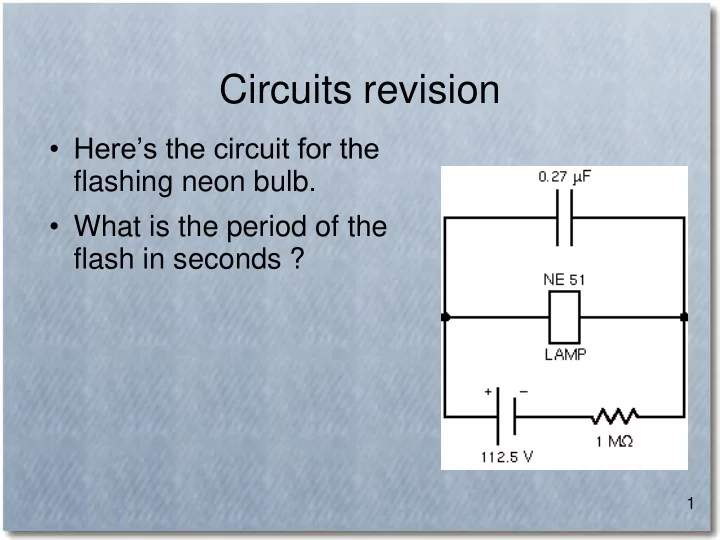
- Here’s the circuit for the
flashing neon bulb.
- What is the period of the
flash in seconds ?
Circuits revision Heres the circuit for the flashing neon bulb. - - PowerPoint PPT Presentation
Circuits revision Heres the circuit for the flashing neon bulb. What is the period of the flash in seconds ? 1 Magnetic Fields revision Please try problem 15 in Ch 24 on page 825. What is the magnetic field at the center of the
1
Circuits revision
flashing neon bulb.
flash in seconds ?
2
Magnetic Fields revision
Please try problem 15 in Ch 24 on page 825. “What is the magnetic field at the center of the loop….”
3
Magnetic Fields and Forces
4
Magnetism
5
Experimental Observations
does not act on stationary charges
come in pairs
6
Magnetic Field lines
a bar magnet
dipole
terminate at south pole
7
Like and unlike poles
Magnetic field lines between poles
8
Electric Currents and Magnetic Fields
Oersted found that a current can move a magnetic compass
9
Direction of Magnetic field
We use the right handed rule to find which way a magnetic compass would point
10
Magnetic field near a loop
11
Field near a solenoid
the coil
magnetic field
12
Magnetic field due to a current
Experimentally, the field strength, B, is proportional to current, I, and inversely proportional to distance, r. Units of Tesla, where μ0 is the permeability constant – 1.257x10⁻⁶ TmA-1
13
Tesla is a large unit
and maglev trains – 10 T
14
Magnetic Field at the center of a current loop
Inside a loop radius R:
R I B 2
15
Magnetic Field at the center of a current loop with N turns
If the loop has N turns, but its not yet a solenoid we have:
16
Magnetic field inside a solenoid
The uniform field in a solenoid is For a solenoid with N turns, Length L and current I. Note: independent of the coil radius. Field is uniform.
17
Magnetic Forces
around two wires will attract or repel, just like bar magnets.
force on a current, or moving charge
direction attract
18
Direction of Magnetic Force
wire with a current is perpendicular to both the magnetic field the direction of the current.
right hand rule
19
Magnitude of the Magnetic Force
The force between a magnetic field and a current along a wire length L perpendicular to the field is:
20
Magnitude of the Magnetic Force
The force between a magnetic field and a current along a wire length L at an angle, α to the field is: If the current and B field are parallel – there is no force.
21
Force on a moving charge
moving charge.
along the wire length L in time Δt
L/Δt
qv IL L qv t q I t L v
22
Magnitude of the Magnetic Force
The force between a magnetic field and a charge, q, moving with a velocity, v perpendicular to the field is:
23
Magnitude of the Magnetic Force
The force between a magnetic field and a charge, q, moving at velocity, v, at an angle, α to the field is: If the moving charge and B field are parallel – there is no force.
24
Direction of Magnetic Force
charge is perpendicular to both the magnetic field the direction of the charge.
the direction of the +ve charge, instead of the current I.
25
Path of charges in a magnetic field
charged particle in a magnetic field is perpendicular to its direction of motion.
circular or spiral paths of charged paths in a magnetic field
26
Path of charges in a magnetic field
an object in a circle
m RqB v qvB r mv F
2
27
Path of charges in a magnetic field
in an electric field V, the charge to mass ratio can be measured, 2 2 2
2 2 1 R B V m q mv qV E
28
Mass spectrometer
measurement of e/m for the electron
distinguish different types of atoms and isotopes
29
Aurora Borealis
(protons & electrons) gets deflected by Earth’s magnetic field.
perpendicular to the field lines, curves the ionizing particles into spirals
ionosphere
30
Magnetic forces between currents
carrying currents I1 and I2.
is
d I LI F L I B F d I B 2 2
2 1 12 1 2 12 2 2
31
Magnetic forces between currents
From the field from the single wire, we can deduce the force between 2 wires carrying currents I1 and I2 is
wires parallel
2 1
32
Torques and Magnetic Moments
pivot
33
Torque
Torque, τ, measures the effectiveness of a force at causing an
a pivot
34
Torque on a current loop in a B field
uniform field
and bottom wires will rotate the loop
35
Torque on a current loop in a B field
be the sum of the torques on the top and bottom wires.
length W
sin sin 2 2 BIWL L F
36
Torque on a current loop in a B field
a loop area A will be: The loop is forced to align with the magnetic field
37
Using torque - MRIs
Imaging (MRI) uses the protons magnetic moment in hydrogen atoms in high 1T fields.
radio waves from the excited states are detected
38
Using Torque – Electric motor
Using commutators, the loop can be made to spin, to produce rotational movement
39
Permanent Magnets - Ferromagnetism
elements – the ability to maintain a permanent magnetic field
metal
gadolinium, dysprosium, europium
the electrons can align
40
Periodic Table
41
Crystalline structure aligned
dipoles are grouped in micron size crystals, domains
aligned by applying a magnetic field
by heating (Curie point) or dropping
42
Electromagnets
solenoid will align the domains inside the iron
magnetic field (factor of 100)
magnetic field
43
Summary
44
Homework problems
Chapter 24 Problems 20, 21, 31, 41, 48, 53, 56, 57