
SLIDE 1
Dayan Pérez-Quintana 1,2, Alicia Torres-García 1,2, Iñigo Ederra 1,2, Miguel Beruete 1,2
Cir ircula lar Pol
- larization Antennas usi
sing Gap Gap Waveguid ide Technologie ies at t 60 60 GH GHz
1 Department of Electrical, Electronic and Communications Engineering, Public University of Navarra, Spain 2 Institute of Smart Cities (ISC), Public University of Navarra, Navarra, Spain
Introduction Theory Simulation Experimental Results Conclusion
References
[1] Ref. 1 A. Berenguer, V. Fusco, D. E. Zelenchuk, D. Sanchez-Escuderos, M. Baquero-Escudero, and V. E. Boria-Esbert, “Propagation Characteristics of Groove Gap Waveguide Below and Above Cutoff,” IEEE Trans. Microw. Theory Tech., vol. 64, no. 1, pp. 27–36, Jan. 2016. [2] Ref. 2A. U. Zaman and P. Kildal, “Wide-Band Slot Antenna Arrays With Single-Layer Corporate-Feed Network in Ridge Gap Waveguide Technology,” IEEE Trans. Antennas Propag., vol. 62, no. 6, pp. 2992–3001, 2014.
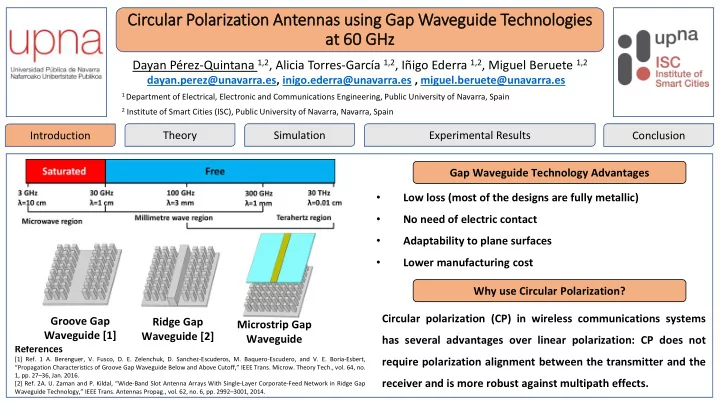
Gap Waveguide Technology Advantages
- Low loss (most of the designs are fully metallic)
- No need of electric contact
- Adaptability to plane surfaces
- Lower manufacturing cost