
SLIDE 1
Cinematic Drone
https://vimeo.com/174064811
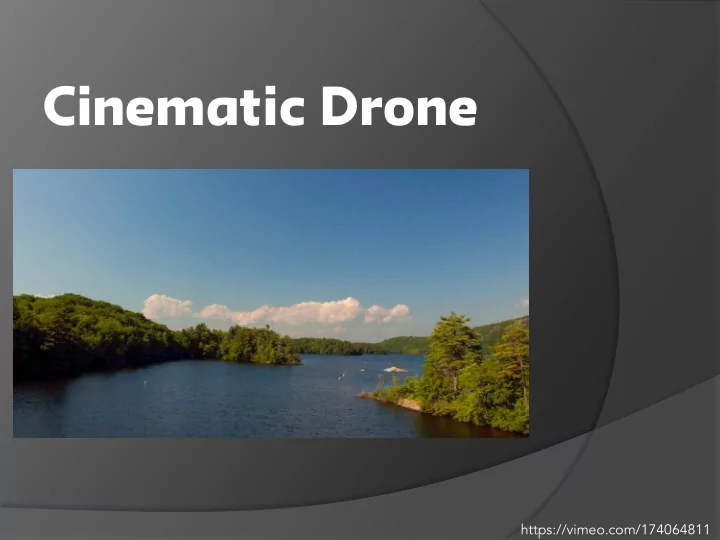
Cinematic Drone https://vimeo.com/174064811 Some basic moves Some - - PowerPoint PPT Presentation
Cinematic Drone https://vimeo.com/174064811 Some basic moves Some basic moves How to pull off five essential drone shots and uplift your videos https://vimeo.com/blog/post/how-to-pull-off-5-essential-drone-shots-and-uplift Grammar of the
https://vimeo.com/174064811
https://vimeo.com/blog/post/how-to-pull-off-5-essential-drone-shots-and-uplift
Jean Luc Godard “Vivre Sa Vie” My Life to Live (1962)
Low Level Angle Subject appears mor Subject appears more dominant, e dominant, powerful, sinister powerful, sinister, bigger , bigger
Eye Level Angle Tells the audience to ells the audience to relate to the subject on elate to the subject on a mor a more personal level as e personal level as if they wer if they were "right ther e "right there" e" with the subject. It is with the subject. It is a fairly neutral shot High Angle This angle has the effect
subject, making them appear less powerful, less significant, vulnerable or even submissive.
Bird's Eye View This is a completely different and somewhat unnatural point of view which can be used for a dramatic effect or for showing a different spatial
as an establishing shot. Worm’s Eye View It can be used to look up to It can be used to look up to something to make an object something to make an object look tall, str look tall, strong and mighty
.
Dutch Tilt or Slanted It gives the audience an of It gives the audience an off-balance f-balance view and can cr view and can create an emotional r eate an emotional response esponse that "something is dif that "something is differ ferent" or "wr ent" or "wrong".
Point-of-View (POV) As the name suggests, point-of-view shots are angles in which the camera incorporates a character’s eyes.
https://www.youtube.com/watch?v=45e1XuA-oLY
Long Take “Touch of Evil” Directed by Orson Wells in 1958
https://www.youtube.com/watch?v=Yg8MqjoFvy4
https://vimeo.com/132993291
Moving the sticks to fast when you are moving backwards get your propellers in frame
A UV filter is also used to protect the lens from damage Using a UV filter reduces the level of ultraviolet rays helping contrasts and eliminating haziness
A polarizing filter is often placed in front of the camera lens in order to darken skies, manage reflections, or suppress glare from the surface of lakes or the sea.
NEUTRAL DENSITY FILTER
ND filters evenly reduce the amount of overall light that enters the lens, which makes it possible to shoot at slower shutter speeds or larger apertures, even during full daylight
GND filters shift from dark at one end to completely clear at the
GND filters as either "hard edge" or "soft edge", depending on how abrupt the transition zone is.
LENS FLARE
Lens flare occurs when a point of light source such as the sun is much brighter than the rest of the scene
REDUCING FLARE WITH LENS HOODS
Dawn and dusk photography provides soft light. Worries about shadow and highlight detail don't exist as all tones blend into a harmonious exposure and evenly-lit subject
Sunrise and sunset are often the best parts of the day for visual impact.
It’s soft, warm and dimensional. It adds a quality to images that can’t be replicated no matter how many actions, filters, or textures you use. It lasts about 60 minutes depending on the season and global location.