CIBC 10th Annual Eastern Institutional Investor Conference September - - PDF document

cibc 10th annual eastern institutional investor
SMART_READER_LITE
LIVE PREVIEW

CIBC 10th Annual Eastern Institutional Investor Conference September - - PDF document

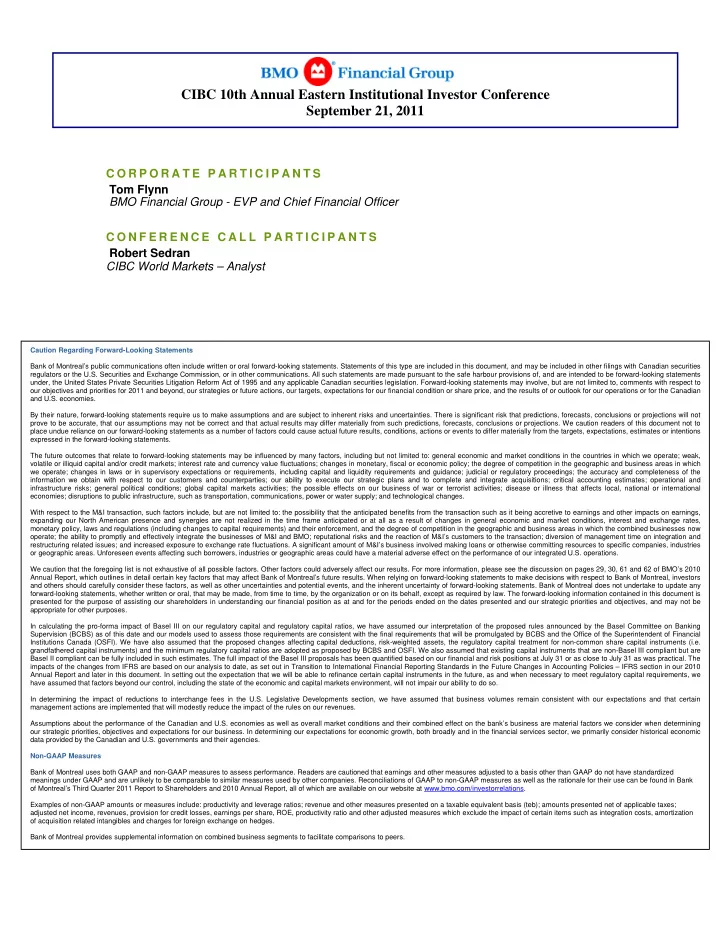
CIBC 10th Annual Eastern Institutional Investor Conference September 21, 2011 C O R P O R A T E P A R T I C I P A N T S Tom Flynn BMO Financial Group - EVP and Chief Financial Officer C O N F E R E N C E C A L L P A R T I C I P A N T S


slide-1
SLIDE 1

C O R P O R A T E P A R T I C I P A N T S Tom Flynn BMO Financial Group - EVP and Chief Financial Officer C O N F E R E N C E C A L L P A R T I C I P A N T S Robert Sedran CIBC World Markets – Analyst

CIBC 10th Annual Eastern Institutional Investor Conference September 21, 2011

Caution Regarding Forward-Looking Statements Bank of Montreal’s public communications often include written or oral forward-looking statements. Statements of this type are included in this document, and may be included in other filings with Canadian securities regulators or the U.S. Securities and Exchange Commission, or in other communications. All such statements are made pursuant to the safe harbour provisions of, and are intended to be forward-looking statements under, the United States Private Securities Litigation Reform Act of 1995 and any applicable Canadian securities legislation. Forward-looking statements may involve, but are not limited to, comments with respect to

  • ur objectives and priorities for 2011 and beyond, our strategies or future actions, our targets, expectations for our financial condition or share price, and the results of or outlook for our operations or for the Canadian

and U.S. economies. By their nature, forward-looking statements require us to make assumptions and are subject to inherent risks and uncertainties. There is significant risk that predictions, forecasts, conclusions or projections will not prove to be accurate, that our assumptions may not be correct and that actual results may differ materially from such predictions, forecasts, conclusions or projections. We caution readers of this document not to place undue reliance on our forward-looking statements as a number of factors could cause actual future results, conditions, actions or events to differ materially from the targets, expectations, estimates or intentions expressed in the forward-looking statements. The future outcomes that relate to forward-looking statements may be influenced by many factors, including but not limited to: general economic and market conditions in the countries in which we operate; weak, volatile or illiquid capital and/or credit markets; interest rate and currency value fluctuations; changes in monetary, fiscal or economic policy; the degree of competition in the geographic and business areas in which we operate; changes in laws or in supervisory expectations or requirements, including capital and liquidity requirements and guidance; judicial or regulatory proceedings; the accuracy and completeness of the information we obtain with respect to our customers and counterparties; our ability to execute our strategic plans and to complete and integrate acquisitions; critical accounting estimates; operational and infrastructure risks; general political conditions; global capital markets activities; the possible effects on our business of war or terrorist activities; disease or illness that affects local, national or international economies; disruptions to public infrastructure, such as transportation, communications, power or water supply; and technological changes. With respect to the M&I transaction, such factors include, but are not limited to: the possibility that the anticipated benefits from the transaction such as it being accretive to earnings and other impacts on earnings, expanding our North American presence and synergies are not realized in the time frame anticipated or at all as a result of changes in general economic and market conditions, interest and exchange rates, monetary policy, laws and regulations (including changes to capital requirements) and their enforcement, and the degree of competition in the geographic and business areas in which the combined businesses now

  • perate; the ability to promptly and effectively integrate the businesses of M&I and BMO; reputational risks and the reaction of M&I’s customers to the transaction; diversion of management time on integration and

restructuring related issues; and increased exposure to exchange rate fluctuations. A significant amount of M&I’s business involved making loans or otherwise committing resources to specific companies, industries

  • r geographic areas. Unforeseen events affecting such borrowers, industries or geographic areas could have a material adverse effect on the performance of our integrated U.S. operations.

We caution that the foregoing list is not exhaustive of all possible factors. Other factors could adversely affect our results. For more information, please see the discussion on pages 29, 30, 61 and 62 of BMO’s 2010 Annual Report, which outlines in detail certain key factors that may affect Bank of Montreal’s future results. When relying on forward-looking statements to make decisions with respect to Bank of Montreal, investors and others should carefully consider these factors, as well as other uncertainties and potential events, and the inherent uncertainty of forward-looking statements. Bank of Montreal does not undertake to update any forward-looking statements, whether written or oral, that may be made, from time to time, by the organization or on its behalf, except as required by law. The forward-looking information contained in this document is presented for the purpose of assisting our shareholders in understanding our financial position as at and for the periods ended on the dates presented and our strategic priorities and objectives, and may not be appropriate for other purposes. In calculating the pro-forma impact of Basel III on our regulatory capital and regulatory capital ratios, we have assumed our interpretation of the proposed rules announced by the Basel Committee on Banking Supervision (BCBS) as of this date and our models used to assess those requirements are consistent with the final requirements that will be promulgated by BCBS and the Office of the Superintendent of Financial Institutions Canada (OSFI). We have also assumed that the proposed changes affecting capital deductions, risk-weighted assets, the regulatory capital treatment for non-common share capital instruments (i.e. grandfathered capital instruments) and the minimum regulatory capital ratios are adopted as proposed by BCBS and OSFI. We also assumed that existing capital instruments that are non-Basel III compliant but are Basel II compliant can be fully included in such estimates. The full impact of the Basel III proposals has been quantified based on our financial and risk positions at July 31 or as close to July 31 as was practical. The impacts of the changes from IFRS are based on our analysis to date, as set out in Transition to International Financial Reporting Standards in the Future Changes in Accounting Policies – IFRS section in our 2010 Annual Report and later in this document. In setting out the expectation that we will be able to refinance certain capital instruments in the future, as and when necessary to meet regulatory capital requirements, we have assumed that factors beyond our control, including the state of the economic and capital markets environment, will not impair our ability to do so. In determining the impact of reductions to interchange fees in the U.S. Legislative Developments section, we have assumed that business volumes remain consistent with our expectations and that certain management actions are implemented that will modestly reduce the impact of the rules on our revenues. Assumptions about the performance of the Canadian and U.S. economies as well as overall market conditions and their combined effect on the bank’s business are material factors we consider when determining

  • ur strategic priorities, objectives and expectations for our business. In determining our expectations for economic growth, both broadly and in the financial services sector, we primarily consider historical economic

data provided by the Canadian and U.S. governments and their agencies. Non-GAAP Measures Bank of Montreal uses both GAAP and non-GAAP measures to assess performance. Readers are cautioned that earnings and other measures adjusted to a basis other than GAAP do not have standardized meanings under GAAP and are unlikely to be comparable to similar measures used by other companies. Reconciliations of GAAP to non-GAAP measures as well as the rationale for their use can be found in Bank

  • f Montreal’s Third Quarter 2011 Report to Shareholders and 2010 Annual Report, all of which are available on our website at www.bmo.com/investorrelations.

Examples of non-GAAP amounts or measures include: productivity and leverage ratios; revenue and other measures presented on a taxable equivalent basis (teb); amounts presented net of applicable taxes; adjusted net income, revenues, provision for credit losses, earnings per share, ROE, productivity ratio and other adjusted measures which exclude the impact of certain items such as integration costs, amortization

  • f acquisition related intangibles and charges for foreign exchange on hedges.

Bank of Montreal provides supplemental information on combined business segments to facilitate comparisons to peers.

slide-2
SLIDE 2

P R E S E N T A T I O N Robert Sedran – CIBC World Markets - Analyst

  • Okay. Our next guest is Tom Flynn from Bank of Montréal. Tom was appointed to his current

position EVP and Chief Financial Officer in March of this year. He joined BMO in 1992. He went

  • n to serve in a number of roles within BMO Capital Markets including the Head of Financial

Services Investment Banking, which was probably helpful through the M&I negotiations. And he also served as Chief Risk Officer of the Bank from 2008 to 2011, which many will remember was a particularly risky time. Tom, I am not sure I'm doing the forward-looking statements for you but I'll say it anyway. Tom's comments may include forward-looking statements that are subject to certain risks and

  • uncertainties. Actual results may differ materially. So I will leave it to Tom for his opening

remarks. Tom E. Flynn – BMO Financial Group - EVP and Chief Financial Officer Okay, thank you. It's good to be here at Montréal. I think that's the first time I have made a presentation and haven't had to do the forward-looking statement caution, so thank you for doing that. I will be brief, I will make a few comments about our quarter and our priorities and then I am happy to take your questions. I'll start with our third quarter results, which we thought were good and consistent with the business performance that we've been delivering through the year. Q3 revenue increased 13%, adjusted net income

1 was $843 million, which was up 24% from last

year, and adjusted EPS

1 was up to a $1.36 which was an increase of 19% from a year ago.

The investments we are making continue to contribute to top line growth. Year-to-date revenue growth was 10% and it was 8% excluding our acquisition of M&I. Year-to-date adjusted income

1

was $2.4 billion, 16% ahead of last year and adjusted EPS

1 was up 13%. In Q2 we introduced

adjusted results to better position us for reporting underlying results after the acquisition of M&I. Adjustments include integration costs for M&I and the amortization of acquisition related intangible assets. Each of the operating groups delivered a solid performance during the quarter and in the year-to-

  • date. In P&C Canada year-to-date net income is $1.3 billion, up 5%. P&C U.S year-to-date net

income was $199 million, up 18%. PCG, our wealth group year-to-date net income was $374 million, up 13% and excluding insurance, it was up 35%. BMO Capital Markets year-to-date net income was $771 million, 28% higher than last year with an ROE of almost 23%. The acquisition

  • f M&I closed on July 5th. M&I added $117 million of revenue and $32 million through adjusted

net income

1 for the 26 days that was in our third quarter results. It also added $29 billion in loans

and $34 billion in deposits. The M&I loan portfolio has been subject to extensive due diligence and we have established what we consider to be a prudent credit mark against the portfolio. We expect to generate in excess of $300 million pre-tax in cost-related synergies with full realization

  • n a run rate basis at the end of 2013.

Looking forward, we have confidence in the performance of our businesses and the results that will generate even during a period of potentially slower economic growth. We think we've got attractive and differentiated levers to grow in the current environment and these include commercial lending, which has always been a strength and a differentiator for BMO. We have a number two position in the Canadian market for commercial lending and a very strong business in

  • ur P&C U.S. Group. This is a plus given that we expect commercial loan growth to exceed retail

loan growth over the next few years.

1 - as reported: Net Income was $793 million, up 18% from last year; EPS was up to $1.27 which was an increase of 12% from a year ago. YTD Income was $2.4 billion, 14% ahead of last year; and EPS is up 11%.

slide-3
SLIDE 3

Our BMO Capital market business in the U.S. represents another source of leverage in a lower growth environment. We've made significant investments in the business. The retooled U.S. capital markets business is well-positioned as a mid market player to take advantage of

  • pportunities.

Our third growth driver will be the lift achieved from the integration of M&I and this has two parts. The first is taking the best from both banks, which will build a much stronger bank overall, and secondly synergies will drive income growth. Lastly, we expect continued good performance through time from our P&C Canada Bank, which has delivered top tier revenue and income growth in the last two years. And with that, I'd be pleased to answer your questions. Q & A Robert Sedran – CIBC World Markets - Analyst You mentioned M&I and I guess it's certainly topical, I know it comes up a lot in my meetings, I'm guessing it comes up a lot in yours as well. You gave us a little bit of flavour for how things are going, can you talk a little bit about the slowing economic environment, what does that do to the plan that you had? Does it affect you at all or are you kind of insulated because you're more internally focused right now? Tom E. Flynn – BMO Financial Group - EVP and Chief Financial Officer I would say that from an income statement perspective, it insulates us because we have a source

  • f growth that is independent of the economy. We've talked about expecting synergies to be in

excess of $300 million, that's up from the $250 million at the time that we announced the transaction in December, and we are confident that we'll get those synergies and have detailed integration plans to get at them over the next two, two and a half years. And those synergies are cost based, they are within our control and far more than not, independent of the economic environment. Just to comment on the environment now versus when we announce the deal; The outlook for the economy has certainly cooled and growth expectations are down. They are down more sharply from where they were earlier in the year compared to where they were in December when we announced the transaction, and expectations increased through the first part of this year and recently have tailed off. So overall, net-net I would say the outlook for growth is somewhat lower than it was when we announced, but not as much lower as it would be comparing sort of the peak

  • f expectations earlier this year to the current outlook.

Robert Sedran – CIBC World Markets - Analyst So you are hoping after the deal was announced, before it closed you thought this might actually be a lot better than you thought and now it's kind of closer to what you originally thought about it? Tom E. Flynn – BMO Financial Group - EVP and Chief Financial Officer Correct. Robert Sedran – CIBC World Markets - Analyst

  • Okay. When I think about the legacy Harris business, and I guess the legacy business at M&I as

well, part of what's going on here is a bit of a retrenchment in M&I followed by re-expansion, is that a fair way to characterize it?

slide-4
SLIDE 4

Tom E. Flynn – BMO Financial Group - EVP and Chief Financial Officer I would say its retrenchment only in areas. M&I was a fine bank with a long tradition of doing very well and serving core markets in a very successful way, but it had a bit of misadventure in commercial real estate. And so there is going to be retrenchment for sure in the commercial real estate part of the portfolio. And as part of that, we will be running down the part of the portfolio when we put about $2.5 billion of commercial real estate loans into our Corporate segment managed by risk and we'll be running those off over the next three to four years. But aside from that the business is, I would say back into in an offensive posture. M&I was going through its difficult time with shoring up its balance sheet and dealing with its issues and less able to aggressively go after good new business. And with the transaction to a very strong balance sheet, we really do think there is power and taking the best from both banks and putting the teams together on the ground to drive the business. And so, overall, the mindset is one of moving forward with confidence and looking to grow the business from a revenue growth perspective. We'll have a bit of a tailwind from the runoff commercial real estate portfolio. And we've got work to do on the synergies, but the overall posture is far more oriented towards moving the business forward. Robert Sedran – CIBC World Markets - Analyst One of the comments I've heard a lot over the last little while, is that the original marks you'd have taken on that loan book that you acquired, you call them prudent, the market might call them excessive, or very conservative to say the least. Let's assume for a second that the world unfolds, even at the conservative, you're well protected against the environment. So let's assume for a second that the experience may not be quite as bad as projected. First talk about your comment

  • n that and then second of all how might we expect the profit to emerge from that legacy book

and from those marks that are currently taken? Tom E. Flynn – BMO Financial Group - EVP and Chief Financial Officer So we've described the mark as being prudent, we did detailed due-diligence during and after announcing and did far more work and announced an update on the mark when we announced

  • ur third quarter results. The update was a number very much in line with the initial number

which was good because it had the benefit of additional work and we basically confirmed the number. In terms of what to look for us as time roles forward, under Canadian accounting we have to in effect true-up the credit market every quarter, and so every quarter we'll have included it in our provision for credit loss. The difference between what we have provided last quarter and the current true-up and that number will move around through time and it will be a function of how the world plays out. And we needed to have a mark that we thought was appropriate, under GAAP we can't have a mark that's unduly conservative and our hope and our expectation is that the mark is adequate and prudent and time will tell. And what we will do is provide disclosure on this because it is a large mark and an important part of our results, it's got the potential in any quarter to create some variability, positive or negative, simply because we've got a large item that's being updated from a mark perspective and we think that we're in a good position post close to deal with the portfolio as it is. Robert Sedran – CIBC World Markets - Analyst Just sticking with the U.S. business for a bit, if you don't mind. When I think about the size of the Harris bank platform, its number three in Chicago and a meaningful player in a very large market. Would you have said you were at scale in that market, or was this acquisition necessary to bring the entire platform to a level where you're now at scale and you feel you have achieved scale with this purchase?

slide-5
SLIDE 5

Tom E. Flynn – BMO Financial Group - EVP and Chief Financial Officer I would say that we considered ourselves to be in a good position in the Chicago market. We had a number three position in the market, 10% deposit share. It's a very large market and so overall we were in a good position. There are some micro markets where we'd like to have more of a presence, but that's more of a local micro market build up issue. So from an overall perspective, we were happy with the Chicago share. We were not at scale, and we were not happy with the productivity level in the business or the return on the business. And with the acquisition, we've combined Harris, which had a very good presence in the Chicago market, with M&I which operates in largely adjacent markets and has had a much lower productivity ratio through time. And so with the combination we want to get more scale and with that a better productivity ratio and a better return and that was an important part of why we wanted to do the transaction. With it we think we in effect have scale. We do want to continue to grow the business, but not in immediate term because the job for us for the next year or plus is to do the job on the integration. Robert Sedran – CIBC World Markets - Analyst So by way of thinking about acquisitions in the next little while, clearly if something small, a tuck- in, easy to do was to come around, you take a look but something more transformational, there is no appetite for it? Tom E. Flynn – BMO Financial Group - EVP and Chief Financial Officer No, there will be no appetite for something transformational. And smaller acquisitions can be a lot

  • f work, and in ways more work than bigger acquisitions. And so I think the bar will be higher in

the P&C U.S. business even for smaller acquisitions as we work on the integration. Robert Sedran – CIBC World Markets - Analyst

  • Okay. Let's move to the entire bank. One of the themes that people are looking to for next year or

perhaps hoping for next year as we are seeing revenue growth start to slow, is the expense line in general. Does the focus on integrating M&I and bringing the expense saves out of the U.S. business distract from the ability to more tightly manage your expenses elsewhere or is that just

  • versimplified and there is lots of room to still manage expenses lower at the bank wide level?

Tom E. Flynn – BMO Financial Group - EVP and Chief Financial Officer I’d come at that from a few ways, I'd say overall expense management should be a good leaper for us, because we do have the benefit of the synergies coming in. So at a consolidated level, the work going on with the synergies is going to help drive expense savings for us. In terms of the impact that the integration work will have on our ability to manage expenses, generally it's two things: In the business affected it's a big positive because we are getting the combination of the integration, and most of the bank is unaffected by the integration. And so we are far more than not, able to manage our expenses in the rest of the bank away from the distraction that the integration represents. There are some parts of the bank where we've got people involved in the integration and they got other responsibilities and their plates are full given the work going on in the integration. But more broadly I don't think that the integration itself has a significant ability for us to manage expenses and in the current environment like everybody we're mindful that we need to have an appropriate relationship between revenue growth and the expense growth, and with the prospect

slide-6
SLIDE 6

for revenue growth likely slowing, expense management is going to become more important as we move into '12. Robert Sedran – CIBC World Markets - Analyst And I guess that's really the dynamic, when we think about expenses I guess going into 2011 the hope was for a better revenue environment than we ultimately saw and so maybe in some cases the expense build was a little bit higher. That's not necessarily just for the industry and as you are looking into next year it is clear that we can't assume a good revenue environment and so the bank I guess and your plans for next year you are assuming on aligning your expense growth I guess with an expected slow revenue growth. Is that a fair comment? Tom E. Flynn – BMO Financial Group - EVP and Chief Financial Officer I would say that's a fair comment, but I think your description is a pretty accurate one and that through this year the expectation was that we would have a good level of growth in the business and the industry overall was more than not making investments in the business. Many of those investments have a tail. And you don't turn the tap off on those overnight and so we've got some continued expense growth related to initiatives that we put in place earlier in the

  • year. We talked on our third quarter conference call about expecting to see expenses in our

personal and commercial banking business show an increase in the fourth quarter because of project spend that we have coming through and that's going to happen. As we roll forward into next year and some of those projects start to tail off then we will absolutely be looking at moderating expense growth and making sure that we've got the right relationship between expense growth and revenue growth. Robert Sedran – CIBC World Markets - Analyst Talk about commercial lending being one of the areas, one of the growth veins I guess for next year or into the future? The bank has actually talked a lot about this, Bill has talked a lot about it in terms of the opportunity on the business side, certainly that's stripping the personal side given the leverage ratios which we had discussed actually previously. Is that happening the way you would have hoped or is this slowing economy in general, slowing the demand for the business side and might we be a little too optimistic about the business lending outlook for next year. Tom E. Flynn – BMO Financial Group - EVP and Chief Financial Officer

  • Yeah. We have talked about that, and I think others have talked it as well. The expectation is

heading into ‘11 was that we would have a pickup in commercial lending activity in Canada and U.S. We saw pretty decent growth in the first few quarters of the year, sort of 7% growth give or take in the loan portfolio in Canada on the commercial side, and lower on the U.S. side. And the growth was a little lower in the third quarter. And so our perspective is that business is watching what's going on in the world. And right now there is a heightened level of uncertainty for all of the reasons that we read about in the paper everyday and people are adopting a little bit of a “wait and see” attitude to get more clarity on the economic outlook before they accelerate spend. So growth expectations have come down a bit, sort of in sympathy with the reduced outlook for the economy, but we continue to think that the commercial side of the business is going to generate better growth than the retail side. And the commercial business isn't just about loan

  • growth. That's the biggest driver, but we are very focused in our business on the fee and deposit

side of the commercial portfolio as well. Our share in the lending business is higher than it is on the deposit side of the business, and we think there is an opportunity to talk to our clients to look to get more of the fee and deposit share of business that they have. So that we've got a better

slide-7
SLIDE 7

relationship between the two, and that's going to be a big focus if the asset side of the growth equation is a little softer. Robert Sedran – CIBC World Markets - Analyst I guess by the nature of the fact that we are all bank consumers or at-least most of us are bank consumers, we see the competitive environment on the retail side a little bit more than the commercial side. Is it as intense and aggressive on the commercial side and the deposit and the loan side as we're seeing in the retail side? Tom E. Flynn – BMO Financial Group - EVP and Chief Financial Officer I would say it's competitive. It's hard to be precise in answering whether it's more or less

  • competitive. The commercial business is an attractive business. All of the banks compete for it. I

think it has been a reasonable competition and give or take to me the competition has been significantly different than it is on the retail side, although as you say the retail side is more visible given that we're all consumers and the advertising spend is higher in that area. Robert Sedran – CIBC World Markets - Analyst I will switch gears to talk about capital markets for a second. Last quarter was a weak trading quarter for everybody except BMO, which actually did reasonably well and certainly was a bit kickoff a head fake to start up earnings season on the trading side. Why is that? Was there something unusual or we are hearing a lot of chatter that the trading environment is getting softer and the numbers we've seen even in 2011 may not be repeatable in 2012. Can you talk about what went well for BMO last quarter and should we be nervous about 2012 and the trading

  • utlook for the industry?

Tom E. Flynn – BMO Financial Group - EVP and Chief Financial Officer So we did have a good Q3 both in absolute terms and relative terms. The trading businesses as you know are ones there is a degree of, I won't use the word volatility, but there are ups and

  • downs. And so in any given quarter, you can do a little better or a little worse depending on how

things happen to end up for you and we were pleased with our performance. The results on the equity side and the commodity side of the business in particular were strong relative to peers. Looking forward, I think people have been pretty clear that the current environment is not a very constructive one from a trading perspective and the situation in Europe has given rise to volatility, wider credit spreads and uncertainty. And to-date for the industry, it has been more negative than positive and the uncertainty is such that the activity levels are down because people are sitting on the sidelines looking for direction. And so the current environment is a tough one we've seen comments on that from U.S. banks and European banks and our hope would be that we'll get more stability in the environment as we move forward and with that a better environment for the business and time will tell. Robert Sedran – CIBC World Markets - Analyst The European issues are above the fold in the newspapers pretty much every day these days, I guess I would be remiss not to ask, I know we had the conference call not long ago and some pretty good talk around how you protected yourself, but some European banks continue to be, let's call it distressed. What is the bank doing to manage counterparty risk and are we managing those relationships on those specific banks, or is there any exposure to them and are those exposures being managed out? Tom E. Flynn – BMO Financial Group - EVP and Chief Financial Officer

slide-8
SLIDE 8

A few things, our exposure to the peripheral countries is very, very small. We've given disclosure

  • n that in our published materials and on the call. In terms of the exposure to European banks we

don't have significant exposure on the balance sheet. We do have relationships with many of those banks, but the practice in the industry as you know for trading activities, is to have CSAs in place where amounts owed to and fro are covered by collateral. So we wouldn't have significant uncollateralized exposure to European banks on the balance sheet and we're watching this situation. Our big concern related to the situation in Europe really isn't the direct impact from the balance sheet, it's being indirectly impacted from what that's doing to confidence from the environment from a market volatility perspective and the impacts on the economy. Robert Sedran – CIBC World Markets - Analyst Do you notice any impact on funding? Tom E. Flynn – BMO Financial Group - EVP and Chief Financial Officer I would say not significant, I mean funding markets in Europe are stressed, we've all read there are more stress for some players. Canadian banks generally are seen as a safe haven, and so we are as an industry in as good a place as we could be I think, in the current environment. North American markets have not been as affected at all as European markets, but there is caution in the market for sure. Robert Sedran – CIBC World Markets - Analyst I want to talk a little bit about some of the regulatory challenges facing the sector, and I guess in Canada it feels like we have a bit more of a collaborative approach where the banks are working together with the regulators to make a healthier environment. It feels like in the U.S. a bit more of confrontational approach. So we have capital reforms, we've had credit card reforms, we've had Durbin and Dodd Frank, and all the rest. There is a feel like the worst is behind and that is a dangerous answer to give I guess, but it feels like the worst is behind and that finally it's going to be about operating the bank

  • r are there more storm clouds on the horizon that we have to worry about on this following, and I

guess you can contrast or compare both sides of the border? Tom E. Flynn – BMO Financial Group - EVP and Chief Financial Officer Yeah, I think your characterization of the tone of the discussion on the two sides of the border is pretty accurate. And I don't know that its a reflection of the fundamental difference, I think it's more a reflection of the different experience the countries had through the downturn, and situation in the U.S. is more severe and the response too, was not surprisingly, more significant. In terms of whether or not the worst is behind us, I'd talk about that in two dimensions. The first is we haven't implemented all of the changes that have been proposed. And so from an implementation perspective, we need to work through the Basel Capital requirements, Basel liquidity requirements, which have not yet been finalized. We need to have rule making on large parts of Dodd-Frank. And so there is a lot of implementation work that we need to work through that I would hope would not give rise to significant surprise, but there is work to do. And then in terms of the risk of significant new developments that would be negative for the industry, I personally think that's a low likelihood, because of the way that all of the things that have been done to date and the reality that there is a lot of work still to do on implementation would add significant incremental reforms on top of everything we have got, I think it would be difficult for anybody to do.

slide-9
SLIDE 9

Robert Sedran – CIBC World Markets - Analyst Is it affecting the competitive environment in the U.S.? The Bank of Montreal is going to be fine, no matter what the environment is. There will be certain amounts, differences in profitability I suppose but not the business model, but a number of your competitors down there presumably are going to struggle under the way, some of the new regulations. Have you noticed the difference in the competitive environment? Like has it been practicable impact of all this on the ground? Tom E. Flynn – BMO Financial Group - EVP and Chief Financial Officer I think the biggest impact on the ground in the U.S. is on the retail side of the business, where some of the Dodd-Frank related reforms have a significant impact on some business models. And for the banks that were most affected, they have got significant issues and they are looking to restructure their business and take significant actions. For us, it is less of an issue. And Reg E was implemented over a year ago, which is fully in our run rate U.S. P&C results. And the interchange that's coming is about $40 million in impact to us pre-tax, with a bit of mitigation built in there, and that's an annual number, so not a significant number for us, but for many industry participants the changes on the retail side are very significant. And I guess our hope would be that the industry is going to react in a way that will restore revenue streams although they'll take a different form, so that we end up with the business that generates adequate return on capital. Robert Sedran – CIBC World Markets - Analyst

  • Okay. Got about three minutes left.. I guess we'll close out talking about credit. Have loan losses

bottomed for this cycle? Tom E. Flynn – BMO Financial Group - EVP and Chief Financial Officer Well, I'll say what we always say on the losses: There is a general trend and the losses will move around quarter-to-quarter. So the general trend for the last year has been down. This was a very good cycle I think from a credit perspective for the Canadian industry, losses were low compared to higher downturns. Last quarter we were at 40 basis points of loss on the portfolio. That's about equal to a 20 year average. And given what's going on in the economy, there's probably not a lot

  • f downward potential from that number.

Unemployment in the U.S. is still high. Unemployment in Canada looks like it's stalled out at the current time and growth is slowing. So feels like the loan losses are going to, if we get the sort of low growth environment that we were talking about come in at above the current level that are coming in for the next number of quarters. Robert Sedran – CIBC World Markets - Analyst When I look at the last three cycles in the loan loss side, and this is for the industry, but I think the same would hold true for Bank of Montreal. The successive peak in the loan losses has been lower every time. The next downtown we're going to enter whenever it happens, whether it's next year or beyond feels like the Canadian consumer is going to enter there with a lot more leverage than they did in previous cycles. Are we going to break that cycle and maybe the next peak in loan losses will actually be higher and then we won't have that same…or will the next down turn be a little bit more painful, I guess what I'm asking. Tom E. Flynn – BMO Financial Group - EVP and Chief Financial Officer Well it has a potential to be, obviously depending on the severity. The last down turn was a good

  • ne. I think exceeded the industry expectations and the market expectations, which was good to
slide-10
SLIDE 10
  • see. The industry has learned lessons through time, so when the recession of the early 90's,

there were big commercial real estate related losses, the industry does business differently today in that sector, and as a result I think it carries lower risk. On the consumer side debt levels are clearly high. There is the potential for losses to be higher than they were this cycle for sure, but the majority of the growth has come from mortgage

  • portfolios. And there, as you know, we don't have exposure above 80% loan to value and 70% of
  • ur portfolio is insured. And so you need a really significant shock to the system to produce

significant losses in that part of portfolio. So I'd say risk is there, the vulnerability is somewhat higher, given the level of debt, but I don't think that we are setup for a really significant problem, given the structure of the market, and fundamentally a relatively conservative approach to assessing debt service capacity that the industry takes. And compare to the U.S. it is important to point out that we don't do sub-prime lending on any kind of scale in Canada. And the U.S. had a very bad down turn from a credit loss

  • perspective. It was a function of a whole lot of things, but one of those was very aggressive

lending and very large sub-prime to the market, which we don't have in Canada. Robert Sedran – CIBC World Markets - Analyst

  • Okay. Well thanks. On behalf of CIBC World markets, I would like to thank you for participating

this year, it was great. Tom E. Flynn – BMO Financial Group - EVP and Chief Financial Officer Thank you.