
SLIDE 1
Advisory Services Program
CHRISTIANSTED
- St. Croix, USVI
June 24 - 29, 2018
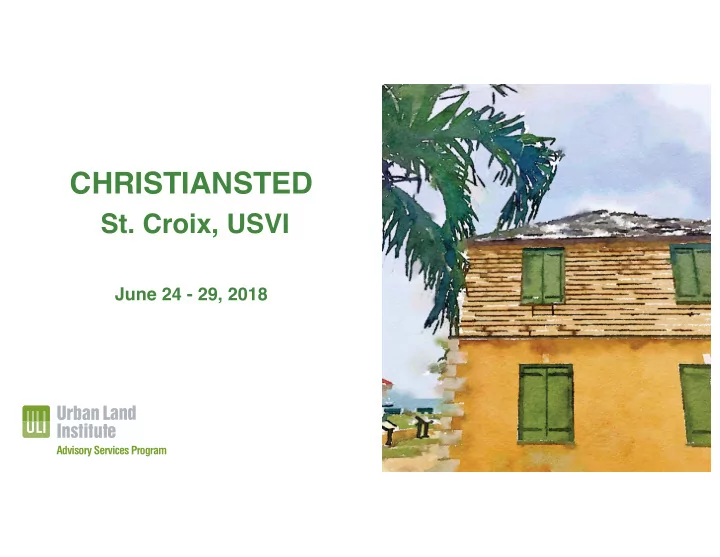
CHRISTIANSTED St. Croix, USVI June 24 - 29, 2018 Advisory Services - - PowerPoint PPT Presentation
CHRISTIANSTED St. Croix, USVI June 24 - 29, 2018 Advisory Services Program About the Urban Land Institute The mission of the Urban Land Institute is to provide leadership in the responsible use of land and in creating and sustaining
Advisory Services Program
June 24 - 29, 2018
The mission of the Urban Land Institute is to provide leadership in the responsible use of land and in creating and sustaining thriving communities worldwide. ULI is a membership organization with nearly 40,000 members, worldwide representing the spectrum of real estate development, land use planning and financial disciplines, working in private enterprise and public service. What the Urban Land Institute does: Conducts Research Provides a forum for sharing of best practices Writes, edits and publishes books and magazines Organizes and conducts meetings Directs outreach programs Conducts Advisory Services Panels
Since 1947 15 - 20 panels a year on a variety of land use subjects Provides independent, objective candid advice
Process Review background materials Receive a sponsor presentation and tour Conduct stakeholder interviews Consider data, frame issues and write recommendations Make presentation Produce a final report
Adrienne Williams • Albert Bryan • Anthony Weeks • Antonio Stevens • Barbra Walsh • Bob Jackson • Cassandra Dunn • Clema Lewis • Clifford Graham • Congresswoman Stacy Plaskett • Cornell Williams • Dawn Henry • Deanna James • Don Dudrow • Donnie Dorsett • Dr. Noreen Michael • Eugene Farrell • Gerville Larson • Gideon Jagrup • Glenice Parris• Gustav James • Jamilah Henry • John Greene • John Wessel • Jonathan Williams • Joshua Felder • Kimme Bryce • Larry Kupfer • La Vaughan Velle • Larry Richards • Leova Harris • Lt. Chris George • Lydia Pelle • Malik Striden • Mary Deema • Maureen Harrigan • Michael Hand • Mike Walsh • Nataki Richards • Neil Canton • Renee Daley • Robert Graham • Senator Marvin Blyden • Senator Positive T.A. Nelson • Stacey Vincent • Sue Southon • Vince Bennett • Vivian St. Juste • Wayne Biggs • Whealan Massicott • Xawntoia Franklin • Yvette Browne
ULI Staff
Carlton Brown, Direct Invest, NY, NY (Chair) April Anderson Lamoureux, Strategic Advisors LLC, Boston, MA (Vice Chair) Nick Egelanian- SiteWorks Retail Real Estate, Annapolis, MD
Robin Hughes- Abode Communities, Los Angeles, CA Sandra Kulli- Kulli Marketing, Los Angeles, CA Amie MacPhee- Cultivate Studio, San Francisco, CA Kim Morque- Spinnaker Real Estate Partners, Norwalk, CT Mehul Patel, Midwood Investment & Development, NY, NY Adam Weers, Trammell Crow Company, Washington, DC Beth Silverman- Vice President- Advisory Services Grace Hill- Manager- Meetings and Events Cali Slepin- Associate- Advisory Services
employment opportunities?
financial tools and incentives should be used to bolster St. Croix’s economic development vision?
a diverse, resilient and sustainable workforce that allows Cruzan households to earn a living wage?
internationally?
goals and innovation?
area)- how should St. Croix determine the housing mix, location, design and scale of family and senior supportive housing?
Christiansted’s central business district, the beach/harbor and the boardwalk?
neighborhoods? Which strategies can be scaled to implement and stimulate investment island-wide?
draw both Virgin Islanders and travelers to the area?
Joined by Our Humanity with each other and the mainland though state players would imply that there is no interconnectedness among us Harm has been done. Climate disasters have affected and will continue to affect St Croix Limited resilience of poor and working class on St Croix because of nothing they have done We can do better because of unique assets, talent and the will to change the things that negatively impact our lives Though the need for immediate action is great, it is important to move forward quickly but deliberately Make no intervention that leaves existing community stakeholders with fewer financial, physical, environmental, social, cultural and human capital assets than before the intervention was made Hope without clear cut plans is the why: There are floods in Christiansted during heavy rains; it is why substandard low cost social housing is all concentrated in marginalized communities without access to the amenities that enable residents to be self-actualized; it is why there is barely a middle class in downtown Christiansted; it is why the economy has struggled to reinvent itself since the closure Refinery and the Jones Act ; it is why it costs as much to build housing in St Croix as it cost to build in NYC or Washington DC, it is why electricity and energy cost consume a larger percentage of household income than in any community on the US Mainland. And finally, it is why this ULI Advisory Panel was invited to St Croix.
One foot in memory, one foot in prophecy
BUILDING BLOCKS
CHALLENGES
a. Lack of Gathering Places and Town Centers
Priority and Opportunity
THE ISLAND
\
BUILDING BLOCKS
Restaurateurs
CHALLENGES
1. Perception that government officials need to more clearly articulate the long-term vision for the future of STX in a manner accessible to all Cruzans 2. Perception that the government needs to engage more fully at the community level to build trust and gain consensus on the future plans for STX 3. Police are not respected and often not trusted
LEADERSHIP
BUILDING BLOCKS
CHALLENGES
Unfunded Pension Obligations:
TERRITORIAL DEBT BURDEN
\ BUILDING BLOCKS
CHALLENGES
Development
JOBS AND ECONOMIC DEVELOPMENT
\ CHALLENGES
Educational Attainment
Electric Utilities
Roads
AGING INFRASTRUCTURE
BUILDING BLOCKS
Building Blocks
Challenges
Subsidized Housing Projects
HOUSING
\ Building Blocks1. Building
Challenges
Violent Crime 3. Generational Brain Drain 4. Declining and Aging Population
Population
PEOPLE
\ “Cities have the capability
everybody, only because, and only when, they are created by everybody” Jane Jacobs, The Death and Life of Great American Cities
A “build it and they will come” approach will NOT work Avoid the temptation of any single “big idea” Start with the premise of helping people Set realistic goals and priorities Implement and measure success The key to future economic success is to create
(agricultural/fishing/artisan)
Incremental Strategies = The Island of Opportunity
Meet people where they are LISTEN Work with community advocates Make it worth their time LISTEN Measure success Leverage each opportunity to cultivate champions LISTEN Communicate using multiple methods Send a diverse team LISTEN Focus on shared decision making Less planning and talking, more implementation and action Understand that trust takes time
Shift How Policy is Formulated – Engagement is Key
Celebrate successes not failures Fix the things that are broken
Reinforce the things that are great
People are the most valuable asset Invest in St. Croix’s public realm
Get the Basics Right
Leverage non-traditional employment opportunities
Co-working space and business incubators Creative economy opportunities and Christiansted arts district Promote sharing economy Expand technology access and improved reliability Export of locally-produced goods Online marketplaces such as Etsy’s Craft Entrepreneurship Program or Facebook’s Level Up Feasibility of US Virgin Islands online marketplace
Embrace how St. Croix is unique and different
Pivot focus from cruise ships & “big ideas” to existing assets Christiansted historic and cultural asset mapping Specialized and unique cultural and heritage tourist offerings Pursue authentic brand Models: Charleston, SC; Costa Rica, Savannah, GA; Chattanooga, TN, Louisville, KY
Provide connections to the global economy
Broadband access and reliability New and expanded marine research and development partnerships Long term: Optimize Christiansted as a Smart City
Revive an historic sector that provides a sustainable food source
Establish Agribusiness Initiative within economic development team Engage food hub partner to connect the dots Landside restoration, ie Green Belt Movement Long Term Play: Explore specialty crop production and food exports Long Term Play: Explore Christiansted Food Market as worker-owned cooperatives
Leverage and layer full range of available tools
Tax Incentive Financing Public Private Partnerships Historic Tax Credits Opportunity Zone Asset Sale New Market Tax Credits Worker Owned Cooperatives
The people of St. Croix are the island’s greatest asset
Basic employment training Online access to education and skills development Maintain people-focus requirements in the business incentive programs Longer Term Play: Native construction techniques and locally sourced materials
○ Reduce fossil fuel-based energy consumption 60% by 2025 ○ Generate 30% of peak capacity from renewables by 2025
connected to the WAPA grid. These systems met about 10% of peak demand on St. Croix
construction across the territory
and government buildings until 2020
damaged
the territory
sited across the island for distributed power production
Short - Long Term Medium - Long Term Medium - Long Term Long Term Long Term
Solar Wind Waste-to-Energy Biomass Geothermal
Potential: TBD Potential: 34MW Potential: 16.5MW Potential: <10MW Potential: Very Low Installed Capacity: >8MW Installed Capacity: 0 Installed Capacity: 0 Installed Capacity: 0 Installed Capacity: 0
$0.14/kWh (generated cost). Potential for large scale wind turbines on the south-west coast of St. Croix.
(polystyrene, polypropylene, polyethylene) into a refined biodiesel which can be used in typical diesel engines found in cars, trucks, boats, and
municipal dump site by mining the landfill
(organic fertilizer) in addition to energy, and can be sited across the island in 5 -10 MW distributed generation plants. Biomass gasification plant on Martinique sustained minimal damage from Hurricanes Maria and Irma
scales (residential to utility) for processing organic waste into biogas (methane)
centralized power systems
transmission lines and ultimately delivery charges
response and emergency back-up
demand, and save consumers money
by WAPA
landscape such as retention ponds, swales, and other strategies commonly used in Permaculture
catchment for irrigation
farmers
Improve walkways in commercial districts
Current state of the road and transportation infrastructure throughout the island presents a significant challenge Underinvestment in the transportation network has created real BARRIERS TO THE MOBILITY AND MOVEMENT of residents and visitors
Negative impact in quality of life on St. Croix
Symptoms include
Feelings of isolation Disconnect between Christiansted and Fredericksted Restricted access of customers (residents and visitors) to retail and commercial assets Enhanced concerns of displacement from public housing resident regarding redevelopment
Significant safety concerns (pedestrian and vehicular) LACK of a reliable PUBLIC TRANSPORTATION network presents a missed opportunity y p
Feelings of isolation Di t b t C Enhanced concerns of displacement f housing resident regarding redevelop
No crosswalks
Need for improved pedestrian paths No clear connections to the ocean Where Do I Walk?
SERIES OF INVESTMENTS to improve the transportation and mobility infrastructure within the study area
Quick and tangible way to strengthen connections between residents and visitors Enhance and revitalize existing commercial, retail, park, and ocean assets, Lay a firm foundation for mobility that will significantly magnify the impact of new development
IMPROVING people’s ABILITY TO MOVE benefits retail assets, parks, and cultural districts Investing in roads and sidewalks CONNECTS PEOPLE TO OTHER PEOPLE as well as Low-cost, high-impact method to amplify the sense
Framework for a larger transportation and mobility strategy
Expand out and tie into an island-wide strategy Can be carried through to a territory-wide strategy
sitors Enhance and revitalize e park and ocean assets
Low-cost, high-impact
3 – MORE WAYS TO MOVE 1 – CREATE GREENWAYS 2 – CONNECT WITH WALKWAYS
creation
new greenways as foundational elements for the EFFICIENT MOVEMENT OF PEOPLE and the connection of key retail, commercial, park and ocean districts
to STRENGTHEN TIES BETWEEN RESIDENTS AND VISITORS that populate the study area and the key retail, commercial, park and ocean districts
the variety
transportation available including bikes, car and scooter sharing, and public transportation to enhance the ACCESSIBLE, AFFORDABLE MOVEMENT
residents and visitors throughout the study area
1 – CREATE GREENWAYS 2 – CONNECT WITH WALKWAYS 1 – CREATE GREENWAYS 1 – CREATE GREENWAYS 3 – MORE WAYS TO MOVE
= sharing station locations Type of transit .Bikeshare .Car share .Scooter share .Rickshaw .Bus stops
First, focus on honoring and preserving the unique architectural cultural heritage.
Document and map significant sites. Identify key government-owned lots. How could they could be used to solve drainage issues, places for new civic spots (parks, markets, shelters, pop up). Host an RFP for Pop Up Insertions into these vacant lots. Go for easy wins on beautifying, e.g. removing the chain link fence at the boardwalk
First, focus on honoring and preserving the unique architectural cultural heritage.
Build on the momentum from the ideas in the Town Plan created by the community charrette process in 2013. Intensify the work around the “missing teeth/missing owners” initiative. It’s good! Engage community to partner with the National Park Service to amplify awareness, education and training around the importance of historic preservation and island legacy.
Connect Christiansted more wonderfully though social and physical opportunities.
Explore ways to move around, beyond the car. Address unsafe streets-- both speeding and infrastructure. Address parking challenges (give tickets to people who park more than 2 hrs.) Engage a bike champion to grow the bike community and facilities. For example, take Cruzin’ Scooters and turn it into a “Bicycle Kitchen” — a place that teaches kids how to repair bikes, helps bike owners learn how to fix their bikes, and grows the bike community. Host a CicLAvia style “open streets” event. Support the efforts in the community for a bike path system.
Find the best places for plazas, markets, sports activities in the map of downtown. Make it easy to get to the sea for all … and be mindful of the disabled users everywhere. Amplify programs like the plastic bag/turtle campaign that builds respect for our island and the sea through marine resources/education, expanding with the children and schools. Use the Boardwalk Extension from Gallows Bay to the Power Station to be multi-use, for locals and for tourists. Get everyone downtown: Host “Walks with your Senator”, potlucks and conversations with the NPS; “Clean up the Town” Days with the kids. Elders storytelling events.
Connect Christiansted more wonderfully though social and physical opportunities.
Design a comprehensive Open Space system that includes: Parks, Greenways, Sea Park, Flood control retention, and path system.
The system can help with flooding, create places for young and old to play and socialize while linking up the community in healthy ways, off the streets. Locate bike/path systems within Open Space system. Make this a cornerstone for the health and wellness opportunities in Christiansted. Link the town to the rest of the Island through a trail system.
Strategy 3: CONNECT
Take what is already working and amplify it. “Placekeeping” not “Placemaking.”
Attract more people to Downtown, more often. Create a place to catalyze agriculture and expanding food infrastructure. Market Hall. Add a school or satellite spot for distant schools to host classrooms in town. Include a small grocery/bodega, get more residents and enforce parking regulations. Recatalyze activities that were thriving in the 1980s in a new 21st Century Style.
Take what is already working and amplify
Gather high school students and get their thinking on ideas for things we could add. Brainstorm with the artists. Talk with the hotel and owners. Use social media as a tool for building heat in town. The Island. The Territory. The World. Celebrate the Food & Wine Festival and the smaller gatherings it inspired all year. Think richly about how civic places might become community gathering places beyond traditional uses, like the Library after hours and on Sundays.
High percentage of housing stock is public housing Affordable and workforce housing are in great demand Housing stock is aging and dilapidated High costs of housing for senior and low income population Housing severely impacted by hurricanes; 10% -20% considered substandard Large stock of historic properties downtown
Governmental Lack of interagency coordination Insufficient capacity of staffing within Housing Authority Inadequate property management and maintenance Private Sector Lack of capacity and expertise in construction trades Limited competition which creates monopoly in market Limited resources leading to high construction costs Environmental challenges Climate uncertainty Hurricanes, wind, and persistent moisture issues Infrastructure – outdated and inadequate, high costs Jobs & Income - static income levels reduces market rate housing & production
Governmental Funding for Recovery (as much as $1.9B) VIHA/VIHFA Assets
Environmental Energy Harness wind and solar Water Maximize capture, treatment and reuse of water Infrastructure – integrate networked, flexible systems into new buildings Leverage Recovery Funding for work force and entrepreneurship programs
Engage and partner on mixed-income housing Seek new sources for procurement Develop best practices / public-private partnerships / Design Build
Guiding Principles No displacement and ensure residents who currently live in Christiansted remain and benefit from future economic prosperity Build diverse, mixed-income, vibrant communities that provide homes for all Cruzans Engage existing public housing residents and local stakeholders in creating a collective vision Broaden socio-economic demographics of the community to drive economic growth
Development Strategy Community visioning and comprehensive master plan Employ best practices for the redevelopment of public housing Range of architecture styles and building types with consideration for local culture and climate Create neighborhood by introducing street grid Ample open space: parks, programmed play areas, active recreation space, community gardens Gathering places, community centers, and multi-purpose space Connectivity within neighborhood, along the boardwalk to downtown, and to rest of island Seek the best talent by attracting high quality design and real estate professionals and by building local workforce capacity
Best Practices Enterprise Rose Architectural Fellowship - Fellowship partners emerging architectural designers with local community development organizations to facilitate an inclusive approach to development that results in green, sustainable, and affordable communities. Enterprise Green Communities is improving the health and well-being of low-income people by transforming the quality of affordable housing. By aligning affordable housing investment strategies with environmentally responsive building practices………to ensure that people living in affordable housing are healthier, spend less money on utilities, and have more
healthcare systems. Create Housing Authority Fellowship Exchange Program to supplement staff capacity within VIHA
Best Practices – Resources
Phase 1 Development Ph 1 Phase 2 Development nt p Developmen p Phase 3 Development P Phase 2 Phase 1 Phase 1 D p Phase 2 DLBJ Pilot Project
systems to reduce energy related barriers to economic development
private sector
low cost high value utility services
and revenues
management, softscape parks/recreation spaces and water recovery systems
and sea natural environments; historical architectural fabric; unique cultural character; unique history and emergent cottage industries
to serve all communities and enhance the human experience for residents and visitors
development models for senior housing pilot