
SLIDE 1
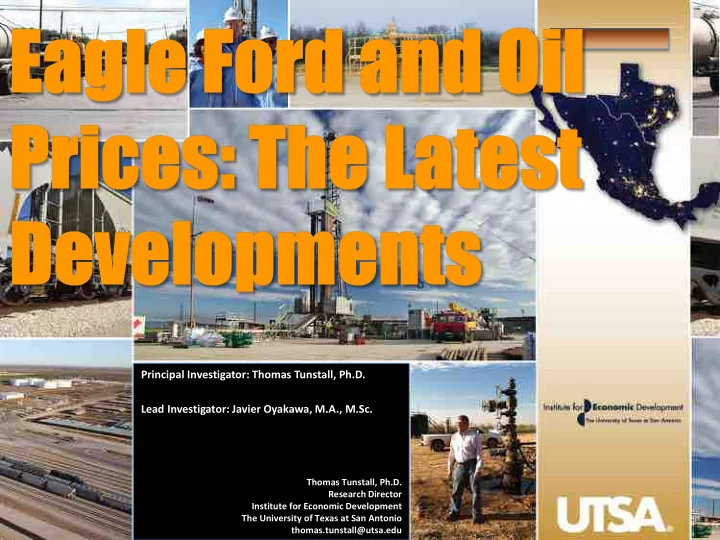
Principal Investigator: Thomas Tunstall, Ph.D. Lead Investigator: Javier Oyakawa, M.A., M.Sc.
Thomas Tunstall, Ph.D. Research Director Institute for Economic Development The University of Texas at San Antonio thomas.tunstall@utsa.edu
Principal Investigator: Thomas Tunstall, Ph.D. Lead Investigator: - - PowerPoint PPT Presentation
Principal Investigator: Thomas Tunstall, Ph.D. Lead Investigator: Javier Oyakawa, M.A., M.Sc. Thomas Tunstall, Ph.D. Research Director Institute for Economic Development The University of Texas at San Antonio thomas.tunstall@utsa.edu
Principal Investigator: Thomas Tunstall, Ph.D. Lead Investigator: Javier Oyakawa, M.A., M.Sc.
Thomas Tunstall, Ph.D. Research Director Institute for Economic Development The University of Texas at San Antonio thomas.tunstall@utsa.edu
University of Texas at San Antonio Institute for Economic Development
Eagle Ford Shale Community Development Program (21 Counties in South Texas) Small Business Development Centers - SBDC (79 Counties in South, West and Central Texas) Rural Business Program (79 Counties in South Texas) Procurement Technical Assistance Center (Texas)
JP Morgan Chase Veteran's Program (Texas)
Southwest Trade Adjustment Assistance Center (TX, OK, LA) SBDC National Information Clearinghouse (National) Minority Business Center (National) Community and Business Research (National, Int’l) International Trade Center (Mexico, Central/South America, Caribbean, North Africa)
UTSA Institute for Economic Development
Research at the Institute focuses on research projects that help business and policymakers plan for a dynamic future: Economic Impact Studies Community Development Studies (I-35, SH 130) EB-5 Immigrant Investor Regional Center Impact Studies Analysis on Various Topics:
Eagle Ford Shale San Antonio Missions South Texas Medical Center University of Texas System Targeted Industry Recruitment / Workforce Analysis Repurposing of Military Bases for Commercial Use
UTSA Institute for Economic Development
As the Research Arm of UTSA’s Institute for Economic Development we are dedicated to serving: Economic development corporations (e.g., SA EDF) City, state and federal governments Workforce development boards Businesses Associations Other community stakeholders
UTSA has become the preeminent authority
Mark Twain
California: 9 Tier 1 Universities
(Population 38 Million) 1. Stanford University (1900) 2. University of California, Berkeley (1900) 3. California Institute of Technology (1934) 4. University of Southern California (1969) 5. University of California, Los Angeles (1974) 6. University of California, San Diego (1982) 7. University of California, Santa Barbara (1995) 8. University of California, Davis (1996) 9. University of California, Irvine (1996)
New York: 6 Tier 1 Universities
(Population 19 Million) 1. Columbia University (1900) 2. Cornell University (1900) 3. University of Rochester (1941) 4. New York University (1950) 5. University at Buffalo, The State University of New York (1989) 6. Stony Brook University-The State University of New York (2001)
Texas: Only 3 Tier 1 Universities
(Population 27 Million) 1. University of Texas at Austin (1929) 2. Rice University (1985) 3. Texas A&M University (2001)
(62 Total AAU Members in U.S.)
Some of the key features of the 2017 San Antonio Bond Program include:
million in outside funding within 37 of the Bond Program projects
$680 million of the Bond is for Council District Projects
Growth Plan (Guiding Principles include investing in Major Corridors and Increasing Connectivity)
residents lives or works
at the lowest interest rates possible putting more property tax dollars into infrastructure projects
Counties Included in Study Area
Producing Counties: – Atascosa – Bee – DeWitt – Dimmit – Frio – Gonzales – Karnes – La Salle – Lavaca – Live Oak – Maverick – McMullen – Webb – Wilson – Zavala Adjacent Counties: – Bexar – Jim Wells – Nueces – San Patricio – Uvalde – Victoria
Counties not included in the analysis are Leon, Milam, Brazos, Burleson, Lee, Fayette, Lavaca, Edwards, Houston, and Wood
Eagle Ford Economic Reports
$2.9 $25.0 $61.2 $87.8
$- $10.0 $20.0 $30.0 $40.0 $50.0 $60.0 $70.0 $80.0 $90.0 $100.0 2010 2011 2012 2013 2014 2015 2016
Economic Impact (billions)
12,601 47,097 116,508 154,984
20,000 40,000 60,000 80,000 100,000 120,000 140,000 160,000 180,000 2010 2011 2012 2013 2014 2015 2016
Job Supported
(over 2 billion barrels)
Texas Oil Production Surpassed 1988 Levels in September 2012
Heard on the Street Wall Street Journal May 12, 2017
How Many Companies Does It Take to Produce 75% Oil Output?
U.S. – 77 (similar numbers for the UK and Canada) Russia – 4 China – 3 Brazil – 1 In Saudi Arabia, Iran, Mexico and Kuwait
U.S. is now the world’s swing producer. OPEC’s New Revelation: There is No Minister of Shale!
20000 40000 60000 80000 100000 120000 140000 160000 180000 200000 1993 1994 1995 1996 1997 1998 1999 2000 2001 2002 2003 2004 2005 2006 2007 2008 2009 2010 2011 2012 2013
Crude Oil U.S. Imports from OPEC Countries (000 Barrels)
2013 – 660 billion cf 2014 – 730 billion cf 2015 – >1 trillion cf
Total Economic Output Impact in 2013 21-County Study Region
and $25B in 2011)
2012 and 47,097 in 2011)
(up from $4.7B in 2012 and $3.1B in 2011)
2012 and $12.63B in 2011)
and $358 million in 2011)
$1B in 2012 and $257 million in 2011)
Moderate Scenario Estimated Combined Impacts for 2023 (21-County Area)
(at $65/bbl: $48-68 billion)
(at $65/bbl: 72,000-101,000 full-time jobs supported)
Changchun, Northeast China – August 2013
Wireframe glimpse of the Shah Deniz 2 platforms in Azerbaijan
Source: IHS
New and Expanded Rail Projects in the Eagle Ford
Rail can move ONE ton 500 miles on ONE gallon of fuel
Gardendale Railroad 2009- La Salle County Status : Abandoned
Gardendale Railroad-2013 La Salle County
Gardendale Rail Spur near Cotulla
Port of Corpus Christi TODAY
OXYCHEM DUPONT KIEWIT SHERWIN ALUMINA NUSTAR OXY INGLESIDE TOPAZ POWER GROUP TRAFIGURA VALERO ELEMENTIS CITGO EAST ADM GRAIN ELEVATOR AIR LIQUIDE MARKWEST JAVELINA CELANESE BISHOP, TX INTERSTATE GRAIN AEP TEXAS BTB REFINING LYONDELLBASELL CITGO WEST FLINT HILLS MAGELLAN GULF MARINE FABRICATORS FLINT HILLS INGLESIDE MARTIN MIDSTREAM GULF COMPRESS
Why Do We Have a Global Oil Market?
The Shape of Things to Come
Microsoft CEO Steve Ballmer, 2007.
Why Oil Prices Won’t Fall Below $100 a Barrel
Chad Shoop, The Sovereign Investor Daily - September 1, 2014
Oil won’t drop below $100 in 2014, Iran says
Mohsen Qamsari, director for international affairs at the National Iranian Oil Company – May 24, 2014
Oil prices won’t fall below $100
Petroleum Policy Intelligence – July 23, 2012
OPEC Won't Let Crude Oil Fall Below $100
Rafael Correa, President of Ecuador – September 27, 2008
Oil prices won't drop below $100
Yusuf bin Ahmed Kanoo group managing director Khalid Mohammed Kanoo – May 27, 2008
Pickens says oil won't go below $100
August 14, 2008
Angolan Finance Minister Armando Manuel IMF Annual Meetings October 6-11, 2015 Lima Peru
Medium-Long Term Strategies for Success
(Destination Locations)
as a Tool for Economic Development (Why was the City Founded in the First Place?)
Zoning That Emphasizes Mixed-Use, Flexibility, Livability and Sustainability
Communities, Higher Education Institutions
County, State and National Levels on Infrastructure Planning
Looking Beyond Eagle Ford: Basics of Sustainable Infrastructure
(Key to Attracting New Residents, Visitors and Industry)
Management
(Bulldozing Derelict Houses, Cleaning Up Junkyards; Renovation and/or Repurposing of Historical Buildings)
Community and Quality of Life (Lakes, Parks, Hike/Bike Trails, Walk-
able Neighborhoods)
Why would someone want to live in or visit your community?
S
Strong Towns contributor Andrew Price has argued this kind of
Examples of Why Public Spaces Fail
(neat, clean and empty)
Lack of places to sit; lack of GOOD places to sit
Lack of Gathering Points
Paris’ Parc de la Villette Laguna Beach along Pacific Coast Highway
Poor Entrances and Visually Inaccessible Places
New York City’s Bryant Park (before and after)
George Street in Sydney, Australia Paris, France
Domination of Space by Vehicles
Blank Walls or Dead Zones Around the Edges of a Place
Inconveniently Located Transit Stops
Paths That Go Where People Don’t Want to Go
Phoenix, Arizona Luxembourg Gardens in Paris
“We have the greatest history of any state in the union—there’s nothing to compare to it. That’s not Texas
about Texas than any state in the
about Texas than all the rest of the states combined. And it’s not because we have so many history professors in Texas. It’s that we have such a diverse and colorful history.”
James Perry Bryan, Jr. from Texas Monthly August 2015
May 2017
Thomas Tunstall, Ph.D. Research Director UTSA Institute for Economic Development thomas.tunstall@utsa.edu
Principal Investigator: Thomas Tunstall, Ph.D. Lead Investigator: Javier Oyakawa, M.A., M.Sc.
Researchers: Gina Conti, Maricela Diaz-Wells, Jason Hernandez, Yongsun Lee, Vincent Loeffelholz, Neeraj Ravi, John Rodriguez, Feihua Teng, Carelli Torres, Binbin Wang, John Zhang
GIS Specialist: Hisham Eid