ChipWhisperer Lite Modeling Power Consumption Every device requires - - PowerPoint PPT Presentation

chipwhisperer lite modeling power consumption
SMART_READER_LITE
LIVE PREVIEW

ChipWhisperer Lite Modeling Power Consumption Every device requires - - PowerPoint PPT Presentation

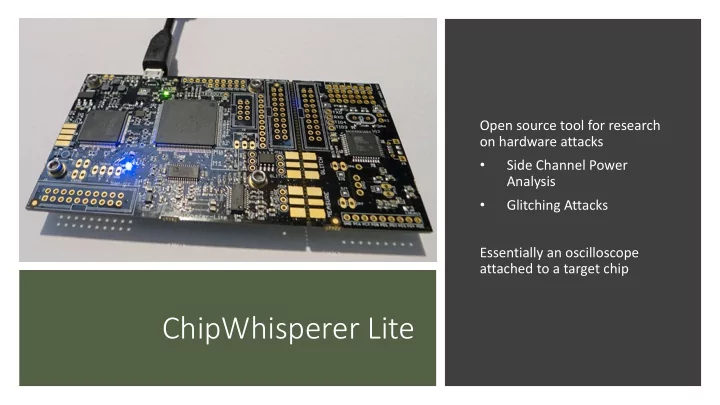
Open source tool for research on hardware attacks Side Channel Power Analysis Glitching Attacks Essentially an oscilloscope attached to a target chip ChipWhisperer Lite Modeling Power Consumption Every device requires power to run


slide-1
SLIDE 1

ChipWhisperer Lite

Open source tool for research

  • n hardware attacks
  • Side Channel Power

Analysis

  • Glitching Attacks

Essentially an oscilloscope attached to a target chip

slide-2
SLIDE 2

Modeling Power Consumption

Every device requires power to run (static power) Data moving through the device changes power consumption (dynamic power) Dynamic Power – Current required to charge or discharge data lines

00110000 transitioning to 00100011

  • 3 bits changed
slide-3
SLIDE 3

Correlation Power Analysis

Force target device to encrypt many different things Log traces of these different encryptions Analyze these different traces and determine subkeys BREAK ENCRYPTION!

slide-4
SLIDE 4

Setting up target device

  • Connect to Chipwhisper and set up target board
  • Connect_cwlite _simpleserial
slide-5
SLIDE 5

Setting up oscilloscope

  • Connect to Chipwhisper and set up scope to capture traces
  • Setup_cwlite_xmega_aes
slide-6
SLIDE 6

CAPTURE TRACES!

  • Settings on left
  • Captured traces displayed on the right
slide-7
SLIDE 7

Analyze Traces

  • attack_cpa
slide-8
SLIDE 8

Attacking AES Encryption

slide-9
SLIDE 9

Results table: first row (in white) is the “result key” from analysis. Note this is the same key as used to generate the traces!

slide-10
SLIDE 10

How’d it do that?

slide-11
SLIDE 11

How AES works:

  • AES algorithm XORs the key and data
  • Uses s-box defined lookup table to replace

data

  • S-box is public

and known

slide-12
SLIDE 12

Breaking AES

Above equation is the relationship between a hypothetical guess for each XOR equation (both key and data to encrypt) compared to the actual change in the trace

slide-13
SLIDE 13

Apply hypothetical guesses

  • Apply hypothetical guesses to each trace and see what matches
  • Keep track of which hypothetical has best guess
  • Percentage confidence is the [0,1] number below the results
slide-14
SLIDE 14

Results Table (again)