childrens homes? Does this differ from other situations/contexts? - - PDF document

children s homes
SMART_READER_LITE
LIVE PREVIEW

childrens homes? Does this differ from other situations/contexts? - - PDF document

11/20/2016 LEARNING TO FLY: Building a Resilient and Reflective Therapeutic Child Care Workforce 15 November 2016 Expectations Perspectives Potential Implications Dr Leslie Hicks Reader in Social Work Research School of Health and Social


slide-1
SLIDE 1

11/20/2016 1

Dr Leslie Hicks

Reader in Social Work Research

School of Health and Social Care lhicks@lincoln.ac.uk

LEARNING TO FLY: Building a Resilient and Reflective Therapeutic Child Care Workforce 15 November 2016

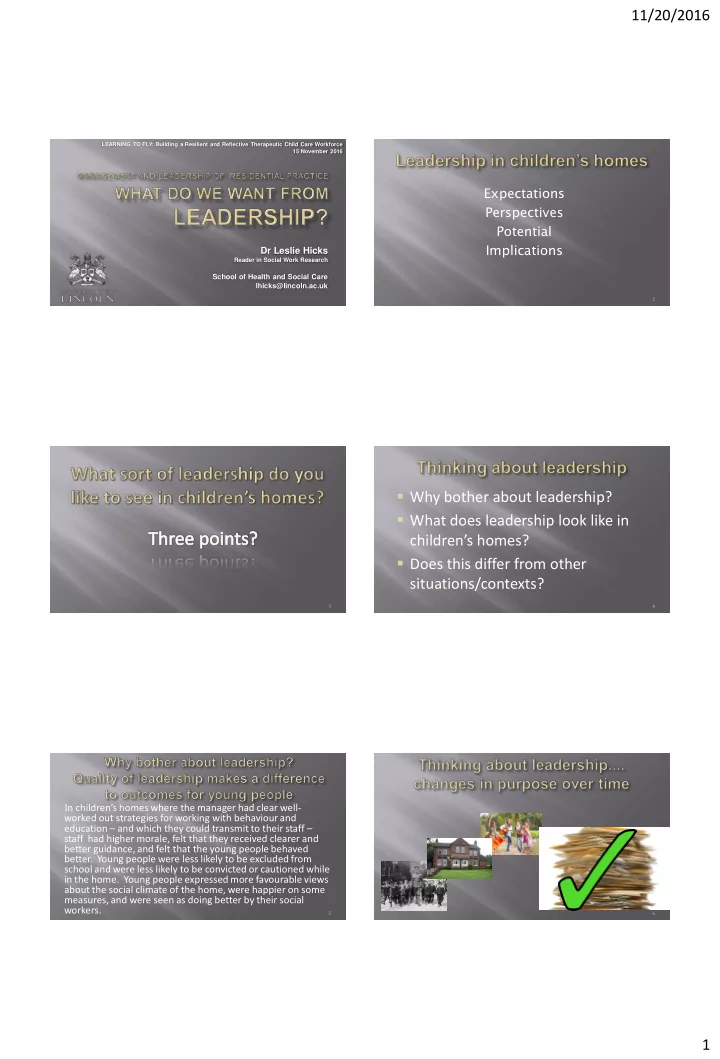
Expectations Perspectives Potential Implications

2 3

  • Why bother about leadership?
  • What does leadership look like in

children’s homes?

  • Does this differ from other

situations/contexts?

4

In children’s homes where the manager had clear well- worked out strategies for working with behaviour and education – and which they could transmit to their staff – staff had higher morale, felt that they received clearer and better guidance, and felt that the young people behaved

  • better. Young people were less likely to be excluded from

school and were less likely to be convicted or cautioned while in the home. Young people expressed more favourable views about the social climate of the home, were happier on some measures, and were seen as doing better by their social workers.

5 6

slide-2
SLIDE 2

11/20/2016 2

7

Apologies for the gendered vocabulary!

8

  • Reliably supportive enablers of practice
  • Alert to the value of autonomy
  • A conduit to ‘external worlds’
  • Insightful and experienced advisors

9

  • Dependable
  • Patient and kind
  • Open and fair
  • Consistent in their approach
  • A conduit to opportunities

10

Examined and linked together:

  • the role of managers
  • the different forms of leadership in operation
  • the ways resources were used
  • the care and outcomes experienced by young

people

11

  • Administer bureaucratic systems
  • Enable goal-oriented practice
  • Share roles and responsibilities
  • Establish collaborative cultures
  • Create, develop, maintain, and influence their staff

teams

12

slide-3
SLIDE 3

11/20/2016 3

  • Consistency across the group while focusing
  • n individual needs
  • Knowing and understanding needs and

characteristics

  • Building relationships – internally and

externally

13

Enabling others to develop, communicate, manage and model requires:

  • Collaboration
  • Sharing of tasks and responsibilities
  • Interdependency in relationships

These are essential components of both leadership and management in children’s homes

14 15

COLLABORATIVE APPROACH high levels of motivation manager’s authority accepted shared goals high levels of synergy all staff contribute WORKING CONSENSUS ACHIEVED

16

  • The manager’s role is highly influential – and this can

play out either positively or negatively

  • But the way leadership works and is held within the

home is not solely a matter for the manager/deputy

  • Positive leadership in children’s homes can be

subverted or enhanced by individual and/or collective contributions

  • Establishing and maintaining good leadership is an
  • ngoing process
  • Good leadership is a shared responsibility

17

  • Knowing and understanding the extent of

individual abilities and strengths

  • Developing coherence: shared goals,

expectations and approaches

  • Establishing and maintaining collaborative

cultures

18

slide-4
SLIDE 4

11/20/2016 4

  • All of the above relies on developing meaningful relationships
  • Routes to this will be both formal and informal
  • Formal support needs to be routinely delivered for both staff

and managers, including the views of young people

  • Supervision: needs to enable learning, development and

critical reflection, making use of meaningful supervision models and without falling off the end of the list of priorities

  • Robust communication opportunities, e.g. young people’s

meetings, team meetings, meetings with external managers

19 20

I expect my staff to professionally challenge each other and professionally criticise each other, and I’ve worked a long time now, for about two years on [this], when we professionally criticise each other, it’s not personal. Don’t run off and boo-hoo in the loos, it’s not a personal attack, it’s a professional

  • challenge. And it’s taken them some time to learn… And building that, you

know, it’s all about trust and respect for each other and consistency among the team. They’re the things I’m trying to nurture and foster with the adults because I think they transfer beautifully into the work for service users.

Emond, R., Steckley, L. and Roesch-Marsh, A. (2016) A Guide to Therapeutic Child Care: What You Need to Know to Create a Healing Home. London: Jessica Kingsley Publishers Hicks, L., Gibbs, I., Weatherly, H. and Byford, S. (2009). Management, leadership and resources in children's homes: What influences outcomes in residential child-care settings? British Journal of Social Work, 39(5), 828-845 Scottish Journal of Residential Child Care 14 (2): special issue on leadership and management in children’s homes, available at: https://www.celcis.org/knowledge-bank/search-bank/journal/scottish-journal- residential-child-care-vol-14-no-2/ Ward, A. (2014) Leadership in residential child care: A relationship–based approach. Norwich: The Smokehouse Press.

21

Dr Leslie Hicks lhicks@lincoln.ac.uk http://staff.lincoln.ac.uk/lhicks

22