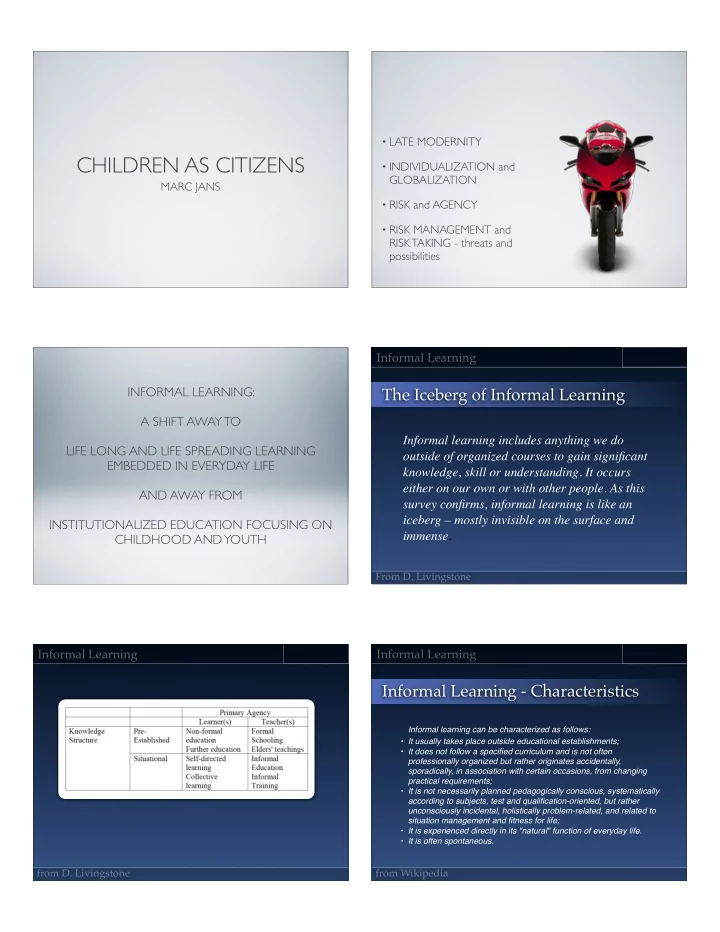
CHILDREN AS CITIZENS INDIVIDUALIZATION and GLOBALIZATION MARC JANS - - PDF document

children as citizens
SMART_READER_LITE
LIVE PREVIEW

CHILDREN AS CITIZENS INDIVIDUALIZATION and GLOBALIZATION MARC JANS - - PDF document

LATE MODERNITY CHILDREN AS CITIZENS INDIVIDUALIZATION and GLOBALIZATION MARC JANS RISK and AGENCY RISK MANAGEMENT and RISK TAKING - threats and possibilities Informal Learning INFORMAL LEARNING: The Iceberg of Informal


slide-1
SLIDE 1

CHILDREN AS CITIZENS

MARC JANS

  • LATE MODERNITY
  • INDIVIDUALIZATION and

GLOBALIZATION

  • RISK and AGENCY
  • RISK MANAGEMENT and

RISK TAKING - threats and possibilities

INFORMAL LEARNING: A SHIFT AWAY TO LIFE LONG AND LIFE SPREADING LEARNING EMBEDDED IN EVERYDAY LIFE AND AWAY FROM INSTITUTIONALIZED EDUCATION FOCUSING ON CHILDHOOD AND YOUTH

From D. Livingstone

Informal Learning

The Iceberg of Informal Learning

Informal learning includes anything we do

  • utside of organized courses to gain significant

knowledge, skill or understanding. It occurs either on our own or with other people. As this survey confirms, informal learning is like an iceberg – mostly invisible on the surface and immense.

from D. Livingstone

Informal Learning

from Wikipedia

Informal Learning

Informal Learning - Characteristics

Informal learning can be characterized as follows:

  • It usually takes place outside educational establishments;
  • It does not follow a specified curriculum and is not often

professionally organized but rather originates accidentally, sporadically, in association with certain occasions, from changing practical requirements;

  • It is not necessarily planned pedagogically conscious, systematically

according to subjects, test and qualification-oriented, but rather unconsciously incidental, holistically problem-related, and related to situation management and fitness for life;

  • It is experienced directly in its "natural" function of everyday life.
  • It is often spontaneous.
slide-2
SLIDE 2

from D. Livingstone

Informal Learning

Nearly everybody (over 90%) is involved in some form

  • f informal learning activities that they can identify as
  • significant. The average number of hours devoted to

informal learning activities by all Canadian adults

  • ver the past year was around 15 hours per week. This

is vastly more time than Canadian adults are spending in organized education courses (an average of about 3 hours per week if we include the entire population). from Wikipedia

Informal Learning

Existing definition and example

Informal knowledge is information that has not been externalized or captured and the primary locus of the knowledge may be inside someone's head. For example, in the case of language acquisition, a mother may teach a child basic concepts of grammar and language at home, prior to the child entering a formal education system In such a case, the mother has a tacit understanding of language structures, syntax and morphology, but she may not be explicitly aware of what these are. She understands the language and passes her knowledge on to her offspring.

Note: Above example is adult centric from Wikipedia

Informal Learning

Informal learning - examples

Other examples of informal knowledge transfer include instant messaging, a spontaneous meeting on the Internet, a phone call to someone who has information you need, a live one-time-only sales meeting introducing a new product, a chat-room in real time, a chance meeting by the water cooler, a scheduled Web-based meeting with a real-time agenda, a tech walking you through a repair process, or a meeting with your assigned mentor or manager. Experience indicates that much of the learning for performance is informal Those who transfer their knowledge to a learner are usually present in real time. Such learning can take place over the telephone or through the Internet, as well as in person.

Note: the above quote deals with knowledge transfer, not other sources of acquisition from D. Livingstone

Informal Learning

from D. Livingstone

Informal Learning

from D. Livingstone

Informal Learning

slide-3
SLIDE 3

from D. Livingstone

Informal Learning

  • Communication - write, speak, responsive, listen
  • Managing Self - learn, organization, manage strains, focus
  • Managing people and tasks - discussions, respond helpfully to

differences, influence,

  • Mobilizing Innovation and Change - Managing Ambiguity -

Research courses - creativity, risk taking, conceptualizing

  • Technical

Base Employment Competencies

from: source on diagram

Informal Learning

Time to Performance

Informal Learning

Childhooding Informal Learning

Footer

Formal Informal Image of the Child

  • bjects / subjects

agents / co-agents Location systems world life world Source expert system

self / others /environment

Process

  • rganized

bricolage Agenticity low high Reflexivity low high Age criteria chronological age experiential age

slide-4
SLIDE 4

PARTICIPATION DISCOURSES

  • CLOSE THE GAP BETWEEN INDIVIDUAL AND

COMMUNITY

  • SYSTEM PERSPECTIVE
  • LIFE WORLD PERSPECTIVE

SYSTEM PERSPECTIVE

  • FUNCTIONING OF SOCIETY
  • ADULT AGENDAS
  • ACTIVE WELFARE STATE - LABOUR MARKET - DEVALUE

CHILDREN - STILL IN SCHOOL

  • INSTRUMENTAL - GOAL IS TO MANAGE RISK
  • NEGLECT SPECIFICITY OF CHILDHOODS

LIFE-WORLD PERSPECTIVE

  • CITIZENSHIP IS MORE LIKE A LEARNING PROCESS IN

ITSELF and not an outcome of educational efforts

  • CHILDREN’S SENSIBILITIES (environment, peace, etc)

considered a base for actual citizenship rather than as a step along the way to actual citizenship

Historical Trends 18th and 19th century: strong social participation and minimal protection 20th Century: Children increasingly sequestered in the home and school and away from the labour market and other public institutions with the goal of educating them to become citizens. Citizenship became the exclusive territory of adults and an endpoint for children. Strong protection and minimal social participation. Children have become an object of observation for adults, especially professionals relying on a predominately psychological and pedagogical conception of children with little interest in the actual life of the child Now there is a tension between regulation and autonomy Learning to live and respond appropriately to this tension or ambivalence is the challenge

slide-5
SLIDE 5

Children are embedded in their society and culture but there are Some possible universal features of childhood: Giving meaning: the appropriation of ecological zones Play: adult centric notions - developmental and pedagogical for children, play allows them to be agents

CHILD SIZED CITIZENSHIP

  • Citizenship as a whole of rights

(e.g., vote) - dependency and protection

  • Citizenship as a whole of

responsibilities (e.g. be decent) - playfulness

  • Citizenship as identity(I am

Canadian) - zones

  • Citizenship as participation (e.g.,

involved in community life - adult child mutual dependency)

From a life world perspective and understanding of citizenship as social involvement and participation, we can define children as citizens.