Child Domestic Labour Rumpun Gema Perempuan (RGP), Mitra Imadei - - PowerPoint PPT Presentation

child domestic labour
SMART_READER_LITE
LIVE PREVIEW

Child Domestic Labour Rumpun Gema Perempuan (RGP), Mitra Imadei - - PowerPoint PPT Presentation

Child Domestic Labour Rumpun Gema Perempuan (RGP), Mitra Imadei & Bangun Mitra Sejati (BMS) What is Child Domestic Labour (CDls)? Definition: Child Domestic Labour? Domestic Work undertaken by children under the legal minimum working age,


slide-1
SLIDE 1

Rumpun Gema Perempuan (RGP), Mitra Imadei & Bangun Mitra Sejati (BMS)
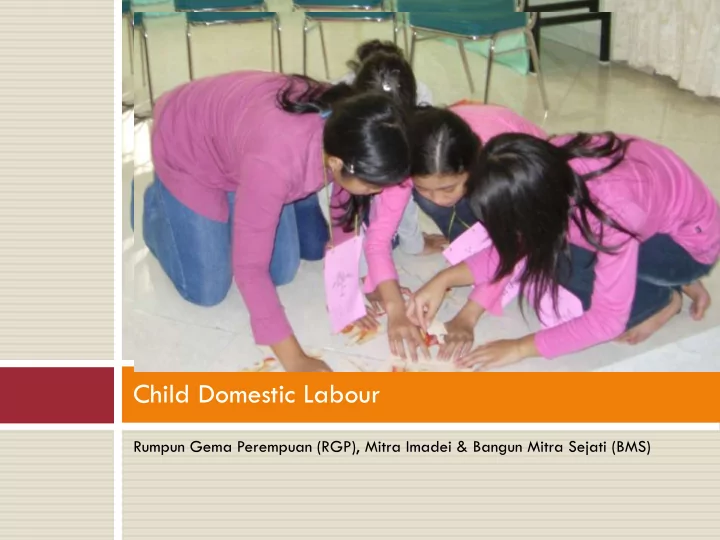
Child Domestic Labour

slide-2
SLIDE 2

What is Child Domestic Labour (CDls)?

Definition: Child Domestic Labour? Domestic Work undertaken by children under the legal minimum working age, as well as by children above the legal minimum age (but under the age of 18) under slavery like, hazardous or other exploitative conditions.

slide-3
SLIDE 3

Magnitude

No ILO Estimation (2003) JALA-PRT Estimation (2010) 1 Domestic Workers (2,5 million) Domestic Workers (10 million) 2 Child Domestic Labor (688,000), Six hundred eighty eight thousand CDWs. Child Domestic Labor (2,5 million) Note: 2/3 of Middle to Upper Class Families in 10 big cities in Indonesia hired Domestic Workers and Child Domestic Labor.

slide-4
SLIDE 4

Vulnerabilities of CDLs

 Work at the very youngest age (12-17 years)  Lack of skills and knowledge to do domestic chores  Uprooted from family roots (most of them migrate from

rural to urban areas)

 Excluded from “labor protection”  Lack of political will from Gov’t to withdrawn CDLs  Vulnerable from abuse (physical, mental and

economical)

 Impaired growth and development (health and

education)

slide-5
SLIDE 5

 Conducting direct services and assistances of education and

health for domestic workers and child domestic workers (F & NFE, Trainings).

 Providing technical assistance to strengthen their organizations

by organizing some trainings, sports and arts rehearsals.

 Providing legal, medical and social services for the victims.  Participating and influencing the government to prevent

trafficking for the purpose of domestic work and forced labor against women and children through policies and relevant activities (Workshop, Public Dialog, Conference etc).

 Involving volunteers from student of Universities in some

activities conducted.

Good Practices (RGP , MI, BMS Sejati)

slide-6
SLIDE 6

Successful Stories

 Withdrawing 574 (Five hundred seventy four) child

domestic labor from the worst form of child labor.

 350 (Three hundred fifty) children have

accomplished their basic education in Junior and Senior High Schools.

 5 (Five) organizations have been established in

District of Bekasi and South Tangerang City.

 Encouraging the program of CDWs in Ministry of

Woman and Empowerment, Child Protection Deputy and Ministry of Manpower and Transmigration.

slide-7
SLIDE 7

Mapping the Location

slide-8
SLIDE 8

Number of Children Withdrawn 574

slide-9
SLIDE 9

Challenges

* Non supportive attitude of employers toward CDWs rights of education and health. * Lack of motivation of CDWs to develop their self. * Lack of capable resources that are willing to work in NGO. * Lack of financial resources to fund the project. * Lack of legal Protection (Domestic worker’s Regulation)

slide-10
SLIDE 10

Current Needed

 Increasing the capacity of field staff to conduct

direct assistance for CDWs

 Providing scholarships for formal and non formal

education for CDWs, including trainings (life skills training).

 Organizing awareness raising to change the

behavior of community toward CDWs.

 Institutional support (utilities, learning centers, books)

slide-11
SLIDE 11

Documentation of Project

slide-12
SLIDE 12

Activities

Sewing Training Cooking

slide-13
SLIDE 13

Thank you very much ………… Contact Person:

  • 1. Aida Milasari (Rumpun Gema) 081314364563
  • 2. M.Clara Bastiani (Mitra Imadei) 08128033905
  • 3. Samsi (BMS Sejati) 08129891117

END