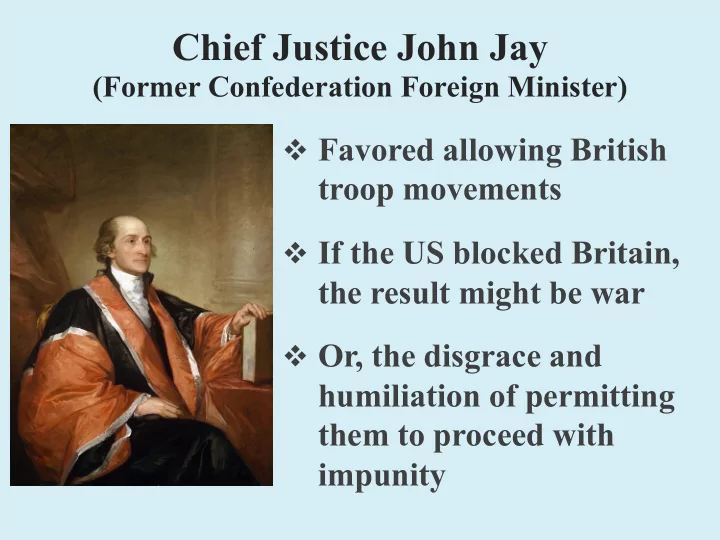
SLIDE 1
Chief Justice John Jay
(Former Confederation Foreign Minister) v Favored allowing British
troop movements
v If the US blocked Britain,
the result might be war
v Or, the disgrace and
humiliation of permitting them to proceed with impunity
SLIDE 2 Secretary of State Jefferson
v Jefferson saw the same
v But he proposed a “middle
course”: they should evasively “avoid giving any answer”
v Thus not embroiling the
infant US in another war
SLIDE 3 Vice President Adams
v Adams urged
regardless of the consequences
v Although he also hoped
that a refusal would lead to negotiations rather than war
SLIDE 4
Secretary of War Henry Knox
v Agreed with Adams: Britain
should be refused
v But, the US should also
worry about France: US still bound by 1778 alliance
v Should France ally with
Spain (very likely) it would expect US support
SLIDE 5 Secretary of War Henry Knox
v Should the US comply with
the 1778 French treaty or proclaim neutrality?
v US might find itself at war
with Britain, regardless of its
v French alliance threatened to
entangle the US in wars
SLIDE 6 Alexander Hamilton
v Hamilton took a more
pragmatic approach than the
v US had no hope of enforcing
a denial of the British
v US would thus derive a
greater benefit from simply giving Britain permission
SLIDE 7 A Negotiated Solution, 1790
v Many historians have
- verlooked this controversy
v Prospect of war a reminder
v Reinforced Washington’s
belief in neutrality
SLIDE 8
Washington and Nootka Sound
v Washington consulted a
large group of advisors
v Never called cabinet together v In fact, not until winter
1792–93 did he even refer to a “cabinet” or meet with them on a regular basis
SLIDE 9
French Revolution, 1789-1799
v Friendly relations, 1778- v Revolution’s violent turn,
1792-
v Polarization in US:
Jeffersonians identified with Revolution
v Federalists feared chaos
would jeopardize the US
SLIDE 10
Second Term Crises, 1793-1797
v Revolution intensifies, as do
tensions with Britain, France
v US political polarization v Anglo-French wars made it
seem unsafe to retire
v Even Jefferson urged him v Another term, reluctantly
SLIDE 11
Foreign Affairs: France
v Washington issued a
Proclamation of Neutrality, April 1793
v Washington cautiously
received the new French envoy, Edmond Charles Genet (“Citizen Genet”) May 1793
SLIDE 12
Jay’s Treaty, 1794
v Calls for war with Britain
widespread by 1794
v Washington sent Jay to
London
v France interpreted the treaty
as a US-British alliance
v France retaliated by seizing
US ships, personnel
SLIDE 13
Controversy over Jay’s Treaty
v Failed to deal with the
impressment problem and American neutrality
v Accepted British supremacy at
sea
v Did put off direct conflict
between America and its stronger rival
SLIDE 14
Washington’s Farewell Address: Dangers of Entangling Alliances
(Does Washington receive sufficient credit? Acts of prevention? Do no harm? A blundering president might have proved fatal)
SLIDE 15
John Adams, 1797-1801
v Struggled in office v Grappled with French and
British
v Franco-American “Quasi
War” 1797-1800
v Alien and Sedition Acts,
1798
SLIDE 16 Problems with France dominated the Adams administration
v France angry about US
refusal to pay Revolutionary debts
v France dismayed by
Anglo-US Jay Treaty
v French expected bribes;
public
SLIDE 17
Coup d'état of 18 Brumaire November 9, 1799
SLIDE 18
The US-French Convention of 1800: Ends 1798–1800 Quasi-War, terminates 1778 Treaty of Alliance
SLIDE 19
SLIDE 20
The French Revolution
v US caught between
Britain & France
v World at war (once
again)
v Britain & France
disrespected US rights with impunity
SLIDE 21
Jefferson and Foreign Affairs
v Frustrations of a pacifist v Barbary Wars, 1801-05 v Louisiana Purchase, 1803 v Perils of a neutral nation v Failed embargo, 1807-09
SLIDE 22
Louisiana Purchase, 1803 An “Empire for Liberty”?
SLIDE 23
US obtained 800,000 square miles between the Mississippi & the Rockies. Purchased from France for $15 million. Increases US territory by 140 percent.
SLIDE 24
Louisiana Purchase: all or portions of 15 states (TX, LA, AR, OK, MO, KS, CO, NE, IA, MN, WY, MT, SD, ND, NM)
SLIDE 25
Emperor Napoleon, 1806
SLIDE 26
Jefferson’s Disillusionment
v “It seemed as if everything
in that country for the last twelve or fifteen years had been a DREAM,” said a disillusioned Jefferson
v Now, he wished only for a
stable constitutional monarchy in France, with a return of the Bourbon dynasty!
SLIDE 27
USS Chesapeake vs. HMS Leopard June 22, 1807
3 Americans killed, 18 wounded; 4 impressed. Of the 4 impressed, only 1 British born! 2 African American, 1 a former slave!
SLIDE 28 Jefferson, Britain & France
v British “Orders in Council”
forbids trade with France,
v Napoleon forbids trade with
Britain, Dec. 17, 1807
v Jefferson signs Embargo Act,
- Dec. 1807, retaliation against
Britain & France (2nd Embargo Act, Jan. 1808)
SLIDE 29
Criticizing Jefferson’s Embargo: “Intercourse or Impartial Dealings”
Jefferson robbed by George III & Napoleon
SLIDE 30 Consequences of the Embargo
v Jefferson’s Embargo Acts
severely damaged economy
v US exports collapsed from
$108 million to $22 million!
v Economic depression settled
SLIDE 31
Congress Repeals Embargo, March 1809
SLIDE 32 Impressment of 8,000 Americans!
- Feb. 1811: Madison halts trade with Britain
unless Orders in Council are repealed. Britain vows to continue to seize US ships.
SLIDE 33
SLIDE 34
Declaration of War
v June 1: Message to Congress,
justifying war with Britain
v June 4: House votes 79-49 for war v June 16: To avoid war with US,
Britain revokes Orders in Council
v News reaches US too late! v June 17: Senate votes 19-13 for
declaration of war (close votes!)
SLIDE 35
Napoleon Crosses the Nieman June 24, 1812