Chapter 6: Contemporary Symmetric Ciphers Dr. Loai Tawalbeh - - PDF document

chapter 6 contemporary symmetric ciphers
SMART_READER_LITE
LIVE PREVIEW

Chapter 6: Contemporary Symmetric Ciphers Dr. Loai Tawalbeh - - PDF document

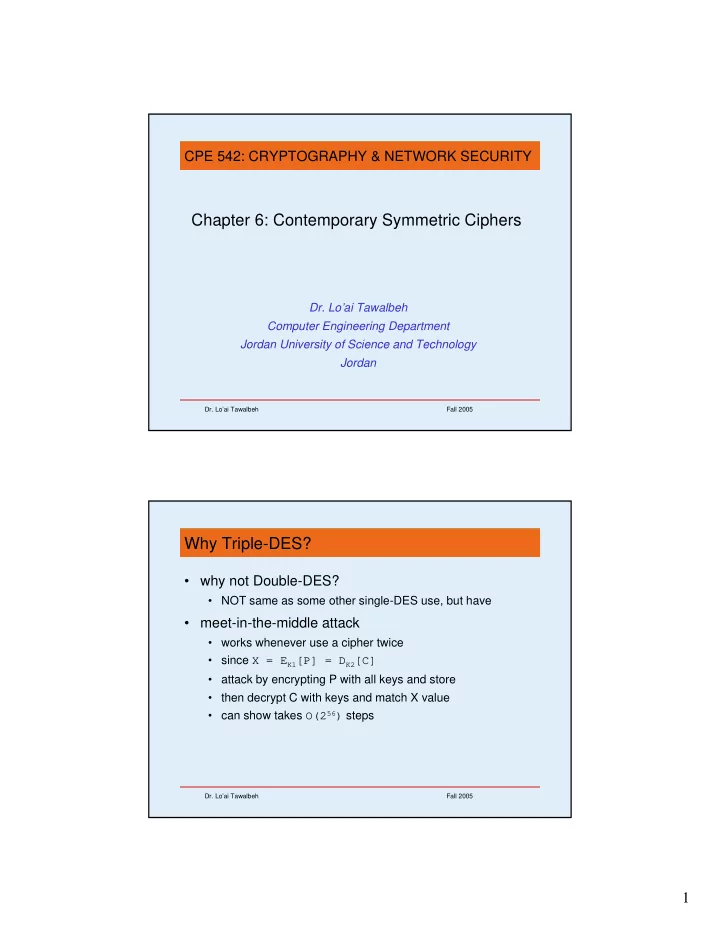
CPE 542: CRYPTOGRAPHY & NETWORK SECURITY Chapter 6: Contemporary Symmetric Ciphers Dr. Loai Tawalbeh Computer Engineering Department Jordan University of Science and Technology Jordan Dr. Loai Tawalbeh Fall 2005 Why Triple-DES?


slide-1
SLIDE 1

1

  • Dr. Lo’ai Tawalbeh

Fall 2005

Chapter 6: Contemporary Symmetric Ciphers

  • Dr. Lo’ai Tawalbeh

Computer Engineering Department Jordan University of Science and Technology Jordan

CPE 542: CRYPTOGRAPHY & NETWORK SECURITY

  • Dr. Lo’ai Tawalbeh

Fall 2005

Why Triple-DES?

  • why not Double-DES?
  • NOT same as some other single-DES use, but have
  • meet-in-the-middle attack
  • works whenever use a cipher twice
  • since X = EK1[P] = DK2[C]
  • attack by encrypting P with all keys and store
  • then decrypt C with keys and match X value
  • can show takes O(256) steps
slide-2
SLIDE 2

2

  • Dr. Lo’ai Tawalbeh

Fall 2005

Triple-DES with Two-Keys

  • hence must use 3 encryptions
  • would seem to need 3 distinct keys
  • but can use 2 keys with E-D-E sequence
  • C = EK1[DK2[EK1[P]]]
  • nb encrypt & decrypt equivalent in security
  • if K1=K2 then can work with single DES
  • no current known practical attacks
  • Dr. Lo’ai Tawalbeh

Fall 2005

Triple-DES with Three-Keys

  • although are no practical attacks on two-key Triple-DES

have some indications

  • can use Triple-DES with Three-Keys to avoid even

these

  • C = EK3[DK2[EK1[P]]]
  • has been adopted by some Internet applications, eg

PGP, S/MIME

slide-3
SLIDE 3

3

  • Dr. Lo’ai Tawalbeh

Fall 2005

Blowfish

  • a symmetric block cipher designed by Bruce Schneier

in 1993/94

  • characteristics
  • fast implementation on 32-bit CPUs
  • compact in use of memory
  • simple structure for analysis/implementation
  • variable security by varying key size
  • has been implemented in various products
  • Dr. Lo’ai Tawalbeh

Fall 2005

Blowfish Key Schedule

  • uses a 32 to 448 bit key, 32-bit words stored in K-array Kj ,j from 1

to 14

  • used to generate
  • 18 32-bit subkeys stored in P array, P1 ….P18
  • four 8x32 S-boxes stored in Si,j , each with 256 32-bit entries
  • Subkeys and S-Boxes Generation:

1- initialize P-array and then 4 S-boxes in order using the fractional part of pi P1 ( left most 32-bit), and so on,,, S4,255. 2- XOR P-array with key-Array (32-bit blocks) and reuse as needed: assume we have up to k10 then P10 XOR K10,, P11 XOR K1 … P18 XOR K8

slide-4
SLIDE 4

4

  • Dr. Lo’ai Tawalbeh

Fall 2005

Blowfish: SubKey and S-Boxes -cont.

3- Encrypt 64-bit block of zeros, and use the result to update P1 and P2. 4- encrypting output form previous step using current P & S and replace P3 and P4. Then encrypting current output and use it to update successive pairs of P. 5- After updating all P’s (last :P17 P18), start updating S values using the encrypted output from previous step.

  • requires 521 encryptions, hence slow in re-keying
  • Not suitable for limited-memory applications.
  • Dr. Lo’ai Tawalbeh

Fall 2005

Blowfish Encryption

  • uses two main operations: addition modulo 232 , and XOR
  • data is divided into two 32-bit halves L0 & R0

for i = 1 to 16 do Ri = Li-1 XOR Pi; Li = F[Ri] XOR Ri-1; L17 = R16 XOR P18; R17 = L16 XOR P17;

  • where

F[a,b,c,d] = ((S1,a + S2,b) XOR S3,c) + S4,d

slide-5
SLIDE 5

5

  • Dr. Lo’ai Tawalbeh

Fall 2005

Blowfish Encryption/Decryption

  • Dr. Lo’ai Tawalbeh

Fall 2005

Blowfish Encryption

slide-6
SLIDE 6

6

  • Dr. Lo’ai Tawalbeh

Fall 2005

Discussion

  • key dependent S-boxes and subkeys, generated using

cipher itself, makes analysis very difficult

  • changing both halves in each round increases security
  • provided key is large enough, brute-force key search is

not practical, especially given the high key schedule cost

  • Dr. Lo’ai Tawalbeh

Fall 2005

RC5

  • can vary key size / data size / variable rounds
  • very clean and simple design
  • easy implementation on various CPUs
  • yet still regarded as secure
slide-7
SLIDE 7

7

  • Dr. Lo’ai Tawalbeh

Fall 2005

RC5 Ciphers

  • RC5 is a family of ciphers RC5-w/r/b
  • w = word size in bits (16/32/64). Encrypts 2w data blocks
  • r = number of rounds (0..255)
  • b = number of bytes in the key (0..255)
  • nominal version is RC5-32/12/16
  • ie 32-bit words so encrypts 64-bit data blocks
  • using 12 rounds
  • with 16 bytes (128-bit) secret key
  • Dr. Lo’ai Tawalbeh

Fall 2005

RC5 Key Expansion

  • RC5 uses t=2r+2 subkey words (w-bits)
  • subkeys are stored in array S[i], i=0..t-1
  • then the key schedule consists of
  • initializing S to a fixed pseudorandom value, based on

constants e and phi

  • the byte key is copied into a c-words array L
  • a mixing operation then combines L and S to form the final S

array

slide-8
SLIDE 8

8

  • Dr. Lo’ai Tawalbeh

Fall 2005

RC5 Key Expansion

  • Dr. Lo’ai Tawalbeh

Fall 2005

RC5 Encryption

  • Three main operations: + mod 2w, XOR, circular left shift <<<, and

there inverses used.

  • split input into two halves A & B (w-bits each)

L0 = A + S[0]; R0 = B + S[1]; for i = 1 to r do Li = ((Li-1 XOR Ri-1) <<< Ri-1) + S[2 x i]; Ri = ((Ri-1 XOR Li) <<< Li) + S[2 x i + 1];

  • each round is like 2 DES rounds
  • note rotation is main source of non-linearity
  • need reasonable number of rounds (eg 12-16)
slide-9
SLIDE 9

9

  • Dr. Lo’ai Tawalbeh

Fall 2005

RC5 Encryption

  • Dr. Lo’ai Tawalbeh

Fall 2005

RC5 Modes

  • 4 modes used by RC5:
  • RC5 Block Cipher, is ECB mode
  • RC5-CBC, is CBC mode
  • RC5-CBC-PAD, is CBC with padding by bytes with value being

the number of padded bytes

  • RC5-CTS, a variant of CBC which is the same size as the
  • riginal message, uses ciphertext stealing to keep size same

as original

slide-10
SLIDE 10

10

  • Dr. Lo’ai Tawalbeh

Fall 2005

RC5 Modes-Ciphertext Stealing (CTS) mode

  • Dr. Lo’ai Tawalbeh

Fall 2005

Block Cipher Characteristics

  • features seen in modern block ciphers are:
  • variable key length / block size / rounds
  • mixed operators, data/key dependent rotation
  • key dependent S-boxes
  • more complex key scheduling
  • operation of full data in each round
  • varying non-linear functions
slide-11
SLIDE 11

11

  • Dr. Lo’ai Tawalbeh

Fall 2005

Stream Ciphers

  • process the message bit by bit (as a stream)
  • typically have a (pseudo) random stream key
  • combined (XOR) with plaintext bit by bit
  • randomness of stream key completely destroys any statistical

properties in the message

  • Ci = Mi XOR StreamKeyi
  • what could be simpler!!!!
  • but must never reuse stream key
  • therwise can remove effect and recover messages
  • Dr. Lo’ai Tawalbeh

Fall 2005

Stream Cipher Properties

  • some design considerations are:
  • long period with no repetitions
  • statistically random
  • depends on large enough key
  • confusion
  • diffusion
  • use of highly non-linear boolean functions
slide-12
SLIDE 12

12

  • Dr. Lo’ai Tawalbeh

Fall 2005

RC4

  • Designed in 1987 as a proprietary cipher owned by RSA
  • simple but effective, widely used: (SSL/TLS standards)
  • variable key size (1 to 256 bytes), byte-oriented stream cipher
  • key forms random permutation of all 8-bit values
  • uses that permutation to scramble input info processed a byte at a

time

  • fast Software implementations.
  • Dr. Lo’ai Tawalbeh

Fall 2005

RC4 Key Schedule

  • starts with an array S of numbers: S[0]=0, …S[255] =255
  • Also initialize T with the key. T[i]= K[ i mod keylength]
  • use key to well and truly shuffle
  • S forms internal state of the cipher
  • given a key k of length l bytes

for i = 0 to 255 do S[i] = i j = 0 for i = 0 to 255 do j = (j + S[i] + k[i mod l]) (mod 256) swap (S[i], S[j])

slide-13
SLIDE 13

13

  • Dr. Lo’ai Tawalbeh

Fall 2005

RC4 Encryption

  • encryption continues shuffling array values
  • sum of shuffled pair selects "stream key" value
  • XOR with next byte of message to en/decrypt

i = j = 0 for each message byte Mi i = (i + 1) (mod 256) j = (j + S[i]) (mod 256) swap(S[i], S[j]) t = (S[i] + S[j]) (mod 256) Ci = Mi XOR S[t]

  • Dr. Lo’ai Tawalbeh

Fall 2005

RC4 Security

  • claimed secure against known attacks
  • have some analyses, none practical
  • result is very non-linear
  • since RC4 is a stream cipher, must never reuse a key
slide-14
SLIDE 14

14

  • Dr. Lo’ai Tawalbeh

Fall 2005

Summary

  • have considered:
  • some other modern symmetric block ciphers
  • Triple-DES
  • Blowfish
  • RC5
  • briefly introduced stream ciphers
  • RC4