Chapter 4 Pick Preparation just in time, the growth in online - - PDF document

chapter 4 pick preparation
SMART_READER_LITE
LIVE PREVIEW

Chapter 4 Pick Preparation just in time, the growth in online - - PDF document

2017/10/19 Chapter 4 Pick Preparation just in time, the growth in online shopping smaller order quantities and more frequent deliveries (p.77) 1 Order Picking: Introduction most costly activity in the warehouse picking 50%, receiving


slide-1
SLIDE 1

2017/10/19 1

Chapter 4 Pick Preparation

1

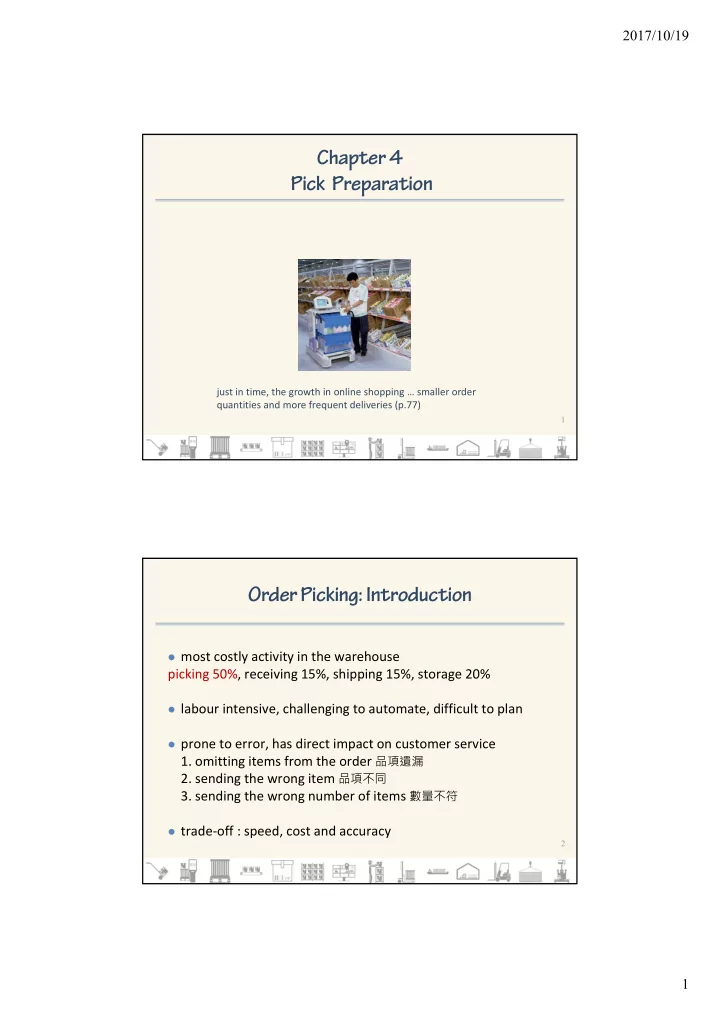
just in time, the growth in online shopping … smaller order quantities and more frequent deliveries (p.77)

Order Picking: Introduction

 most costly activity in the warehouse

picking 50%, receiving 15%, shipping 15%, storage 20%

 labour intensive, challenging to automate, difficult to plan  prone to error, has direct impact on customer service

  • 1. omitting items from the order 品項遺漏
  • 2. sending the wrong item 品項不同
  • 3. sending the wrong number of items 數量不符

 trade‐off : speed, cost and accuracy

2

slide-2
SLIDE 2

2017/10/19 2

Key performance measures for picking operations.

3

Picking Interrelated Decisions

4

slide-3
SLIDE 3

2017/10/19 3

Preparation: ABC classification

 Pareto’s Law or the 80/20 rule. (P.79)  roughly 80% of effects come from 20% of causes.  concentrate time and resources on the important 20% or the

‘vital few’.

 ABC classification can produce an effective warehouse layout.

儲位規畫

5

Examples of the 80/20 rule in Warehouse

 80 ﹪of sales come from the top 20 % of the product lines.  80 % of sales come from 20 % of the customers.  80 % of profits come from 20 % of the customers .  80 % of profits come from the top 20 % of products.  80 % of the cube usage within the warehouse comes from 20 %

  • f the products. (?)

 80 % of the inventory value is in 20 % of the products.  80 % of problems come from 20 % of your suppliers.  80 % of complaints come from 20 % of the customers .  80 % of staff problems come from 20 % of your workforce.

6

品項

slide-4
SLIDE 4

2017/10/19 4

Figure 4.2 Pareto’s Law(Sales)

7

品項數 單位數 重量 體積

Figure 4.3 Pareto Analysis of Orders and SKU

8

(P.79)

slide-5
SLIDE 5

2017/10/19 5

9

ABC classification 雖然可以用來輔助倉庫的設施佈置,但並無法僅以 ABC classification 來做決定,還須納入其他考慮因素,如:揀貨次數、 產品體積與重量與特殊情形(如:高價值商品)。

Double ABC Categorization

 Picking area layout should be based on the number of pick‐face

visits … such as high security items. P.81

 combine two factors : case volume and frequency

10

出貨金額 訂購次數

slide-6
SLIDE 6

2017/10/19 6

11

different strategies can be introduced for each of the sectors 簡化訂貨 供應商關係

降低進價 提高售價

最佳化 盤點庫存 單價高 降低補貨時間 風險高 需求預測 (P.82)

12

total demand  picking frequency

slide-7
SLIDE 7

2017/10/19 7

Preparation: Slotting

 Calculates the optimum location for products.  Take into account value, cube, weight, crushability, and

seasonality.

 Placing fast moving products close to despatch.  Very fast‐moving lines will require multiple faces to avoid a

bottleneck at a single location

 Place items that frequently ship together next to each other.

(bolts and nuts)

 Goal is to reduce travel time.

13

排面

14

Demand Correlation Analysis

衣服的款式 品項的尺寸 顏色

Table 4.4

slide-8
SLIDE 8

2017/10/19 8

Preparation: Order Analysis

 How many different product codes make up an order? (B2B vs.

B2C)

 How many pick locations we will visit for each order?  Which pick method to use ?  How much space to allocate ?  Where and how to store the product?

15

Order Analysis ―Lines per Order:

16

(P.86)

slide-9
SLIDE 9

2017/10/19 9

17

With such a large number of single‐line orders we also need to determine whether these are standard orders or possibly back orders.

Family group 6

(p.87)

Cube per order index (COI)

 the ratio of a product line’s space requirement at the pick

face to the number of picks per day. 出貨量體積/揀貨次數

 The lower the COI, the better the space utilization of the

  • product. It should be placed nearer to the despatch bay.

 B2C: small cube orders  roll cage or trolley 以推車批次揀貨  B2B: larger cube orders  pallet trucks or pallet jacks. 以拖板

車單一揀貨

18

slide-10
SLIDE 10

2017/10/19 10

Cube Movement Distribution

 Decide on the most appropriate storage mode.

19

suggests bin, shelf, flow rack, carousel storage Pallet storage

20

Preparation: Warehouse pick area layout

傳統倉儲規劃包含

  • 候補儲貨區
  • 貨箱揀選區
  • 零箱揀選區
slide-11
SLIDE 11

2017/10/19 11

Preparation: Picking Route

Pick sequence as per the most effective route beginning at the front of the racking nearest the despatch bays.

Heaviest items are picked first.

able to pick from both sides. ( Fig. 4.9 )

Shortcuts are programmed into the system to minimize travel. (Fig. 4.8)

The picker ends up as close to the despatch area as possible.

The most popular items need to be set up to avoid congestion at the pick

  • bays. 避免過度集中A類

21

Supermarket Psychology: Supermarket Layout https://www.youtube.com/watch?v=g3IwOgA3Ngw

22

slide-12
SLIDE 12

2017/10/19 12

23

the aisles are numbered, not the rows of racking

01 (row) 06 (bay) 01 (ground floor)

Preparation: Information

Information required to determine the most effective picking system :

dimensions and weight of the product

product group (hazardous, temperature sensitive, high value, etc.)

total number of SKUs by category (ABC)

total number of orders in a period 訂單量尖離峰變化

total number of deliveries

mode and average number of lines per order (EN)

mode and average number of units per line (IQ)

pick‐face visits per SKU (IK)

item, case or full‐pallet picks by SKU 品項的出貨單位

typical family groupings

items sold together frequently.

24

slide-13
SLIDE 13

2017/10/19 13

25

EIQ analysis

E (訂單 order Entry), I (品項 Item), Q (數量 Quantity) 常用統計包括平均值、最大與最小值、次數分佈、Pareto分析 訂單量(EQ)分析:瞭解單張訂單總訂購量的分佈情況(≈COI), 可用於決定訂單分批或個別處理的原則、揀貨系統的規劃, 並影響出貨方式及出貨區規劃 訂單品類數(EN)分析:單張訂單訂購品項數的分析 品類數量(IQ)分析:瞭解各品項出貨量的分佈情況,分析品項 的重要程度與庫存規模,用於倉儲設備的選用、儲存空間 的估算,並將影響揀貨方式及揀貨區的規劃 品項受訂次數(IK)分析:單一品項出貨次數的分析

26

Line Items

I1 I2 I3 I4 I5 I6 EN EQ

Order

E1 3 5 1 2 3 5 14 E2 2 4 6 7 4 19 E3 4 8 2 12 E4 2 8 3 5 2 5 20 IK 4 2 1 3 3 3 IQ 11 13 4 10 14 13

slide-14
SLIDE 14

2017/10/19 14

Make Picking Easy and Comfortable

 good lighting (>200 lux, <5000K)  ergonomic equipment  equipment aids (scanners, voice, RFID)  assistance with heavy items  placement of product: easy‐to‐reach shelf locations  clear and unambiguous labels

27

Summary and Conclusion

Ten Commandments of picking (p.93)

  • 1. Design for flexibility and scalability.
  • 2. Keep pickers picking.

3 Minimize travel.

  • 4. Minimize product touches. 降低產品接觸
  • 5. Never let pickers arrive at an empty location. 揀貨時不缺貨
  • 6. Measure, measure, measure.
  • 7. Pick logically, slot intelligently. 儲位安排、揀貨順序
  • 8. Pick accurately.
  • 9. Continue to learn and explore.
  • 10. Advocate continuous improvement.

28