SLIDE 1
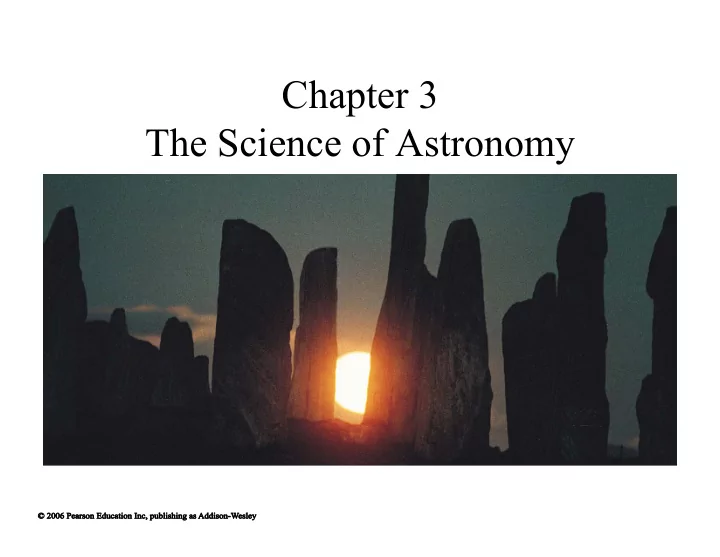
Chapter 3 The Science of Astronomy
SLIDE 2 3.1 The Ancient Roots of Science
- In what ways do all humans employ
scientific thinking?
- How did astronomical observations benefit
ancient societies?
- What did ancient civilizations achieve in
astronomy?
Our goals for learning:
SLIDE 3 In what ways do all humans employ scientific thinking?
- Scientific thinking is based on everyday
ideas of observation and trial-and-error experiments.
SLIDE 4 How did astronomical observations benefit ancient societies?
- Keeping track of time and seasons
– for practical purposes, including agriculture – for religious and ceremonial purposes
SLIDE 5
Ancient people of central Africa (6500 BC) could predict seasons from the orientation of the crescent moon
SLIDE 6
Days of week were named for Sun, Moon, and visible planets
SLIDE 7 What did ancient civilizations achieve in astronomy?
- Daily timekeeping
- Tracking the seasons and calendar
- Monitoring lunar cycles
- Monitoring planets and stars
- Predicting eclipses
- And more…
SLIDE 8
Shadows tell time of day.
SLIDE 9
England: Stonehenge (completed around 1550 B.C.)
SLIDE 10
England: Stonehenge (1550 B.C.)
SLIDE 11
Mexico: model of the Templo Mayor
SLIDE 12
New Mexico: Anasazi kiva aligned north-south
SLIDE 13
SW United States: “Sun Dagger” marks summer solstice
SLIDE 14
Scotland: 4,000-year-old stone circle; Moon rises as shown here every 18.6 years.
SLIDE 15
Peru: Lines and patterns, some aligned with stars.
SLIDE 16
Macchu Pichu, Peru: Structures aligned with solstices.
SLIDE 17 South Pacific: Polynesians were very skilled in art of celestial navigation
SLIDE 18
France: Cave paintings from 18,000 B.C. may suggest knowledge of lunar phases (29 dots)
SLIDE 19 China: Earliest known records of supernova explosions (1400 B.C.)
Bone or tortoise shell inscription from the 14th century BC. "On the Xinwei day the new star dwindled."
"On the Jisi day, the 7th day
big new star appeared in the company of the Ho star."
SLIDE 20 What have we learned?
- In what ways do all humans employ scientific
thinking? – Scientific thinking involves the same type of trial and error thinking that we use in our everyday live, but in a carefully organized way.
- How did astronomical observations benefit
ancient societies? – Keeping track of time and seasons; navigation
SLIDE 21 What have we learned?
- What did ancient civilizations achieve in
astronomy?
– To tell the time of day and year, to track cycles of the Moon, to observe planets and
- stars. Many ancient structures aided in
astronomical observations.
SLIDE 22 3.2 Ancient Greek Science
- Why does modern science trace its roots to
the Greeks?
- How did the Greeks explain planetary
motion?
- How was Greek knowledge preserved
through history?
Our goals for learning:
SLIDE 23
Our mathematical and scientific heritage originated with the civilizations of the Middle East
SLIDE 24
Artist’s reconstruction of Library of Alexandria
SLIDE 25
people known to make models of nature.
patterns in nature without resorting to myth or the supernatural. Greek geocentric model (c. 400 B.C.)
Why does modern science trace its roots to the Greeks?
SLIDE 26
Special Topic: Eratosthenes measures the Earth (c. 240 BC)
Calculate circumference of Earth: 7/360 × (circum. Earth) = 5000 stadia ⇒ circum. Earth = 5000 × 360/7 stadia ≈ 250,000 stadia Measurements: Syene to Alexandria distance ≈ 5000 stadia angle = 7° Compare to modern value (≈ 40,100 km): Greek stadium ≈ 1/6 km ⇒ 250,000 stadia ≈ 42,000 km
SLIDE 27 Underpinnings of the Greek geocentric model: Plato Aristotle
How did the Greeks explain planetary motion?
- Earth at the center of the universe
- Heavens must be “perfect”: Objects
moving on perfect spheres or in perfect circles.
SLIDE 28
But this made it difficult to explain apparent retrograde motion of planets…
Review: Over a period of 10 weeks, Mars appears to stop, back up, then go forward again.
SLIDE 29 The most sophisticated geocentric model was that of Ptolemy (A.D. 100-170) — the Ptolemaic model:
remain in use for 1,500 years.
Ptolemy’s work named Almagest (“the greatest compilation”) Ptolemy
SLIDE 30
So how does the Ptolemaic model explain retrograde motion? Planets really do go backward in this model..
SLIDE 31 How was Greek knowledge preserved through history?
- Muslim world preserved and enhanced the knowledge they
received from the Greeks
- Al-Mamun’s House of Wisdom in Baghdad was a great
center of learning around A.D. 800
- With the fall of Constantinople (Istanbul) in 1453, Eastern
scholars headed west to Europe, carrying knowledge that helped ignite the European Renaissance.
SLIDE 32 What have we learned?
- Why does modern science trace its roots to the
Greeks? – They developed models of nature and emphasized that the predictions of models should agree with observations
- How did the Greeks explain planetary motion?
– The Ptolemaic model had each planet move
- n a small circle whose center moves around
Earth on a larger circle
SLIDE 33 What have we learned?
- How was Greek knowledge preserved
through history?
– While Europe was in its Dark Ages, Islamic scientists preserved and extended Greek science, later helping to ignite the European Renaissance
SLIDE 34 3.3 The Copernican Revolution
- How did Copernicus, Tycho, and Kepler
challenge the Earth-centered idea?
- What are Kepler’s three laws of planetary
motion?
- How did Galileo solidify the Copernican
revolution?
Our goals for learning:
SLIDE 35 How did Copernicus, Tycho, and Kepler challenge the Earth-centered idea?
Copernicus (1473-1543):
- Proposed Sun-centered model
(published 1543)
- Used model to determine layout of
solar system (planetary distances in AU) But . . .
- Model was no more accurate than
Ptolemaic model in predicting planetary positions, because it still used perfect circles.
SLIDE 36 Tycho Brahe (1546-1601)
- Compiled the most accurate (one
arcminute) naked eye measurements ever made of planetary positions.
- Still could not detect stellar parallax,
and thus still thought Earth must be at center of solar system (but recognized that other planets go around Sun)
- Hired Kepler, who used Tycho’s
- bservations to discover the truth about
planetary motion.
SLIDE 37 Johannes Kepler (1571-1630)
- Kepler first tried to match Tycho’s
- bservations with circular orbits
- But an 8-arcminute discrepancy led
him eventually to ellipses… “If I had believed that we could ignore these eight minutes [of arc], I would have patched up my hypothesis accordingly. But, since it was not permissible to ignore, those eight minutes pointed the road to a complete reformation in astronomy.”
SLIDE 38
An ellipse looks like an elongated circle What is an ellipse?
SLIDE 39
Eccentricity of an Ellipse
SLIDE 40
Kepler’s First Law: The orbit of each planet around the Sun is an ellipse with the Sun at one focus. What are Kepler’s three laws of planetary motion?
SLIDE 41 Kepler’s Second Law: As a planet moves around its
- rbit, it sweeps out equal areas in equal times.
⇒ means that a planet travels faster when it is nearer to the Sun and slower when it is farther from the Sun.
SLIDE 42
SLIDE 43
More distant planets orbit the Sun at slower average speeds, obeying the relationship
p2 = a3
p = orbital period in years a = avg. distance from Sun in AU
Kepler’s Third Law
SLIDE 44
Kepler’s Third Law
SLIDE 45
Graphical version of Kepler’s Third Law
SLIDE 46 How did Galileo solidify the Copernican revolution?
Galileo (1564-1642) overcame major
- bjections to Copernican view. Three
key objections rooted in Aristotelian view were:
- 1. Earth could not be moving because
- bjects in air would be left behind.
- 2. Non-circular orbits are not “perfect”
as heavens should be.
- 3. If Earth were really orbiting Sun,
we’d detect stellar parallax.
SLIDE 47 Galileo’s experiments showed that objects in air would stay with a moving Earth. Overcoming the first objection (nature of motion):
- Aristotle thought that all objects naturally come to rest.
- Galileo showed that objects will stay in motion unless
a force acts to slow them down (Newton’s first law of motion).
SLIDE 48 Overcoming the second objection (heavenly perfection):
- Tycho’s observations of comet and
supernova already challenged this idea.
- Using his telescope, Galileo saw:
- Sunspots on Sun (“imperfections”)
- Mountains and valleys on the Moon
(proving it is not a perfect sphere)
SLIDE 49
- Tycho thought he had measured stellar distances, so
lack of parallax seemed to rule out an orbiting Earth.
- Galileo showed stars must be much farther than
Tycho thought — in part by using his telescope to see the Milky Way is countless individual stars. If stars were much farther away, then lack of detectable parallax was no longer so troubling. Overcoming the third objection (parallax):
SLIDE 50 Galileo also saw four moons orbiting Jupiter, proving that not all objects
SLIDE 51 Galileo’s observations of phases of Venus proved that it
- rbits the Sun and not Earth.
SLIDE 52
Galileo Galilei The Catholic Church ordered Galileo to recant his claim that Earth orbits the Sun in 1633 His book on the subject was removed from the Church’s index of banned books in 1824 Galileo was formally vindicated by the Church in 1992
SLIDE 53 What have we learned?
- How did Copernicus, Tycho and Kepler
challenge the Earth-centered idea?
– Copernicus created a sun-centered model; Tycho provided the data needed to improve this model; Kepler found a model that fit Tycho’s data
- What are Kepler’s three laws of planetary
motion?
– 1. The orbit of each planet is an ellipse with the Sun at one focus – 2. As a planet moves around its orbit it sweeps our equal areas in equal times – 3. More distant planets orbit the Sun at slower average speeds: p2 = a3
SLIDE 54 What have we learned?
- What was Galileo’s role in solidifying the
Copernican revolution?
– His experiments and observations overcame the remaining objections to the Sun-centered solar system
SLIDE 55 3.4 The Nature of Science
- How can we distinguish science from
nonscience?
- What is a scientific theory?
Our goals for learning:
SLIDE 56 How can we distinguish science from non-science?
- Defining science can be surprisingly difficult.
- Science from the Latin scientia, meaning “knowledge.”
- But not all knowledge comes from science…
SLIDE 57 The idealized scientific method
testing hypotheses
- hypothesis = educated guess
SLIDE 58 But science rarely proceeds in this idealized way… For example:
- Sometimes we start by “just looking” then
coming up with possible explanations.
- Sometimes we follow our intuition rather
than a particular line of evidence.
SLIDE 59 Hallmarks of Science: #1
Modern science seeks explanations for
- bserved phenomena that rely solely on
natural causes.
(A scientific model cannot include divine intervention)
SLIDE 60 Hallmarks of Science: #2
Science progresses through the creation and testing of models of nature that explain the
- bservations as simply as possible.
(Simplicity = “Occam’s razor”)
SLIDE 61 Hallmarks of Science: #3
A scientific model must make testable predictions about natural phenomena that would force us to revise or abandon the model if the predictions do not agree with
SLIDE 62 What is a scientific theory?
- The word theory has a different meaning in
science than in everyday life.
- In science, a theory is NOT the same as a
hypothesis, rather:
- A scientific theory must:
—Explain a wide variety of observations with a few simple principles, AND —Must be supported by a large, compelling body of evidence. —Must NOT have failed any crucial test of its validity.
SLIDE 63 What have we learned?
- How can we distinguish science from non-
science?
– Science: seeks explanations that rely solely on natural causes; progresses through the creation and testing of models of nature; models must make testable predictions
- What is a scientific theory?
– A model that explains a wide variety of
- bservations in terms of a few general principles
and that has survived repeated and varied testing
SLIDE 64 3.5 Astrology
- How is astrology different from astronomy?
- Does astrology have any scientific validity?
Our goals for learning:
SLIDE 65 How is astrology different from astronomy?
- Astronomy is a science focused on learning about
how stars, planets, and other celestial objects work.
- Astrology is a search for hidden influences on
human lives based on the positions of planets and stars in the sky.
SLIDE 66 Does astrology have any scientific validity?
shown that astrological predictions are no more accurate than we should expect from pure chance.
SLIDE 67 What have we learned?
- How is astrology different from astronomy?
– Astronomy is the scientific study of the universe and the celestial objects within it. – Astrology assumes that the positions of celestial
- bjects influence human events.
- Does astrology have any scientific validity?
– Scientific tests show that the predictions of astrology are no more accurate than pure chance.