Shall I Bow to My Creator? NO! YES! ancient myths ancient - - PowerPoint PPT Presentation

shall i bow to my creator
SMART_READER_LITE
LIVE PREVIEW

Shall I Bow to My Creator? NO! YES! ancient myths ancient - - PowerPoint PPT Presentation

Shall I Bow to My Creator? NO! YES! ancient myths ancient monotheism eastern religions ancient Israel western philosophy Bible modern theology fundamentalism Continuity of Being


slide-1
SLIDE 1

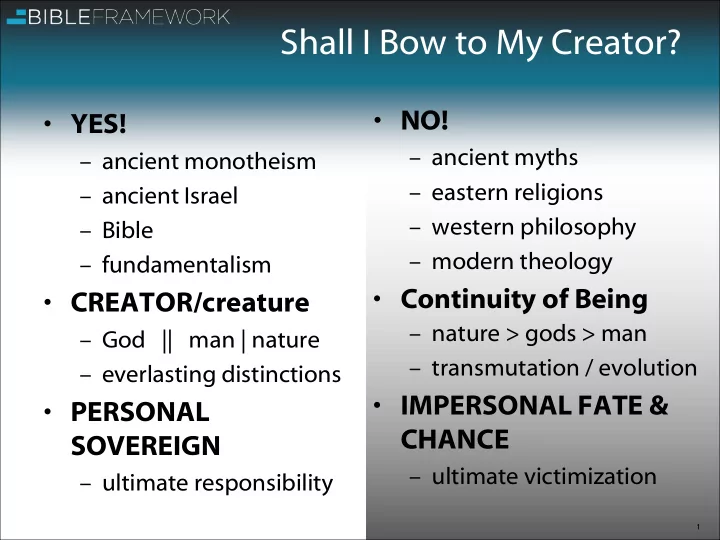
Shall I Bow to My Creator?

  • YES!

– ancient monotheism – ancient Israel – Bible – fundamentalism

  • CREATOR/creature

– God || man | nature – everlasting distinctions

  • PERSONAL

SOVEREIGN

– ultimate responsibility

  • NO!

– ancient myths – eastern religions – western philosophy – modern theology

  • Continuity of Being

– nature > gods > man – transmutation / evolution

  • IMPERSONAL FATE &

CHANCE

– ultimate victimization

1

slide-2
SLIDE 2

Science is . . .?

“Science . . . is an invented institution not present in all societies . . . it demands some sort of unique soil in which to flourish and [without that soil] is as capable of decay and death as any other human activity” Loren Eiseley, “Francis Bacon,” The Horizon Book of Makers of

Modern Thought (95-96).

2

slide-3
SLIDE 3

What Wisdom Gave the World

3

“In a forthcoming book . . . I will deal with the origins of the new ways of thinking which seem suddenly to appear among the Greeks in the early sixth century B.C. . . . The roots of this movement can be traced to the earlier literature of Israel. . . . We have in Qoheleth [Ecclesiastes] some of the raw material on which the earliest Greek philosophers built their metaphysical structures. . . .”

William F Albright, Yahweh and the Gods of Canaan: A Historical Analysis

  • f Two Contrasting Faiths (Garden City, NY: Doubleday, 1968), 259, 262
slide-4
SLIDE 4

Science Develops in the West

4

Middle Ages: monks begin serious studies of nature with some experiments accompanying

James Hannam, The Genesis of Science: How the Christian Middle Ages Launched the Scientific Revolution Rodney Stark, How the West Won

Protestant Reformation: Hands on Labor as a Calling of God

Nancy Pearcey and Charles Thaxton, The Soul of Science

slide-5
SLIDE 5

The So-Called War Between Religion and Science

5

Key book: President Andrew White’s book A History of the Warfare of Science with Theology “Their goal was to secularize society, replacing the Christian worldview with scientific naturalism. They understood very well that they were replacing one religion with another for they described their goal as the establishment of the ‘church scientific’.” Nancy Pearcey and Charles Thaxton, The Soul of Science

slide-6
SLIDE 6

Science and its Funding Sources

6

“A steady increasing share [of research] is conducted for, by, or at the direction of the federal government . . . The solitary inventor . . . has been overshadowed by task forces of scientists in laboratories . . . The free university, historically the fountainhead of scientific discovery, has experienced a revolution in the conduct of research. Partly because of the huge costs involved, a government contract becomes a substitute for intellectual curiosity. . . . The prospect of domination of the nation’s scholars by federal employment, project allocations, and the power of money is gravely to be regarded. . . . We must also be alert to the equal and opposite danger that public policy could itself become the captive of a scientific-technological elite.” Dwight Eisenhower, Farewell Address, 1961

slide-7
SLIDE 7

“Post-Normal” Science

7

“The concept of post-normal science goes beyond the traditional assumptions that science is both certain and value-free . . . The exercise of scholarly activities is defined by the dominance of goal orientation where scientific goals are controlled by political or societal

  • actors. . . . In post-normal science, the maintenance of

quality, rather than the establishment of factual knowledge, is the key task of scientists. Scientists have to contribute to society by learning as quickly as possible about different [group] perceptions . . . instead of seeking deep ultimate knowledge.” [UK blogger citing the scholarly work of Funtowicz and Ravetz during the 1990s]

slide-8
SLIDE 8

The Dynamics of Modern Scientific Communities

8

  • Politically funding educational curricula and

research

  • Manufactured consensus
  • Secular agenda for training children
  • Not “evidence-based decision making” but

“decision-based evidence making”

slide-9
SLIDE 9

Limitations of Reason

9

Pr

  • positions

Cate gor ie s Conc lusions “Re a so n” is me re ly a c a lc ula ting ma c hine , no t a le g isla to r o f re a lity

Unavoidable de pe nde nc e

  • n wor

ldvie w

L

  • g ic a l Rule s

(to o ls Go d ha s g ive n to o rg a nize re ve la tio n a nd disc o ve r so me o f His c o he re nt tho ug ht)

slide-10
SLIDE 10

GOD NATURE MAN

Correspondence criterion: man’s ideas can correspond with factual reality outside his head because both are part of a unified creation KNOWS partially as a creature Consistency criterion: man’s thoughts can be

  • rderly because

God’s plan is

  • rderly

Who has put wisdom in the mind? Job 38:36

slide-11
SLIDE 11

Does Math Success Imply a Pre-Established Design?

“Nature seems very conversant with the rules of pure mathematics. Nature and our minds work according to the same laws.”

Sir James Jeans (1877–1946)

11

“The laws of our thoughts coincide with the regularity of the flow of impressions which we receive from the external world.” Max Planck (1858–1947)

slide-12
SLIDE 12

Does Math Success Imply a Pre-Established Design?

12

Albert Einstein (1879–1955)

“The success of [scientific] procedure supposes in the

  • bjective world a high degree of
  • rder which we are in no way

entitled to expect a priori. There lies the “miracle” . . . . I think of the comprehensibility of the world as a miracle or an eternal mystery.”

slide-13
SLIDE 13

What is Mathematics?

“Is mathematics a collection of diamonds hidden in the depths of the universe and gradually unearthed one by one or is it a collection of synthetic stones manufactured by man but so brilliant that it bedazzles those mathematicians who are already partially blinded by pride in their own creations?”

Morris Kline, Mathematics for the Non-Mathematician, p 545

13

slide-14
SLIDE 14
  • 6
  • 2
  • 4
  • 8
  • 10
  • 12
  • 14
  • 16
  • 18

2 4 6 8 10 12 14 16 18 20 22

Age of Universe Life Beginning Historical Period One Year One Hour One Second Sound Period Visible Light Period X-Ray Period

  • 12
  • 10
  • 8
  • 6
  • 4
  • 2

2 4 6 8 10 12 14 16 18 20 22

Time: Log10 (seconds)

Atom Molecules Bacteria

Spatial Domain of Natur e

One cm Man Mountains Sun Solar System Galaxies

Space: Log10 (cm)

T e mpor al Domain of Natur e

Deductions Deductions Conjecture Ultra-speed filming Telescope Deductions Microscope

Limits of Empirical Knowledge

14

BUT the sc ie ntific me tho d re q uire s spe c ia l a dditio ns (wo rldvie w de pe nde nt c o nje c ture s) in o rde r to pe ne tra te uno b se rva b le pa st & future do ma ins Ma n c re a te d to ha ve do minio n

  • ve r na ture sta rting with the

c o rre spo nde nc e Go d c re a te d b e twe e n ma ny o f ma n’ s e mpiric a lly-b a se d c o nc e ptio ns a nd na ture ’ s de sig n

Direct Observation Historical Testimony Instruments

Reconstructed from Julio Garrido, “The Theory of Evolution and the Limitation of Human Knowledge,” CRSQ, March 1970, Vol 6, pp. 185-187