Chapter 15, 16 Health, Safety, and Environment 15 Health and Safety - - PDF document

chapter 15 16 health safety and environment
SMART_READER_LITE
LIVE PREVIEW

Chapter 15, 16 Health, Safety, and Environment 15 Health and Safety - - PDF document

Chapter 15, 16 Health, Safety, and Environment 15 Health and Safety Warehousing covers a whole range of activities, all of which have their own hazards and risks. Employers need to ensure effective health and safety management, looking at the


slide-1
SLIDE 1

1

1

Chapter 15, 16 Health, Safety, and Environment

15 Health and Safety

Warehousing covers a whole range of activities, all of which have their own hazards and risks. Employers need to ensure effective health and safety management, looking at the risks involved in the workplace and then putting in place effective control measures to manage health and safety. 了解與降低風險

16 Environment

Environmental and waste issues have affected us all, both at home and at

  • work. 節能減碳、回收再利用

Legislation is likely to result in carbon becoming a ‘new currency’ within a new ‘carbon economy’… aware of ‘carbon footprints’ to gain a better understanding of where missions come from and how to reduce them.

2

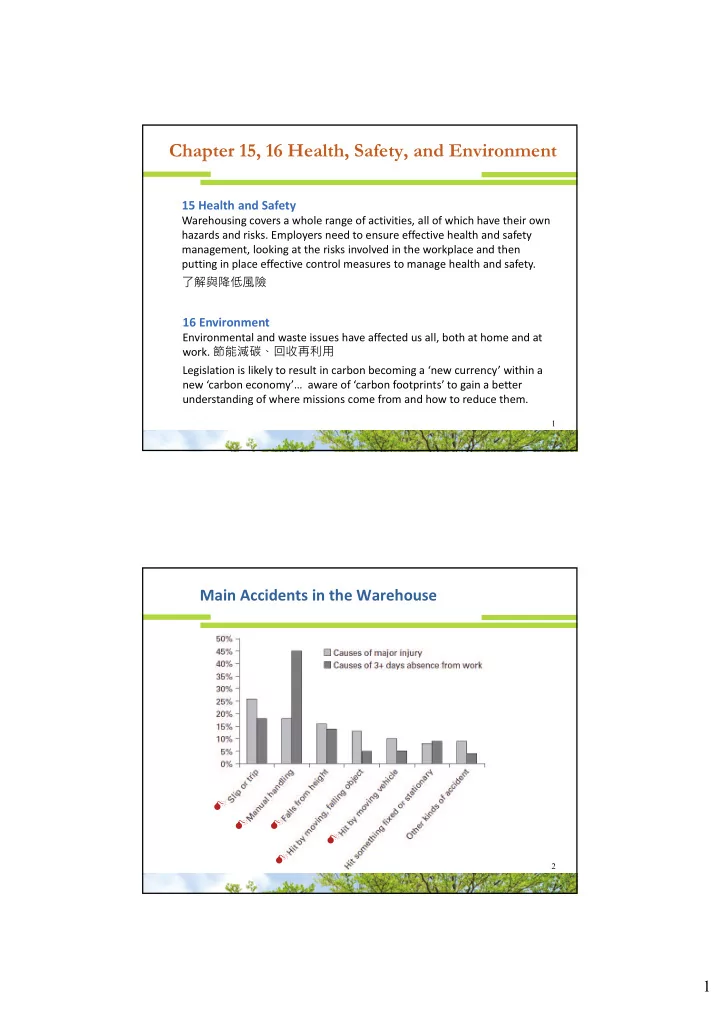
Main Accidents in the Warehouse

    

slide-2
SLIDE 2

2

3

Occupational Safety and Health Administration

also cite the following causes of accidents/injuries:

 unsafe use of forklifts;  improper stacking of products;  failure to use proper personal protective equipment; 人身安全防護  failure to follow proper lockout/tagout procedures, ie prevent

equipment from being accidentally energized; 設備意外啟動

 inadequate fire safety provisions;  repetitive motion injuries.

4

Responsibility for Health and Safety

雇主employer responsibilities: –– provision of a health and safety statement policy; –– provision of safety equipment; –– commitment to train staff. 員工employee responsibilities: –– obligation to cooperate with their employer; –– obligation to undertake training, report issues and not to misuse equipment. 設備製造商manufacturers’ responsibilities: –– ensure product is safe to use and fit for purpose.

slide-3
SLIDE 3

3

5

Racking Inspection

Is the equipment on sound, level flooring?

Are double‐sided runs connected properly? 兩排料架的固定

Are the beam connector locks securely fastened?

Are the racks aligned properly?

Are the correct pallets being used?

Are the pallets in good condition?

Is there any visible damage?

When was it last inspected?

Are staff trained properly?

Are there signs on the end detailing weight capacities?

Are there any receptacles for rubbish? 垃圾放置

6

Slips and Trips

Enforce good housekeeping. Don’t allow spills to stay on the floor.

Don’t let your aisles become cluttered. 走道勿堆放貨物

Remove or strictly control the use of cell phones.

Provide anti‐slip mats in areas known for wet or oily conditions. Install carpet mats at entrances.

Make sure workers wear appropriate footwear on plant floor.

Be sure handrails are installed wherever possible.

Be certain that lighting is adequate. (100 lux)

Make sure people understand that running isn’t allowed. 東京手扶梯

Keep floors and traffic routes free from obstruction, particularly near stairs, on emergency routes or in/near doorways.

www.youtube.com/watch?v=v2FNbuPR01Y 4:30‐7:30

slide-4
SLIDE 4

4

7

Manual Handling

Manual handling can often cause back pain and neck pain. When considering a manual handling operation, the following must be taken into account:

the task;

the load;

the working environment; and

individual capacity. Wherever possible, you should try to use mechanical handling devices such as lift trucks, pallet trucks, trolleys or scissors lifts.

https://www.youtube.com/watch?v=z7gPpHT1Blk

8

Forklifts

Make sure that workers do not operate a forklift unless they have been trained and licensed.

Establish a vehicle inspection and maintenance programme.

Separate forklift traffic and other workers.

Install physical barriers where practical to ensure that workstations are isolated from aisles travelled by forklifts.

Make every effort to alert workers when a forklift is nearby. Use horns, audible reversing alarms and flashing lights to warn workers and other forklift operators in the area. 蜂鳴器與警示燈

slide-5
SLIDE 5

5

9

Other Safety Issues

Working at height

All work at height should be avoided; however, if this is impossible, … to be carried out in as safe a way as possible.

攀登貨架或站立於牙叉上

Vehicles

the driver moves off before warehouse

  • peratives have actually finished loading or unloading...

The vehicle/trailer can be immobilized in some way either by using wheel locks, clamps, chocks or trailer safety interlocks…

A system of lights can be introduced on the loading bay indicating when it is safe for a driver to pull away ... 駕駛視線有死角

10

Risk Assessments

Step 1: Identify the hazards. Step 2: Decide who might be harmed and how. Step 3: Evaluate the risks and decide on precautions. Step 4: Record and communicate your findings and implement them. Step 5: Review your risk assessment regularly and update if necessary.

Managers have to take appropriate steps to identify potential areas where accidents can occur and take steps to avoid them.

slide-6
SLIDE 6

6

11

類別 風險 可能性 嚴重度 評分 生產設施無法運作 斷電 2 2 4 停水 2 2 4 鄰廠事故 3 3 9 地震 3 2 6 洪水 3 2 6 圍廠 3 3 9 火災 3 2 6 化學品外洩 3 3 9 違反環保法規 3 3 9 違反工安法規 3 3 9

12

Risk Assessment Example

種類 受害者 現有措施 待做 執行者 開始日期 完成日期

slide-7
SLIDE 7

7

13

Emergency Response Plan

First aid

First aid training must be available to any first aiders and they must be retrained before the expiration of each three‐year certificate in first aid at work. Employers need to have an emergency plan that describes what is expected of employees in the event of an emergency. Businesses should have an ‘appointed person’ where necessary to take charge in the event of an emergency. 地震、颱風、水災的應變計劃

Fire safety

provisions for emergency exit locations and evacuation procedures; procedures for accounting for all employees and visitors; and equipment location and use of fire extinguishers and other emergency

14

日本311地震對食品物流業的影響

日清食品Ajinomoto位於川崎市的 自動倉庫因料架傾倒而無法運作, 影響東京地區的食材供應,直到 五月下旬才恢復運作。 仙台市的物流中心因為海嘯而嚴重毀損,影響東北地區的 食材供應,五月下旬開始恢復部份營運。 日本冷藏Nichirei因設備損壞而損失32億日圓 ,包括肉品與冷凍食品加工廠以及物流中心。 Nichirei於2014年於東扇島興建全球第一座防 震的冷凍倉庫。

slide-8
SLIDE 8

8

15

  • 16. Warehouse and Environment

World Economic Forum suggests that humans are responsible for greenhouse gas emissions of 50,000 mega‐tonnes of CO2e. 碳排放

The logistics industry contributes around 6% of total emissions.

Logistics industry emissions are not only caused by fuel consumption but also packaging and the energy used in warehouses.

社會壓力 Customer pressure, company image and differentiation together with regulatory compliance are the main driving forces for the introduction of sustainability measures. 成本壓力 Barriers to environmental initiatives include a lack of ROI, not prioritized by management, lack of or inconsistent standards and economic instability.

16

Warehouse Energy Usage

常溫倉儲

slide-9
SLIDE 9

9

17

Ways to Reduce Lighting Costs

–– introduce energy efficient lighting; –– switch off all non‐essential lighting

  • ut of business hours;

–– install movement sensors and timers –– introduce and regularly clean skylights and clerestory windows to increase the use of natural light; –– switch off lights when daylight is sufficient; –– turn off external lights when daylight is sufficient;

色溫<5000K,照度>200 lux

18

Potential Energy Savings 10 hours per day, 5 days a week

Key Reduction Areas Savings CO2 tonnes Based Upon

Turn lights off in warehouse when an area is unoccupied £700 4.26 50% reduction in lighting Turn lights off in warehouse when daylight is sufficient £300 4.92 18% reduction in lighting Replace 250W and 400W sodium

  • r 400W metal halide lights

£550 3 鈉燈、鹵素燈 Install lighting controls £70 0.4 T8 having controls added Clean or replace roof lights £300 4.92 18% reduction in lighting Turn off external lights used for loading/unloading when daylight is sufficient £420 2.5 50% reduction in lighting

slide-10
SLIDE 10

10

19

Green Energy

The self‐production of energy is a potential option for warehouse

  • perators to consider when looking to offset their CO2 usage.

Photovoltaic (solar) panels 太陽能發電 and small wind generators

風力發電 are still not cost efficient, but combined with subsidies

and other government incentives they can have a reasonable ROI.

Regulation plays an important role here. For example, in the UK many local authorities require businesses to generate at least 10 % of their energy needs onsite, using renewable energy sources.

台灣:認購綠能發電

20

Waste Management

Waste disposal 分類以降低處置成本

Look to reduce disposal costs by segregating the waste correctly and, where feasible, selling it to waste recyclers or re‐processors.

Hazardous waste

Something is hazardous if it is dangerous to people, animals or the

  • environment. First check the goods as stated in the

consignment/transfer note and follow your own acceptance criteria.

有害事業廢棄物經過再處理後可被認定為一般事業廢棄物,或 交由專業廠商代為處理 (要追蹤)

slide-11
SLIDE 11

11

21

Waste Management: Packaging

  • 1. Primary (sales) packaging. This is the packaging around a product

at the point of purchase by the user/consumer.

  • 2. Secondary (grouped) packaging. This packaging groups a number
  • f items together until the point of sale.
  • 3. Tertiary (transport) packaging. This packaging allows handling and

transportation of a number of grouped items as a single unit load. Over recent years the mainstays of returnable transit packaging (RTP), including plastic pallets, tote boxes and metal cages. 可回

收包裝材料

22

Waste Management: Cartons and Pallets

Cartons

A significant trade‐off is the strength of the packaging and potentially less damage versus the additional cost of the packaging. Where possible, cartons should be reused. The replacement of cardboard packaging with plastic totes is possible. However, a robust system of tracking needs to be in place.

Pallets

Utilizing recycled pallets … likely to be cheaper and potentially stronger as a result of seasoning, which increases the strength of the wood. Plastic pallets which are recyclable are also a potential alternative albeit they take more energy to produce, are more expensive at the

  • utset and will require a robust system to track their whereabouts.
slide-12
SLIDE 12

12

23

Example of ISO 14001 Environmental Policy

Case Study p.369

Wood, plastic, paper, card and metal is separated and recycled and removed by three recycling companies.

Two balers 壓縮打包機 are installed (one plastic, one cardboard) and staff trained to use.

Office paper is shredded and used as packing materials in warehouse.

No plastic/paper cups used in office areas.

90 % of incoming cardboard boxes are reused for packing.

No general waste goes to landfill.

24

綠建築:生態、節能、減廢、健康

全台第一座物流業者建構的太陽能發電與建築結合的國 際物流中心,日前在桃園市觀音區舉行動土典禮。

觀音國際物流中心採用「綠建築」的環保理念,設置 295W太陽光電模組1694片,發電系統總設置容量 499.73KW,可節省室內用電、減少有害氣體的製造量 ,每年減少二氧化碳排放量達27萬2565公斤。估計室內 降溫約2~3度,每降溫1度約節省6%用電費,達到節約 光電能源的目標。

2017-08-01 經濟日報

○○○○強調維護環保的社會責任,觀音國際物流中心是一棟擁有 綠建築黃金級證書的建物,有兩大指標:一是節能指標,廠房外殼 增隔熱與遮陽性能,減少熱傳透,同時抑制過度照明設計;二是減 廢指標,建築物使用輕量化設計,減少施工與日後拆除的廢棄物。

slide-13
SLIDE 13

13

25

Save Energy

Green energy. Use of natural lighting/ventilation systems.

Source materials locally.

Encourage staff to walk or cycle to work or take public

  • transport. Introduce car sharing schemes for staff.

Waste Reduction and Recycling

Move to utilizing plastic totes/bins in place of cardboard. Use plastic or aluminum pallets.

Low water use in sanitary appliances. Rainwater collection for reuse in vehicle washing, toilets, etc.

Stretch‐wrap machines can reduce the usage of wrap and make the unit load more stable.

26

Summary

Managers need to be vigilant and undertake regular risk

  • assessments. … staff are working to the correct procedures

and that equipment is maintained to the highest standards.

By combining available technologies and solutions in terms of energy savings…, a warehouse can be designed that emits 70 % less CO2 than the typical 15‐year‐old warehouse. (374)

自利  利他