Chapter 13 Solutions Roy Kennedy Massachusetts Bay Community - - PDF document

chapter 13 solutions
SMART_READER_LITE
LIVE PREVIEW

Chapter 13 Solutions Roy Kennedy Massachusetts Bay Community - - PDF document

Introductory Chemistry , 3 rd Edition Nivaldo Tro Chapter 13 Solutions Roy Kennedy Massachusetts Bay Community College Wellesley Hills, MA 2009, Prentice Hall Tragedy in Cameroon Lake Nyos ! Lake in Cameroon, West Africa. ! On August 22,


slide-1
SLIDE 1

Roy Kennedy Massachusetts Bay Community College Wellesley Hills, MA

Introductory Chemistry, 3rd Edition Nivaldo Tro

Chapter 13 Solutions

2009, Prentice Hall

Tro's Introductory Chemistry, Chapter 13 2

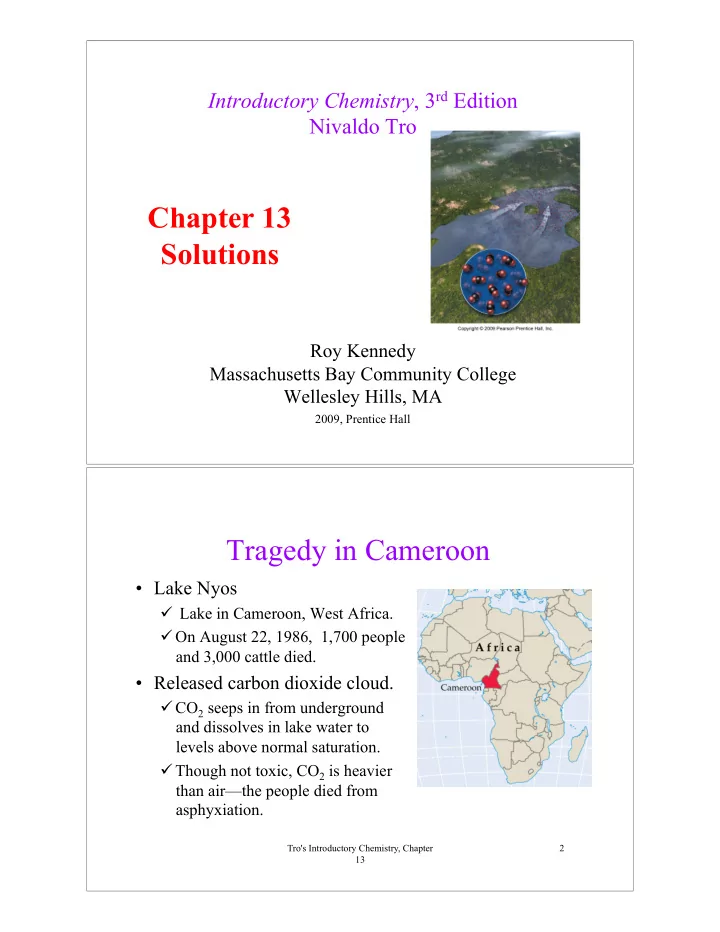
Tragedy in Cameroon

  • Lake Nyos

! Lake in Cameroon, West Africa. ! On August 22, 1986, 1,700 people and 3,000 cattle died.

  • Released carbon dioxide cloud.

! CO2 seeps in from underground and dissolves in lake water to levels above normal saturation. ! Though not toxic, CO2 is heavier than air—the people died from asphyxiation.

slide-2
SLIDE 2

Tro's Introductory Chemistry, Chapter 13 3

Tragedy in Cameroon: A Possible Solution

  • Scientists have studied Lake

Nyos and similar lakes in the region to try and keep such a tragedy from reoccurring.

  • Currently, they are trying to

keep the CO2 levels in the lake water from reaching the very high supersaturation levels by venting CO2 from the lake bottom with pipes.

Tro's Introductory Chemistry, Chapter 13 4

Solutions

  • Homogeneous mixtures.

! Composition may vary from one sample to another. ! Appears to be one substance, though really contains multiple materials.

  • Most homogeneous materials we encounter

are actually solutions.

! E.g., air and lake water.

slide-3
SLIDE 3

Tro's Introductory Chemistry, Chapter 13 5

Solutions, Continued

  • Solute is the dissolved substance.

! Seems to “disappear.” ! “Takes on the state” of the solvent.

  • Solvent is the substance solute dissolves in.

! Does not appear to change state.

  • When both solute and solvent have the same

state, the solvent is the component present in the highest percentage.

  • Solutions in which the solvent is water are called

aqueous solutions.

Brass

Type Color % Cu % Zn Density g/cm3 MP °C Tensile strength psi Uses Gilding

Reddish

95 5 8.86 1066 50K Pre-83 pennies, munitions, plaques Commercial Bronze 90 10 8.80 1043 61K Door knobs, grillwork Jewelry Bronze 87.5 12.5 8.78 1035 66K Costume jewelry Red Golden 85 15 8.75 1027 70K Electrical sockets, fasteners, eyelets Low Deep yellow 80 20 8.67 999 74K Musical instruments, clock dials Cartridge Yellow 70 30 8.47 954 76K Car radiator cores Common Yellow 67 33 8.42 940 70K Lamp fixtures, bead chain Muntz metal Yellow 60 40 8.39 904 70K Nuts & bolts, brazing rods
slide-4
SLIDE 4

Tro's Introductory Chemistry, Chapter 13 7

Common Types of Solution

Solution phase Solute phase Solvent phase Example Gaseous solutions Gas Gas

Air (mostly N2 and O2)

Liquid solutions Gas Liquid Solid Liquid Liquid Liquid

Soda (CO2 in H2O) Vodka (C2H5OH in H2O) Seawater (NaCl in H2O)

Solid solutions Solid Solid

Brass (Zn in Cu)

Tro's Introductory Chemistry, Chapter 13 8

Solubility

  • When one substance (solute) dissolves in another

(solvent) it is said to be soluble. ! Salt is soluble in water. ! Bromine is soluble in methylene chloride.

  • When one substance does not dissolve in another it

is said to be insoluble. ! Oil is insoluble in water.

  • The solubility of one substance in another

depends on two factors: nature’s tendency towards mixing and the types of intermolecular attractive forces.

slide-5
SLIDE 5

Tro's Introductory Chemistry, Chapter 13 9

Will It Dissolve?

  • Chemist’s rule of thumb:

Like dissolves like

  • A chemical will dissolve in a

solvent if it has a similar structure to the solvent.

  • When the solvent and solute

structures are similar, the solvent molecules will attract the solute particles at least as well as the solute particles to each other.

Classifying Solvents

Solvent Class Structural feature Water, H2O Polar O-H Ethyl alcohol, C2H5OH Polar O-H Acetone, C3H6O Polar C=O Toluene, C7H8

Nonpolar C-C and C-H

Hexane, C6H14

Nonpolar C-C and C-H

Diethyl ether, C4H10O

Nonpolar

C-C, C-H, and C-O

slide-6
SLIDE 6

11

Will It Dissolve in Water?

  • Ions are attracted to polar solvents.

! Many ionic compounds dissolve in water.

" Generally, if the ions total charges < 4.

  • Polar molecules are attracted to polar solvents.

! Table sugar, ethyl alcohol, and glucose all dissolve well in water.

" Have either multiple OH groups or little CH.

  • Nonpolar molecules are attracted to nonpolar solvents.

! β-carotene (C40H56) is not water soluble; it dissolves in fatty (nonpolar) tissues.

  • Many molecules have both polar and nonpolar structures

—whether they will dissolve in water depends on the kind, number, and location of polar and nonpolar structural features in the molecule.

Tro's Introductory Chemistry, Chapter 13 12

Salt Dissolving in Water

slide-7
SLIDE 7

Tro's Introductory Chemistry, Chapter 13 13

Solvated Ions

When materials dissolve, the solvent molecules surround the solvent particles due to the solvent’s attractions for the solute. This process is called solvation. Solvated ions are effectively isolated from each other.

Tro's Introductory Chemistry, Chapter 13 14

Practice—Decide if Each of the Following Will Be Significantly Soluble in Water.

  • potassium iodide, KI
  • octane, C8H18
  • methanol, CH3OH
  • copper, Cu
  • cetyl alcohol, CH3(CH2)14CH2OH
  • iron(III) sulfide, Fe2S3
  • potassium iodide, KI soluble.
  • octane, C8H18 insoluble.
  • methanol, CH3OH soluble.
  • copper, Cu insoluble.
  • cetyl alcohol, CH3(CH2)14CH2OH insoluble.
  • iron(III) sulfide, Fe2S3 insoluble.
slide-8
SLIDE 8

Tro's Introductory Chemistry, Chapter 13 15

Solubility

  • There is usually a limit to the solubility of one

substance in another. ! Gases are always soluble in each other. ! Two liquids that are mutually soluble are said to be miscible.

" Alcohol and water are miscible. " Oil and water are immiscible.

  • The maximum amount of solute that can be

dissolved in a given amount of solvent is called solubility.

Tro's Introductory Chemistry, Chapter 13 16

Descriptions of Solubility

  • Saturated solutions have the maximum

amount of solute that will dissolve in that solvent at that temperature.

  • Unsaturated solutions can dissolve more

solute.

  • Supersaturated solutions are holding more

solute than they should be able to at that temperature.

! Unstable.

slide-9
SLIDE 9

Tro's Introductory Chemistry, Chapter 13 17

Supersaturated Solution

A supersaturated solution has more dissolved solute than the solvent can hold. When disturbed, all the solute above the saturation level comes out of solution.

Tro's Introductory Chemistry, Chapter 13 18

Adding Solute to various Solutions

Unsaturated Saturated Supersaturated

slide-10
SLIDE 10

Tro's Introductory Chemistry, Chapter 13 19

Electrolytes

  • Electrolytes are substances whose

aqueous solution is a conductor of electricity.

  • In strong electrolytes, all the

electrolyte molecules are dissociated into ions.

  • In nonelectrolytes, none of the

molecules are dissociated into ions.

  • In weak electrolytes, a small

percentage of the molecules are dissociated into ions.

20

Solubility and Temperature

  • The solubility of the solute in the solvent depends on the

temperature. ! Higher temperature = Higher solubility of solid in liquid. ! Lower temperature = Higher solubility of gas in liquid.

slide-11
SLIDE 11

Tro's Introductory Chemistry, Chapter 13 21

Solubility and Temperature, Continued

Warm soda pop fizzes more than cold soda pop because the solubility of CO2 in water decreases as temperature increases.

Tro's Introductory Chemistry, Chapter 13 22

Changing Temperature = Changing Solubility

  • When a solution is saturated, it is holding

the maximum amount of solute it can at that temperature.

  • If the temperature is changed, the solubility
  • f the solute changes.

! If a solution contains 71.3 g of NH4Cl in 100 g

  • f water at 90 °C, it will be saturated.

! If the temperature drops to 20 °C, the saturation level of NH4Cl drops to 37.2 g. ! Therefore, 24.1 g of NH4Cl will precipitate.

slide-12
SLIDE 12

Tro's Introductory Chemistry, Chapter 13 23

Purifying Solids: Recrystallization

  • When a solid precipitates from a solution, crystals
  • f the pure solid form by arranging the particles in

a crystal lattice.

  • Formation of the crystal lattice tends to reject

impurities.

  • To purify a solid, chemists often make a saturated

solution of it at high temperature; when it cools, the precipitated solid will have much less impurity than before.

Tro's Introductory Chemistry, Chapter 13 24

Solubility of Gases: Effect of Temperature

  • Many gases dissolve in water.

! However, most have very limited solubility.

  • The solubility of a gas in a liquid decreases

as the temperature increases.

! Bubbles seen when tap water is heated (before the water boils) are gases that are dissolved, coming out of the solution. ! Opposite of solids.

slide-13
SLIDE 13

Tro's Introductory Chemistry, Chapter 13 25

Solubility of Gases: Effect of Pressure

  • The solubility of a gas is directly

proportional to its partial pressure.

! Henry’s law. ! The solubility of solid is not effected by pressure.

  • The solubility of a gas in a liquid increases

as the pressure increases.

Tro's Introductory Chemistry, Chapter 13 26

Solubility and Pressure

  • The solubility of gases in water depends on the

pressure of the gas.

  • Higher pressure = higher solubility.
slide-14
SLIDE 14

Tro's Introductory Chemistry, Chapter 13 27

Solubility and Pressure, Continued

When soda pop is sealed, the CO2 is under pressure. Opening the container lowers the pressure, which decreases the solubility of CO2 and causes bubbles to form.

Tro's Introductory Chemistry, Chapter 13 28

Solution Concentrations

slide-15
SLIDE 15

Tro's Introductory Chemistry, Chapter 13 29

Describing Solutions

  • Solutions have variable composition.
  • To describe a solution, you need to describe

both the components and their relative amounts.

  • Dilute solutions have low amounts of

solute per amount of solution.

  • Concentrated solutions have high

amounts of solute per amount of solution.

Tro's Introductory Chemistry, Chapter 13 30

Concentrations—Quantitative Descriptions of Solutions

  • A more precise method for describing a

solution is to quantify the amount of solute in a given amount of solution.

  • Concentration = Amount of solute in a

given amount of solution.

! Occasionally amount of solvent.

slide-16
SLIDE 16

Tro's Introductory Chemistry, Chapter 13 31

Mass Percent

  • Parts of solute in every 100 parts solution.

! If a solution is 0.9% by mass, then there are 0.9 grams of solute in every 100 grams of solution.

" Or 10 kg solute in every 100 kg solution.

  • Since masses are additive, the mass of the solution

is the sum of the masses of solute and solvent.

Tro's Introductory Chemistry, Chapter 13 32

Example 13.1—Calculate the Mass Percent of a Solution Containing 27.5 g of Ethanol in 175 mL H2O.

The answer seems reasonable as it is less than 100%.

Check: Solve: 1 mL H2O = 1.00 g Solution Map: Relationships: 27.5 g ethanol, 175 mL H2O % by mass Given: Find: mL H2O g H2O g sol’n g EtOH, g H2O % 27.5 g ethanol, 202.5 g solution % by mass

slide-17
SLIDE 17

Tro's Introductory Chemistry, Chapter 13 33

Example 13.1:

  • Calculate the mass percent of a solution containing 27.5 g
  • f ethanol (C2H6O) and 175 mL of H2O. (Assume the

density of H2O is 1.00 g/mL.)

Tro's Introductory Chemistry, Chapter 13 34

Example: Calculate the mass percent of a solution containing 27.5 g

  • f ethanol (C2H6O) and 175

mL of H2O. (Assume the density of H2O is 1.00 g/mL.)

  • Write down the given quantity and its units.

Given: 27.5 g C2H6O 175 mL H2O

slide-18
SLIDE 18

Tro's Introductory Chemistry, Chapter 13 35

  • Write down the quantity to find and/or its units.

Find: mass percent

Information: Given: 27.5 g C2H6O; 175 mL H2O Example: Calculate the mass percent of a solution containing 27.5 g

  • f ethanol (C2H6O) and 175

mL of H2O. (Assume the density of H2O is 1.00 g/mL.)

Tro's Introductory Chemistry, Chapter 13 36

  • Collect needed equations:

Information: Given: 27.5 g C2H6O; 175 mL H2O Find: % by mass Example: Calculate the mass percent of a solution containing 27.5 g

  • f ethanol (C2H6O) and 175

mL of H2O. (Assume the density of H2O is 1.00 g/mL.)

slide-19
SLIDE 19

Tro's Introductory Chemistry, Chapter 13 37

  • Collect needed conversion factors:

Information: Given: 27.5 g C2H6O; 175 mL H2O Find: % by mass Equation: Example: Calculate the mass percent of a solution containing 27.5 g

  • f ethanol (C2H6O) and 175

mL of H2O. (Assume the density of H2O is 1.00 g/mL.)

d(H2O) = 1.00 g/mL ∴ 1.00 g H2O = 1 mL H2O

Tro's Introductory Chemistry, Chapter 13 38

  • Design a solution map:

Information: Given: 27.5 g C2H6O; 175 mL H2O Find: % by mass Equation: Conversion Factor: 1.00 g H2O = 1 mL H2O Example: Calculate the mass percent of a solution containing 27.5 g

  • f ethanol (C2H6O) and 175

mL of H2O. (Assume the density of H2O is 1.00 g/mL.) Mass Solution Mass Solute & Mass Percent Vol Solvent Mass Solvent density Solution = solute + solvent

slide-20
SLIDE 20

Tro's Introductory Chemistry, Chapter 13 39

  • Apply the solution maps:

Information: Given: 27.5 g C2H6O; 175 mL H2O Find: % by mass Equation: Conversion Factor: 1.00 g H2O = 1 mL H2O Solution Map: mass solution and volume solvent → mass solvent → mass solution → mass percent

Example: Calculate the mass percent of a solution containing 27.5 g

  • f ethanol (C2H6O) and 175

mL of H2O. (Assume the density of H2O is 1.00 g/mL.)

Mass of solution = mass C2H6O + mass H2O = 27.5 g C2H6O + 175 g H2O = 202.5 g

40

  • Apply the solution maps and equation:

= 13.5802%

Information: Given: 27.5 g C2H6O; 175 mL H2O Find: % by mass Equation: Conversion Factor: 1.00 g H2O = 1 mL H2O Solution Map: mass solution and volume solvent → mass solvent → mass solution → mass percent

Example: Calculate the mass percent of a solution containing 27.5 g

  • f ethanol (C2H6O) and 175

mL of H2O. (Assume the density of H2O is 1.00 g/mL.)

= 13.6%

slide-21
SLIDE 21

Tro's Introductory Chemistry, Chapter 13 41

  • Check the solution:

The units of the answer, %, are correct. The magnitude of the answer makes sense since the mass of solute is less than the mass of solvent. mass percent = 13.6%

Information: Given: 27.5 g C2H6O; 175 mL H2O Find: % by mass Equation: Conversion Factor: 1.00 g H2O = 1 mL H2O Solution Map: mass solution and volume solvent → mass solvent → mass solution → mass percent

Example: Calculate the mass percent of a solution containing 27.5 g

  • f ethanol (C2H6O) and 175

mL of H2O. (Assume the density of H2O is 1.00 g/mL.)

Tro's Introductory Chemistry, Chapter 13 42

Practice—Calculate the Mass Percent of a Solution that Has 10.0 g of I2 Dissolved in 150.0 g of Ethanol.

slide-22
SLIDE 22

Practice—Calculate the Mass Percent of a Solution that Has 10.0 g of I2 Dissolved in 150.0 g of Ethanol, Continued

The answer seems reasonable as it is less than 100%.

Check: Solve: Solution Map: Relationships: 10.0 g I2, 150.0 g ethanol H2O % by mass Given: Find: g sol’n g EtOH, g H2O % 10.0 g I2, 160.0 g solution % by mass

Tro's Introductory Chemistry, Chapter 13 44

Using Concentrations as Conversion Factors

  • Concentrations show the relationship between

the amount of solute and the amount of solvent.

! 12% by mass sugar (aq) means 12 g sugar ≡ 100 g solution.

  • The concentration can then be used to convert

the amount of solute into the amount of solution or visa versa.

slide-23
SLIDE 23

Tro's Introductory Chemistry, Chapter 13 45

Example 13.2—What Volume of 11.5% by Mass Soda Contains 85.2 g of Sucrose?

The unit is correct. The magnitude seems reasonable as the mass of sugar ≈ 10% the volume of solution.

Check: Solve: 100 g sol’n = 11.5 g sugar, 1 mL solution = 1.00 g Solution Map: Relationships: 85.2 g sugar volume, mL Given: Find: g solute g sol’n mL sol’n

Tro's Introductory Chemistry, Chapter 13 46

Example 13.2:

  • A soft drink contains 11.5% sucrose (C12H22O11) by
  • mass. What volume of soft drink in milliliters contains

85.2 g of sucrose? (Assume the density is 1.00 g/mL.)

slide-24
SLIDE 24

Tro's Introductory Chemistry, Chapter 13 47

Example: A soft drink contains 11.5% sucrose (C12H22O11) by mass. What volume of soft drink in milliliters contains 85.2 g of sucrose? (Assume the density is 1.00 g/mL.)

  • Write down the given quantity and its units.

Given: 85.2 g C12H22O11

Tro's Introductory Chemistry, Chapter 13 48

  • Write down the quantity to find and/or its units.

Find: volume of solution, mL

Information: Given: 85.2 g C12H22O11 Example: A soft drink contains 11.5% sucrose (C12H22O11) by mass. What volume of soft drink in milliliters contains 85.2 g of sucrose? (Assume the density is 1.00 g/mL.)

slide-25
SLIDE 25

Tro's Introductory Chemistry, Chapter 13 49

  • Collect needed conversion factors:

d = 1.00 g/mL ∴ 1.00 g solution = 1 mL solution

Information: Given: 85.2 g C12H22O11 Find: mL solution Example: A soft drink contains 11.5% sucrose (C12H22O11) by mass. What volume of soft drink in milliliters contains 85.2 g of sucrose? (Assume the density is 1.00 g/mL.)

11.5% by mass ∴ 11.5 g C12H22O11 ≡ 100 g solution

Tro's Introductory Chemistry, Chapter 13 50

  • Design a solution map:

Mass Solution Mass Solute Volume Solution Density Information: Given: 85.2 g C12H22O11 Find: mL solution Conversion Factors: 11.5 g C12H22O11 ≡ 100 g solution 1.00 g solution = 1 mL solution Example: A soft drink contains 11.5% sucrose (C12H22O11) by mass. What volume of soft drink in milliliters contains 85.2 g of sucrose? (Assume the density is 1.00 g/mL.) Mass percent

slide-26
SLIDE 26

Tro's Introductory Chemistry, Chapter 13 51

  • Apply the solution map:

Information: Given: 85.2 g C12H22O11 Find: mL solution Conversion Factors: 11.5 g C12H22O11 ≡ 100 g solution 1.00 g solution = 1 mL solution Solution Map: g sucrose → g solution → mL solution

Example: A soft drink contains 11.5% sucrose (C12H22O11) by

  • mass. What volume of soft

drink in milliliters contains 85.2 g of sucrose? (Assume the density is 1.00 g/mL.)

= 740.87 mL = 741 mL

Tro's Introductory Chemistry, Chapter 13 52

  • Check the solution:

The units of the answer, mL, are correct. The magnitude of the answer makes sense since the mass of solute is less than the volume of solution. volume of solution = 741 mL

Information: Given: 85.2 g C12H22O11 Find: mL solution Conversion Factors: 11.5 g C12H22O11 ≡ 100 g solution 1.00 g solution = 1 mL solution Solution Map: g sucrose → g solution → mL solution

Example: A soft drink contains 11.5% sucrose (C12H22O11) by

  • mass. What volume of soft

drink in milliliters contains 85.2 g of sucrose? (Assume the density is 1.00 g/mL.)

slide-27
SLIDE 27

Tro's Introductory Chemistry, Chapter 13 53

Practice—Milk Is 4.5% by Mass Lactose. Determine the Mass of Lactose in 175 g of Milk. Practice—Milk Is 4.5% by Mass Lactose. Determine the Mass of Lactose in 175 g of Milk, Continued.

Given: 175 g milk ≡ 175 g solution Find: g lactose Equivalence: 4.5 g lactose ≡ 100 g solution Solution Map: g solution

g Lactose

Apply Solution Map: Check Answer:

Units are correct. Number makes sense because lactose is a component of the mixture, therefore, its amount should be less.

slide-28
SLIDE 28

Tro's Introductory Chemistry, Chapter 13 55

Preparing a Solution

  • Need to know amount of solution and

concentration of solution.

  • Calculate the mass of solute needed.

! Start with amount of solution. ! Use concentration as a conversion factor.

" 5% by mass ⇒ 5 g solute ≡ 100 g solution.

! “Dissolve the grams of solute in enough solvent to total the total amount of solution.”

Example—How Would You Prepare 250.0 g of 5.00% by Mass Glucose Solution (Normal Glucose)?

Given: 250.0 g solution Find: g glucose Equivalence: 5.00 g glucose ≡ 100 g solution Solution Map:

g solution g glucose

Apply Solution Map: Answer: Dissolve 12.5 g of glucose in enough water to total 250.0 g.

slide-29
SLIDE 29

Tro's Introductory Chemistry, Chapter 13 57

Practice—How Would You Prepare 450.0 g of 15.0% by Mass Aqueous Ethanol?

Tro's Introductory Chemistry, Chapter 13 58

Practice—How Would You Prepare 450.0 g of 15.0% by Mass Aqueous Ethanol?, Continued

Given: 450.0 g solution Find: g ethanol (EtOH) Equivalence: 15.0 g EtOH ≡ 100 g solution Solution map:

g solution g EtOH

Apply solution map: Answer: Dissolve 67.5 g of ethanol in enough water to total 450.0 g.

slide-30
SLIDE 30

Tro's Introductory Chemistry, Chapter 13 59

Solution Concentration Molarity

  • Moles of solute per 1 liter of solution.
  • Used because it describes how many molecules
  • f solute in each liter of solution.
  • If a sugar solution concentration is 2.0 M , 1 liter
  • f solution contains 2.0 moles of sugar, 2 liters =

4.0 moles sugar, 0.5 liters = 1.0 mole sugar: Molarity = moles of solute liters of solution

Tro's Introductory Chemistry, Chapter 13 60

Preparing a 1.00 M NaCl Solution

Weigh out 1 mole (58.45 g)

  • f NaCl and add

it to a 1.00 L volumetric flask. Step 1 Step 2 Add water to dissolve the NaCl, then add water to the mark. Step 3 Swirl to mix.

slide-31
SLIDE 31

Tro's Introductory Chemistry, Chapter 13 61

Example 13.3—Calculate the Molarity of a Solution Made by Dissolving 15.5 g of NaCl in 1.50 L of Solution

The unit is correct, the magnitude is reasonable. Check: Solve:

M = mol/L, 1 mol NaCl = 58.44 g

Solution Map: Relationships: 15.5 g NaCl, 1.50 L solution M Given: Find: g NaCl mol NaCl L solution M

Tro's Introductory Chemistry, Chapter 13 62

Example 13.3:

  • Calculate the molarity of a solution made by putting

15.5 g of NaCl into a beaker and adding water to make 1.50 L of NaCl solution.

slide-32
SLIDE 32

Tro's Introductory Chemistry, Chapter 13 63

Example: Calculate the molarity of a solution made by putting 15.5 g of NaCl into a beaker and adding water to make 1.50 L of NaCl solution.

  • Write down the given quantity and its units.

Given: 15.5 g NaCl 1.50 L solution

Tro's Introductory Chemistry, Chapter 13 64

  • Write down the quantity to find and/or its units.

Find: molarity (M)

Information: Given: 15.5 g NaCl; 1.50 L solution Example: Calculate the molarity of a solution made by putting 15.5 g of NaCl into a beaker and adding water to make 1.50 L of NaCl solution.

slide-33
SLIDE 33

Tro's Introductory Chemistry, Chapter 13 65

  • Collect needed equations and conversion factors:

Molar mass NaCl = 58.44 g/mol ∴ 58.44 g NaCl = 1 mol.

Information: Given: 15.5 g NaCl; 1.50 L solution Find: molarity, M Example: Calculate the molarity of a solution made by putting 15.5 g of NaCl into a beaker and adding water to make 1.50 L of NaCl solution.

Tro's Introductory Chemistry, Chapter 13 66

  • Design a solution map:

Volume solution Mass solute Molarity Information: Given: 15.5 g NaCl; 1.50 L solution Find: molarity, M Conversion Factors: 58.44 g = 1 mol NaCl; Example: Calculate the molarity of a solution made by putting 15.5 g of NaCl into a beaker and adding water to make 1.50 L of NaCl solution. L solution Mole solute Already liters

slide-34
SLIDE 34

Tro's Introductory Chemistry, Chapter 13 67

  • Apply the solution map:

Information: Given: 15.5 g NaCl; 1.50 L solution Find: molarity, M Conversion Factors: 58.44 g = 1 mol NaCl; Example: Calculate the molarity of a solution made by putting 15.5 g of NaCl into a beaker and adding water to make 1.50 L of NaCl solution. = 0.177 M NaCl

Tro's Introductory Chemistry, Chapter 13 68

  • Check the solution:

The units of the answer, M, are correct. The magnitude of the answer makes sense since the mass of solute is less than the 1 mole and the volume is more than 1 L. Molarity of solution = 0.177 M

Information: Given: 15.5 g NaCl; 1.50 L solution Find: molarity, M Conversion Factors: 58.44 g = 1 mol NaCl; Example: Calculate the molarity of a solution made by putting 15.5 g of NaCl into a beaker and adding water to make 1.50 L of NaCl solution.

slide-35
SLIDE 35

Tro's Introductory Chemistry, Chapter 13 69

Practice—What Is the Molarity of a Solution Containing 3.4 g of NH3 (MM 17.03) in 200.0 mL

  • f Solution?

Tro's Introductory Chemistry, Chapter 13 70

Practice—What Is the Molarity of a Solution Containing 3.4 g of NH3 (MM 17.03) in 200.0 mL of Solution?, Continued

The unit is correct, the magnitude is reasonable. Check: Solve:

M = mol/L, 1 mol NH3 = 17.03 g, 1 mL = 0.001 L

Solution Map: Relationships: 3.4 g NH3, 200.0 mL solution M Given: Find: g NH3 mol NH3 mL sol’n L sol’n M

slide-36
SLIDE 36

Tro's Introductory Chemistry, Chapter 13 71

Using Concentrations as Conversion Factors

  • Concentrations show the relationship between the

amount of solute and the amount of solvent.

! 0.12 M sugar (aq) means 0.12 mol sugar ≡ 1.0 L solution.

  • The concentration can then be used to convert the moles
  • f solute into the liters of solution, or visa versa.
  • Since we normally measure the amount of solute in

grams, we will need to convert between grams and moles.

Tro's Introductory Chemistry, Chapter 13 72

Example 13.4—How Many Liters of a 0.114 M NaOH Solution Contains 1.24 mol of NaOH?

The unit is correct, the magnitude seems reasonable as the moles of NaOH > 10x the amount in 1 L.

Check: Solve: 1.00 L solution = 0.114 mol NaOH Solution Map: Relationships: 1.24 mol NaOH volume, L Given: Find: mol NaOH L solution

slide-37
SLIDE 37

Tro's Introductory Chemistry, Chapter 13 73

Example 13.4:

  • How many liters of a 0.114 M NaOH solution contains

1.24 mol of NaOH?

Tro's Introductory Chemistry, Chapter 13 74

Example: How many liters of a 0.114 M NaOH solution contains 1.24 mol of NaOH?

  • Write down the given quantity and its units.

Given: 1.24 mol NaOH

slide-38
SLIDE 38

Tro's Introductory Chemistry, Chapter 13 75

  • Write down the quantity to find and/or its units.

Find: volume of solution (L)

Information: Given: 1.24 mol NaOH Example: How many liters of a 0.114 M NaOH solution contains 1.24 mol of NaOH?

Tro's Introductory Chemistry, Chapter 13 76

  • Collect needed conversion factors:

Molarity = 0.114 mol/L ∴ 0.114 mol NaOH = 1 L solution.

Information: Given: 1.24 mol NaOH Find: L solution Example: How many liters of a 0.114 M NaOH solution contains 1.24 mol of NaOH?

slide-39
SLIDE 39

Tro's Introductory Chemistry, Chapter 13 77

  • Design a solution map:

L solution Mole solute Information: Given: 1.24 mol NaOH Find: L solution Conversion Factor: 0.114 mol = 1 L Example: How many liters of a 0.114 M NaOH solution contains 1.24 mol of NaOH?

Tro's Introductory Chemistry, Chapter 13 78

  • Apply the solution map:

Information: Given: 1.24 mol NaOH Find: L solution Conversion Factor: 0.114 mol = 1 L Solution Map: mol → L Example: How many liters of a 0.114 M NaOH solution contains 1.24 mol of NaOH?

slide-40
SLIDE 40

Tro's Introductory Chemistry, Chapter 13 79

  • Check the solution:

The units of the answer, L, are correct. The magnitude of the answer makes sense. Since 1 L only contains 0.114 moles, the volume must be more than 1 L. Volume of solution = 10.9 L

Information: Given: 1.24 mol NaOH Find: L solution Conversion Factor: 0.114 mol = 1 L Solution Map: mol → L Example: How many liters of a 0.114 M NaOH solution contains 1.24 mol of NaOH?

Tro's Introductory Chemistry, Chapter 13 80

Practice—Determine the Mass of CaCl2 (MM = 110.98) in 1.75 L of 1.50 M Solution.

slide-41
SLIDE 41

Tro's Introductory Chemistry, Chapter 13 81

Practice—Determine the Mass of CaCl2 (MM = 110.98) in 1.75 L of 1.50 M Solution, Continued.

Given: 1.75 L solution Find: g CaCl2 Equivalence: 1.50 mol CaCl2 ≡ 1 L solution; 110.98 g = 1 mol CaCl2 Solution Map: L solution mol CaCl2 Apply Solution Map: Check Answer: Units are correct. g CaCl2

Tro's Introductory Chemistry, Chapter 13 82

Practice—How Many Grams of CuSO4•5 H2O (MM 249.69) are in 250.0 mL of a 1.00 M Solution?

slide-42
SLIDE 42

Tro's Introductory Chemistry, Chapter 13 83

Practice—How Many Grams of CuSO4•5 H2O (MM 249.69) are in 250.0 mL of a 1.00 M Solution?, Continued

The unit is correct, the magnitude seems reasonable as the volume is ¼ of a liter.

Check: Solve:

1.00 L solution = 1.00 mol; 1 mL = 0.001 L; 1 mol = 249.69 g

Solution Map: Relationships: 250.0 mL solution mass CuSO4• 5 H2O, g Given: Find: mL sol’n L sol’n g CuSO4

mol CuSO4

84

Example—How Would You Prepare 250 mL

  • f 0.20 M NaCl?

Given: 250 mL solution Find: g NaCl Equivalence: 0.20 moles NaCl ≡ 1 L solution; 0.001 L = 1 mL; 58.44 g = 1 mol NaCl Solution Map: Apply Solution Map: Answer: Dissolve 2.9 g of NaCl in enough water to total 250 mL.

moles NaCl mL solution L solution g NaCl

slide-43
SLIDE 43

Tro's Introductory Chemistry, Chapter 13 85

Practice—How Would You Prepare 100.0 mL

  • f 0.100 M K2SO4 (MM = 174.26)?

86

Practice—How Would You Prepare 100.0 mL

  • f 0.100 M K2SO4 (MM = 174.26)?, Continued

Given: 100.0 mL solution Find: g K2SO4 Equivalence: 0.100 moles K2SO4 ≡ 1 L solution; 0.001 L = 1 mL; 174.26 g = 1 mol K2SO4 Solution map: Apply solution map: Answer: Dissolve 1.74 g of K2SO4 in enough water to total 100.0 mL.

moles K2SO4 mL solution L solution g K2SO4

slide-44
SLIDE 44

Tro's Introductory Chemistry, Chapter 13 87

Molarity and Dissociation

  • When strong electrolytes dissolve, all the

solute particles dissociate into ions.

  • By knowing the formula of the compound

and the molarity of the solution, it is easy to determine the molarity of the dissociated

  • ions. Simply multiply the salt concentration

by the number of ions.

Tro's Introductory Chemistry, Chapter 13 88

Molarity and Dissociation

NaCl(aq) = Na+(aq) + Cl-(aq) 1 “molecule” = 1 ion + 1 ion 100 “molecules” = 100 ions + 100 ions 1 mole “molecules” = 1 mole ions + 1 mole ions 1 M NaCl “molecules” = 1 M Na+ ions + 1 M Cl- ions 0.25 M NaCl = 0.25 M Na+ + 0.25 M Cl-

slide-45
SLIDE 45

Tro's Introductory Chemistry, Chapter 13 89

Molarity and Dissociation, Continued

CaCl2(aq) = Ca2+(aq) + 2 Cl-(aq) 1 “molecule” = 1 ion + 2 ion 100 “molecules” = 100 ions + 200 ions 1 mole “molecules” = 1 mole ions + 2 mole ions 1 M CaCl2 = 1 M Ca2+ ions + 2 M Cl- ions 0.25 M CaCl2 = 0.25 M Ca2+ + 0.50 M Cl-

Tro's Introductory Chemistry, Chapter 13 90

Example 13.5—Determine the Molarity of the Ions in a 0.150 M Na3PO4(aq) Solution.

The unit is correct, the magnitude seems reasonable as the ion molarities are at least as large as the Na3PO4.

Check: Solve: Na3PO4(aq) → 3 Na+(aq) + PO4

3−(aq)

Relationships: 0.150 M Na3PO4(aq) concentration of Na+ and PO4

3−, M

Given: Find:

slide-46
SLIDE 46

Tro's Introductory Chemistry, Chapter 13 91

Practice—Find the Molarity of All Ions in the Given Solutions of Strong Electrolytes.

  • 0.25 M MgBr2(aq).
  • 0.33 M Na2CO3(aq).
  • 0.0750 M Fe2(SO4)3(aq).

Tro's Introductory Chemistry, Chapter 13 92

Practice—Find the Molarity of All Ions in the Given Solutions of Strong Electrolytes, Continued.

  • MgBr2(aq) → Mg2+(aq) + 2 Br-(aq)

0.25 M 0.25 M 0.50 M

  • Na2CO3(aq) → 2 Na+(aq) + CO3

2-(aq)

0.33 M 0.66 M 0.33 M

  • Fe2(SO4)3(aq) → 2 Fe3+(aq) + 3 SO4

2-(aq)

0.0750 M 0.150 M 0.225 M

slide-47
SLIDE 47

Tro's Introductory Chemistry, Chapter 13 93

Dilution

  • Dilution is adding extra solvent to decrease the

concentration of a solution.

  • The amount of solute stays the same, but the

concentration decreases.

  • Dilution Formula:

Concstart solnx Volstart soln = Concfinal solnx Volfinal sol

  • Concentrations and volumes can be most units as

long as they are consistent.

Tro's Introductory Chemistry, Chapter 13 94

Example—What Volume of 12.0 M KCl Is Needed to Make 5.00 L of 1.50 M KCl Solution?

Given: Initial solution Final solution Concentration 12.0 M 1.50 M Volume ? L 5.00 L Find: L of initial KCl Equation: (conc1)·(vol1) = (conc2)·(vol2) Rearrange and apply equation:

slide-48
SLIDE 48

Tro's Introductory Chemistry, Chapter 13 95

Making a Solution by Dilution

M1 x V1 = M2 x V2 M1 = 12.0 M V1 = ? L M2 = 1.50 M V2 = 5.00 L Dilute 0.625 L of 12.0 M solution to 5.00 L.

Tro's Introductory Chemistry, Chapter 13 96

Example—Dilution Problems

  • What is the concentration of a solution made by

diluting 15 mL of 5.0% sugar to 135 mL?

  • How would you prepare 200 mL of 0.25 M

NaCl solution from a 2.0 M solution?

(5.0%)(15 mL) = M2 x (135 mL) M2 = 0.55%

(2.0 M) x V1 = (0.25 M)(200 mL) V1 = 25 mL

Dilute 25 mL of 2.0 M NaCl solution to 200 mL. M1 = 5.0 % M2 = ? % V1 = 15 mL V2 = 135 mL

M1 = 2.0 M M2 = 0.25 M V1 = ? mL V2 = 200 mL

slide-49
SLIDE 49

Tro's Introductory Chemistry, Chapter 13 97

Practice—Determine the Concentration of the Following Solutions.

  • Made by diluting 125 mL of 0.80 M HCl to 500 mL.
  • Made by adding 200 mL of water to 800 mL of 400 ppm.

Tro's Introductory Chemistry, Chapter 13 98

Practice—Determine the Concentration of the Following Solutions, Continued.

  • Made by diluting 125 mL of 0.80 M HCl to 500 mL.
  • Made by adding 200 mL of water to 800 mL of 400 ppm.

(0.80 M)(125 mL) = M2 x (500 mL) M2 = 0.20 M (400 PPM)(800 mL) = M2 x (1000 mL) M2 = 320 PPM M1 = 0.80 M M2 = ? M V1 = 125 mL V2 = 500 mL M1 = 400 ppm M2 = ? ppm V1 = 800 mL V2 = 200 + 800 mL

slide-50
SLIDE 50

Tro's Introductory Chemistry, Chapter 13 99

Example—To What Volume Should You Dilute 0.200 L of 15.0 M NaOH to Make 3.00 M NaOH?

Since the solution is diluted by a factor

  • f 5, the volume should increase by a

factor of 5, and it does.

M1V1 = M2V2

V1 = 0.200L, M1 = 15.0 M, M2 = 3.00 M

V2, L Check:

  • Check.

Solve:

  • Follow the

solution map to Solve the problem. Solution Map: Relationships:

  • Strategize.

Given: Find:

  • Sort

information.

V1, M1, M2 V2

Tro's Introductory Chemistry, Chapter 13 100

Practice Question 1—How Would You Prepare 400 mL of a 4.0% Solution From a 12% Solution? Practice Question 2—How Would You Prepare 250 mL of a 3.0% Solution From a 7.5% Solution?

slide-51
SLIDE 51

Tro's Introductory Chemistry, Chapter 13 101

Practice Question 1—How Would You Prepare 400 ML of a 4.0% Solution From a 12% Solution?, Continued (12%) x V1 = (4.0%)(400 mL) V1 = 133 mL Dilute 133 mL of 12% solution to 400 mL. Practice Question 2—How Would You Prepare 250 ML of a 3.0% Solution From a 7.5% Solution?, Continued (7.5%) x V1 = (3.0%)(250 mL) V1 = 100 mL Dilute 100 mL of 7.5% solution to 250 mL. M1 = 12 % M2 = 4.0 % V1 = ? mL V2 = 400 mL M1 = 7.5 % M2 = 3.0 % V1 = ? mL V2 = 250 mL

Tro's Introductory Chemistry, Chapter 13 102

Solution Stoichiometry

  • We know that the balanced chemical equation

tells us the relationship between moles of reactants and products in a reaction.

! 2 H2(g) + O2(g) → 2 H2O(l) implies that for every 2 moles of H2 you use, you need 1 mole of O2 and will make 2 moles of H2O.

  • Since molarity is the relationship between moles
  • f solute and liters of solution, we can now

measure the moles of a material in a reaction in solution by knowing its molarity and volume.

slide-52
SLIDE 52

Tro's Introductory Chemistry, Chapter 13 103

Example 13.7—How Many Liters of 0.115 M KI Is Needed to React with 0.104 L of a 0.225 M Pb(NO3)2?

2 KI(aq) + Pb(NO3)2(aq)→ 2 KNO3(aq) + PbI2(s)

The unit is correct.

Check: Solve:

0.225 mol Pb(NO3)2 = 1 L; 2 mol KI = 1 mol Pb(NO3)2; 0.115 mol KI = 1 L

Solution Map: Relationships: 0.104 L Pb(NO3)2 L KI Given: Find: L

Pb(NO3)2

mol

Pb(NO3)2

L

KI

mol

KI

Tro's Introductory Chemistry, Chapter 13 104

Example 13.7:

  • How much 0.115 M KI solution, in liters, is required to

completely precipitate all the Pb2+ in 0.104 L of 0.225 M Pb(NO3)2?

2 KI(aq) + Pb(NO3)2(aq) → PbI2(s) + 2 KNO3(aq)

slide-53
SLIDE 53

Tro's Introductory Chemistry, Chapter 13 105

Example: How much 0.115 M KI solution, in liters, is required to completely precipitate all the Pb2+ in 0.104 L of 0.225 M Pb(NO3)2? 2 KI(aq) + Pb(NO3)2(aq) → PbI2(s) + 2 KNO3(aq)

  • Write down the given quantity and its units.

Given: 0.104 L Pb(NO3)2

Tro's Introductory Chemistry, Chapter 13 106

  • Write down the quantity to find and/or its units.

Find: volume of KI solution, L

Information: Given: 0.104 L Pb(NO3)2 Example: How much 0.115 M KI solution, in liters, is required to completely precipitate all the Pb2+ in 0.104 L of 0.225 M Pb(NO3)2? 2 KI(aq) + Pb(NO3)2(aq) → PbI2(s) + 2 KNO3(aq)

slide-54
SLIDE 54

Tro's Introductory Chemistry, Chapter 13 107

  • Collect needed conversion factors:

0.115 M KI ∴ 0.115 mol KI ≡ 1 L solution.

Information: Given: 0.104 L Pb(NO3)2 Find: L KI Example: How much 0.115 M KI solution, in liters, is required to completely precipitate all the Pb2+ in 0.104 L of 0.225 M Pb(NO3)2? 2 KI(aq) + Pb(NO3)2(aq) → PbI2(s) + 2 KNO3(aq)

0.225 M Pb(NO3)2 ∴ 0.225 mol Pb(NO3)2 ≡ 1 L solution. Chemical equation ∴ 2 mol KI ≡ 1 mol Pb(NO3)2.

108

  • Design a solution map:

Example: How much 0.115 M KI solution, in liters, is required to completely precipitate all the Pb2+ in 0.104 L of 0.225 M Pb(NO3)2? 2 KI(aq) + Pb(NO3)2(aq) → PbI2(s) + 2 KNO3(aq) Information: Given: 0.104 L Pb(NO3)2 Find: L KI Conversion Factors: 0.115 mol KI ≡ 1 L solution 0.225 mol Pb(NO3)2 ≡ 1 L solution 2 mol KI ≡ 1 mol Pb(NO3)2 mol Pb(NO3)2 L Pb(NO3)2 mol KI L KI

slide-55
SLIDE 55

Tro's Introductory Chemistry, Chapter 13 109

  • Apply the solution map:

= 0.40696 L = 0.407 L

Example: How much 0.115 M KI solution, in liters, is required to completely precipitate all the Pb2+ in 0.104 L of 0.225 M Pb(NO3)2? 2 KI(aq) + Pb(NO3)2(aq) → PbI2(s) + 2 KNO3(aq)

Information: Given: 0.104 L Pb(NO3)2 Find: L KI Conversion Factors: 0.115 mol KI ≡ 1 L solution 0.225 mol Pb(NO3)2 ≡ 1 L solution 2 mol KI ≡ 1 mol Pb(NO3)2 Solution Map: L Pb(NO3)2 → mol Pb(NO3)2 → mol KI → L KI

Tro's Introductory Chemistry, Chapter 13 110

  • Check the solution:

The units of the answer, L KI solution, are correct. The magnitude of the answer makes sense since the molarity of Pb(NO3)2 is larger than KI and it takes 2x as many moles of KI as Pb(NO3)2, the volume of KI solution should be larger than the volume of Pb(NO3)2.

Volume of KI solution required = 0.407 L.

Example: How much 0.115 M KI solution, in liters, is required to completely precipitate all the Pb2+ in 0.104 L of 0.225 M Pb(NO3)2? 2 KI(aq) + Pb(NO3)2(aq) → PbI2(s) + 2 KNO3(aq)

Information: Given: 0.104 L Pb(NO3)2 Find: L KI Conversion Factors: 0.115 mol KI ≡ 1 L solution 0.225 mol Pb(NO3)2 ≡ 1 L solution 2 mol KI ≡ 1 mol Pb(NO3)2 Solution Map: L Pb(NO3)2 → mol Pb(NO3)2 → mol KI → L KI

slide-56
SLIDE 56

Tro's Introductory Chemistry, Chapter 13 111

Practice—How Many Liters of 0.0623 M Ba(OH)2(aq) Are Needed to React with 0.438 L of 0.107 M HCl? Ba(OH)2(aq) + 2 HCl(aq) → BaCl2(aq) + 2 H2O(l)

Tro's Introductory Chemistry, Chapter 13 112

Practice—How Many Liters of 0.0623 M Ba(OH)2(aq) Are Needed to React with 0.438 L of 0.107 M HCl? Ba(OH)2(aq) + 2 HCl(aq) → BaCl2(aq) + 2 H2O(l), Continued

The unit is correct.

Check: Solve:

0.0623 mol Ba(OH)2 = 1 L; 2 mol HCl= 1 mol Ba(OH)2; 0.107 mol HCl = 1 L

Solution Map: Relationships: 0.0.438 L HCl L Ba(OH)2 Given: Find: L

HCl

mol

HCl

L

Ba(OH)2

mol

Ba(OH)2

slide-57
SLIDE 57

Tro's Introductory Chemistry, Chapter 13 113

Why Do We Do That?

  • We spread salt on icy roads and

walkways to melt the ice.

  • We add antifreeze to car radiators

to prevent the water from boiling

  • r freezing.

! Antifreeze is mainly ethylene glycol.

  • When we add solutes to water, it

changes the freezing point and boiling point of the water.

Tro's Introductory Chemistry, Chapter 13 114

Colligative Properties

  • The properties of the solution are different

from the properties of the solvent.

  • Any property of a solution whose value

depends only on the number of dissolved solute particles is called a colligative property.

! It does not depend on what the solute particle is.

  • The freezing point, boiling point, and osmotic

pressure of a solution are colligative properties.

slide-58
SLIDE 58

Tro's Introductory Chemistry, Chapter 13 115

Solution Concentration Molality, m

  • Moles of solute per 1 kilogram of solvent.

! Defined in terms of amount of solvent, not solution. ! Does not vary with temperature.

" Because based on masses, not volumes.

Mass of solution = mass of solute + mass of solvent. Mass of solution = volume of solution x density.

Tro's Introductory Chemistry, Chapter 13 116

Example 13.8—What Is the Molality of a Solution Prepared by Mixing 17.2 g of C2H6O2 with 0.500 kg of H2O?

The unit is correct, the magnitude is reasonable. Check: Solve:

m = mol/kg, 1 mol C2H6O2 = 62.07 g

Concept Plan: Relationships: 17.2 g C2H6O2, 0.500 kg H2O m Given: Find: g C2H6O2 mol C2H6O2 kg H2O m

slide-59
SLIDE 59

Tro's Introductory Chemistry, Chapter 13 117

Example 13.8:

  • Calculate the molality of a solution containing 17.2 g of

ethylene glycol (C2H6O2) dissolved in 0.500 kg of water.

Tro's Introductory Chemistry, Chapter 13 118

Example: Calculate the molality of a solution containing 17.2 g of ethylene glycol (C2H6O2) dissolved in 0.500 kg of water.

  • Write down the given quantity and its units.

Given: 17.2 g C2H6O2 0.500 kg H2O

slide-60
SLIDE 60

Tro's Introductory Chemistry, Chapter 13 119

  • Write down the quantity to find and/or its units.

Find: molality (m)

Information: Given: 17.2 g C2H6O2; 0.500 kg H2O Example: Calculate the molality of a solution containing 17.2 g of ethylene glycol (C2H6O2) dissolved in 0.500 kg of water.

Tro's Introductory Chemistry, Chapter 13 120

  • Collect needed equations and conversion factors:

Molar Mass C2H6O2 = 62.08 g/mol ∴ 62.08 g C2H6O2 = 1 mol.

Information: Given: 17.2 g C2H6O2; 0.500 kg H2O Find: molality, m Example: Calculate the molality of a solution containing 17.2 g of ethylene glycol (C2H6O2) dissolved in 0.500 kg of water.

slide-61
SLIDE 61

Tro's Introductory Chemistry, Chapter 13 121

  • Design a solution map:

Mass solvent Mass solute Molality kg solvent Mole solute Already kg

Information: Given: 17.2 g C2H6O2; 0.500 kg H2O Find: molality, m Conversion Factors: 62.08 g C2H6O2 = 1 mol

Example: Calculate the molality of a solution containing 17.2 g of ethylene glycol (C2H6O2) dissolved in 0.500 kg of water.

Tro's Introductory Chemistry, Chapter 13 122

  • Apply the solution map:

= 0.554 m C2H6O2

Information: Given: 17.2 g C2H6O2; 0.500 kg H2O Find: molality, m Conversion Factors: 62.08 g C2H6O2 = 1 mol

Example: Calculate the molality of a solution containing 17.2 g of ethylene glycol (C2H6O2) dissolved in 0.500 kg of water.

slide-62
SLIDE 62

Tro's Introductory Chemistry, Chapter 13 123

  • Check the solution:

The units of the answer, m, are correct. The magnitude of the answer makes sense since the mass of solute is less than the ½ mole and the mass of solvent is ½ kg. Molality of solution = 0.554 m.

Information: Given: 17.2 g C2H6O2; 0.500 kg H2O Find: molality, m Conversion Factors: 62.08 g C2H6O2 = 1 mol

Example: Calculate the molality of a solution containing 17.2 g of ethylene glycol (C2H6O2) dissolved in 0.500 kg of water.

Tro's Introductory Chemistry, Chapter 13 124

Practice—What Is the Molality of a Solution that Is Made by Dissolving 3.4 g of NH3 (MM 17.03) in 1500 mL of H2O (d =1.00 g/mL).

slide-63
SLIDE 63

Tro's Introductory Chemistry, Chapter 13 125

Practice—What Is the Molality of a Solution that Is Made by Dissolving 3.4 g of NH3 (MM 17.03) in 1500 mL of H2O (d =1.00 g/mL), Continued.

The unit is correct, the magnitude is reasonable. Check: Solve:

m = mol/kg, 1 mol NH3 = 17.03 g, 1 kg = 1000g, 1.00 g = 1 mL

Solution Map: Relationships: 3.4 g NH3, 1500 mL H2O m Given: Find: g NH3 mol NH3 mL H2O g H2O m kg H2O

Tro's Introductory Chemistry, Chapter 13 126

Freezing Points of Solutions

  • The freezing point of a solution is always lower

than the freezing point of a pure solvent.

! Freezing point depression.

  • The difference between the freezing points of the

solution and pure solvent is directly proportional to the molal concentration.

  • ΔTf = m x Kf

! Kf = freezing point constant.

  • Used to determine molar mass of compounds.
slide-64
SLIDE 64

Tro's Introductory Chemistry, Chapter 13 127

Freezing and Boiling Point Constants

Tro's Introductory Chemistry, Chapter 13 128

Example 13.9—What Is the Freezing Point of a 1.7 m Aqueous Ethylene Glycol Solution, C2H6O2?

The unit is correct, the freezing point being lower than the normal freezing point makes sense. Check: Solve:

ΔTf = m ·Kf, Kf for H2O = 1.86 °C/m, FPH2O = 0.00 °C

Solution Map: Relationships:

1.7 m C2H6O2(aq) Tf, °C

Given: Find: m ΔTf FP

FPsolv − FPsol’n = ΔT

slide-65
SLIDE 65

Tro's Introductory Chemistry, Chapter 13 129

Example 13.9:

  • Calculate the freezing point of a 1.7 m ethylene glycol

solution.

Tro's Introductory Chemistry, Chapter 13 130

Example: Calculate the freezing point of a 1.7 m ethylene glycol solution.

  • Write down the given quantity and its units.

Given: 1.7 m C2H6O2

slide-66
SLIDE 66

Tro's Introductory Chemistry, Chapter 13 131

  • Write down the quantity to find and/or its units.

Find: freezing point (°C)

Information: Given: 1.7 m C2H6O2 in H2O Example: Calculate the freezing point of a 1.7 m ethylene glycol solution.

Tro's Introductory Chemistry, Chapter 13 132

  • Collect needed equations:

Information: Given: 1.7 m C2H6O2 in H2O Find: FP (°C) Example: Calculate the freezing point of a 1.7 m ethylene glycol solution.

slide-67
SLIDE 67

Tro's Introductory Chemistry, Chapter 13 133

  • Design a solution map:

Molality Information: Given: 1.7 m C2H6O2 in H2O Find: FP (°C) Equations: ( (ΔTf = m · Kf; FPsolution = FPsolvent - ΔTf Example: Calculate the freezing point of a 1.7 m ethylene glycol solution. ΔTf FPsolution ΔTf = m · Kf FPsolution = FPsolvent - ΔTf

134

  • Apply the solution map:

Information: Given: 1.7 m C2H6O2 in H2O Find: FP (°C) Equation: ΔTf = m · Kf; FPsolution = FPsolvent – ΔTf Solution Map: m → ΔTf → FPsolution Example: Calculate the freezing point of a 1.7 m ethylene glycol solution.

slide-68
SLIDE 68

Tro's Introductory Chemistry, Chapter 13 135

  • Check the solution:

The units of the answer, °C, are correct. The magnitude of the answer makes sense since the freezing point of the solution is less than the freezing point of H2O. Freezing point of solution = −3.2 °C.

Information: Given: 1.7 m C2H6O2 in H2O Find: FP (°C) Equation: ΔTf = m · Kf; FPsolution = FPsolvent – ΔTf Solution Map: m → ΔTf → FPsolution Example: Calculate the freezing point of a 1.7 m ethylene glycol solution.

Tro's Introductory Chemistry, Chapter 13 136

Practice—What Is the Freezing Point of a Solution that Has 0.20 moles of Sulfur Dissolved in 0.10 kg

  • f Cyclohexane?

(FPcyclohexane = 6.5 °C, Kf = 20.0 °C/m)

slide-69
SLIDE 69

Tro's Introductory Chemistry, Chapter 13 137

Practice—What Is the Freezing Point of a Solution that Has 0.20 moles of Sulfur Dissolved in 0.10 kg of Cyclohexane?, Continued

The unit is correct, the freezing point being lower than the normal freezing point makes sense. Check: Solve:

ΔTf = m ·Kf, Kf = 20.0 °C/m, FP = 6.5 °C, m = mol/kg

Solution Map: Relationships:

0.20 mol S, 0.10 kg cyclohexane Tf, °C

Given: Find: m ΔTf

mol S, kg solvent

FP

FPsolv − FPsol’n = ΔT

Tro's Introductory Chemistry, Chapter 13 138

Boiling Points of Solutions

  • The boiling point of a solution is always

higher than the boiling point of a pure solvent.

! Boiling point elevation.

  • The difference between the boiling points of

the solution and pure solvent is directly proportional to the molal concentration.

  • ΔTb = m x Kb

! Kb = boiling point constant.

slide-70
SLIDE 70

Tro's Introductory Chemistry, Chapter 13 139

Example 13.10—What Is the Boiling Point of a 1.7-m Aqueous Ethylene Glycol Solution, C2H6O2?

The unit is correct, the boiling point being higher than the normal boiling point makes sense. Check: Solve:

ΔTb = m ·Kb, Kb H2O = 0.512 °C/m, BPH2O = 100.00 °C

Solution Map: Relationships:

1.7 m C2H6O2(aq) Tb, °C

Given: Find: m ΔTb BP

BPsol’n − BPsolv = ΔT

Tro's Introductory Chemistry, Chapter 13 140

Example 13.10:

  • Calculate the boiling point of a 1.7 m ethylene glycol

solution.

slide-71
SLIDE 71

Tro's Introductory Chemistry, Chapter 13 141

Example: Calculate the boiling point of a 1.7-m ethylene glycol solution.

  • Write down the given quantity and its units.

Given: 1.7 m C2H6O2

Tro's Introductory Chemistry, Chapter 13 142

  • Write down the quantity to find and/or its units.

Find: boiling point (°C)

Information: Given: 1.7 m C2H6O2 in H2O Example: Calculate the boiling point of a 1.7 m ethylene glycol solution.

slide-72
SLIDE 72

Tro's Introductory Chemistry, Chapter 13 143

  • Collect needed equations:

Information: Given: 1.7 m C2H6O2 in H2O Find: BP (°C) Example: Calculate the boiling point of a 1.7 m ethylene glycol solution.

144

  • Design a solution map:

Molality Information: Given: 1.7 m C2H6O2 in H2O Find: BP (°C) Equations: ΔTb = m · Kb; BPsolution = BPsolvent + ΔTb Example: Calculate the boiling point of a 1.7 m ethylene glycol solution. ΔTb BPsolution ΔTb = m · Kb BPsolution = BPsolvent + ΔTb

slide-73
SLIDE 73

145

  • Apply the solution map:

Information: Given: 1.7 m C2H6O2 in H2O Find: BP (°C) Equation: ΔTb = m · Kb; BPsolution = BPsolvent + ΔTb Solution Map: m → ΔTb → BPsolution Example: Calculate the boiling point of a 1.7 m ethylene glycol solution.

146

  • Check the solution:

The units of the answer, °C, are correct. The magnitude of the answer makes sense since the boiling point of the solution is higher than the boiling point of H2O. Boiling point of solution = 100.87 °C.

Information: Given: 1.7 m C2H6O2 in H2O Find: BP (°C) Equation: ΔTb = m · Kb; BPsolution = BPsolvent + ΔTb Solution Map: m → ΔTb → BPsolution Example: Calculate the boiling point of a 1.7 m ethylene glycol solution.

slide-74
SLIDE 74

Tro's Introductory Chemistry, Chapter 13 147

Practice—What Is the Boiling Point of a Solution that Has 0.20 moles of Sulfur Dissolved in 0.10 kg

  • f Cyclohexane?

(BPcyclohexane = 80.7 °C, Kb= 2.79 °C/m)

Tro's Introductory Chemistry, Chapter 13 148

Practice—What Is the Boiling Point of a Solution that Has 0.20 moles of Sulfur Dissolved in 0.10 kg of Cyclohexane?, Continued

The unit is correct, the boiling point being higher than the normal boiling point makes sense. Check: Solve:

ΔTb = m ·Kb, Kb= 2.79 °C/m, BP =80.7 °C, m = mol/kg

Solution Map: Relationships:

0.20 mol S, 0.10 kg cyclohexane Tb, °C

Given: Find: m ΔTb

mol S, kg solvent

BP

BPsol’n − BPsolv = ΔT

slide-75
SLIDE 75

Tro's Introductory Chemistry, Chapter 13 149

Osmosis and Osmotic Pressure

  • Osmosis is the process in which solvent molecules pass

through a semipermeable membrane that does not allow solute particles to pass.

! Solvent flows to try to equalize concentration of solute on both sides. ! Solvent flows from side of low concentration to high concentration.

  • Osmotic pressure is pressure that is needed to prevent
  • smotic flow of solvent.
  • Isotonic, hypotonic, and hypertonic solutions.

! Hemolysis.

Tro's Introductory Chemistry, Chapter 13 150

Drinking Seawater

Because seawater has a higher salt concentration than your cells, water flows

  • ut of your cells into the

seawater to try to decrease its salt concentration. The net result is that, instead

  • f quenching your thirst,

you become dehydrated.

slide-76
SLIDE 76

Tro's Introductory Chemistry, Chapter 13 151

Osmotic Pressure

Solvent flows through a semipermeable membrane to make the solution concentration equal on both sides of the membrane. The pressure required to stop this process is osmotic pressure.

Tro's Introductory Chemistry, Chapter 13 152

Hemolysis and Crenation

Normal red blood cell in an isotonic Solution. Red blood cell in a hypotonic solution. Water flows into the cell, eventually causing the cell to burst. Red blood cell in hypertonic

  • solution. Water

flows out

  • f the cell,

eventually causing the cell to distort and shrink.