
13-1
- A. Spectroscopic Analysis—Tools for Structure Determination
We have seen many organic structures, but we have not discussed how we can figure out what these structures are. Naturally, the ability to analyze a sample in the lab for its identity and purity is essential. We have powerful tools that provide info about structure, but
- ften only indirectly—one must know how to interpret the data.
Two such techniques will be introduced in this Chapter:
- 1. Mass spectrometry—info about MW and/or formula
- 2. Infrared spectroscopy—info about functional groups present
Chapter 13: Mass Spectrometry and Infrared Spectroscopy
13-2
- B. Mass spectrometry (MS)
- MS enables measurement of the molecular weight (MW) and,
sometimes, the formula of a compound.
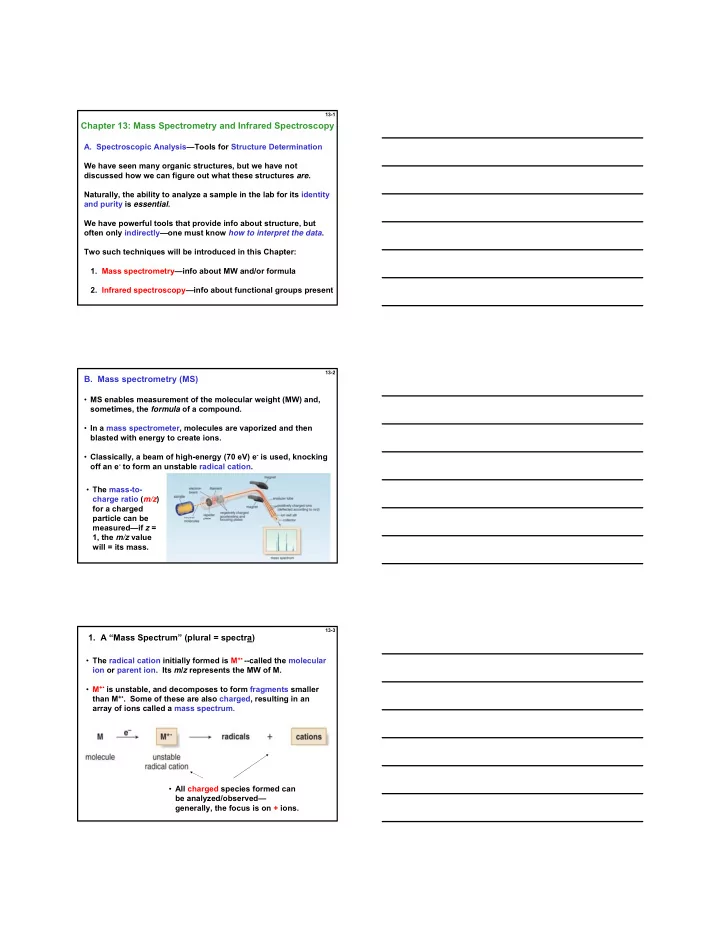
- In a mass spectrometer, molecules are vaporized and then
blasted with energy to create ions.
- Classically, a beam of high-energy (70 eV) e- is used, knocking
- ff an e- to form an unstable radical cation.
- The mass-to-
charge ratio (m/z) for a charged particle can be measured—if z = 1, the m/z value will = its mass.
13-3
- The radical cation initially formed is M+• --called the molecular
ion or parent ion. Its m/z represents the MW of M.
- M+• is unstable, and decomposes to form fragments smaller
than M+•. Some of these are also charged, resulting in an array of ions called a mass spectrum.
- 1. A “Mass Spectrum” (plural = spectra)
- All charged species formed can
be analyzed/observed— generally, the focus is on + ions.