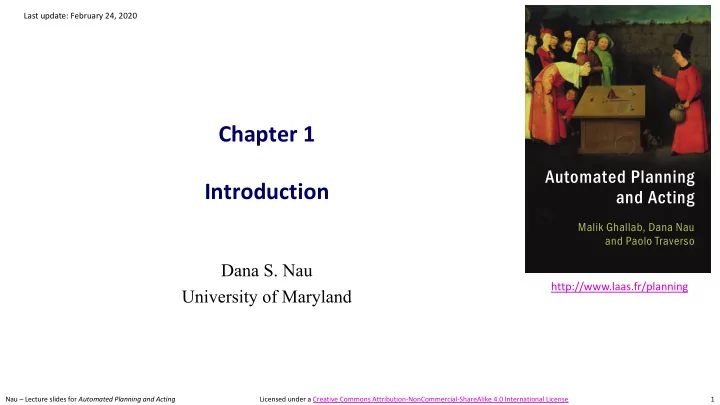
Chapter 1 Automated Planning Introduction and Acting Malik - - PowerPoint PPT Presentation

chapter 1
SMART_READER_LITE
LIVE PREVIEW

Chapter 1 Automated Planning Introduction and Acting Malik - - PowerPoint PPT Presentation

Last update: February 24, 2020 Chapter 1 Automated Planning Introduction and Acting Malik Ghallab, Dana Nau and Paolo Traverso Dana S. Nau http://www.laas.fr/planning University of Maryland Nau Lecture slides for Automated Planning and


slide-1
SLIDE 1

1 Nau – Lecture slides for Automated Planning and Acting

Automated Planning and Acting

Malik Ghallab, Dana Nau and Paolo Traverso

Last update: February 24, 2020

http://www.laas.fr/planning

Licensed under a Creative Commons Attribution-NonCommercial-ShareAlike 4.0 International License

Chapter 1 Introduction

Dana S. Nau University of Maryland

slide-2
SLIDE 2

2 Nau – Lecture slides for Automated Planning and Acting

Deliberation components Execution platform

Commands Percepts

Other actors

Objectives Messages

External World

Signals Actuations

Actor

Deliberation components Execution platform

Planning Acting Queries Plans

Motivation

  • Actor: agent that performs actions
  • Deliberation functions

▸ Planning What actions to perform ▸ Acting How to perform them

slide-3
SLIDE 3

3 Nau – Lecture slides for Automated Planning and Acting

Planning

  • Relies on prediction + search
  • Uses descriptive models of the actions

▸ Predict what the actions will do ▸ Don’t tell how to do them

  • Search over predicted states and possible
  • rganizations of feasible actions
  • Different types of actions ⇒

▸ Different predictive models ▸ Different planning problems and techniques ▸ Motion and manipulation planning ▸ Perception planning ▸ Navigation planning ▸ Communication planning ▸ Task planning Most AI planning

  • • •

s a s′ = γ(s,a)

slide-4
SLIDE 4

4 Nau – Lecture slides for Automated Planning and Acting

Deliberation components Execution platform

Commands Percepts

Other actors

Objectives Messages

External World

Signals Actuations

Actor

Deliberation components Execution platform

Planning Acting Queries Plans

Acting

  • Traditional “AI planning” view:

▸ Carrying out an action is just execution ▸ Can ignore how it’s done

  • Sometimes that’s OK

▸ If the environment has been engineered to make actions predictable ▸ Example on next slide

  • Usually acting is more complicated

▸ Example later

slide-5
SLIDE 5

5 Nau – Lecture slides for Automated Planning and Acting

Acting as Execution

Video: https://www.cs.umd.edu/~nau/apa/kiva.mp4

slide-6
SLIDE 6

6 Nau – Lecture slides for Automated Planning and Acting

Deliberative Acting

Video: https://www.cs.umd.edu/~nau/apa/crow.mov

slide-7
SLIDE 7

7 Nau – Lecture slides for Automated Planning and Acting

Planning stage Acting stage

Deliberative Acting

  • Actor is in a dynamic unpredictable environment

▸ Adapt actions to current context ▸ React to events

  • Relies on

▸ Operational models telling how to perform the actions ▸ Observations of current state

slide-8
SLIDE 8

8 Nau – Lecture slides for Automated Planning and Acting

Planning and Acting

  • Multiple levels of abstraction

▸ Actors are organized into physical subsystems ▸ Deliberation reflects this

  • Heterogeneous reasoning

▸ Different techniques

  • at different levels
  • different subsystems at same level
  • Continual online planning

▸ Can’t plan everything in advance ▸ Plans are abstract and partial until more detail is needed

Deliberation components Execution platform

Commands Percepts

Other actors

Objectives Messages

External World

Signals Actuations

Actor

Deliberation components Execution platform

Planning Acting Queries Plans

slide-9
SLIDE 9

9 Nau – Lecture slides for Automated Planning and Acting

Bremen Harbor

slide-10
SLIDE 10

10 Nau – Lecture slides for Automated Planning and Acting

Example: Harbor Management

  • Importing/exporting cars

▸ Based on Bremen Harbor

  • Multiple levels of abstraction

▸ Reflect physical organization of harbor

  • Continual online planning

▸ Top level can be planned offline ▸ The rest is online, based on current conditions

  • Heterogeneous reasoning

▸ Different components work in different ways ▸ Online synthesis of automata to control their interactions

… … manage incoming shipment unload unpack store … … … … … … registration manager storage assignment manager release manager booking manager navigation … … await order prepare deliver storage area C manager storage area B manager storage area A manager

Planning Acting

slide-11
SLIDE 11

11 Nau – Lecture slides for Automated Planning and Acting

Example: Service Robot

  • Multiple levels of abstraction

▸ Higher levels: more planning ▸ Lower levels: more acting

  • Continual online planning

▸ What room is o7 in? ▸ What route? ▸ What kind of door? ▸ Close enough to door handle?

  • Heterogeneous reasoning

▸ planning abstract tasks ▸ path planning ▸ reactive (e.g., open door) Planning Acting

ungrasp grasp knob turn knob maintain move back pull monitor identify type

  • f

door pull monitor move close to knob

  • pen door

… … get out close door respond to user requests

… …

bring o7 to room2 go to hallway deliver

  • 7

… … … … … move to door fetch

  • 7

navigate to room2 navigate to room1

slide-12
SLIDE 12

12 Nau – Lecture slides for Automated Planning and Acting

Outline of Book

1: Introduction (this lecture) 2: Deterministic models ▸ Conventional (classical) AI planning ▸ Integrating it with acting 3: Refinement methods ▸ Acting and planning by refining abstract activities into less-abstract activities 4: Temporal models ▸ Reasoning about time constraints 5: Nondeterministic models ▸ Actions with multiple possible outcomes 6: Probabilistic models ▸ Multiple possible outcomes, with probabilities 7: Other: ▸ perceiving, monitoring, goal reasoning, learning, hybrid models, ontologies

Automated Planning and Acting

Malik Ghallab, Dana Nau and Paolo Traverso

slide-13
SLIDE 13

13 Nau – Lecture slides for Automated Planning and Acting

Cover image: The Conjuror. Hieronymus Bosch (c.1450–1516)

Any questions?