Chap 4. Growth and Metabolism I. Terminology 1. Growth Irreversible - - PowerPoint PPT Presentation

chap 4 growth and metabolism
SMART_READER_LITE
LIVE PREVIEW

Chap 4. Growth and Metabolism I. Terminology 1. Growth Irreversible - - PowerPoint PPT Presentation

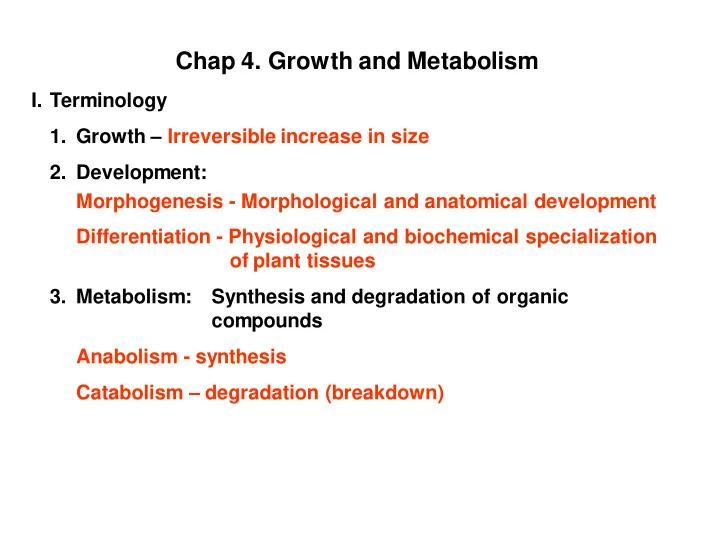
Chap 4. Growth and Metabolism I. Terminology 1. Growth Irreversible increase in size 2. Development: Morphogenesis - Morphological and anatomical development Differentiation - Physiological and biochemical specialization of plant tissues


slide-1
SLIDE 1

Chap 4. Growth and Metabolism

  • I. Terminology
  • 1. Growth – Irreversible increase in size
  • 2. Development:

Morphogenesis - Morphological and anatomical development Differentiation - Physiological and biochemical specialization

  • f plant tissues
  • 3. Metabolism:

Synthesis and degradation of organic compounds Anabolism - synthesis Catabolism – degradation (breakdown)

slide-2
SLIDE 2
  • II. Major Chemical Processes of Plants
  • 1. Photosynthesis

Chlorophyll

12 H2O + 6 CO2 + Light --------------► C6H12O6 + 6 O2 + 6 H2O

(Water) (Carbon dioxide) (Energy) Chloroplast (Carbohydrate) (Oxygen) (Water)

  • 2. Metabolism

(Enzyme)

C6H12O6 + Mineral --------------► Various Organic Compounds

(Carbohydrate) (Fertilizer)

(Cytoplasm) (Protein, fats, starch, hormones, etc.)

  • 3. Respiration

(Enzyme)

Organic Compds + O2 ----------------► CO2 + H2O + Energy + Mineral

(Substrates, (Oxygen) (Mitochondria) (ATP) (Inorganic) Energy source)

The energy released from respiration is used for growth and development of plants

slide-3
SLIDE 3

How Do Plants Manufacture Their Own Food?

slide-4
SLIDE 4
  • 1. Light phase of photosynthesis

Photolysis – Cleavage of water into hydrogen and oxygen by light enery Photophosphorylation Conversion of ADP to ATP by light energy Sum: Conversion of light energy to chemical energy ADP ATP e- H2O O2 H+ e- NADP NADPH2 (Hill Reaction) ATP ADP Energy NADP H+ NADPH2 (Reducing power)

used in many energy transfer process of the cell

  • III. Photosynthesis
slide-5
SLIDE 5
slide-6
SLIDE 6
  • 2. Dark Phase of Photosynthesis

Calvin Cycle

12 3PGA

C3

Calvin Cycle

6 CO2

12 Diphosphoglyceride C3 12 Glyceraldehyde–3P C3

6 RuBP C5 Glyceraldehyde3-P

12 ATP 12 ADP + 12 Pi 12 NADPH2 12 NADP

2 3PGAC3 Fructose C6 Glucose C6

C12 (C6)n

Sucrose starch

C3

6Pi+6ADP 6 ATP

A series of enzymatically mediated reactions in which CO2 reduced to 3-phosphoglyceraldehyde(3PGA) and the CO2 receptor (Ribulosebiphosphate:RUBP) is generated

Net Gain 6 CO2 (6C) + 12 H2O + light C6H12O6 (C6) + 6 O2 + 6 H2O

slide-7
SLIDE 7
  • 3. Two Different CO2 Pathways

C3 Pathway

  • C3 Plants (many dicots: soybean, tomato, apple, etc.)
  • The 1st product of CO2 fixation is C3 acids
  • Only the Calvin Cycle operates
  • Photorespiration exists

CO2 + RuBP (C5) C3 Acids (3PGA)

RuBP

Carboxylase

Calvin cycle

Fructose Glucose Starch

slide-8
SLIDE 8

C4 Pathway

  • C4 Plants (Tropical grass, corn, sugarcane, some dicots like amaranth, Atriplex)
  • First product of CO2 fixation is C4 acids
  • Both C4 pathway and Calvin cycle operate
  • Lacks photorespiration
  • C4 plants grow faster than C3 plants, due to efficient use of CO2

CO2 + PEP (C3) C4 acids (Oxaloacetate C4)

PEP Carboxylase

C4 Pathway

Aspartate (C4)

Malate(C4) MalateC4 Pyruvate

C3

Pyruvate

C3

CO2 3 PGA RuBP

Fructose Glucose,Sucrose, Starch

Bundle Sheath Cell MesophyII cells

RuBP Carboxylase

Calvin Cycle

slide-9
SLIDE 9
slide-10
SLIDE 10
slide-11
SLIDE 11
  • 4. Photorespiration

The process of respiration that consumes oxygen and releases CO2 in the presence of light

  • Does not produce ATP
  • Consumes the reducing power for reducing O2 to CO2
  • Reduces photosynthetic efficiency
  • Occurs in C3 plants

RuBP (C5) O2 CO2, H2O PGA C3 Sugars

{

PGA C3 +

Phosphoglycolic Acid C2

CO2 release

Peroxisomes

Calvin Cycle

Photorespiration

(High O2, low CO2 atmosphere) (High CO2, low O2)

slide-12
SLIDE 12
  • 5. Carbon Dioxide Compensation Point

A steady state of CO2 concentration in the air at which CO2 taken up by plants via photosynthesis is the same as the CO2 given off via respiration

  • At CO2 compensation point, no growth occurs
  • Below compensation point, plants will degrade
  • C3 plants have higher CO2 compensation points than the C4 plants

CO2 Compensation Points:

Soybean (C3 plant) - - - - - 50 ppm at 25 oC Corn (C4 plant) - - - - - - - - 10 ppm at 25 oC Ambient CO2 concentration: 300 ppm (0.03 %)

  • Same principles apply to Light Compensation Points

Net Photosynthesis = Gross Photosynthesis-Respiration

slide-13
SLIDE 13
  • IV. Nutrient Absorption and Translocation
  • 1. Plant Nutrients
  • 16 elements
  • Macronutrients: Nitrogen (N), Phosphorus (P), Potassium (K)

Calcium (Ca), Magnesium (Mg), Sulfur (S)

  • Micronutrients:

Boron (B), Chloride (Cl), Copper (Cu), Iron (Fe), Manganese (Mn), Molybdenum (Mo), Zinc (Zn)

  • 2. Ability to Manufacture Food
  • Most green plants are autotrophic

Autotrophic – Capable of manufacturing its own food from minerals Heterotrophic – Incapable of manufacturing its own food Depends on other sources for organic matter

(Immature embryo, dodder, human)

slide-14
SLIDE 14

Heterotrophic (Parasitic) Plants

Cuscuta species (Dodders)

Flower Seed Parasitic growth of plant Parasitic growth of plant

slide-15
SLIDE 15
  • 3. Nutrient and Water Movement
  • Diffusion – Movement of molecules (a substance) from a region of

high concentration to the region of low concentration

  • Osmosis – Diffusion of water through differentially permeable

membrane

Reverse osmosis (RO) water- purified water low in salt content

  • Translocation – Movement of inorganic and organic solutes from
  • ne part to another part of the plant

Water conduction and mineral movement via xylem Carbohydrate translocation through phloem

  • Transpiration – Loss of water vapor from the leaf via stomata
  • Evaporation – Loss of water by vaporization
  • Evapo-transpiration – Loss of water by evaporation and transpiration
slide-16
SLIDE 16
  • V. Plant Respiration
  • 1. Reverse of Photosynthesis

The process of releasing energy, CO2 and water from organic materials by oxidation

C6H12O6 + 6 O2 -----------► 6 H2O + 6 CO2 + Energy

  • 2. Chemical Process

Glycolysis – Conversion of C6 sugars to CO2 and pyruvic acid Citric Acid Cycle (Kreb Cycle) – Oxydation of pyruvic acid to H+, e- and CO2 (occurs in mitochondria)

  • 3. The Q10
  • The rate of respiration doubles when temperature rises 10 oC (18 oF)
  • Respiration can be reduced by lowering O2 and increasing CO2

concentrations Application: a) CO2 storage of apples and pears b) Hypobaric storage of flowers and fruits

(Low atmospheric pressure)

slide-17
SLIDE 17
  • VII. Plant Constituents
  • Carbohydrates

– Monosaccharides - simple carbohydrates (pentose C5, hexose C6) – Disaccharides – maltose (glu-glu), sucrose (glu-fru) C12 – Olygosaccharides -1-10 monosacchrides lined together – Polysaccharides – starch (poly glu), cellulose, hemicellulose, insulin, etc.

  • Lipids (fats, phospholipids, waxes)
  • Proteins (structural, soluble)
  • Aromatic Compounds (Vanillin, flavonoids)
  • Terpenoids and Steroids
  • Non-Protein Nitrogen Compounds (DNA, RNA, Bases)
  • Vitamins (Vitamin C, Thiamin B1)