Changes to undergraduate nursing and midwifery curriculum for 2018 - - PDF document

changes to undergraduate nursing and midwifery curriculum
SMART_READER_LITE
LIVE PREVIEW

Changes to undergraduate nursing and midwifery curriculum for 2018 - - PDF document

10/17/2017 Changes to undergraduate nursing and midwifery curriculum for 2018 Why change? Reaccreditation every 5 years Higher Education Authority requirements no longer able to offer 4 week courses ANMAC requirements must


slide-1
SLIDE 1

10/17/2017 1

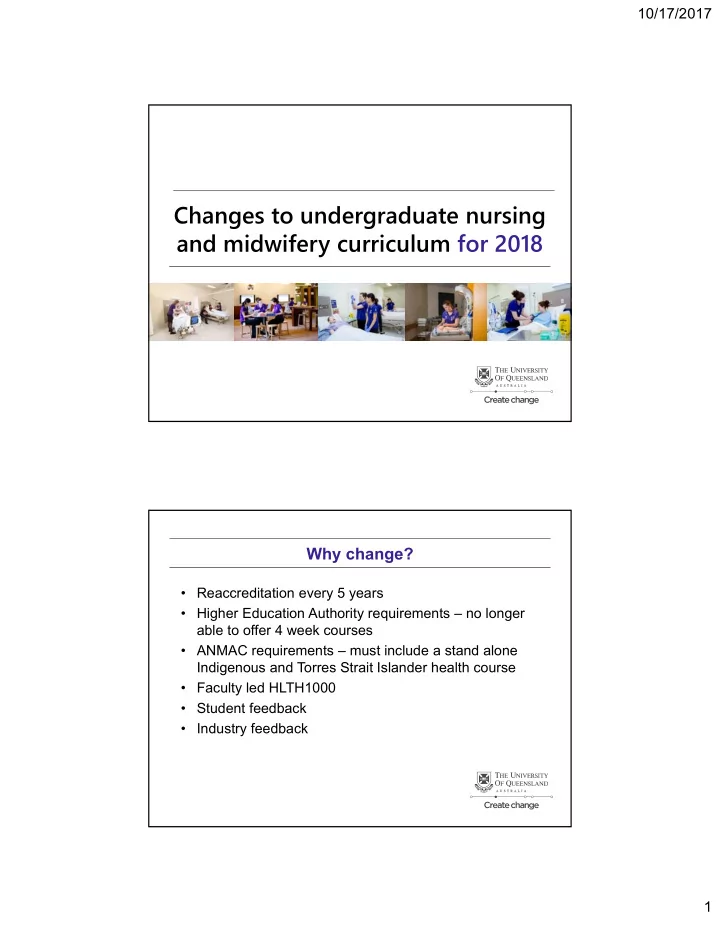
Changes to undergraduate nursing and midwifery curriculum for 2018

Why change?

  • Reaccreditation every 5 years
  • Higher Education Authority requirements – no longer

able to offer 4 week courses

  • ANMAC requirements – must include a stand alone

Indigenous and Torres Strait Islander health course

  • Faculty led HLTH1000
  • Student feedback
  • Industry feedback
slide-2
SLIDE 2

10/17/2017 2

Student / industry feedback

  • You said:

– Keep the clinical hours the same – Need more science – Need more pharmacology – Keep integrated placement (industry feedback was that they wanted first year students to have more skills) – More support in 3rd year – Need more support with finding employment

  • We did:

– Clinical hours either the same or increased – Stand alone science courses in semester 1 and 3 – Stand alone pharmacology course – Integrated placement remains (first year students will have a block placement towards end of semester – There will be structured teaching time built into year 3 courses around skill development and transfer of knowledge into the RN/RM role) – Employability strategy embedded into curriculum

Program aims

Nursing Midwifery The University of Queensland Bachelor of Nursing aims to prepare graduates who are committed to partnering with healthcare consumers, patients and their families to deliver safe, high quality, culturally responsive care. The University of Queensland Bachelor of Midwifery aims to prepare graduates who are committed to partnering with women to deliver safe, high quality, culturally responsive care.

slide-3
SLIDE 3

10/17/2017 3

Program learning objectives

Program Learning Objectives

Nursing

  • Demonstrate emerging nursing leadership through critical reasoning skills and preparation for

practice within dynamic health care contexts

  • Practice research informed care by integrating critical thinking and research skills in the provision
  • f evidenced based care
  • Practice in a compassionate, safe and responsive manner that meets professional standards for

practice

  • Establish professional and respectful relationships with nursing colleagues and the

interprofessional team

  • Establish collaborative and trusting relationships with the client /person and their carers/

significant others

  • Apply principles of social justice and cultural competence in responding to the needs of people

from culturally, socially diverse and vulnerable populations

  • Commit to positively impact on the health and well- being of Aboriginal and Torres Strait Islander

populations Midwifery

  • Practice compassionately in partnership with women using the philosophy of woman centred

care to advocate for normal birth across all settings of care

  • Display professional competence, integrity and moral courage in upholding professional

standards and legislation

  • Demonstrate collaborative, respectful, trusting relationships based on teamwork with colleagues

and an intimate connection with women

  • Foster resilience through self-care, reflection, self- regulation, and professional engagement
  • Demonstrate research informed care by integrating critical thinking and research skills in the

provision of evidenced based care

  • Apply principles social justice and cultural competence in representing the needs of women from

culturally and linguistically diverse backgrounds including socially diverse and vulnerable populations

  • Commit to positively impact on the health and well- being of Aboriginal and Torres Strait Islander

populations

Graduates of our programs will possess the following personal qualities

Nursing Midwifery

  • Person-centredness
  • Caring and compassionate
  • Honesty and integrity
  • Commitment and professionalism
  • Self-reflective and self-reflexive
  • Cultural responsiveness
  • Resilience
  • Advocacy
  • Empathy and compassion
  • Companionship and advocacy
  • Honesty and integrity
  • Commitment and professionalism
  • Dignity and sensitivity
  • Intelligent kindness and

accountability

  • Resilience and self-regulation
slide-4
SLIDE 4

10/17/2017 4

Teaching pedagogy

  • IBL

– Student-centred / interactive – Learning how to learn – Active learning and application of knowledge – Develops higher order thinking skills

  • Narrative

– Critiques, examines and deconstructs experiences – Student / teacher partnership

  • Scaffolded approach

– Level 1 (confirmation) – provision of information – Level 2 (structured) – generation of explanations – Level 3 (guided) – seeking questions and answers – Level 4 (open) – formulate own ideas, self-directed

Thematic Frameworks (Nursing & Midwifery)

Principles:

  • The Australian Safety and Quality Framework for Health Care
  • National Primary Health Care Strategic (NPHC) framework
  • Aboriginal and Torres Strait Islander Health Curriculum Framework
  • National Health Priority Areas (NHPAs) – nursing
  • National Maternity Services Plan (NMSP) - midwifery
slide-5
SLIDE 5

10/17/2017 5

Bachelor of Nursing

Year One Semester One Semester two The focus is on learning the context of nursing, health and healthcare and acquiring safe foundational, evidence- based nursing skills. There is a focus on clinical assessment, communication and professional responsibilities BIOM1060 Anatomy & Physiology for Nursing & Midwifery NUMW1102 Professional Practice 1 NURS1101 Health across the Lifespan NURS1103 Clinical Practice 1 BIOM1061 Pharmacology & Therapeutics for Nursing & Midwifery HLTH1000 Professions, People and Healthcare NURS1104 Older Adults’ Health NURS1105 Clinical Practice 2 Year Two Semester One Semester Two The focus is on developing theoretical and technical / clinical knowledge and skills to provide care in a range of acute and non-acute healthcare environments. Students build on foundation skills to implement and evaluate a range of nursing care responsibilities BIOM2070 Integrated Biomedical Sciences for Nursing NUMW2101 Mental Health NURS2102 Acute Care Nursing NURS2103 Clinical Practice 3 INDH2107 Working with Aboriginal and Torres Strait Islander People NURS2104 Child and Family Nursing NURS2105 Managing Chronic Health Issues NURS2106 Clinical Practice 4 Year 3 Semester One Semester Two The focus of final year is to consolidate clinical skills including assessment, planning, implementation and evaluation

  • f care. Students will also further

develop evidence based practice knowledge and skills and develop beginning leadership skills NUMW3101 Evidence Based Practice NURS3102 Clinical Practice 5 NUMW3103 Professional Practice 2 NURS3104 Clinical Practice 6

Bachelor of Midwifery

Year One Semester One Semester Two The focus is on introducing students to the art and science of midwifery practice BIOM 1060 Anatomy & Physiology for Nursing & Midwifery NUMW1102 Professional Practice 1 MIDW1101 Introduction to Midwifery Practice MIDW1103 Clinical Midwifery Practice 1 BIOM1061 Pharmacology & Therapeutics for Nursing & Midwifery HLTH1000 Professions, People and Healthcare MIDW1104 Working in Partnership with Women and Families MIDW1105 Clinical Midwifery Practice 2 Year Two Semester One Semester Two The focus is on extending midwifery practice to include care for women with pregnancy and birth related complexities BIOM2071 Integrated Biomedical Sciences for Midwifery NUMW2101 Mental Health MIDW2102 Health Complexities in Pregnancy MIDW2103 Clinical Midwifery Practice 3 INDH2107 Working with Aboriginal and Torres Strait Islander People MIDW2104 Postpartum and Infancy MIDW2105 Critical Illness in the Mother and Neonate MIDW2106 Clinical Midwifery Practice 4 Year 3 Semester One Semester Two The focus of final year is to develop advanced midwifery skills including those around leadership and professional

  • practice. Students will also further

develop evidence based practice skills and consider the requirements for midwifery practice review, and eligibility MIDW3102 Clinical Midwifery Practice 5 MIDW3105 Woman Centred Care Towards a Philosophy of Practice NUMW3101 Evidence Based Practice MIDW3104 Clinical Midwifery Practice 6 NUMW3103 Professional Practice 2

slide-6
SLIDE 6

10/17/2017 6

Clinical Learning (Nursing & Midwifery)

  • Activities – theoretical, simulated and placement-learning experiences are threaded

through the curriculum

  • Bachelor of Nursing and Bachelor of Midwifery include an employability framework

across the programs – aims to foster lifelong learning and professional growth for students by providing

  • pportunities for them to engage in a variety of on and off campus experiences

– four pillars

  • awareness –developing both discipline knowledge and skills, as well as

personal attributes that guide workplace performance;

  • experiences – providing students with a range of experiences helps to

develop employability;

  • learning - reflecting on experiences to realise individual employability; and
  • transfer - effectively applying learned skills in the workplace to translate

learning into performance

Practice hours (Bachelor of Nursing)

Year One, Semester One Year One, Semester Two 120hrs clinical practice

  • 1. 40hrs observation practice
  • 2. 80hrs consolidated nursing practice in community

healthcare settings 120hrs integrated clinical practice in older adult health care settings Skills: supporting people across health care contexts including: assessment skills eg. Vital signs, communication, role of the registered nurse. Skills: building on assessment and communication skills and developing technical skills such as medication administration and aseptic techniques. Students will begin to initiate care. Year Two, Semester One Year Two, Semester Two 120 hrs integrated nursing practice in healthcare setting 120 hrs integrated nursing practice in healthcare setting Skills: skills that support people during periods of crisis requiring acute care including specialised environments such as mental health. Students will further develop culturally responsive nursing skills to practice safely in these

  • environments. Students will develop skills in the planning,

implementation and evaluation of care they provide. Skills: develop further clinical skills in primary, secondary and tertiary nursing and in specialised settings such as community, paediatric and / or telehealth and primary healthcare settings. They will demonstrate their assessment and evaluation skills in these specialised. Year Three, Semester One Year Three, Semester Two 320hrs of consolidated clinical practice in a healthcare setting (elective placement) 320hrs of consolidated clinical practice in a healthcare setting Skills: students will consolidate their knowledge and skills from years 1 and 2 and manage an increasing load in nursing care within a healthcare context demonstrating culturally responsive care. Skills: students will continue to consolidate skills and demonstrate beginning leadership skills through applying skills in delegation and mentoring of less experienced

  • students. They will be able to apply these skills to

demonstrate how they meet the standards explicit and implicit to the role of the registered nurse.

slide-7
SLIDE 7

10/17/2017 7

Practice hours (Bachelor of Midwifery)

Year One, Semester One Year One, Semester Two 120hrs integrated clinical practice in midwifery setting Commencing required 20 Continuity of care experiences Focus on communication in a professional context and experience of the midwifery environment and the role of the midwife in providing woman centred care. Skills in supporting women across different midwifery contexts including: assessment, communication, the experience of the midwifery care environment and the role

  • f the registered midwife.

120hrs integrated clinical practice in midwifery setting Building on midwifery foundational skills and communication skills and developing technical skills such as safety in drug administration to both the mother and neonate Year Two, Semester One Year Two, Semester Two 120 hrs integrated midwifery practice in various models of care Students will develop skills that support women and their babies during normal birth and periods of crisis requiring acute care including specialised environments such as mental health. 120 hrs integrated midwifery practice in various models of care Students will develop further midwifery skills in specialised environments such as special care nurseries and primary healthcare midwifery settings. They will demonstrate their assessment and evaluation skills in these specialised areas that reflect knowledge and practice that is culturally responsive. Year Three, Semester One Year Three, Semester Two 240hrs of consolidated clinical practice in a midwifery setting Students will consolidate their knowledge and skills from years 1 and 2 and manage an increasing load within a midwifery context. 320hrs of consolidated clinical practice in a midwifery setting Students will continue to consolidate skills and experience beginning leadership skills through applying skills in delegation and mentoring of less experienced students. They will be able to apply these skills to demonstrate how they meet the standards explicit and implicit to the role of the registered midwife.

Clinical learning

  • Simulated clinical learning

– Clinical skills workshops at Mater Whitty building South Brisbane, TRI (PA hospital) or SHRS

slide-8
SLIDE 8

10/17/2017 8

Clinical supervision

  • Overseen by the Professional Placement Unit, which is led by an

academic staff member, a clinical placement coordinator and the academic coordinators for the clinical practice courses.

  • Whilst on placement several models of clinical supervision are

employed depending on the clinical partner requirements, the clinical environment and the geographical location of the placement

Assessment of clinical learning

(Nursing & Midwifery)

  • Australian Nursing Standards Assessment Tool (ANSAT)

– validated instrument, which assesses students’ level of ability across the Registered Nurse standards for practice in a clinical setting

  • Australian Midwifery Standards Assessment Tool (AMSAT)
slide-9
SLIDE 9

10/17/2017 9

Dual degree

The University of Queensland Bachelor of Nursing / Bachelor of Midwifery aims to prepare future graduate nurses and midwives who are committed to partnering with individuals who utilise healthcare services, to deliver safe and high quality, culturally responsive care.

Dual degree program learning objectives

  • Demonstrate emerging leadership in nursing and midwifery practice through critical

reasoning skills and preparation for practice within dynamic health care contexts.

  • Practice research informed care by integrating critical thinking and research skills in

the provision of evidenced based care.

  • Practice in a compassionate, safe and responsive manner that values partnerships

with individuals and which meets professional standards for practice.

  • Establish professional and respectful relationships with individuals and with

interprofessional colleagues.

  • Apply principles of social justice and cultural competence in responding to the needs
  • f individuals from culturally, socially diverse and vulnerable populations
  • Practice using the philosophies of woman centred and person-centred care to

advocate across all settings of care

  • Display professional competence, integrity and moral courage in upholding

professional standards and legislation.

  • Foster resilience through self-care, reflection, self- regulation, and professional

engagement.

slide-10
SLIDE 10

10/17/2017 10

Graduates of our dual degree program will possess the following personal qualities:

  • Empathy and compassion
  • Companionship and advocacy
  • Commitment and

professionalism

  • Dignity and sensitivity
  • Accountability
  • Person-centredness
  • Caring and compassionate
  • Honesty and integrity
  • Self-reflective and self-reflexive
  • Cultural responsiveness
  • Resilience and self-regulation

Dual Degree Year 1 Semester one Dual Degree Year 1 Semester two BIOM1060 Anatomy & Physiology for Nursing & Midwifery (#2) NUMW1102 Professional Practice 1 (#2) MIDW1101 Introduction to Midwifery Practice (#2) MIDW1103 Clinical Midwifery practice 1 (#2) BIOM1061 Pharmacology & Therapeutics for Nursing & Midwifery (#2) MIDW1104 Working in Partnership with Women and Families (#2) NURS1104 Older Adults’ Health (#2) NURSXXXX Clinical Nursing Practice 2 (#2) Year 2 Semester One Year 2 Semester Two BIOM2070 Integrated Biomedical Sciences for Nursing (#2) NUMW2101 Mental Health (#2) NURS2102 Acute Care Nursing (#2) NURS2103 Clinical Practice 3 (Nursing) (#2) HLTH1000 Professions, People and Healthcare (#2) NURS2105 Managing Chronic Health Issues (#2) NURS2104 Child & Family Nursing (on line) (#2) NURS2106 Clinical Practice 4 (Nursing) (#2) Year 3 Semester One Year 3 Semester Two BIOM2071 Integrated Biomedical Sciences for Midwifery (#2) MIDW2102 Health Complexities in Pregnancy (#2) MIDW3105 Woman Centred Care towards a Philosophy of Practice (#2) MIDW2103 Clinical Midwifery Practice 3 (#2) CoCe 3 INDH2107 Working with Aboriginal and Torres Strait Islander People (#2) MIDW2104 Postpartum and Infancy (#2) MIDW2105 Critical Illness in the Mother and Neonate (#2) MIDW2106 Clinical Midwifery Practice 4 (#2) CoCe 3 Year 4 Semester One Year 4 Semester Two NUMW3101 Evidence Based Practice (#2) MIDW3104 Clinical Midwifery Practice 6 (#6) CoCe 4 NUMW3103 Professional Practice 2 (#2) (on line) NURSXXXX Clinical Practice 6 (#6)

slide-11
SLIDE 11

10/17/2017 11

What does this mean for me? Bachelor of Nursing

Year 1, 2017 - Enrol in year 2 of the new curriculum in 2018

Semester 1, 2018 Semester 2, 2018

BIOM2070 Integrated Biomedical Sciences for Nursing INDH2107 Working with Indigenous and Torres Strait Islander People NUMW2101 Mental Health NURS2104 Child & Family Nursing NURS2102 Acute Care Nursing NURS2105 Managing Chronic Health Issues NURS2103 Clinical Nursing Practice 3 NURS2106 Clinical Nursing Practice 4

Semester 1, 2019 Semester 2, 2019

NUMW3101 Evidence Based Practice NUMW3103 Professional Practice 2 NURS3102 Clinical Nursing Practice 5 NURS3104 Clinical Nursing Practice 6

What does this mean for me? Bachelor of Midwifery

Year 1, 2017 - Enrol in year 2 of the new curriculum in 2018

Semester 1, 2018 Semester 2, 2018

BIOM2071 Integrated Biomedical Sciences for Midwifery INDH2107 Working with Indigenous and Torres Strait Islander People MIDW2102 Health Complexities in Pregnancy MIDW2104 Postpartum and Infancy MIDW2103 Clinical Midwifery Practice 3 MIDW2105 Critical Illness in the Mother and Neonate NUMW2101 Mental Health MIDW2106 Clinical Midwifery Practice 4

Semester 1, 2019 Semester 2, 2019

MIDW3102 Clinical Midwifery Practice 5 MIDW3104 Clinical Midwifery Practice 6 MIDW3105 Women Centered Care towards a Philosophy of Practice NUMW3103 Professional Practice 2 NUMW3101 Evidence Based Practice
slide-12
SLIDE 12

10/17/2017 12

What does this mean for me?

Bachelor of Nursing / Bachelor of Midwifery

Year 1, 2017 - Enrol in year 2 of the new curriculum in 2018

Semester 1, 2018 Semester 2, 2018 BIOM2070 Integrated Biomedical Sciences for Nursing HLTH10000 Professions, People and Healthcare NUMW2101 Mental Health NURS2104 Child & Family Nursing NURS2102 Acute Care Nursing NURS2105 Managing Chronic Health Issues NURS2103 Clinical Nursing Practice 3 NURS2106 Clinical Nursing Practice 4 Semester 1, 2019 Semester 2, 2019 BIOM2071 Integrated Biomedical Sciences for Midwifery INDH2107 Working with Indigenous and Torres Strait Islander People MIDW2102 Health Complexities in Pregnancy MIDW2104 Postpartum and Infancy MIDW2103 Clinical Midwifery Practice 3 MIDW2105 Critical Illness in the Mother and Neonate MIDW3105 Women Centered Care towards a Philosophy of Practice MIDW2106 Clinical Midwifery Practice 4 Semester 1, 2020 Semester 2, 2020 MIDW3104 Clinical Midwifery Practice 6 NUMW3103 Professional Practice 2 NUMW3101 Evidence Based Practice NURS3104 Clinical Nursing Practice 6

What does this mean for me?

Bachelor of Nursing / Bachelor of Midwifery

Year 2, 2017 - Enrol in year 3 of the new curriculum in 2018

Semester 1, 2018 Semester 2, 2018 BIOM2071 Integrated Biomedical Sciences for Midwifery INDH2107 Working with Indigenous and Torres Strait Islander People MIDW2102 Health Complexities in Pregnancy MIDW2104 Postpartum and Infancy MIDW2103 Clinical Midwifery Practice 3 MIDW2105 Critical Illness in the Mother and Neonate MIDW3105 Women Centered Care towards a Philosophy of Practice MIDW2106 Clinical Midwifery Practice 4 Semester 1, 2019 Semester 2, 2019 MIDW3104 Clinical Midwifery Practice 6 NUMW3103 Professional Practice 2 NUMW3101 Evidence Based Practice NURS3104 Clinical Nursing Practice 6

slide-13
SLIDE 13

10/17/2017 13

School of Nursing Midwifery and Social Work Level 3, Chamberlain Building (35) nmsw@uq.edu.au (07) 3365 2068 Contact information