change alter the olive oil chemical composition and its nutritional - - PowerPoint PPT Presentation

change alter the olive oil chemical composition and
SMART_READER_LITE
LIVE PREVIEW

change alter the olive oil chemical composition and its nutritional - - PowerPoint PPT Presentation

Can the increment of temperature associated to climate change alter the olive oil chemical composition and its nutritional and nutraceutical properties? Rosa Snchez-Lucas 1, *, Cristina Lpez-Hidalgo 1 , Mara Benlloch-Gonzlez 2 , and Jess


slide-1
SLIDE 1

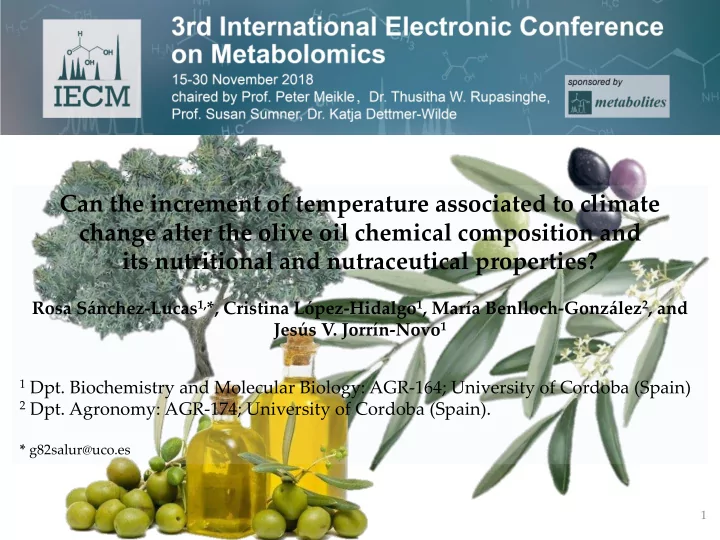
Can the increment of temperature associated to climate change alter the olive oil chemical composition and its nutritional and nutraceutical properties?

Rosa Sánchez-Lucas1,*, Cristina López-Hidalgo1, María Benlloch-González2, and Jesús V. Jorrín-Novo1

1 Dpt. Biochemistry and Molecular Biology: AGR-164; University of Cordoba (Spain) 2 Dpt. Agronomy: AGR-174; University of Cordoba (Spain).

* g82salur@uco.es

1

slide-2
SLIDE 2

2

Introduction

Olive oil production (1000 t)

Arbequina Hojiblanca Picual

  • Olive tree as experimental system
  • Strategic crop for Spain.
  • 3 major varieties.
slide-3
SLIDE 3

3

Olive oil as nutraceutical food product

  • Olive oil = olive juice without chemical extraction or aditives.
  • High content FA (unsaturated) and low content FFA
  • High content of polyphenols (antioxidant power) .
  • Different vitamins, sterols, pigments…
slide-4
SLIDE 4

4

Thermal stress

  • Climate change scenarios
  • Thermal increase
  • Mediterranean area with several

damages.

slide-5
SLIDE 5

5

Objectives

I. To study how thermal increase (+4ºC) affected to the development, maturity and organoleptic properties of olive fruits through phenology, morphometry and biomolecular approaches. II. Metabolite profiles of ripening stages: i) green fruits; ii) turning red; iii) and purple pigmentation, were analyzed by UHPLC/qTOF strategy.

  • III. To identify the principal metabolites affected by thermal

increase and that play a role in the quality of the oil (organoleptic and nutraceutical characteristics).

slide-6
SLIDE 6

6

Ventilation Grill Outdoor Air Injection Turbine Resistances +4ºC Treatment Ambient Temperature Temperature Pobe and Datalogger

Open Top Chambers (OTC)

Materials and Methods

Experimental design AT+4ºC:

  • 8 OTC indoor trees

AT:

  • 8 Control outdoor trees

Campaign 2015/2016

slide-7
SLIDE 7

7

Phenology

  • Growth
  • Flowering processes [1]
  • Ripening processes

Morphology and chemical composition

  • Total production
  • Fruit size
  • Fat yield
  • Anthocyanins and polyphenols contents

Metabolomic approaches

  • 5 ripening stages were collected
  • 3 ripening stages were selected

[1] Benlloch-González et al. (2018). Scientia Horticulturae, 240:405-410.

slide-8
SLIDE 8

8

Metabolomic analysis by UPLC-MS/MS

Tissue homogeneization Metabolite extraction: methanol: chloroform: water (5:2:2) protocol[2] Extract SpeedVac desecation UHPLC/qTOF- MS analysis (UPLC Acquity H-Class Xevo G-2) Statistical analysis Spectra analyses Identification and Quantification Metabolites methanol reconstitution

[2] Valledor et al. (2014.). Plant J. 79, 173–180

slide-9
SLIDE 9

9

Results

Perfect Flowers (% ) Total Production/tree (Kg FW) Fruit size (g FW/nº fruits) Pulpe/pit (g FW/g FW) Fat yield (% DW) AT 6.0 ± 1.4 a* 5.8 ± 0.7 a** 5.7 ± 0.1 a** 9.0 ± 0.3 a** 54 ± 1 a* AT+4ºC 0.5 ± 0.2 b* 0.3 ± 0.0 b** 3.2 ± 0.2 b** 3.7 ± 0.3 b** 36 ± 5 b*

slide-10
SLIDE 10

10

~ 97.000 signals 9877 annotated compounds ~700 metabolites identified

slide-11
SLIDE 11

11

~ 49.000 signals 1162 annotated compounds ~290 metabolites identified

slide-12
SLIDE 12

12

slide-13
SLIDE 13

13

193 metabolites were differents at green ripening stage Fold Change │2│

slide-14
SLIDE 14

14

Functional categorization was carried out manually

177 metabolites were differents at turning-red ripening stage Fold Change │2│ 241 metabolites were differents at purple ripening stage Fold Change │2│

slide-15
SLIDE 15

15

  • Around 800 metabolites were identified by UHPLC/qTOF MS

strategy using a restricted parameters.

  • Present in 2/3replicates and absent in blank
  • With description known and fragmentation spectra
  • Quality control reproducibility
  • Around

200 metabolites/ripening stage present differences (FDR<0,05) between AT and AT+4ºC treatments.

  • The major ripening processes affected by +4ºC were fatty acids

synthesis, plant cell wall degradation, and terpene, phenylpropanoids and flavonoids biosynthesis.

  • The results suggest that global warming will be affect the

ripening processes modifying the fruit characteristics and the final oil quantity and quality.

Conclusions

slide-16
SLIDE 16

16

  • Analysis by RT-qPCR of 103 gene expressions
  • Lipid metabolism
  • ABA- ethylene-AIA response
  • Plant wall degradation
  • Anthocyanin biosynthesis
  • Olive secondary metabolites
  • Analysis of flowering and ripening processes by proteomics

assays

  • Extension of the study with other varieties

Perspectives

slide-17
SLIDE 17

17

  • Dpt. Agronomy; AGR-174

Manuel Benlloch María Benlloch González

  • Dpt. Biochemistry and Molecular Biology; AGR-164

Jesús Jorrín Novo Ana Maldonado Alconada MªCarmen Molina Gómez Mª Dolores Rey Santomé MªÁngeles Castillejo Sánchez Victor M. Guerrero Sánchez Cristina López Hidalgo Isabel Gómez Gálvez Fabiola Santos Rodríguez

Acknowledgements: Consejería de Economía y Conocimiento de la Junta de Andalucía “Incentivos a Proyectos de Investigación de Excelencia” (Ref. AGR/7152). FPU grant supported by the Ministry of Education of Spain (FPU14/00186).

slide-18
SLIDE 18

18

Thanks for your attention