Chair: Vicknasingam B Kasinather, Universiti Sains Malaysia, - - PowerPoint PPT Presentation

chair vicknasingam b kasinather universiti sains malaysia
SMART_READER_LITE
LIVE PREVIEW

Chair: Vicknasingam B Kasinather, Universiti Sains Malaysia, - - PowerPoint PPT Presentation

Identifying Knowledge Gaps as Kratom Emerges on the Global Stage Summary Slides National Institute on Drug Abuse (NIDA) International Symposium at College on Problems of Drug Dependence (CPDD) San Diego, June 9 2018 We lead Chair:


slide-1
SLIDE 1

We lead

Identifying Knowledge Gaps as Kratom Emerges on the Global Stage – Summary Slides

National Institute on Drug Abuse (NIDA) International Symposium at College on Problems of Drug Dependence (CPDD) San Diego, June 9 2018

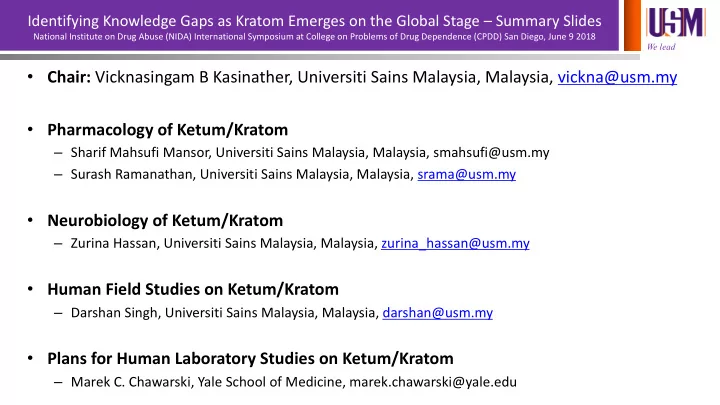
  • Chair: Vicknasingam B Kasinather, Universiti Sains Malaysia, Malaysia, vickna@usm.my
  • Pharmacology of Ketum/Kratom

– Sharif Mahsufi Mansor, Universiti Sains Malaysia, Malaysia, smahsufi@usm.my – Surash Ramanathan, Universiti Sains Malaysia, Malaysia, srama@usm.my

  • Neurobiology of Ketum/Kratom

– Zurina Hassan, Universiti Sains Malaysia, Malaysia, zurina_hassan@usm.my

  • Human Field Studies on Ketum/Kratom

– Darshan Singh, Universiti Sains Malaysia, Malaysia, darshan@usm.my

  • Plans for Human Laboratory Studies on Ketum/Kratom

– Marek C. Chawarski, Yale School of Medicine, marek.chawarski@yale.edu

slide-2
SLIDE 2

Professor Dr. Sharif Mahsufi Mansor

Centre For Drug Research (CDR) Universiti Sains Malaysia

slide-3
SLIDE 3

We lead

MGN is chemically unrelated to any known analgesic agents or opioid medications. MGN is qualitatively different from narcotic analgesics, in terms of activity and side effect profile. Controlled clinical trials need to be conducted to evaluate MGN as a new class of analgesics and for potential treatment of conditions/disorders related to opioid use.

Conclusions

slide-4
SLIDE 4

Surash Ramanathan Ph.D.

Centre For Drug Research (CDR) Universiti Sains Malaysia

slide-5
SLIDE 5

We lead

Ø Case se re report rt on Kra Kratom m poiso soning and death Ø No dire rect ct evi vidence ce of death re related to Kra Kratom m

  • Death : unintentional or

r acci ccidental: (i) due to adulterated Kratom products (synthetic adulterants: amphetamines, benzodiazepines or

  • pioids amitriptyline, oxycodone etc)

(ii) Most cases the victims are poly drug users of other substance of abuse. (iii) Underlying medical conditions e.g. alcohol abuse, depression, anxiety disorder.

Kratom Poisoning

slide-6
SLIDE 6

We lead

Conclusions

MGN has a very low bioavailability (3%) in rats In kratom users, MGN has a long elimination half life (24hr) The current MGN dispersion may offer a more a uniform dosage form of MGN with better bioavailability for future preclinical studies MGN is safe at low dose (1-10mg/kg) but toxic at high dose (100mg/kg) in rats Evidence on death related to Kratom poisoning is lacking.

slide-7
SLIDE 7

Zurina Hassan, Ph.D

Centre For Drug Research (CDR) Universiti Sains Malaysia

slide-8
SLIDE 8

W e l e a d

Conclusions

  • MGN at high doses (10 and 30mg/kg) exhibited

a CPP effect, an indicator of addictive properties

  • f MGN but not at low doses (1 and 5 mg/kg)
  • Locomotor sensitization only observed after 10

days treatment in high dose (20mg/kg)

  • There are participations of the opioidergic and

GABAergic systems in modulating the effects of MGN in MGN-induced CPP.

  • There are pharmacological similarities between

MOR and MGN; suggesting that MGN should be evaluated as a potential agent for treatment of

  • pioid use disorder.

Rewarding properties

  • f MGN:
slide-9
SLIDE 9

W e l e a d

Continued..

  • MGN at high doses (5 and 10mg/kg)

impaired spatial learning but not at low dose (1mg/kg).

  • There are contribution of opioidergic and

GABAergic mediated during memory and learning functions.

  • Memory impairment in a new learning

task during abstinence was only observed at a high dose of MGN (10mg/kg).

Cognitive effects of MGN:

slide-10
SLIDE 10

Current studies in CDR

Assessment of the effectiveness of MGN, methadone & buprenorphine in morphine addicted model

Microdialysis Measuring the extracellular neurotransmitters release in certain brain sites

Intravenous self administration (IVSA) is the best model to assess addictive liability of psychoactive substances

slide-11
SLIDE 11

Field Studies on Ketum/Kratom Use

Darshan Singh, PhD Centre for Drug Research Universiti Sains Malaysia (USM)

slide-12
SLIDE 12

We lead

Overview of Field Findings on Kratom Effects.

Kratom Studies in Southeast Asia

Grewal, 1932. Burkill, 1936. Lee, 1957. Suwanlert, 1976. Assanangkornchai et al., 2007. Vicknasingam et al., 2010. Ahmad & Aziz, 2012. Saingam et al., 2012. Trakulsrichai et al., 2013. Singh et al., 2014. Singh et al., 2015. Singh et al., 2018a. Singh et al., 2018b. Singh et al., 2018c. Chewing of fresh leaves & consumption

  • f kratom

decoction.

Findings

Increased tolerance to heat, steadiness & work capacity. As an opium substitute. Causes unpleasant withdrawal symptoms during cessation. Users become happy, relaxed, strong & active. Its use does not lead to harmful consequences. Males used kratom more frequently in social context. Regular users become easily addicted to kratom. Chronic use is associated with severe dependence & withdrawal effects. Used to reduce dependence & suppress opiate (heroin) withdrawal. Regular use does not impair social-functioning. Traditional consumption (e.g. brewed kratom tea) does not lead to serious health problems.

slide-13
SLIDE 13

We lead

Kratom Dependence?

(Singh et al. Drug and Alcohol Dependence, 2014).

Self-report surveys in Malaysia found that regular consumption was associated with kratom dependence. Kratom dependence was associated with higher frequency & heavy kratom consumption. Being dependent on kratom was not affiliated with impaired social functioning, though users had difficulty abstaining from kratom use. Regular users were more likely to increase their kratom intake overtime.

slide-14
SLIDE 14

We lead

Kratom Withdrawal Symptoms.

(Singh et al., Journal of Psychoactive Drugs, 2015 & 2018c, 2018d).

Kratom withdrawal symptoms are claimed to resemble opioid-like withdrawal symptoms. Kratom produces dose- dependent withdrawal effects during abrupt cessation. Kratom users with long-term (>1 year) & chronic kratom use history (daily ingestion of >1 litter of brewed kratom tea) have difficulty ceasing from kratom use. However, users have their own ways to overcome (e.g. shower, sleep, sweat profusely, etc.) kratom withdrawal symptoms. Most users have never sought treatment for kratom withdrawal symptoms.

slide-15
SLIDE 15

We lead

Safety.

(Kronstrand et al., Journal of Analytical Toxicology, 2011; Singh et al., Brain Research Bulletin, 2016; Lydeker et al., 2016; Anwar et al., CDC, 2016; Grundmann, Drug and Alcohol Dependence, 2017).

Long-term kratom effects are poorly elucidated. Long-term users appeared thin, have darker skin & hepatic face, experience constipation, dehydration, psychological problems & experienced fatigue. So far, there have been no kratom toxicity incidents in Malaysia. Perhaps, consumption of brewed kratom tea could be less toxic than the ingestion of powdered kratom extracts. In the West, kratom use (regardless

  • f duration & quantity) was

associated with kratom exposure (poisoning & death). Current toxicity cases stem from the co-used of kratom with other substances & unresolved medical problems. Users have elevated risk

  • f experiencing

gastrointestinal (e.g. constipation, abdominal pain, etc.) & cardiovascular (e.g. tachycardia, hypertension, drowsiness, etc.) related effects. Despite the unpleasant effects, majority have not sought medical or mental health care treatment for kratom use.

slide-16
SLIDE 16

We lead

Current Research Gaps.

(Singh et al., Brain Research Bulletin, 2016; Singh et al., Journal of Ethnopharmacology, 2018a).

Current studies on kratom effects in humans are based

  • n anecdotal
  • bservations,

surveys among kratom users, clinical case-reports, in-depth interviews & review articles. There are conflicting findings on dependence, withdrawal & the toxic effects of kratom use. Controlled-clinical trials are needed to establish kratom (Mitragyna speciosa Korth.) effects and safety profile in humans.

slide-17
SLIDE 17

Kratom studies at University Sains Malaysia (USM): Human Laboratory and Clinical Research

Marek C. Chawarski, PhD Yale School of Medicine Vicknasingam B. Kasinather, PhD University Sains Malaysia

slide-18
SLIDE 18

Findings overview

  • Mitragyna speciosa plant (leaves) contains 57 compounds, 37 unique

alkaloids (Brown et al. 2017)

  • Known active alkaloids are Mitragynine (12% - 66%) & 7-Hydroxy Mitragynine (2%)

(Ponglux et al. 1994)

  • Content of Mitragynine varies depending on type and source of the raw material and

geographical, climate, and seasonal factors (Adkin et al. 2011; Shellard et al. 1978)

  • Mitragynine appears chemically unrelated to any known analgesic agents
  • r opioids and is qualitatively different from other analgesics
  • The current data is inadequate to establish the safety profile of kratom
  • There are no known reported severe toxicity or fatality incidents in Malaysia or

Thailand where there are large populations of long-term, daily users or kratom

slide-19
SLIDE 19

Reported effects of kratom use in humans

  • Pain relieve or increased pain tolerance
  • Relieve or alleviation of opioid withdrawal symptoms
  • Mood alteration, anti-depressive properties
  • However, kratom use effects in humans are based primarily on

anecdotal reports, observational findings, or self-reports collected using surveys, interviews, and focus groups

  • Only one small study of mitragynine pharmacokinetics in humans

published to date (Trakulsrichai, et al., 2015; N=10 in Thailand)