CFAR DEVELOPMENTAL AWARDS PROGRAMS BASIC SCIENCE AWARD PROGRAM IN - - PDF document

cfar developmental awards programs basic science award
SMART_READER_LITE
LIVE PREVIEW

CFAR DEVELOPMENTAL AWARDS PROGRAMS BASIC SCIENCE AWARD PROGRAM IN - - PDF document

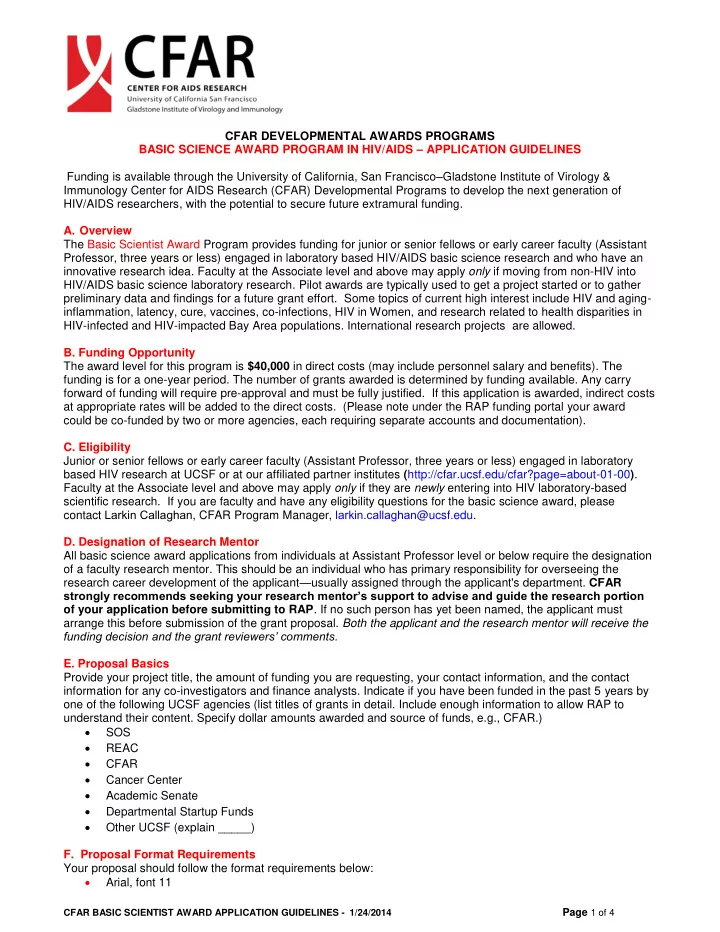
CFAR DEVELOPMENTAL AWARDS PROGRAMS BASIC SCIENCE AWARD PROGRAM IN HIV/AIDS APPLICATION GUIDELINES Funding is available through the University of California, San Francisco Gladstone Institute of Virology & Immunology Center for AIDS


slide-1
SLIDE 1

CFAR BASIC SCIENTIST AWARD APPLICATION GUIDELINES - 1/24/2014

Page 1 of 4

CFAR DEVELOPMENTAL AWARDS PROGRAMS BASIC SCIENCE AWARD PROGRAM IN HIV/AIDS – APPLICATION GUIDELINES Funding is available through the University of California, San Francisco–Gladstone Institute of Virology & Immunology Center for AIDS Research (CFAR) Developmental Programs to develop the next generation of HIV/AIDS researchers, with the potential to secure future extramural funding.

  • A. Overview

The Basic Scientist Award Program provides funding for junior or senior fellows or early career faculty (Assistant Professor, three years or less) engaged in laboratory based HIV/AIDS basic science research and who have an innovative research idea. Faculty at the Associate level and above may apply only if moving from non-HIV into HIV/AIDS basic science laboratory research. Pilot awards are typically used to get a project started or to gather preliminary data and findings for a future grant effort. Some topics of current high interest include HIV and aging- inflammation, latency, cure, vaccines, co-infections, HIV in Women, and research related to health disparities in HIV-infected and HIV-impacted Bay Area populations. International research projects are allowed.

  • B. Funding Opportunity

The award level for this program is $40,000 in direct costs (may include personnel salary and benefits). The funding is for a one-year period. The number of grants awarded is determined by funding available. Any carry forward of funding will require pre-approval and must be fully justified. If this application is awarded, indirect costs at appropriate rates will be added to the direct costs. (Please note under the RAP funding portal your award could be co-funded by two or more agencies, each requiring separate accounts and documentation).

  • C. Eligibility

Junior or senior fellows or early career faculty (Assistant Professor, three years or less) engaged in laboratory based HIV research at UCSF or at our affiliated partner institutes (http://cfar.ucsf.edu/cfar?page=about-01-00). Faculty at the Associate level and above may apply only if they are newly entering into HIV laboratory-based scientific research. If you are faculty and have any eligibility questions for the basic science award, please contact Larkin Callaghan, CFAR Program Manager, larkin.callaghan@ucsf.edu.

  • D. Designation of Research Mentor

All basic science award applications from individuals at Assistant Professor level or below require the designation

  • f a faculty research mentor. This should be an individual who has primary responsibility for overseeing the

research career development of the applicant—usually assigned through the applicant's department. CFAR strongly recommends seeking your research mentor’s support to advise and guide the research portion

  • f your application before submitting to RAP. If no such person has yet been named, the applicant must

arrange this before submission of the grant proposal. Both the applicant and the research mentor will receive the funding decision and the grant reviewers’ comments.

  • E. Proposal Basics

Provide your project title, the amount of funding you are requesting, your contact information, and the contact information for any co-investigators and finance analysts. Indicate if you have been funded in the past 5 years by

  • ne of the following UCSF agencies (list titles of grants in detail. Include enough information to allow RAP to

understand their content. Specify dollar amounts awarded and source of funds, e.g., CFAR.)  SOS  REAC  CFAR  Cancer Center  Academic Senate  Departmental Startup Funds  Other UCSF (explain _____)

  • F. Proposal Format Requirements

Your proposal should follow the format requirements below:  Arial, font 11

slide-2
SLIDE 2

CFAR BASIC SCIENTIST AWARD APPLICATION GUIDELINES - 1/24/2014

Page 2 of 4

 0.5 inch for all margins  6-page limit, including figures and tables, excluding literature cited  No appendices

  • G. Animal Subjects. Indicate if Animal subjects will be used or not. Supply the following:

 IACUC date of approval  IACUC approval number  Specify if pending

  • H. Abstract (one paragraph only, max 300 words summary of project including objective, design, duration of

study, and statistical analysis of data).

  • I. Proposal (maximum 6 pages, including figures and tables, [A-G] excluding literature cited)
  • A. Aims (list two aims)
  • B. Background and Significance
  • C. Preliminary studies
  • D. Experimental Design and Methods (include time-table)

a. Hypothesis, ii) Rationale, iii) Experimental approach, iv) Interpretation of results

  • E. Explain how this pilot project is important for your career goals (e.g., lead to major funding, etc.)

(max 5 lines of text)

  • F. Human Subjects: describe patients, specimens, and/or human subject data that will be used in your

research, and describe the methods that will be used to protect subjects and/or information

  • G. Understanding of and commitment to following security and confidentiality guidelines for all Protected

Health Information (PHI)

  • H. Literature cited (not included in the page limit)
  • J. Budget

The award level for this program is $40,000 in direct costs for a one-year period. Direct costs may include personnel (salary and fringe benefits), consultant costs, equipment, supplies, travel to perform the study or to present findings from the study, and other expenses. For all awards, appropriate direct costs will be added to the total direct costs. Any required subcontracts will be negotiated at a maximum indirect rate of 26%. Travel, along with other costs, must be fully justified. Note: Any foreign component is limited to 8% indirect costs, plus 26% on the first 25,000, for each sub-contracting institution. Please use the NIH PHS 398 form “Page 4: Detailed Budget for Initial Budget Period” ” (http://grants.nih.gov/grants/funding/phs398/fp4.doc) to prepare your budget. The grid below describes the budget items which are allowable/not allowable for the Basic Scientist Award Program: Please use the NIH PHS 398 form “Page 4: Detailed Budget for Initial Budget Period” (http://grants.nih.gov/grants/funding/phs398/fp4.doc) to prepare your budget. The grid below describes the budget items which are allowable/not allowable for the Pilot Award Program: Pilot Award Program Budget Allowable Not Allowable*** PI Salary X Post Doc Salary X Administrative Support X Supplies X Equipment X Software X Personal Computers X Mailing X Tuition X Travel* X

slide-3
SLIDE 3

CFAR BASIC SCIENTIST AWARD APPLICATION GUIDELINES - 1/24/2014

Page 3 of 4

* Travel for awardees is allowed only if required to conduct the study or to present findings from this study at a conference (not simply to attend a conference). **Refer to UCSF Charging Practices for examples of allowable expenses http://controller.ucsf.edu/fin_compliance/files/CAS_Appendix_A.pdf ***Refer to UCSF Charging Practices for examples of unallowable expenses http://controller.ucsf.edu/fin_compliance/files/CAS_appendix_B.pdf

Note: If chosen for an award, applicants must adhere to NIH policy regarding the collection of salary support from these CFAR NIH funds while simultaneously collecting salary support from an NIH "K" and/or T32 award (it is unallowable).

  • K. Budget Justification: justify all costs fully
  • L. Background of Principal Investigators

BioSketch of Principal Investigator, co-investigators, and UCSF Faculty Mentor(s): Use NIH 398/2590 Biographical Sketch format page (http://grants.nih.gov/grants/funding/phs398/biosketch.doc).

  • M. Letter of Support

Please provide a letter of support from the department chair or other unit head. For all applicants, department chair/unit head should indicate support for the application with signature. In addition, for junior investigators, department chairs/unit heads should comment on the independence of the applicant and availability of lab space and other resources for the proposed research.

  • N. Criteria for Review/Evaluation of Applications

Applications that are complete and meet eligibility requirements will be evaluated for scientific and technical merit by an appropriate review committee convened by the UCSF Resource Allocation Program in accordance with NIH review criteria: 1. Significance, 2. Approach, 3. Innovation, 4. Investigator, 5. Environment. Each of these criteria will be addressed and considered in assigning the overall application score:

  • 1. Significance: Does this study address an important problem? If the aims of the application are achieved,

how will scientific knowledge or clinical practice be advanced? What will be the effect of these studies on the concepts, methods, technologies, treatments, services, or preventative interventions that drive this field? If the aims of the project are achieved, how will the applicant’s research career be enhanced?

  • 2. Approach: Are the conceptual or clinical framework, design, methods, and analyses adequately

developed, well integrated, well-reasoned, and appropriate to the aims of the project? Does the applicant acknowledge potential problem areas and consider alternative tactics? Are the administrative plans for the management of the research project appropriate, including plans for resolving conflicts? Is the research hypothesis-driven or hypothesis-generating?

  • 3. Innovation: Is the project original and innovative? For example: Does the project challenge existing

paradigms or clinical practice; address an innovative hypothesis or critical barrier to progress in the field? Does the project develop or employ novel concepts, approaches, methodologies, tools, or technologies for this area?

  • 4. Investigators: Is the work proposed appropriate to the experience level of the applicant? How will this

award enhance the applicant’s career development? Do the letters of support document a strong commitment to help the applicant develop his/her career?

  • 5. Environment: Does the scientific environment(s) in which the work will be done contribute to the

probability of success? Do the proposed studies benefit from unique features of the scientific environment, or subject populations, or employ useful collaborative arrangements? Is there evidence of institutional support? Research Staff Support (e.g. SRA;

  • Lab. Technician)

X Patient Care X Indirect Costs (26%) X Other Expenses** X

slide-4
SLIDE 4

CFAR BASIC SCIENTIST AWARD APPLICATION GUIDELINES - 1/24/2014

Page 4 of 4

  • O. CHR/IRB Approvals

All NIH-funded research requires IRB approval and human subjects training certification. All awardees whose research involves human subjects (e.g., patients or cohorts or the use of specimens/samples /medical record data) will be required to apply for and obtain approval for their research from the UCSF Committee on Human Research (CHR). See the CHR Overview of the Application Process: http://www.research.ucsf.edu/chr/Guide/AppCommRevGI.asp#General. New investigators should visit the UCSF CHR website for details on when and how to apply for CHR approval at http://www.research.ucsf.edu/chr/NewInv/chrNewInv.asp. Information on training, including online training resources, can be found on the CHR website at http://www.research.ucsf.edu/chr/Train/chrTrain.asp. Research that is NOT considered human subject research per CHR Guidelines, (refer to http://www.research.ucsf.edu/chr/Guide/chrExemptApp.asp#NotHuman). Under limited circumstances, research involving only unidentifiable or coded private information or specimens is not considered human subjects

  • research. This can be determined and certified by the Principal Investigator based on the diagram Determining

Whether Human Subjects are Involved in Research When Obtaining Private Information (data) or Biological Specimens, http://www.research.ucsf.edu/chr/guide/HSDecisTree.pdf. If only coded/unidentifiable samples or data will be used in the proposed research, a CHR waiver or self-certification will be required, refer to Exempt Certification and Non-Human Subject Research Application http://www.research.ucsf.edu/chr/guide/chrExemptApp.asp. Note: Funding for research projects involving human subjects will not be released until a CHR approval or CHR waiver letter (citing the awardee's name) and proof of human subjects training have been received and forwarded to the NIH program office. If you have any questions regarding the CHR approval process, please contact the MSO for your department. At no point can CHR approval or waiver expire during the project. Should CHR approval expire before the study is completed, all study research must be stopped immediately, and cannot be recommenced until CHR approval has been obtained.

  • P. Research Resources

Awardees are encouraged to use one or more support services from our CFAR research cores:

  • 1. Clinical and Population Sciences Core - Steven Deeks, MD & Jeff Martin, MD, MPH, Directors

(SDeeks@php.ucsf.edu; martin@psg.ucsf.edu)

  • 2. Immunology Core - Elizabeth Sinclair, PHD, Director (esinclair@sfgh.ucsf.edu)
  • 3. Virology Core - Teri Liegler, PhD; Joseph Wong, MD, Directors (TLiegler@sfgh.ucsf.edu,

Joseph.Wong2@va.gov)

  • 4. Specimen Bank Core - John Greenspan, PhD & Yvonne DeSouza, Directors (John.Greenspan@ucsf.edu,

Yvonne.DeSouza@ucsf.edu)

  • 5. Pharmacology Core - Francesca Aweeka, Director (FAweeka@sfghsom.ucsf.edu)
  • Q. Research involving use of animals or stem cells

Research involving human stem-cells, you will need to supply the GESCR date and approval number.

  • R. Publications

All studies and publications resulting from funded projects should cite CFAR as the funder as follows:

  • S. Progress Reporting

Progress reports will be due to the CFAR program office after the first six months and at the end of the project

  • period. Progress reports are provided to the CFAR Directors and to the NIH program office.
  • T. Program Contact

Should you have any questions regarding submission or reporting procedures, please contact Brenda Sanchez, CFAR Program Analyst, at 415-575-0508 or Brenda.sanchez@ucsf.edu. Additional information related to application for funding can be found on the CFAR website: http://cfar.ucsf.edu/cfar?page=funding-00-00.

This research was supported by a grant from the National Institutes of Health, University of California, San Francisco-Gladstone Institute of Virology & Immunology Center for AIDS Research, P30-AI027763