Central philosophy of the work Making Gnutella-like P2P - - PowerPoint PPT Presentation

central philosophy of the work making gnutella like p2p
SMART_READER_LITE
LIVE PREVIEW

Central philosophy of the work Making Gnutella-like P2P - - PowerPoint PPT Presentation

Central philosophy of the work Making Gnutella-like P2P File-sharing is a dominant P2P application Systems Scalable DHTs might not be suitable for file-sharing Gnutellas design Presented by: Karthik Lakshminarayanan


slide-1
SLIDE 1

Making Gnutella-like P2P Systems Scalable

Presented by: Karthik Lakshminarayanan Yatin Chawathe, Sylvia Ratnasamy, Lee Breslau, Nick Lanham, and Scott Shenker

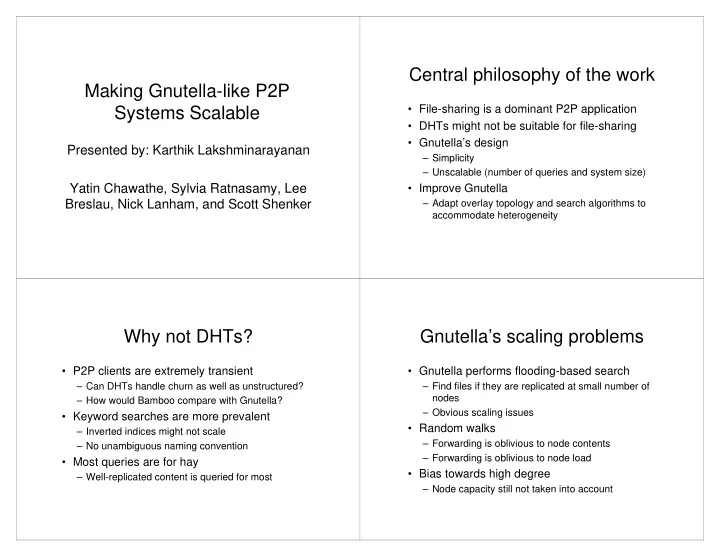
Central philosophy of the work

  • File-sharing is a dominant P2P application
  • DHTs might not be suitable for file-sharing
  • Gnutella’s design

– Simplicity – Unscalable (number of queries and system size)

  • Improve Gnutella

– Adapt overlay topology and search algorithms to accommodate heterogeneity

Why not DHTs?

  • P2P clients are extremely transient

– Can DHTs handle churn as well as unstructured? – How would Bamboo compare with Gnutella?

  • Keyword searches are more prevalent

– Inverted indices might not scale – No unambiguous naming convention

  • Most queries are for hay

– Well-replicated content is queried for most

Gnutella’s scaling problems

  • Gnutella performs flooding-based search

– Find files if they are replicated at small number of nodes – Obvious scaling issues

  • Random walks

– Forwarding is oblivious to node contents – Forwarding is oblivious to node load

  • Bias towards high degree

– Node capacity still not taken into account

slide-2
SLIDE 2

GIA design

  • 1. Dynamic topology adaptation

– Nodes are close to high-capacity nodes

  • 2. Active flow control scheme

– Avoid overloaded hot-spots – Explicitly handles heterogeneity

  • 3. One-hop replication of pointers to content

– Allows high-capacity nodes to answer more queries

  • 4. Search protocol

– Based on random walks towards high-capacity nodes

Exploit heterogeneity

  • 1. Topology adaptation
  • Goal: Make high-capacity nodes have high

degree (i.e., more neighbors)

  • Each node has a level of satisfaction, S

– S = 0 if no neighbors (dissatisfied) – S = 1 if enough good neighbors (fully satisfied) – S is a function of capacity, degree, age of neighbors and capacity of node – Improve the neighbor set as long as S < 1

  • 1. Topology adaptation
  • Improving neighbor set

– Pick a new neighbor – Decide whether to preempt an existing neighbor

  • Depends on degree, capacity of neighbors
  • Asymmetric links?
  • Issues

– Avoid oscillations – use hysteresis – Converge to a stable state

  • 2. Proactive flow control
  • Allocate tokens to neighbors based on

processing capability

– Cannot perform arbitrary dropping due to random walk mechanism of GIA

  • Allocation is proportional to neighbors’

capacities

– Incentive to announce true capacities

  • Uses token assignment based on SFQ
slide-3
SLIDE 3
  • 3. One-hop replication
  • Each GIA node maintains index of

contents of all neighbors

  • Exchanged during neighbor setup
  • Periodically incrementally updated
  • Flushed on node failures
  • 4. Search protocol
  • Biased random walk

– Pick highest capacity node to which it has tokens – If no tokens, queues till tokens arrive

  • TTLs to bound duration of random walks
  • Book-keeping

– Maintain list of neighbors to which a query (unique GUID) has been forwarded

Simulation results

  • Compare four systems

– FLOOD: TTL-scoped, random topologies – RWRT: Random walks, random topologies – SUPER: Supernode-based search – GIA: search using GIA protocol suite

  • Metric:

– Success-rate, Delay, Hop-count

  • Knee/collapse point at a particular query rate

– Collapse point:

  • Per-node query rate at the knee
  • Aggregate throughput that the system can sustain

System model

  • Capacities of nodes based on UW study

– Separated by 4 orders of magnitude

  • Query generation rate for each node

– Limited by node capacity

  • Keyword queries are performed

– Files are randomly replicated

  • Control traffic consumes resources
  • Use uniformly random graphs

– Prevent bias against FLOOD and RWRT

slide-4
SLIDE 4

Questions addressed by simulations

  • What is the relative performance of the

four algorithms?

  • Which of the GIA components matters

the most?

  • What is the impact of heterogeneity?
  • How does the system behave in the

face of transient nodes?

Single search response

  • GIA outperforms SUPER, RWRT & FLOOD by many
  • rders of magnitude in terms of aggregate query load
  • Also scales to very large size network as replication

factor determines scalability

0.00001 0.001 0.1 10 1000 0.01 0.1 1 Replication Rate (percentage) Collapse Point (qps/node)

GIA: N=10,000 SUPER: N=10,000 RWRT: N=10,000 FLOOD: N=10,000

Factor Analysis

  • No single component is useful by itself; the

combination of all of them is what makes GIA scalable 0.0006

RWRT+FLWCTL

0.001

RWRT+TADAPT

0.0015

RWRT+BIAS

0.005

RWRT+OHR

0.0005

RWRT

Collapse point Algorithm

2

GIA – FLWCTL

0.2

GIA – TADAPT

6

GIA – BIAS

0.004

GIA – OHR

7

GIA

Collapse point Algorithm

10000 nodes, 0.1% replication

Impact of Heterogeneity

  • GIA improves under heterogeneity
  • Large CP-HC for GIA under uniform capacities as

queries are directed towards high capacity nodes

10000 nodes, 0.1% replication

slide-5
SLIDE 5

Node failures

  • Even under heavy churn GIA outperforms the other

algorithms (under no churn) by many orders of magnitude

0.001 0.01 0.1 1 10 100 1000 10 100 1000 10000 Per-node max-lifetime (seconds) Collapse point (qps/node)

replication rate = 1.0% replication rate = 0.5% replication rate = 0.1%

10000 nodes GIA system

Implementation

  • Capacity settings

– Bandwidth, CPU, disk access – Configured by user

  • Satisfaction level

– Based on capacity, degree, age of neighbors and capacity of node – Adaptation interval I = T. K-(1-s) , K = degree of aggressiveness

  • Query resilience

– Keep-alive message periodically sent – Optimizations on adaptation to avoid query dropping

Deployment

  • Ran GIA on 83 nodes of PlanetLab for 15 min
  • Artificially imposed capacities on nodes
  • Progress of topology adaptation shown

Conclusions

  • GIA: scalable Gnutella

– 3–5 orders of magnitude improvement in system capacity

  • Unstructured approach is good enough!

– DHTs may be overkill – Incremental changes to deployed systems

  • Can DHTs be used for file-sharing at all?