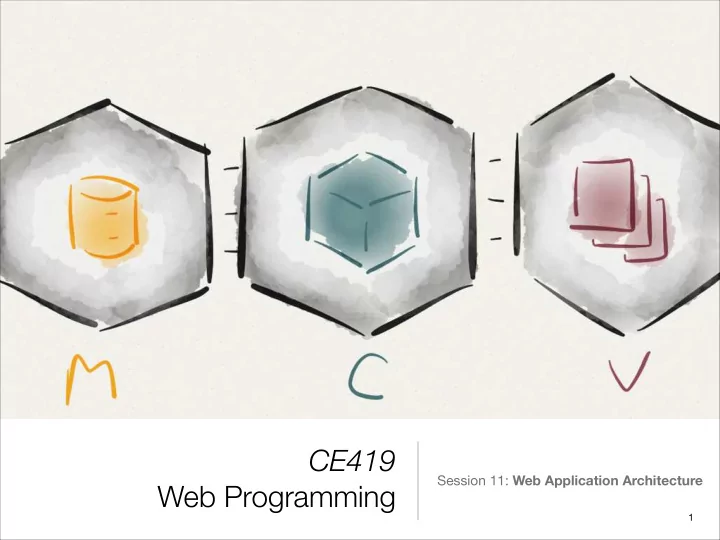
SLIDE 1 CE419 Web Programming
Session 11: Web Application Architecture
1
SLIDE 2 There are two common elements: One is the highest-level breakdown of a system into its parts; the other, decisions that are hard to change.
What is architecture?
2
SLIDE 3 Architectural Styles
- Pipe and Filter, Client-Server, Event-based, Object-
- riented, Layered, etc.
- A good architecture:
- Minimizes coupling between modules.
- Maximizes the cohesion of each module.
3
SLIDE 4 Layering
- Layering is one of the most common techniques to break
apart a complicated software system.
- The higher layer uses various services defined by the
lower layer, but the lower layer is unaware of the higher layer.
- Each layer usually hides its lower layers from the layers
above.
4
SLIDE 6 Layering: Pros & Cons
- Benefits:
- You can understand a single layer as a coherent whole
without knowing much about the other layers.
- You can substitute layers with alternative
implementations of the same basic services.
- You minimize dependencies between layers.
- Once you have a layer built, you can use it for many
higher-level services.
6
SLIDE 7 Layering: Pros & Cons (cont'd)
- But there are downsides:
- Extra layers can harm performance.
- Layers encapsulate some, but not all, things well.
- May not be able to identify (clean) layers.
- Cascading changes.
- The hardest part of a layered architecture is deciding what
layers to have and what the responsibility of each layer should be.
7
SLIDE 8 Two-Layer Model
- Client-server systems.
- The client held the user interface and other application
code, and the server was usually a relational database.
- If the application was all about the display and simple
update of relational data, then these client–server systems worked very well.
8
SLIDE 9 Three-Layer Method
- Rise of Object-oriented Programming
- The object community had an answer to the problem of
domain logic: Move to a three-layer system.
- In this approach you have a presentation layer for your
UI, a domain layer for your domain logic, and a data source.
9
SLIDE 10 The Three Principal Layers
Provision of services, display of information
Logic that is the real point of the system
Communication with databases, messaging systems, etc.
10
SLIDE 12 Web Presentation
- Rise of Web-browser-based applications.
- We talked about its advantages before.
- Three-Layer architecture for Web apps.
SLIDE 13 Model-View-Controller
- Model–View–Controller (MVC) is a software
architecture pattern which separates the representation
- f information from the user's interaction with it.
SLIDE 14
–Connelly Barnes
“An easy way to understand MVC: the model is the data, the view is the window on the screen, and the controller is the glue between the two.”
SLIDE 15
The model consists of application data, business rules, logic, and functions.
Model-View-Controller
SLIDE 16
A view can be any output representation of data, such as a chart or a diagram.
Model-View-Controller
SLIDE 17
The controller mediates input, converting it to commands for the model or view.
Model-View-Controller
SLIDE 18 Model-View-Controller
- Several commercial and noncommercial web application
frameworks have been created that enforce the pattern.
- Django, Ruby on Rails, Symfony, ASP
.NET MVC, etc.
- Early web MVC frameworks took a thin client approach that placed
almost the entire model, view and controller logic on the server.
- As client technologies have matured, frameworks have been
created that allow the MVC components to execute partly on the client.
- Angular.js, Ember.js, etc.
SLIDE 19 View Patterns
- Three popular patterns on the view side:
- Template View
- Transform View
- Two-Step View
SLIDE 20 Template View
- Template View allows you write the presentation in the
structure of the page and embed markers into the page to indicate where dynamic content needs to go.
<!doctype html> <html> <head><title>My Bank</title></head> <body> <h1>Welcome, {{ user.username }}</h1> <p>Your balance is: {{ user.balance }}</p> </body> </html>
SLIDE 21
Let's take a look at PHP
<!doctype html> <html> <head><title>My Bank</title></head> <body> <?php $user = run_query("SELECT * FROM accounts WHERE username = $username"); $username = $user['username']; ?> <h1>Welcome, <?php echo $username ?></h1> <p>Your balance is: <?php $balance = get_balance($username); for($i = 0; $i < 100; $i++) { do_something(...); } ?></p> </body> </html>
SLIDE 22 Transform View
- The basic notion of Transform View is writing a program
that looks at domain-oriented data and converts it to HTML.
SLIDE 23 Two-Step View
- The first stage assembles the information in a logical
screen structure that is suggestive of the display elements yet contains no HTML. The second stage takes that presentation-oriented structure and renders it into HTML.
SLIDE 24 Two-Step View (cont'd)
<album> <title>Zero Hour</title> <artist>Astor Piazzola</artist> <trackList> <track><title>Tanguedia III</title><time>4:39</time></track> <track><title>Milonga del Angel</title><time>6:30</time></track> <track><title>Concierto Para Quinteto</title><time>9:00</time></track> <track><title>Milonga Loca</title><time>3:05</time></track> <track><title>Michelangelo '70</title><time>2:50</time></track> <track><title>Contrabajisimo</title><time>10:18</time></track> <track><title>Mumuki</title><time>9:32</time></track> </trackList> </album> <screen> <title>Zero Hour</title> <field label="Artist">Astor Piazzola</field> <table> <row><cell>Tanguedia III</cell><cell>4:39</cell></row> <row><cell>Milonga del Angel</cell><cell>6:30</cell></row> <row><cell>Concierto Para Quinteto</cell><cell>9:00</cell></row> <row><cell>Milonga Loca</cell><cell>3:05</cell></row> <row><cell>Michelangelo '70</cell><cell>2:50</cell></row> <row><cell>Contrabajisimo</cell><cell>10:18</cell></row> <row><cell>Mumuki</cell><cell>9:32</cell></row> </table> </screen>
SLIDE 25 References
- Patterns of Enterprise Application Architecture
By Martin Fowler, David Rice, Matthew Foemmel, Edward Hieatt, Robert Mee, Randy Stafford
- http://c2.com/cgi/wiki?ModelViewController
- http://queens.db.toronto.edu/~papaggel/courses/
csc309/docs/lectures/web-architectures.pdf
- http://www.cs.toronto.edu/~sme/CSC340F/slides/21-
architecture.pdf
27
SLIDE 26 Any questions?
Thank you.
28