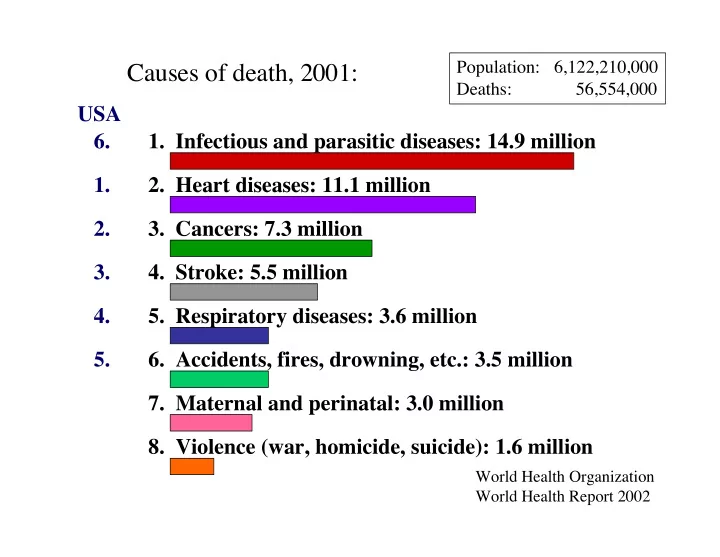
SLIDE 1 Causes of death, 2001:
- 1. Infectious and parasitic diseases: 14.9 million
- 2. Heart diseases: 11.1 million
- 3. Cancers: 7.3 million
- 4. Stroke: 5.5 million
- 5. Respiratory diseases: 3.6 million
- 6. Accidents, fires, drowning, etc.: 3.5 million
- 7. Maternal and perinatal: 3.0 million
- 8. Violence (war, homicide, suicide): 1.6 million
World Health Organization World Health Report 2002
Population: 6,122,210,000 Deaths: 56,554,000
USA 6. 1. 2. 3. 4. 5.
SLIDE 2
Cancer Incidence
SLIDE 3 Essential Characteristics of Cancer Cells
- 1. Rapid/dysregulated cell division
- 2. Avoid apoptosis/differentiation
- 3. Avoid senesence by telomere shortening
- 4. Genomically unstable (Mut L/S HNPCC vs. FAP)
- 5. Invasive
- 6. Survive Elsewhere (10-3 to 10-6; e.g. angiogenesis)
SLIDE 4
Genomic Instability
SLIDE 5
Break-Fusion-Bridge and Telomeres
SLIDE 6
Invasiveness and Ectopic Survival
SLIDE 7
Multiple Hits are Required/Cancer Heterogeneity
SLIDE 8
Environment versus Genetics
80-90% estimated delayable based on environmental factors! But what are they?
SLIDE 9
Oncogenes vs. Tumour Supressors
SLIDE 10
Developmental Pathways in Cancer
Wnt, Hedgehog, Notch/Delta, TGFβ , RTK’s
SLIDE 11 Questions:
1.
- 2. Does transformation require persistance of the initiating
genetic perturbation?
SLIDE 12
Conventional Cytotoxic Chemotherapy
SLIDE 13 Alternate Directed Therapies
- 2. Anti-Receptor mAb’s (e.g. Herceptin) or
soluble ligand/receptor proteins (e.g. Avastin)
- 3. Kinase Enzyme Inhibitors
1.
SLIDE 14
30 Yr. Progress: the Case for Early Detection
SLIDE 15
Human Kinome
SLIDE 16
Human Tyrosine Kinome
SLIDE 17
TK Signaling Pathways
SLIDE 18
Erb RTK Family
SLIDE 19
Erb Receptor Cancer Involvement
SLIDE 20
Erb Signaling Mechanism
SLIDE 21
Erb 1 Inhibitors
SLIDE 22
Tarceva On Erb1
SLIDE 23
Erb1 Mutations in Glioblastoma
SLIDE 24
Philadelphia Chromosome Rearrangement
SLIDE 25 Myeloblast Neutrophil Eosinophil Basophil Promyelocyte Myelocyte Metamyelocyte Stab Cell Neutrophil Eosinophil Basophil Proeythroblast Lymphoblast Monoblast Megakaryoblast Monocyte B cell T cell Plasma cell Active T cell Reticulocyte Erythrocyte Megakaryocyte Platelets Pluripotent Hematopoietic Stem Cell
Blood Cell Differentiation
SLIDE 26
Abl Domains
SLIDE 27
Abl Autoinhibition
SLIDE 28
Gleevec
SLIDE 29
Gleevec Resistance Mutations in Abl
SLIDE 30
Structural Basis for Gleevec Resistance
SLIDE 31 Questions:
Erb RTK K.O. in mice is embryonic lethal. Abl TK K.O. in mice induces perinatal lethality, defects
- f eye/head formation, and hematopoetic problems.
Based on what evidence should one choose a target for inhibition?
SLIDE 32 Papers
Lynch TJ, et al. (2004). "Activating mutations in the epidermal growth factor receptor underlying responsiveness of non-small-cell lung cancer to gefitinib." N Engl J Med. 350(21):2129-39. Fabian MA, et al. (2005). “A small molecule-kinase interaction map for clinical kinase inhibitors.” Nat Biotechnol. 23(3):329-36.