Categories of Client Resistance Chamberlin, Patterson, Reid, - - PowerPoint PPT Presentation

categories of client resistance
SMART_READER_LITE
LIVE PREVIEW

Categories of Client Resistance Chamberlin, Patterson, Reid, - - PowerPoint PPT Presentation

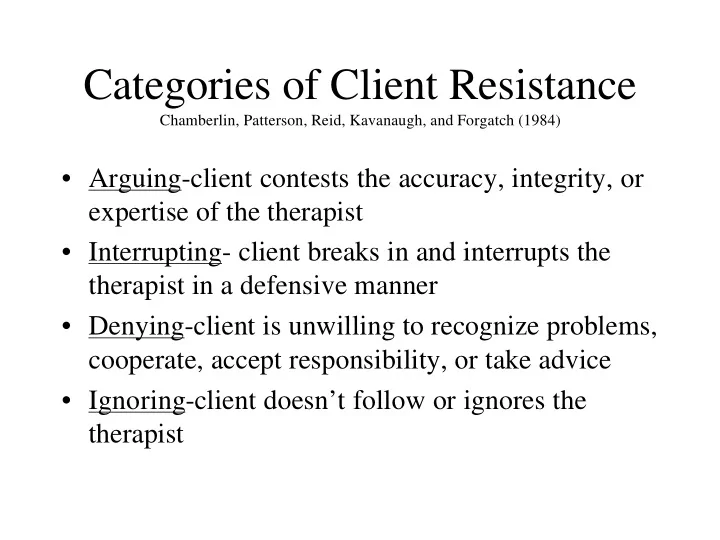
Categories of Client Resistance Chamberlin, Patterson, Reid, Kavanaugh, and Forgatch (1984) Arguing-client contests the accuracy, integrity, or expertise of the therapist Interrupting- client breaks in and interrupts the therapist in a


slide-1
SLIDE 1

Categories of Client Resistance

Chamberlin, Patterson, Reid, Kavanaugh, and Forgatch (1984)

  • Arguing-client contests the accuracy, integrity, or

expertise of the therapist

  • Interrupting- client breaks in and interrupts the

therapist in a defensive manner

  • Denying-client is unwilling to recognize problems,

cooperate, accept responsibility, or take advice

  • Ignoring-client doesn’t follow or ignores the

therapist

slide-2
SLIDE 2

Arguing

  • Challenging-client directly challenges the

accuracy of what the therapist has said

  • Discounting- client questions the therapists

authority and expertise

  • Hostility- client expresses direct hostility

toward the therapist

slide-3
SLIDE 3

Interrupting

  • Talking Over- client speaks while the

therapist is still talking

  • Cutting Off- client breaks in with word to

cut the therapist off

slide-4
SLIDE 4

Denying

  • Blaming
  • Disagreeing
  • Excusing
  • Claiming Impunity- client is not in danger
  • Minimizing
  • Pessimism
  • Reluctance
  • Unwillingness to change
slide-5
SLIDE 5

Ignoring

  • Inattention
  • Non-answer
  • No response
  • Sidetracking
slide-6
SLIDE 6

Traps

  • Question and Answer
  • Taking Sides
  • Expert
  • Labeling
  • Premature Focus
  • Blaming
slide-7
SLIDE 7

Initial Approaches

  • Open-ended Questions
  • Reflective Listening
  • Affirmation
  • Summarization
  • Eliciting Change Talk
slide-8
SLIDE 8

Eliciting Change Talk

Evocative Questions

– Disadvantages of the status quo – Advantages of change – Optimism about change – Intention to change

slide-9
SLIDE 9

Eliciting Change Talk

Exploring the Decisional Balance Elaborating Querying Extremes Looking Back Looking Forward Exploring Goals and Values

slide-10
SLIDE 10

Approaches to Resistance

  • Reflection

– Simple – Amplified-exaggerate what client has said – Double-Sided-adding the other side of the clients ambivalence

  • Shift Focus
  • Agreement with a twist
  • Emphasize personal choice and control
  • Reframing
  • Paradox
slide-11
SLIDE 11

Sign of Readiness for Change

  • Decreased resistance
  • Decreased questions about the problem
  • Resolve
  • Self-motivational statements
  • Increased questions about change
  • Envisioning
  • Experimenting
slide-12
SLIDE 12

Recapitulation

  • Summarize the clients perception of the problem
  • Summarize the clients ambivalence
  • Summarize the objective data about the problem
  • Restate any indications the client has made

regarding change

  • Provide your assessment of the clients situation
slide-13
SLIDE 13

Key Questions

  • What do you think you will do?
  • What does this mean about your drinking/drug use?
  • What’s the next step?
  • What do you think has to change?
  • What could you do?
  • What are your options?
  • How would you like things to turn out?
  • What concerns do you have about changing your

alcohol/drug use?

  • What would be some of the positive things about

change?