Case Study: The University of Utah Post-Earthquake Response April - - PowerPoint PPT Presentation

case study
SMART_READER_LITE
LIVE PREVIEW

Case Study: The University of Utah Post-Earthquake Response April - - PowerPoint PPT Presentation

Post-Earthquake Reconnaissance Workshop Case Study: The University of Utah Post-Earthquake Response April 18, 2018 Demographics Post-Earthquake Reconnaissance Workshop Tier 1 Research Institution 32,000 students / 3000 faculty / 17,500


slide-1
SLIDE 1

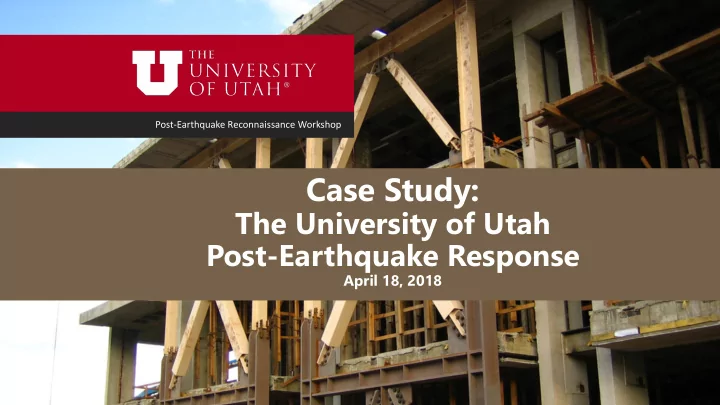
Case Study:

The University of Utah Post-Earthquake Response

April 18, 2018

Post-Earthquake Reconnaissance Workshop
slide-2
SLIDE 2

Demographics

  • Tier 1 Research Institution
  • 32,000 students / 3000 faculty / 17,500 staff
  • Member of PAC 12

Post-Earthquake Reconnaissance Workshop

slide-3
SLIDE 3

Hazard Identification and Risk Assessment

Post-Earthquake Reconnaissance Workshop

slide-4
SLIDE 4

Vision

The University of Utah resolves to be a safe, disaster-resilient campus.

Post-Earthquake Reconnaissance Workshop

  • Enhanced communication, collaboration and partnerships
  • Become certified through Emergency Management Accreditation Program
  • Comprehensive planning
  • Training and exercise
  • Planned event support
slide-5
SLIDE 5

Safe and disaster-resilient campus

Operational 24/7/365

Post-Earthquake Building Evaluation Workshop

slide-6
SLIDE 6

Building Official’s Role in Reoccupation

  • f Damaged Buildings and Structures
  • Organizes interdisciplinary teams to conduct Damage Assessments
  • Oversees training of members of the Damage Assessment teams
  • Coordinates need for structural repairs
  • Makes exceptions to the inspection process as dictated by

circumstances

  • Determines level of building safety provided by Damage Assessment

teams

Post-Earthquake Reconnaissance Workshop

slide-7
SLIDE 7

Rapid Assessment Team (RAT)

  • University of Utah staff approved and trained to perform general

exterior building status (Situational Awareness) for prioritized buildings and structures as directed by the EOC. RAT shall post White tags on prioritized buildings.

Post-Earthquake Reconnaissance Workshop

slide-8
SLIDE 8

Damage Assessment Team (DAT)

  • University of Utah faculty and staff approved and trained by the

Building Official to conduct building and structure damage assessments following the building safety criteria spelled out in Addendum to the ATC-20 Post Earthquake Building Safety Evaluation Procedures published by the Applied Technology Council, prepared for National Science Foundation.

Post-Earthquake Reconnaissance Workshop

slide-9
SLIDE 9

Consultant Damage Assessment Team (CDAT)

  • The CDAT members shall consist of licensed architects, structural

engineers, mechanical engineers with hazardous materials expertise, and other professional engineers as deemed necessary by the Building Official, retained by agreement to perform the ATC-20 Rapid Evaluation and Detailed Evaluation.

Post-Earthquake Reconnaissance Workshop

slide-10
SLIDE 10

Assessment Protocols

  • RAT protocol is implemented by the EOC for prioritized buildings and

structures posting White Tags

  • The DAT members shall perform the Damage Assessments and tag

each building and structure according to the ATC-20 criterion with Green, Yellow, or Red tags

  • The CDAT members shall report to the Building Official providing the

results of the Damage Assessments for their designated buildings within 48 to 72 hours after activation of the EOC.

Post-Earthquake Reconnaissance Workshop

slide-11
SLIDE 11

Assessment Priorities

Post-Earthquake Reconnaissance Workshop

slide-12
SLIDE 12

Questions?

Post-Earthquake Reconnaissance Workshop

Jeff Graviet

Director of Emergency Management The University of Utah jeff.graviet@dps.utah.edu

Bryan Romney

Building Official The University of Utah bryan.romney@fm.utah.edu