
SLIDE 1
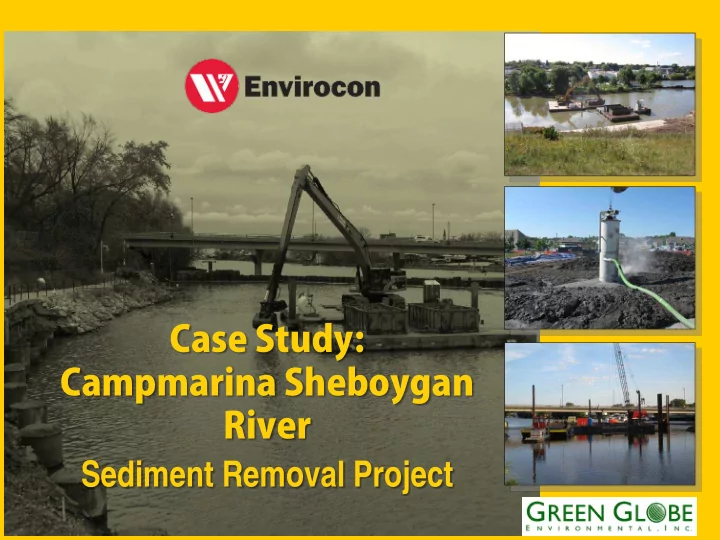
Case Study: Campmarina Sheboygan River Sediment Removal Project - - PowerPoint PPT Presentation
Case Study: Campmarina Sheboygan River Sediment Removal Project Project I ntroduction Sheboygan River, Sheboygan, Wisconsin Parties Owner: Wisconsin Public Service Contractor: Envirocon, Inc. Engineer: Natural Resources
Owner: Wisconsin Public Service Contractor: Envirocon, Inc. Engineer: Natural Resources Technology Key Subcontractors: McMullen & Pitz, Gillen, & Green Globe Environmental
COC’s: TSCA & Non-TSCA PCB’s, NAPL, & PAH impacted sediments Existing Waterloo Wall from earlier Superfund project Site is a city park in a residential neighborhood
TSCA PCB’s: 1,177 BCY, “Surgically Removed” Non TSCA PCB’s, PAH’s, & NAPL: 18,936 BCY Supplemental: 6,000 BCY, only 900 BCY (North Supplemental) removed Stabilize sediments for off site disposal (TSCA to a hazardous waste facility, Non-TSCA to a non-hazardous landfill)
Site Laydown Stabilization Pad H2O Treatment Sheetpile Coffer Buttress System Dredge Boat I sland Condos
Existing Waterloo Barrier & Cap Setting: residential neighborhood & city park Waterloo barrier and cap = LGP, mats & deflection monitoring Project Coordination & Sequencing No TSCA / Non TSCA cross contamination Buttress of waterloo barrier before sediment removal Odor Control NAPL, PCB, and PAH impacted sediments, NAPL being most odorous from coal tar Air monitoring (suma canisters), dust monitoring, and
Water Treatment TSS (total suspended solids) removal key to prevent PCB exceedance Batch filtration proved effective Guidance System Issues Hypack Dredgepack used on the mechanical dredges Change implementation on complex site models
Key Challenges: Installation of sheet pile coffer dam Removal of TSCA material separate from Non-TSCA material Stabilization of sediments Installation of buttress system / deflection monitoring / LGP on the cap & wall Removal of Wakefield Wall Work coordination with a separate but adjoining dredging project
Sheet pile coffer dam was used to contain suspended solids, especially in areas with TSCA PCB contaminated sediments. Details 2 wings, North & South Between Boat Island & East Shore 35’ long Z pile Vibrated in place Installed by M&P Buttress install and dredging simultaneous with coffer dam install
Existing Waterloo wall was not tied into bedrock. There was concern that the existing capped and remediated Superfund site (the park) could deflect when removing sediments against it, breaking the grouted joints and causing leaking into the river. Deflection monitoring and LGP measures implemented on the Waterloo wall and cap Impacted sediments removed by jetting along the Waterloo wall to allow for the installation
Buttress System: 42” diameter steel pipe, 40’ long, double I-beam wales between Waterloo wall and 42” pipe A wood wakefield wall was discovered along the buttress alignment. Much of the wall had to be sheared off.
Given the Site location in a residential area and the odorous nature of the NAPL MGP coal tar residuals (much like moth ball odors), extensive control measures were taken. Key Control Measures: Rusmar foaming of pile Ecosorb “Air Fresheners” Tarping of the pile LKD was used to stabilize the sediments to pass the paint filter
addition is that it heats the pile which promotes off-gassing. Approximately 2,000 BCY of sediments were stored and stabilized on the pile at any given time.
Permit Requirements: PCB Total: 0.8 mg/L daily maximum PAH’s: 0.1 mg/L monthly average TSS: 10 mg/L daily maximum Plant sized to handle 50 GPM and 2.6M gallons over the project duration Plant treated water from: stabilization pad, free liquids at the sediment offload, decontamination water Key components: positive displacement pumps and piping, geotubes, weir tanks, bag filters, sand filters, and carbon filters
Final grade models consisted of: TSCA PCB’s: 0.5’ x 0.5’ grid NAPL: flat bottom elevations PAH’s: contoured grades Modeling methods: Hypack does not import TIN surfaces from Autodesk Civil
lifted from the designed
used in Hypack/Dredgepack Civil 3D does not quickly make the grid but several add-ins do.
Numerous design changes, meant numerous model changes Existing grade updated using Hydrolite Single Beam Sonar, multiple times per
Model Changes TSCA by cut from OG TSCA cut to provided pts NAPL: Visual depths PAH’s: 3 added contours DTM implications and horizon lines.
SPS 852 base station (GNSS enabled), 450 mhz radios (Trimmark 3), GNSS enabled RTK receivers, 880 Extreme rover and SPS 700 robotic total station, Hydrolite Sonar. Etrac sensors for the guidance system. Complex models. NAPL was cleaned until visually removed (core samples). Depth revised throughout. Vertical edges, no laybacks. Tolerances were at grade to -0.5’ below grade. “Surgical Removal” of TSCA areas Software solutions: Autodesk Civil 3D, Terramodel, Logmein, and Hypack