Case 3:16-md-02741-VC Document 331 Filed 06/08/17 Page 1 of 3 - - PDF document

case 3 16 md 02741 vc document 331 filed 06 08 17 page 1
SMART_READER_LITE
LIVE PREVIEW

Case 3:16-md-02741-VC Document 331 Filed 06/08/17 Page 1 of 3 - - PDF document

Case 3:16-md-02741-VC Document 331 Filed 06/08/17 Page 1 of 3 1 Aimee Wagstaff, SBN 278480 aimee.wagstaff@andruswagstaff.com 2 Andrus Wagstaff, PC 7171 West Alaska Drive 3 Lakewood, CO 80226 Telephone: (303) 376-6360 4 Facsimile:


slide-1
SLIDE 1
  • 1 -

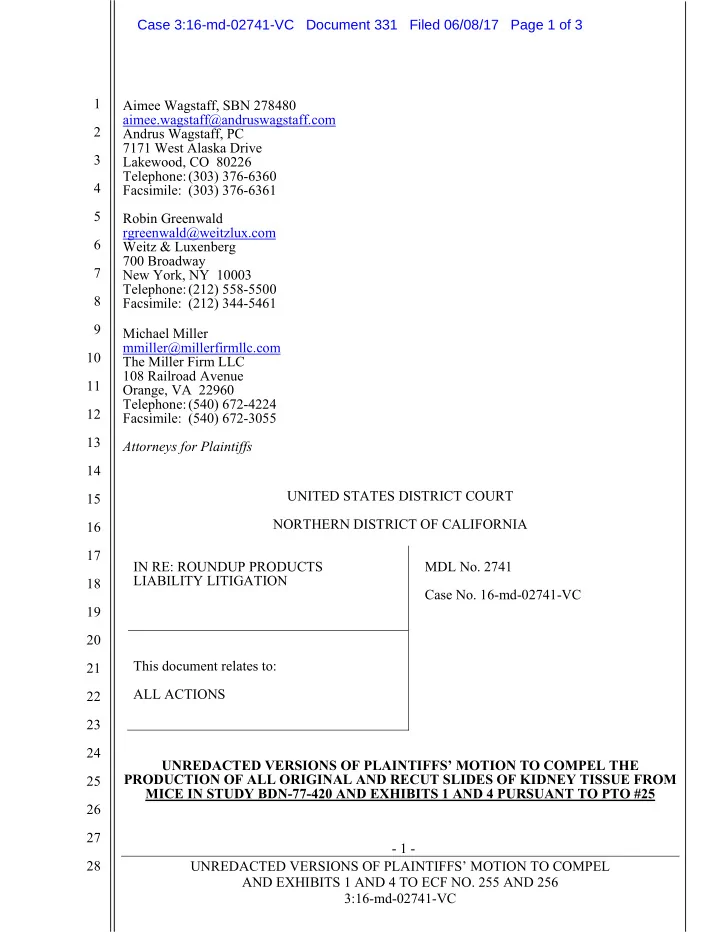
UNREDACTED VERSIONS OF PLAINTIFFS’ MOTION TO COMPEL AND EXHIBITS 1 AND 4 TO ECF NO. 255 AND 256 3:16-md-02741-VC 1 2 3 4 5 6 7 8 9 10 11 12 13 14 15 16 17 18 19 20 21 22 23 24 25 26 27 28 Aimee Wagstaff, SBN 278480 aimee.wagstaff@andruswagstaff.com Andrus Wagstaff, PC 7171 West Alaska Drive Lakewood, CO 80226 Telephone: (303) 376-6360 Facsimile: (303) 376-6361 Robin Greenwald rgreenwald@weitzlux.com Weitz & Luxenberg 700 Broadway New York, NY 10003 Telephone: (212) 558-5500 Facsimile: (212) 344-5461 Michael Miller mmiller@millerfirmllc.com The Miller Firm LLC 108 Railroad Avenue Orange, VA 22960 Telephone: (540) 672-4224 Facsimile: (540) 672-3055 Attorneys for Plaintiffs UNITED STATES DISTRICT COURT NORTHERN DISTRICT OF CALIFORNIA UNREDACTED VERSIONS OF PLAINTIFFS’ MOTION TO COMPEL THE PRODUCTION OF ALL ORIGINAL AND RECUT SLIDES OF KIDNEY TISSUE FROM MICE IN STUDY BDN-77-420 AND EXHIBITS 1 AND 4 PURSUANT TO PTO #25 IN RE: ROUNDUP PRODUCTS LIABILITY LITIGATION MDL No. 2741 Case No. 16-md-02741-VC This document relates to: ALL ACTIONS Case 3:16-md-02741-VC Document 331 Filed 06/08/17 Page 1 of 3

slide-2
SLIDE 2
  • 2 -

UNREDACTED VERSIONS OF PLAINTIFFS’ MOTION TO COMPEL AND EXHIBITS 1 AND 4 TO ECF NO. 255 AND 256 3:16-md-02741-VC 1 2 3 4 5 6 7 8 9 10 11 12 13 14 15 16 17 18 19 20 21 22 23 24 25 26 27 28 Pursuant to the Court’s Pretrial Order #25, entered on June 6, 2017 (ECF No. 330), attached hereto are un-redacted versions of Plaintiffs’ Motion to Compel the Production of all Original and Recut Slides of Kidney Tissue from Mice in Study BDN-77-420 and Exhibits 1 and 4 to said Motion

  • riginally filed on April 21, 2017 (ECF No. 256-2).

Dated: June 8, 2017 Respectfully Submitted, /s/ Aimee Wagstaff Aimee Wagstaff, SBN 278480 aimee.wagstaff@andruswagstaff.com 7171 West Alaska Drive Lakewood, CO 80226 Telephone: (303) 376-6360 Facsimile: (303) 376-6361 Co-Lead Plaintiffs’ Counsel For MDL 2741 Case 3:16-md-02741-VC Document 331 Filed 06/08/17 Page 2 of 3

slide-3
SLIDE 3
  • 3 -

UNREDACTED VERSIONS OF PLAINTIFFS’ MOTION TO COMPEL AND EXHIBITS 1 AND 4 TO ECF NO. 255 AND 256 3:16-md-02741-VC 1 2 3 4 5 6 7 8 9 10 11 12 13 14 15 16 17 18 19 20 21 22 23 24 25 26 27 28 CERTIFICATE OF SERVICE I hereby certify that a true and correct copy of the foregoing document was filed with the Court and electronically served through the CM-ECF system which will send a notification of such filing to all counsel of record. . DATED: June 8, 2017 /s/ Aimee Wagstaff ANDRUS WAGSTAFF, PC Aimee H. Wagstaff, SBN 278480 aimee.wagstaff@andruswagstaff.com 7171 West Alaska Drive Lakewood, CO 80226 Telephone: (303) 376-6360 Facsimile: (303) 376-6361 Case 3:16-md-02741-VC Document 331 Filed 06/08/17 Page 3 of 3

slide-4
SLIDE 4

EXHIBIT 1

Case 3:16-md-02741-VC Document 331-2 Filed 06/08/17 Page 1 of 13

slide-5
SLIDE 5
  • Mr.

Douglas D. Campt Director, Registration Division Office of Pesticide Programs U.S. Environmental Protection Agency 1921 Jefferson Davis Highway Arlington, Virginia 22702 March 13, 1985

Subject: Roundup@ Herbicide EPA Reg. Nos. 524-308, 524-330, 524-339, 524-332 524-343

were used in this Even though the highest feeding level was equivalent to 3% glyphosate in the diet, no major chronic effects were observed nor were there any treatment related oncogenic effects noted. This study was

m,_

x^ r

Upon completion of its review, the Agency indicated concern over

a very low incidence of microscopic renal

adenomas observed in high dose male mice. The incidence data were

0, 0, 1, 3

for control, low-dose, mid-dose, and high dose levels, respectively, and are not statistically significant at the 99% confidence level. in mice. Dietary levels of Dear Mr. Campt: As part of a program to replace IBT toxicology studies Monsanto conducted

a chronic feeding study with glyphosate

in response to

a request by the Agency,

we submitted historical control data from tha laboratory which performed the study as well

as

two other major contract laboratories. The data indicated that this lesion does

  • ccur occasionally

and in comparable ranges.

Monsanto

Monsanto Company

1101 17th

  • Street. N. W.

Washington.

D.

  • C. 20036

Phone : (202 452-8860

mom

Dr. Lyle GingericI, Dr. Fred Johannsen

  • and

I met with Drs.

Farber and Burnam of the EPA. We had

a

full exchange of opinions at this meeting and appreciated the

  • pportunity to explore the EPA position on glyphosate with

them.

Confidential - Produced Subject to Protective Order

MONGLY00233278

Case 3:16-md-02741-VC Document 331-2 Filed 06/08/17 Page 2 of 13

slide-6
SLIDE 6
  • Mr.

Campt March 13, 1985 Page

2

In the course of our meeting, however, it became clear that the

.

e s-.:the

The purpose

  • f this letter

is to summarize

the scientific basis for our position and to provide addition- al interpretation and information for your consideration.

A.

Inconsistency With Treatment-Related Etiology

1.

Sex- specific Occurrence Renal adenomas were only observed in male and not female mice following

2 years of glyphosate treatment.

Significantly, and perhaps not considered by the EPA, was the fact that female mice in the high-dose group took in fully 20% more glyphosate on an mg/kg/day basis than their male counterparts

( 4232-9859 mg/kg/day in

females vs . 3465 -7220 mg/kg/day in males ). If this lesion were treatment -related ,

  • ne would have expected

a dose -dependent increase in tumor development.

This

  • bviously did not occur because no females
  • n test

developed

a renal

adenoma.

  • bservation supports

the before the end of the 24 month study period. This

2.

No Time Course to Tumor Development The small incidence of renal tumors seen in male mice possessed no normal time course to tumor development. Lesions were only observed in terminally sacrificed animals , while none were found in animals which died ecause

a decreased time-to-tumor interval would have been

expected had the latter been the case.

3.

No Progression of Neoplastic Lesion not malignant, lad this effect been treatment related,

a

progression towards carcinomas formation and

a multipli- :ity of sites would have been expected,

especially in senile mice.

Confidential - Produced Subject to Protective Order

MONGLY00233279

Case 3:16-md-02741-VC Document 331-2 Filed 06/08/17 Page 3 of 13

slide-7
SLIDE 7

Mr.

Campt March 13, 1985_ Page

3

4.

No Evidence to Support

a Preneoplastic Effect

In contrast to thoughts

expressed by the EPA at our

In fac no such effects_we_re observe n groups

  • mice fed

glyphosate at a dose level of 50,000 ppm for up to

3

lack of geno-toxicity.

5.

Specie Specificity Results of

a previously submitted 2-year rat study

mutagenicity assays designed to assess point mutations, DNA damage or chromosomal effects in mammalian and bacterial cell systems uniformly resulted in

a complete

months; report submitted in May 1980, accession number 242799. Similarly, evaluation in a broad range of clearly established that there were

  • A.

Consistency With Spontaneous Etiology

1.

Lack of Statistical Significance The original

analysis

  • f multiple comparison of renal

tumors between control and treated groups was conducted using the chi-square test for homogeneity. The significance level,

  • r p-value,
  • btained from this test

was 0.1241 (corrected) and 0.0408 (uncorrected). The ;corrected chi-square

is essentially the same test but

with

a correction factor designed to improve the

approximation. More imprtantly, the more widely accepted Fisher's Exact Test gives

a p-value of 0.1249.

Analysis

  • f the data by the

linear dose-response trends gives

a

Theoretically,

a finding of either one less tumor in the

high dose group

  • r one tumor in the control or low-dose

group results in lack of statistical significance at the p=0.05 level. See Table on page 4 of this letter. Most importantly,

  • Confidential - Produced Subject to Protective Order

MONGLY00233280

Case 3:16-md-02741-VC Document 331-2 Filed 06/08/17 Page 4 of 13

slide-8
SLIDE 8

Mr.

Campt March

13,

1985 Page 4 Number of Tumors at Dose Cochran Armitage Test 1000 ppm 5000 ppm 30 , 000 ppm p-Value 0.016 0.068 0.063 0.239

While the mean incidence

  • f renal

adenomas in large

1 3 1 1 3 1 1 3 1 2

2.

Within Range

(%)

  • f Historical Values

groups of male mice

is

quite

low,

Monsanto has supplied Since the glyphosate

  • 3.

Spontaneously Occurring Tumors Appear to be Sex Specific male control group di no contain an animal with

a

renal tumor it obviously was at the low end of the range. The incidence of renal adenomas in high dose male mice were within, albeit at the high end,

  • f the

historical range of 7.1% for adenomas . The fact that no carcinomas were observed in any test group puts all four groups at the lowest end (0.0%)

  • f the historical

range for this tumor delineation. Based on literature surveyed and historical control data gathered, The fact that the renal adenomas seen in this study were also seen only in males , not females

( even though females

consumed

a higher total glyphosate intake in this

study), is consistent with the data available on the spontaneous

  • ccurrence
  • f this tumor type.
  • This conclusion ha; been reached not only by

Monsanto scientists but by regulatory agencies worldwide. As you know, Roundup is an extremely important herbicide to agriculture

in the U.

S.

and a:eound the world. Monsanto

is

concerned that even the initiation of formal regulatory action would have serious negative economic repercussions

Confidential - Produced Subject to Protective Order

MONGLY00233281

Case 3:16-md-02741-VC Document 331-2 Filed 06/08/17 Page 5 of 13

slide-9
SLIDE 9
  • Mr.

Campt March 13, 1985 Page

5

which we believe are not justified by the scientific evidence. Therefore, Thank you for your consideration of our request. Monsanto places high priority on the satisfactory resolution of this matter and we look forward to your response. Should you have any questions, please contact Dr. Chester Dickerson or Mr. Lyle Gingerich of our Washington office or

me. Sincerely,

Frank

S.

Serdy Manager , Federal and State Registration Affairs /pt

cc: Mr.

Lyle

L.

Gingerich/Dr. Chester T. Dickerson,

Jr. Dr.

J.

Akerman

Dr.

T.

Farber

Mr.

R. J.

Taylor

Confidential - Produced Subject to Protective Order

MONGLY00233282

Case 3:16-md-02741-VC Document 331-2 Filed 06/08/17 Page 6 of 13

slide-10
SLIDE 10

Monsanto

Monsanto Company

1101 17th

Street, N. W.

Washington.

0.

  • C. 20036

Phone:

'202:! 452-8860

March

13,

1985 Mr.

Douglas D. Campt

Director, Registration Division Office of Pesticide Programs U.S. Environmental Protection Agency 1921 Jefferson Davis Highway Arlington, Virginia 22702

bcc:

E. E.

Debus

R. L.

Harness

T. F.

Armstrong

R. W.

Street

F. R.

Johannsen

T. W.

Fuhremann Subject:

Roundup@ Herbicide EPA Reg. Nos. 524-308, 524-330, 524-339, 524-332 524-343 Chronic Mouse Study with

Glyphosate

9

Dear Mr. Campt: As part of

a program to replace

IBT toxicology studies Monsanto conducted

a chronic

feeding study with glyphosate in mice. Dietary levels

  • f

0,

1000, 5000, and 30,000 ppm were used in this two year oncogenicity study. Even though the highest feeding level was equivalent to 3% glyphosate in the diet, no major chronic effects were observed nor were there any treatment related oncogenic effects noted. This study was submitted to the Agency in August, 1983. Upon completion of its review, the Agency indicated concern over a very low incidence

  • f microscopic

renal adenomas

  • bserved

in high dose male mice. The incidence data were

0, 0, 1,

3

for control, low-dose, mid-dose, and high dose levels, respectively, and are not statistically significant at the 99% confidence level. In March, 1984, in response to

a request by the Agency,

we submitted historical control data from the laboratory which performed the study

as well as two other major contract

laboratories. The data indicated that this lesion does

  • ccur occasionally and

in comparable ranges. On February

21,

1985, Dr. Lyle Gingerich, Dr. Fred Johannsen and

I met with Drs.

Farber and Burnam of the EPA. We had

a

full exchange

  • f opinions

at this meeting and appreciated the

  • pportunity to explore

the EPA position on glyphosate with them.

Confidential - Produced Subject to Protective Order

MONGLY00246215

Case 3:16-md-02741-VC Document 331-2 Filed 06/08/17 Page 7 of 13

slide-11
SLIDE 11

Mr.

Campt March

13,

1985 Page

2

In the course of our meeting,

however, it became clear that the EPA considers the results of the mouse study to be posi- tive and that glyphosate should be categorized

as

a

"possible" human carcinogen, albeit acknowledging that the weight of the evidence for this conclusion is weak. We continue to believe that the results of the chronic mouse study do not support the conclusion of

a treatment-related

  • ncogenic effect.

The purpose of this letter is to summarize the scientific basis for our position and to provide addition-

al interpretation

and information for your consideration.

A.

Inconsistency With Treatment-Related Etiology

1.

Sex-specific Occurrence

Renal adenomas were only observed in male and not female mice following

2 years

  • f glyphosate

treatment. Significantly, and perhaps not considered by the EPA, was the fact that female mice in the high-dose group took in fully 20% more glyphosate

  • n an mg/kg/day basis

than their male counterparts (4232-9859 mg/kg/day in females

vs.

3465-7220 mg/kg/day in males). If this lesion were treatment-related,

  • ne would have expected

a dose-dependent increase

in tumor development. This

  • bviously did not occur because no

females

  • n test

developed

a renal

adenoma.

2.

No Time Course to Tumor Development The small

incidence of renal tumors seen in male mice possessed no normal time course to tumor development. Lesions were only observed in terminally sacrificed animals, while none were found in animals which died before the end of the 24 month study period. This

  • bservation supports

the contention that these lesions were age-related rather than treatment-related because

a decreased time-to-tumor interval would have been

expected had the latter been the case.

3.

No Progression of Neoplastic Lesion Only benign, not malignant, renal tumors were observed in aged male mice. Additionally, these lesions were found only unilaterally with no evidence

  • f multiplicity
  • f

form.

Had this effect been treatment related,

a

progression towards carcinomas formation and

a multipli-

city of sites would have been expected, especially in senile mice.

Confidential - Produced Subject to Protective Order

MONGLY00246216

Case 3:16-md-02741-VC Document 331-2 Filed 06/08/17 Page 8 of 13

slide-12
SLIDE 12

Mr.

Campt March

13, 1985

Page

3

4.

No Evidence to Support

a Preneoplastic Effect

In contrast to thoughts expressed by the EPA at our

February 21 meeting, no evidence

  • f renal hyperplasia
  • r inflammatory changes suggestive
  • f

a preneoplastic

effect were seen in male mice from this

study. In fact, no such effects were observed in groups of mice fed

glyphosate at

a dose level

  • f 50,000 ppm for up to

3

months; report submitted in May 1980, accession number 242799. Similarly, evaluation in

a broad range of

mutagenicity assays designed to assess point mutations, DNA damage or chromosomal effects in mammalian and bacterial

cell systems uniformly resulted in

a complete

lack of geno-toxicity.

5.

Specie Specificity Results of

a previously submitted 2-year rat study

clearly established that there were no treatment-related renal tumors

in that test species.

s

A.

Consistency With Spontaneous Etiology

1.

Lack of Statistical Significance The original analysis

  • f multiple comparison of renal

tumors between control and treated groups was conducted using the chi-square test for homogeneity. The significance

level,

  • r p-value ,
  • btained from this

test was 0.1241

( corrected )

and

0 . 0408

(uncorrected). The

f,.y

chi- square is essentially the same test but

with

a correction

factor designed to improve the approximation . More imprtantly , the more widely accepted Fisher's Exact Test gives

a p -value of 0.1249. Thus,

by either the Fisher ' s Exact test or chi - square (corrected ) test the tumor incidence data are not significant at the p equals 0.05 level. Analysis

  • f the

data by the Cochran-Armitage test for linear dose - response trends gives

a p-value

  • f 0.016.

Theoretically ,

a

finding of either one less tumor in the high dose group or one tumor in the control

  • r low-dose

group results

in lack of statistical significance at the

p=0.05 level .

See Table on page 4 of this letter.

Most importantly , the lack of any complementary or confirming evidence

  • f

a treatment relationship

for this tumor, as

discussed previously with EPA and in this letter, casts doubt on the likelihood of any dose -response relationship.

Confidential - Produced Subject to Protective Order

MONGLY00246217

Case 3:16-md-02741-VC Document 331-2 Filed 06/08/17 Page 9 of 13

slide-13
SLIDE 13

Mr.

Campt March

13,

1985 Page

4

Number of Tumors

at Dose Cochran Armitage Test 1000 ppm 5000 ppm 30,000 ppm

p-Value

1 3

0.016

1 3

0.068

1 1 3

0.063

1 2

0.239

2.

within Range

(%)

  • f Historical Values

While the mean incidence of renal adenomas in large groups

  • f male mice

is

quite low , Monsanto has supplied historical control data indicating

a range of 0.0%-7.1%

in individual study populations . Since the glyphosate male control group did not contain an animal with

a

renal tumor it obviously was at the low end of the range. The incidence of renal adenomas in high dose male mice were within, albeit at the high end,

  • f the

historical range of

7 . 1% for adenomas .

The fact that no carcinomas were observed in any test group puts all four groups at the lowest end

(0 . 0%)

  • f the historical

range for this tumor delineation.

3.

Spontaneously Occurring Tumors Appear to be Sex Specific Based on literature surveyed and historical control data gathered , renal tumors have only been seen spontaneously in male not female mice of the CD- 1 strain. The fact that the renal adenomas seen in this study were also seen only in males, not females

( even though females

consumed

a higher total glyphosate intake in this

study), is consistent with the data available on the spontaneous

  • ccurrence of this tumor type.

In sum

Monsanto strongly believes that the overwhelming weight of evidence available supports the position that the incidence of renal adenomas in this study

is unrelated to

treatment. This conclusion has been reached not only by Monsanto scientists but by regulatory agencies worldwide

As you know, Roundup is an extremely important herbicide to agriculture in the

U. S.

and around the world. Monsanto

is

concerned that even the initiation of formal regulatory action would have serious negative economic repercussions

Confidential - Produced Subject to Protective Order

MONGLY00246218

Case 3:16-md-02741-VC Document 331-2 Filed 06/08/17 Page 10 of 13

slide-14
SLIDE 14

Mr.

Campt March

13,

1985 Page

5

which we believe are not justified by the scientific evidence. Therefore, we request that you inform us

  • f the next steps

EPA intends

to take on the review of glyphosate. Furthermore,

if,

  • n the basis
  • f the

chronic mouse study, the Agency intends to move toward regulation

  • f glyphosate,

we request the opportunity to meet with Messrs. Campt and Melone to discuss further our position. Thank you for your consideration of our request. Monsanto places high priority on the satisfactory resolution of this matter and we look forward to your response.

Should you have any questions, please contact Dr. Chester Dickerson or Mr. Lyle Gingerich of our Washington office

  • r

me. Sincerely, Frank

S.

Serdy Manager, Federal and State Registration Affairs /pt

cc: Mr.

Lyle

L.

Gingerich/Dr. Chester

T.

Dickerson,

Jr. Dr.

J.

Akerman

Dr.

T.

Farber

Mr.

R. J.

Taylor

Confidential - Produced Subject to Protective Order

MONGLY00246219

Case 3:16-md-02741-VC Document 331-2 Filed 06/08/17 Page 11 of 13

slide-15
SLIDE 15

MAY 16 10

  • MARVIN KUSCHNER, M. D.

64 EAST GATE DRIVE HUNTINWrDN , N. Y. 11743

T[I*PHONC

( 516) 367-4811

May 11, 1985

is

  • Timothy J.

Long,

  • Ph. D.

Senior Product Toxicologist Monsanto Company 800 N. Lindbergh Boulevard

  • St. Louis, Missouri

63167 Dear Doctor Long: At your request I have examined the sections of mouse kidneys in Project No, M-6 77-2061. Individual slides were derived from animals 1001 through 4550 with the exception of animal 1016 which was noted to be missing. This first examination was undertaken to:

(1) attempt to illuminate the

morphogenesis of neoplasms by identifying pre-neoplastic changes;

(2) keek for evidence of cytotoxic effects that might suggest a pro-

moting action of the test material ;

(3) determine the presence or absence

  • f epithelial neoplasia .

The incidence of lymphomatous infiltration and non-neoplastic changes such as amyloidosis, pyelonephritis , renal abs- cesses , and multicystic change were not recorded by me although noted to be of common occurrence in all groups. Evidence of pre-neoplastic change and of cytotoxic effects were not found. The neoplasms noted were as follows: Group I M - Animal 1028

Group III )L - Animal 3023 Group IV M - (Animals 4029; 4032; 4041

These tumors were all of the renal cortical epithelial type. In animals 1028 and 4029 the tumors were minute

(lmm or less ) and were

apparently not observed grossly. Tumors in the remaining 3 animals were large and men grossly . The largest of these (#3023) showed most evidence of aty?icality. There seems to be little point to classifying this tumor as malignant and the others as benign since it would appear that all these have the potential for enlargement , anaplasia, and peripheral invasion. No distinguishing histological characteristics of malignancy have; been identified.

Confidential - Produced Subject to Protective Order

MONGLY00233286

Case 3:16-md-02741-VC Document 331-2 Filed 06/08/17 Page 12 of 13

slide-16
SLIDE 16

MARVIN KUSCHNER. M. D.

64 EAST UATE DRIVE

  • HUNTINGTQN. N. Y. 11743

TELEPHONE (516 ) 367-4811

Timothy J. Long , Ph.D.

  • 2-

Re:

Project No M-6 77-2061 The single tumor in the control animal (#1028) is of the so-called "clear-cell" type. A11 others are predominantly of the "dark-cell"

variety although one (#4032) has "clear-cell" components.

I know of

no biological distinction between these types.

  • Confidential - Produced Subject to Protective Order

MONGLY00233287

Case 3:16-md-02741-VC Document 331-2 Filed 06/08/17 Page 13 of 13

slide-17
SLIDE 17

EXHIBIT 4

Case 3:16-md-02741-VC Document 331-3 Filed 06/08/17 Page 1 of 2

slide-18
SLIDE 18

MEMORANDUM

UNITED STATES ENVIRONMENTAL PROTECTION AGENCY WASHINGTON O.C. 20460

December 4, 1985 TO: William Dykstra, Ph.D. Reviewer , Toxicology Branch, TS-769 FROM : Louis Kasza , D.V.M., Ph.D.

e

'

Pathologist, Toxicology Branch, TS-769

  • rrlca or

rtITICIDC$ AND TOXIC IUUSTANCti

SUBJECT: Glyphosphate -- Evaluation of Kidney Tumors in Male Mice: Chronic Feeding Study. INTRODUCTION : Tumors

(0

(1)*; 0; 1; 3 ) were found in the kidneys of male mice at

different dose levels . There were differences in the pathologists'

  • pinions

as to whether the small localized change in one kidney of the control group (#1028 ) represented a tumor or not. In order to provide more information, the Agency recommended the preparation of three (3) additional sections from each kidney in the male groups. "The lesion was not present in the recut specimens from that animal" in the control group (#1028). In the final re- evaluation of the questionable control kidney slides (#1028), the conclusion was formulated that "The pathology staff at Bio/dynamics and I

(Dr. McConnell)

reviewed the lesion and concur that it may be representative of a developing tumor". MATERIALS AND METHODS :

I (Dr. Kasza , Branch Pathologist )

requested all kidney sections from male mice . After selection of slides from all animals in which kidney tumors were diagnosed ,

I studied them under the microscope.

RESULTS : There was no difference in diagnoses between my and other pathologists' diagnoses with respect to kidney tumors in mid- (#3023) and high dose (#4029, 4023, 4041) groups. With regard to the questionable male control kidney (#1028), it is my opinion that the presence of a tumor can not definitely be established. My interpretation is similar to the conclusion of Bio /dynamics ' pathology staff and Dr. McConnell , that the lesion "may be" a proliferative change having the potential to lead to the development of .a. frank tumor. But as the tissue can be seen under the microscope as a small well-demarcated focal cell aggregate morphologically different from the healthy looking surrounding kidney tissue, this morphological alteration does not represent a pathophysiologically significant change. *In parentheses is the review pathologist ' s findings. cc:

T.

Farber

W.

Burnam

R.

Engler

R.

Zendzian

Confidential - Produced Subject to Protective Order

MONGLY00235488

Case 3:16-md-02741-VC Document 331-3 Filed 06/08/17 Page 2 of 2