Case #1: Unexpected Pre-op Labs 62 yo man admitted for bilateral - - PDF document

case 1 unexpected pre op labs
SMART_READER_LITE
LIVE PREVIEW

Case #1: Unexpected Pre-op Labs 62 yo man admitted for bilateral - - PDF document

11/7/2017 Management of the Hospitalized Patient Hematology Cases: Musings from the UCSF Hematology Consult Service Andrew D. Leavitt, MD October 19, 2017 Case #1: Unexpected Pre-op Labs 62 yo man admitted for bilateral Total Hip Arthroplasty


slide-1
SLIDE 1

11/7/2017 1

Management of the Hospitalized Patient

Andrew D. Leavitt, MD

October 19, 2017

Hematology Cases:

Musings from the UCSF Hematology Consult Service

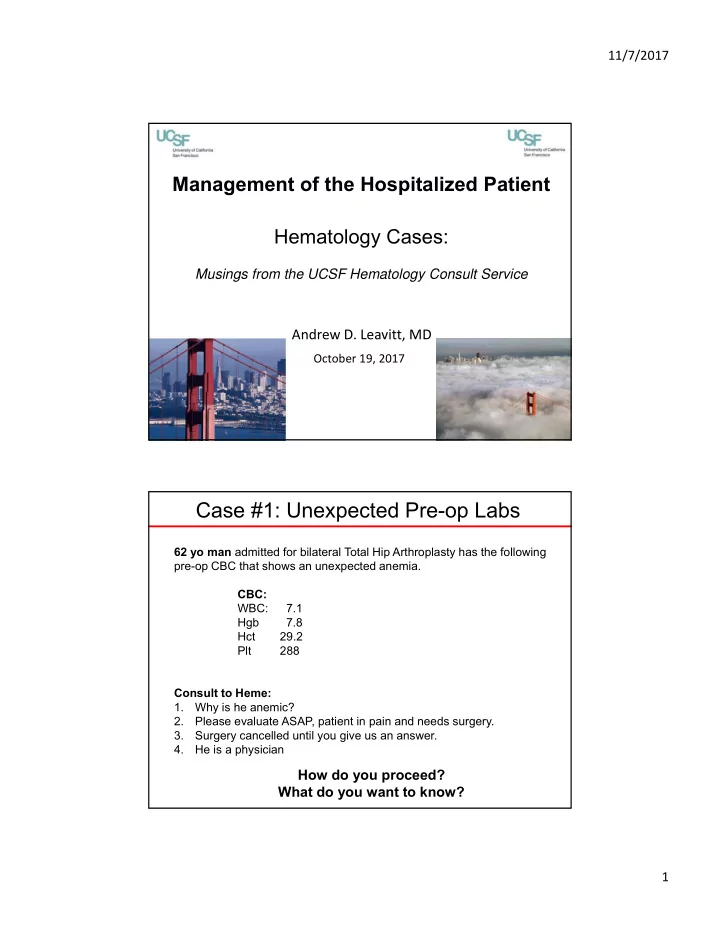
Case #1: Unexpected Pre-op Labs

62 yo man admitted for bilateral Total Hip Arthroplasty has the following pre-op CBC that shows an unexpected anemia. CBC: WBC: 7.1 Hgb 7.8 Hct 29.2 Plt 288 Consult to Heme: 1. Why is he anemic? 2. Please evaluate ASAP, patient in pain and needs surgery. 3. Surgery cancelled until you give us an answer. 4. He is a physician

How do you proceed? What do you want to know?

slide-2
SLIDE 2

11/7/2017 2

Case #1: Unexpected Pre-op Labs

MCV, Retic, Smear, and…

Case #1: Unexpected Pre-op Labs

No Retic on record Major Spine Surgery Ferritin 9 (low); Iron sat 3% (low)

…History

slide-3
SLIDE 3

11/7/2017 3

Case #1: Progression to Iron Def. Anemia

Modified from Harrison’s 18th ed

POINTS:

  • 1. Microcytosis is late to the table. Trends can be useful.
  • 2. Low ferritin should not be ignored when SI and %sat are normal

*

*SI = serum iron

Case 2: Anemia – Need a Marrow Biopsy?

64 yo woman: “Persistent microcytic anemia. Does she need a bone marrow biopsy?” Most recent CBC that prompted the referral: There was no retic & no smear to review when asked to see patient

3 - 10 x 109/L 4 - 5.2 x 10¹²/L 4.4 – 5.9 x 10¹²/L 12 - 15.5 g/dL 13.6 – 17.5 g/dL 36 - 46%; 41 - 53% 80-100 fL

NORMAL VALUES

slide-4
SLIDE 4

11/7/2017 4

Case 2: Anemia – Need a Marrow Biopsy?

The Mighty EMR 1. Stable MCV 2. Iron studies in early 2015 not c/w iron deficiency 3. Hemoglobinopathy eval in early 2015…

Case 2: Anemia – Need a Marrow Biopsy?

NORMAL <1.0 2.2 ‐ 3.2 96.7 – 97.8

Normal? Abnormal? Tells you what?

slide-5
SLIDE 5

11/7/2017 5

Erythropoiesis: Hemoglobin Switching

(Hgb: 2 alpha & 2 “beta-like” [aka, non-alpha; 3 options]) Embryo Fetus Birth Adult 6 mo.

Globin chain synthesis (%)

50

     

HgF  (75) HgA  (25) HgA  (96-98) HgA2  (2-3) HgF  (<1)

Hoffman et al. Hematology 2000

Alpha: Chromosome 16 Beta-like: Chromosome 11

So… No Bone Marrow Biopsy YES Alpha Gene Analysis

4 Alpha Genes:   Silent c.)  Trait)  Trait)  Hg H)  hydrops)

Then always MCV, Retic, Smear*, and… EMR trends

*Gives insight into marrow and possible need for BM BX

Anemia?

slide-6
SLIDE 6

11/7/2017 6

ANEMIA: Basic Outline

MCV Retic NOT elevated Retic elevated

Fe <80 Anemia of Inflammation Thalassemia (ACD) Pb 80-100 Anemia of Inflammation Bleeding (loss of blood cells): (ACD)

  • 1. Outside the body

Primary Marrow

  • 2. Inside

Multifactorial Retroperitoneum, body cavity, GI Io RBC: Hgb; enzyme; membrane 2o RBC (the RBC environment): Immune (AIHA, AlloIHA) Not immune (DIC, TTP, HUS, Sepsis) >100 MDS Elevated Retics B12/folate Hypo-T4 Liver Dz/ EtOH Rx

CASE #3: Anemia: Would you transfuse?

slide-7
SLIDE 7

11/7/2017 7

Case #3: Does She Need RBC Transfusion?

34 YO woman with hx of Fe-deficiency anemia admitted for RLQ pain. Was found to be anemic and to have a R gonadal vein thrombosis The primary team wants to anti-coagulate for the gonadal vein thrombosis but is concerned because she (i) is so anemic and (2) is having her menses.

Heme Consult 200mg Venofer: IV Iron Sucrose 100mg 200mg 100mg

WBC HGB MCV PLT RETIC

Hemoglobin Comment >10 RBC Tfx not indicated (typically) 8-10 Usually not indicated – be a doc 7-8 Should be considered (post-op; cardiovascular symptoms) <7 Likely indicated (but think…not always) <6 Indicated with rare exception

*Guideline = A place to start your thinking, NOT a place to stop your thinking!

Transfusion Guidelines* - RBCs

2012 AABB Guidelines

slide-8
SLIDE 8

11/7/2017 8

*Carson et al. JAMA. 2016;316(19):2025-2035

Transfusion Guidelines* - RBCs

2016 AABB Guidelines

  • The AABB recommends a restrictive RBC transfusion threshold in which the

transfusion is not indicated until the hemoglobin level is 7g/dL for hospitalized adult patients who are hemodynamically stable, including critically ill patients, rather than a liberal threshold when the hemoglobin level is 10g/dL (strong recommendation, moderate quality evidence).

  • For patients undergoing orthopedic surgery or cardiac surgery and those with

preexisting cardiovascular disease, the AABB recommends a restrictive RBC transfusion threshold (hemoglobin level of 8g/dL; strong recommendation, moderate quality evidence).The restrictive hemoglobin transfusion threshold of 7 g/dL is likely comparable with 8 g/dL, but RCT evidence is not available for all patient categories.

  • These recommendations apply to all but the following conditions for which the

evidence is insufficient for any recommendation: acute coronary syndrome, severe thrombocytopenia (patients treated for hematological or oncological disorders who are at risk of bleeding), and chronic transfusion–dependent anemia.

ANSWER: NO, BUT… Tell me more about your iron deficiency….

Case #3: Does She Need RBC Transfusion?

For years. Very heavy and prolonged menstrual periods. Struggled with oral iron on and off for years. Factor 8 55 (43-168) vWF Antigen 40 (42-191) Ristocetin Co-Factor 33 (42-191)
slide-9
SLIDE 9

11/7/2017 9

Case #4: Prolonged PT

28 yo woman G2P1 36 weeks pregnant admitted for hypertension and proteinuria, concern for pre-eclampsia. INR 3.1. You are called as they are concerned about her coagulopathy. PT 30.2 WBC 11.2 (ANC 8.8; ALC 1.8) INR 3.1 Hgb 11.5 aPTT 22.1 MCV 79 Fibrinogen 525 Plt 262

  • She was feeling well prior to this admission
  • Eats a balanced diet and was not on any medications other than her

prenatal vitamins.

  • Afebrile

What is on your differential diagnosis for her prolonged PT? XII XIIa XI XIa IX IXa VIIIa X Xa Va II IIa (thrombin)

Fibrinogen Fibrin

VIIa VII

X-linked Fibrin XIIIa

Ca++/PL Ca++/PL

Kallikrein HMWK

INTRINSIC

EXTRINSIC

COMMON

TF/VIIa TF

Isolated Prolonged PT

(EXTRINSIC)

  • Early Liver Dz
  • Early Vit K
  • Warfarin
  • Early DIC
  • F VII def/inhib

PT

slide-10
SLIDE 10

11/7/2017 10

Case #4: Prolonged PT Tests Ordered:

Mixing Study: Factor VII activity: <6% (54-169%)

Case #4: Prolonged aPTT

22 yo man admitted with abdominal pain going to OR for cholecystectomy. You are asked to evaluate for bleeding risk given lab results.

Chemistries – fine CBC – all normal values PT/INR – 12.4/1.0 aPTT 34. On repeat 35 (normal: 22.4 – 32.7) Consult question: “Can we safely take this patient to surgery?”

slide-11
SLIDE 11

11/7/2017 11

Case #4: Prolonged aPTT

22 yo man evaluated for possible living-related kidney transplant.

  • Most common cause of an isolated prolonged aPTT?

Concern for bleed? Concern for clot? Neither?

XII XIIa XI XIa IX IXa VIIIa X Xa Va II IIa (thrombin)

Fibrinogen Fibrin

VIIa VII

X-linked Fibrin XIIIa

Ca++/PL Ca++/PL

Kallikrein HMWK INTRINSIC

EXTRINSIC COMMON

TF/VIIa TF

Disorders with isolated prolonged aPTT

(INTRINSIC)

  • F VIII*
  • vWD
  • F IX*
  • Heparin
  • F XI
  • F XII
  • Contact factors
  • Lupus anticoagulant (clotting)**

aPPT

slide-12
SLIDE 12

11/7/2017 12

Case #4: Prolonged aPTT

22 yo man evaluated for possible living-related kidney transplant.

  • Most common cause of an isolated prolonged aPTT?

Concern for bleed? Concern for clot? Neither? Factor VIII 120 (nl) Factor IX 145 (nl) Factor XI 112 (nl) Factor XII 41 (low)

Factor XII deficiency has no known clinical consequence

A Brief Image Intermezzo

Normal Iron Deficient Target cells Schistocytes

slide-13
SLIDE 13

11/7/2017 13

Case #5: Young Man Feeling Fatigued

23 yo man experienced 4 days of progressive fatigue, mild headache, and occasional palpitations. He then had difficulty focusing at work and co-workers said he looked pale. Went to local urgent care. CLINIC EXAM: T 37.1 HR 117 BP 144/68 RR16 100%RA Pale, no acute distress, no scleral icterus Hear, lung and abdominal exams all normal Labs drawn at clinic: CBC: WBC 13.4, Hg 5.1, Hct 15.9, Platelets 264 Chem: 137/3.6/102/28; Bun 13, Creatinine 0.74 PMH: No prior surgeries or significant medical problems. No GI or GU complaints. The patient was sent to the UCSF ED for evaluation. AT UCSF ER: Patient is as described. BP 144/68, HR 117, Temp 98.8 (37.1), Res 16 O2 Sat 100% (room air) WBC 13.8, Hgb 5, Hct 15.9, MCV 113, Plt 271

MORE LABS BACK: Reticulocyte count 487K/uL LDH 413, AST 26, ALT 14, Alk Phos 55, T.bili 2.1, D.bili 0.2 Additional labs pending…

Case #5: Young Man Feeling Fatigued

slide-14
SLIDE 14

11/7/2017 14

You sent Type and Crossmatch to the Blood Bank. You ask them to set up 4 units of blood and you want two units STAT. 20 minutes later blood bank says that his antibody screen is positive, there could be a delay. AND… 25 minutes later they say that he has an antibody and they are working to identify it so that they can provide compatible units. They ask: What do you want to do? You want to ask: Auto or Allo Ab? How many more tubes do you need for a phenotype?

Case #5: Young Man Feeling Fatigued

Lets discuss the EMR Blood Bank info Direct Coombs = DAT

Case #5: Young Man Feeling Fatigued

slide-15
SLIDE 15

11/7/2017 15

Warm-reacting Ab Warm-reacting Ab, Anti-M, Cold-reacting Ab

Lets discuss the EMR Blood Bank info

Case #5: Young Man Feeling Fatigued Case #6: Admitted from ER with Hgb 6.1

71 yo woman with myelodysplastic syndrome (MDS) presents to the ER with worsening fatigue and DOE over the past 4 days and is admitted to your service. She receives transfusions every ~4 weeks for the past 3 months and received 2 units RBC 10 days ago for a Hgb of 6.0. When you see her: BP 115/78, HR 102 RR 17; O2 Sat 96% on room air She appears mildly icteric but who can tell with fluorescent lighting…. WBC: 2.8 (ANC 0.9) her baseline Platelets 79 her baseline Hgb 6.1 Retic 52 x 109/L

  • T. Bili 2.4; D. Bili 0.5 (new)
slide-16
SLIDE 16

11/7/2017 16

Case #6: Admitted from ER with Hgb 6.1

The blood bank says there is an antibody and it will take time to get her

  • blood. A few hours later they say that she has an anti-E antibody and

can get you blood in 30 minutes.

  • Your leading diagnosis is:

A. Her underlying MDS B. Iron Deficiency

  • C. Anemia of Inflammation
  • D. Drug-induced hemolysis

E. Autoimmune Hemolytic Anemia F. Other

Case #6: Admitted from ER with Hgb 6.1

Delayed Hemolytic Transfusion Reaction:

Antibody directed to a specific antigen (vs. non-specific in AIHA). Prior exposure to the antigen and your antibody titer dropped below level of detection. Typically manifests 4-12 days post transfusion. Can present with fevers. Blood Banks (should) respect all historical antibodies.

slide-17
SLIDE 17

11/7/2017 17

Case 7: A Man Complains of Bruising

56 yo man c/o one month of spontaneous ecchymoses on arms and legs. A large one on his left leg brought him to the ER Denies prior problem with bleeding. Circumcision – no problem Multiple wisdom teeth removed in his 20’s– no problem Was in the army – no problem Denies family hx of bleeding disorders EXAM: You are impressed by the bruise and there is leg swelling and marked tenderness Labs: CBC: WBC 6.9, Hgb Hgb 12.1, Platelets 285 PT 12.6 (INR 1.0), aPTT 37.2 (nl 22-32) Lytes, BUN, Creat, LFTs - normal

Thoughts?

ACQUIRED HEMOPHILIA Factor 8 inhibitor (Ab)

  • Bleeds soft tissue and CNS, not the typical

joint bleeds of inherited hemophilia

  • Extent of aPTT prolongation is not

predictive of bleeding risk

  • Auto-immune problem
  • Diagnosed by a mixing study (inhibitor) &

a Factor 8 assay

Case 7: A Man Complains of Bruising

slide-18
SLIDE 18

11/7/2017 18

Case #8: Prophylactic Platelet Transfusions

Case 8: AML Induction Therapy & Thrombocytopenia

For chemotherapy-related thrombocytopenia, you provide prophylactic platelet transfusion when: A. Platelets are <20 B. Platelets are <15 C. Platelets are <10 D. Platelets are <5 E. N/A.

slide-19
SLIDE 19

11/7/2017 19

Case 8: AML Induction Therapy & Thrombocytopenia

When you have a patient refractory to platelet transfusion, you: A. Keep giving random platelets B. Switch to crossmatched platelets C. Switch to HLA-matched platelets D. I am not sure E. I do not care for such patients When you have a patient refractory to platelet transfusion, you: A. Transfuse once/day B. Transfuse twice/day C. Transfuse >twice/day D. It depends E. I am not sure F. I do not care for such patients

Case 8: AML Induction Therapy & Thrombocytopenia

slide-20
SLIDE 20

11/7/2017 20

Prophylactic Platelet Transfusions

  • We have little data for their efficacy
  • They represent over half of all platelets transfused
  • 2008 transfusion data [U.S.]:
  • ~ 2 million platelet transfusions in 2008
  • ~2/3 prophylactic; ~1/3 therapeutic
  • Estimated cost of prophylactic platelet transfusions:

~ $1,000/transfusion, so ~1.3 billion dollars/year

The Life of a Platelet…or Platelet Kinetics

Aka - how long should they last after I give a transfusion

  • Platelet life span – 8-9 days [in healthy person]
  • Average life span at time of collection: 4-5 days
  • But…they are sitting in a bag for 3-5 days….hmmmm?
  • Platelet clearance in vivo:
  • platelet senescence
  • baseline vascular support [7-8,000/ul/day]

Conclusion: They never last as long as you think or hope they will

Ashwell-Morell (asialoglycoprotein) Receptor

slide-21
SLIDE 21

11/7/2017 21

Indications for platelet transfusions

  • Guidelines, typically determined locally
  • UCSF guidelines are on line for MDs to reference
  • Prophylactic w/o procedure:
  • <10,000/ml (CHECK ONCE DAILY!)
  • higher if confounding variables, i.e. DIC, mucositis
  • Prophylactic w/ invasive procedure:
  • typically 50,000; 100,000 for CNS
  • Coordinate timing with procedure

Thank you! Any Questions?