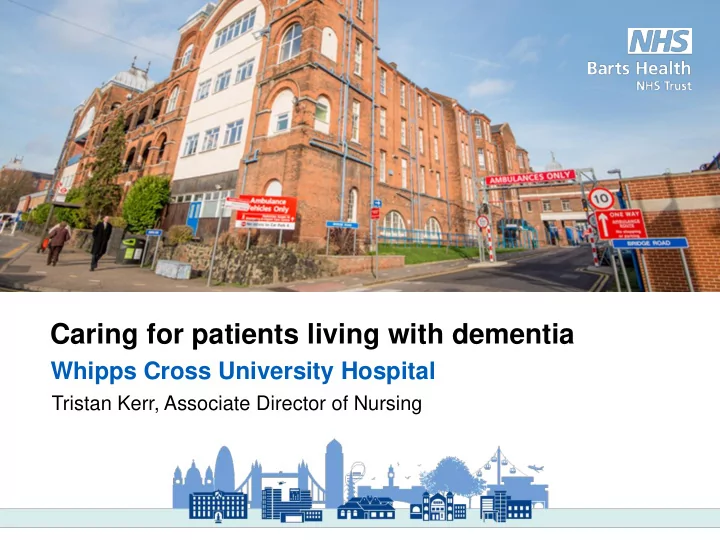
Caring for patients living with dementia Whipps Cross University - - PowerPoint PPT Presentation
Caring for patients living with dementia Whipps Cross University Hospital Tristan Kerr, Associate Director of Nursing What is dementia and delirium? Dementia The Alzheimers Society explains that dementia describes a set of symptoms that may
What is dementia and delirium?
The Alzheimer’s Society explains that dementia describes a set of symptoms that may include memory loss and difficulties with thinking, problem-solving or language. These changes are often small to start with, but for someone with dementia they have become severe enough to affect daily life. A person with dementia may also experience changes in their mood or behaviour.
Dementia Delirium
The Alzheimer’s Society explains that delirium causes a person to become easily distracted and more confused than normal. Delirium is different from dementia. For someone with delirium, symptoms come on over a matter of hours or a few days. The symptoms of dementia come on slowly, over a period of months or even years.
Our commitment to caring for patients living with dementia
- Barts Health NHS Trust is committed to becoming dementia friendly
- We have a dementia and delirium strategy to ensure that our patients receive the care
and support that they need
- Our strategy incorporates the seven key principles identified by the NHS London Acute
Hospital Network for Dementia and encompasses the Dementia Action Alliance Dementia-Friendly hospital charter
- All our hospitals have their own implementation plans of our strategy. Progress is
reviewed monthly and linked into the Trust-wide Older Peoples Network
Our dementia and delirium strategy 2013 - 2018
Strong ownership and leadership for dementia throughout the Trust Care is person centred and individual Environments that are dementia friendly Assessment and early identification of dementia Supporting people with dementia to be discharged back home Staff are skilled and have the time to care Strong partnership working with people with dementia, their carers and other agencies
Key principles
Strong ownership and leadership for dementia
- There is visible leadership in dementia across the Trust
- Site-based dementia and delirium teams have been operational for 18 months and are
fully staffed
- A multi-disciplinary dementia strategy steering group meets monthly on each site to
develop and adopt best practice
- Dementia champions have been identified in all clinical and non-clinical departments
- The Trust Board regularly reviews serious incidents, falls, delayed discharges,
complaints and patient experience metrics associated with patients with a diagnosis of dementia
Care is person centred and individual
‘Forget me not’
Care is person centred and individual
- We are embedding the ‘Forget me Not’ tool - a trust wide recognition scheme to aid
the identification of people with dementia by staff in all departments
- Patients living with dementia having a personalised care plan to support their individual
needs
- Specialist teams support patients with complex needs, including holistic therapy
assessments and advice for people with swallowing or eating and drinking problems
- Our safeguarding team ensure staff who care for people with dementia are
appropriately supported
- We actively seek feedback from individuals with dementia and their carers to improve
- ur services
Environments that are dementia friendly
- We are improving the experience and outcome of care for
people living with dementia by developing dementia friendly environments
- With funding from Barts Charity, five wards have been
- verhauled with new flooring, new day rooms for patients
and an improved layout to allow staff to be closer to patients
- Signage on wards is now specifically aimed at people with
dementia, and new artwork is helping to make the spaces friendly and welcoming
- Each ward, as well as the wider hospital, is also benefiting
from artwork showing familiar local landmarks
- Improvement work has been led by our dementia specialists
who spoke to patients and their families to make sure the changes reflected their wishes
Assessment and early identification of dementia
- We use the F.A.I.R dementia screening within our routine practice:
- Finding,
- Assessing
- Investigating and
- Referral
- All patients admitted over the age 75 years in an emergency have their cognition
assessed
- There is support for patients and carers to access community services through
signposting and onward referrals for further assessment and treatment as needed
Supporting people with dementia to be discharged back home
- We have key partnerships with services that support and facilitate discharge
- The dementia and delirium team assist with complex discharges to ensure that the
person living with dementia and their carers needs are met
- Information resources available for individuals with dementia and their carers that
identifies local support services
Staff are skilled and have the time to care
- Every ward has a dementia champion and a dementia resource folder
- We have developed dementia buddies – volunteers who are trained in engaging
with people living with dementia to work on our older peoples wards. We have recruited 8 dementia buddies at Whipps Cross to date
- All new staff are provided one hour dementia awareness training on induction
- We have a dedicated dementia training plan which is accessible to staff of all levels
and disciplines:
All new staff – tier one Two hour induction Two day dementia care training All grades Three day dementia champions course All grades Four day dementia leadership course Band 6 and above
Strong partnership working
- Barts Health is signed up to the John’s campaign – which has one principle: We should
not enforce disconnection between carers and those who need care. When someone with dementia is hospitalized, the medical staff should do all within their power to make access easy for family carers and utilise their expert knowledge and their love
- As a result, we have introduced carers badges, flexible visiting hours and information
leaflets for carers to ensure that carers needs are met
- The dementia and delirium team have strong links with community organisations and
resources
- We work in partnership with our local Alzheimer's societies, and various statutory and