Careers Information Advice and Guidance (CIAG) for Adults National - - PowerPoint PPT Presentation

careers information advice and guidance ciag for adults
SMART_READER_LITE
LIVE PREVIEW

Careers Information Advice and Guidance (CIAG) for Adults National - - PowerPoint PPT Presentation

Careers Information Advice and Guidance (CIAG) for Adults National DWP Retraining A requirement of the Work Coach Scheme role, however with Working to fill skills the introduction of gaps however UC time with unclear if CIAG customers


slide-1
SLIDE 1

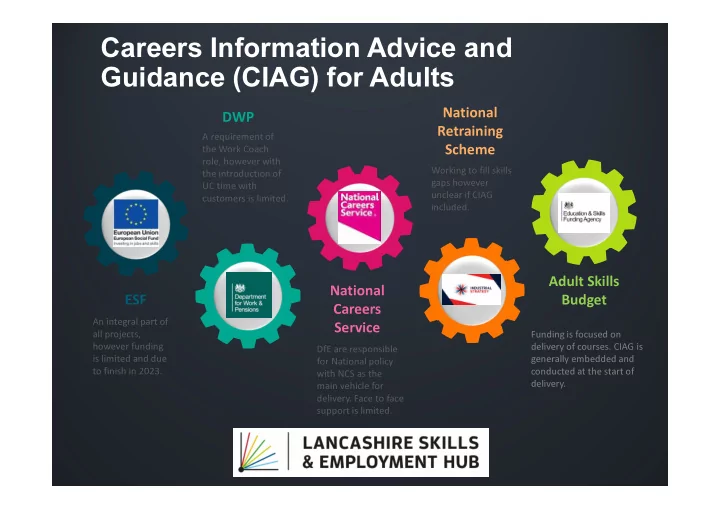
Careers Information Advice and Guidance (CIAG) for Adults

ESF DWP

A requirement of the Work Coach role, however with the introduction of UC time with customers is limited.

National Careers Service

DfE are responsible for National policy with NCS as the main vehicle for

  • delivery. Face to face

support is limited.

National Retraining Scheme

Working to fill skills gaps however unclear if CIAG included.

Adult Skills Budget

An integral part of all projects, however funding is limited and due to finish in 2023. Funding is focused on delivery of courses. CIAG is generally embedded and conducted at the start of delivery.

slide-2
SLIDE 2

The Policy Context - The Careers Strategy

The Careers Strategy December 2017 states that: “Local Industrial Strategies, supported by Skills Advisory Panel analysis, will bring together local partnerships and relationships with businesses, Mayoral Combined Authorities and LEPs to help make sure that careers advice is well-positioned to support local economic growth. National Careers Service providers will use up-to-date information on the skills and jobs available in their areas and advisers will use local labour market information to help their customers make informed decisions on future careers, jobs or learning.” “Our aim: We want everyone to get support tailored to their circumstances at any time. All adults will be able to access free face-to-face advice with more bespoke support for those who need it most.”

slide-3
SLIDE 3

The Policy Context - The Careers Strategy

  • The strategy notes the requirement to improve social mobility and tackle

the UK’s productivity challenge and notes the need to develop the skills of those in the workforce as well as those entering employment.

  • The key delivery mechanism for this will be the National Careers Service.
  • The Government is investing £40 million in Career Learning Pilots to test

how they can effectively engage adults about the opportunities and benefits of learning.

  • Announced in the 2017 budget the National Retraining Scheme which will

“give individuals the skills they need to progress in work, redirect their careers and secure the high paid, high skilled jobs of the future.”

slide-4
SLIDE 4

National Careers Service

Overview

The Careers Strategy sets out the role of the National Careers Service which will continue to provide universal information and advice via its website and phone service. Local labour market intelligence is used to inform material

  • n the website and advice provided through web chats with advisers, over the phone and in face-to-face sessions.

Skills Advisory Panels will contribute to this material. People are encouraged and supported to manage their careers proactively throughout their working lives. The National Careers Service is delivered in Lancashire by The Growth Company and their local partners as follows:

  • Blackpool, Fylde, Wyre, West Lancashire, Chorley, South Ribble, Ribble Valley – Career Connect
  • Preston and Lancaster and Morecambe – Inspira
  • Blackburn with Darwen – Blackburn with Darwen Council
  • Rossendale and Hyndburn – Growth Company Employment
  • Pendle and Burnley – Burnley College

Implications

  • Contracted until October 2021
  • Digital first service with targeted face to face support
  • Quality will depend on local delivery partners
slide-5
SLIDE 5

ESF

Overview

There are currently 14 projects delivering support for residents in Lancashire. All projects include elements of IAG for the participants. Lancashire’s LMI was used to inform the specifications. The training delivered aims to respond to an individual’s skills needs and the support they require to move forward on their journey into work. The specifications state that support must be delivered in the context of a personalised skills training programme whose objective is to secure a job outcome.

Implications

  • Funding until 2023
  • Prospects for funding via Shared Prosperity Fund are unconfirmed post 2023
  • Quality and impartiality dependant on the delivery partner and IAG (Matrix) standard used
  • The evidence for ESF requirements is to deliver IAG to support participants to create an

Individual Learning Plan

slide-6
SLIDE 6

Department for Work & Pensions

Overview

An integral part of the role of work coaches within Jobcentre Plus is to signpost customers to services offering training and support to make career choices. There are tools to support work coaches with the options for each customer. DWP are now working with Universal Credit claimants who are employed and seeking to increase hours or income.

Implications

  • With the priority of the roll out of Universal Credit, work coaches may have limited time with customers
  • Initial contact is all online, with reduced opportunity for face to face advice
  • There is a wide range of provision which could be challenging for work coaches to understand
slide-7
SLIDE 7

National Retraining Scheme

Overview

The National Retraining Scheme has been allocated £100m of funding and is a partnership between the government, CBI and the TUC. The aim of the partnership is to “help set the strategic priorities for the scheme and

  • versee its implementation, working with new Skills Advisory Panels to ensure that local economies’ needs are

reflected.” The scheme is using learning from the Career Learning Pilots to inform the priorities and approach to the National Retraining Scheme. The Scheme will include targeted short-term action in sectors with immediate skills shortages. Government is investing £30 million to develop digital skills as an early Scheme initiative, as well as £34 million to expand innovative construction training programmes across the country. The scheme will expand its reach as the Career Learning Pilots are evaluated and future priorities are set. So far none of the money allocated has been earmarked for CIAG but we expect this to change as priorities develop.

Implications

  • Not yet available locally
  • Based on Career Learning Pilots where results are still to be evaluated
slide-8
SLIDE 8

Adult Education Budget (AEB)

Overview

Ministers have agreed the AEB funding nationally, for a period of 2 years following devolution (funding years 2019 to 2020 and 2020 to 2021) From the 2019 to 2020 academic year (1 August 2019 to 31 July 2020), the government will devolve the AEB to the 6 combined authorities and where there are no combined authorities it will continue to sit with ESFA. Adult Education Budget (AEB) 2018 to 2019 introduced increased flexibility for learners in receipt of low wage.

Implications

  • There is no direct requirement for careers advice
  • Issues with the reduction/removal of this funding stream
  • Some partners in Lancashire have had not received AEB funding this contract year
  • Quality and impartiality dependant on the delivery partner
slide-9
SLIDE 9

CIAG for Adults

ESF DWP National Careers Service National Retraining Scheme Adult Skills Budget

What is the Skills Hub currently doing?

  • SPM partnership work
  • Escalate
  • Lancashire Adult Skills Forum
  • Labour Market Information
  • Projects in Partnership Events
  • Employer Skills Forum
  • Project Steering Groups
slide-10
SLIDE 10

CIAG for Adults

ESF DWP National Careers Service National Retraining Scheme Adult Skills Budget

  • Does this meet the needs of the labour market in Lancashire?
  • Where are the gaps?
  • How do we influence the quality, impartiality and reach of CIAG across

Lancashire?

  • Do we need to explore ways of bringing greater coherence to the current

provision?