SLIDE 1
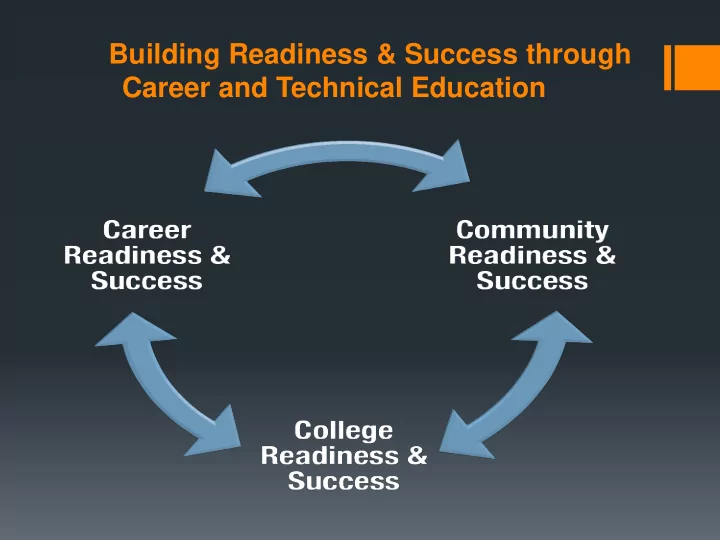
Building Readiness & Success through Career and Technical Education
SLIDE 2 Perkins V Plan Development Building Hawaii’s Career Pathway System
Leading at the Intersections
Status update September 12, 2019
SLIDE 3
Reminder:
In order to access federal funds WIOA must align with the US Department of Education’s ➢Carl Perkins Act (aka Perkins V) ➢Elementary and Secondary Education Act
SLIDE 4
But we do it because
It’s the right thing to do for our clients and students
SLIDE 5
Our guiding principles for WIOA, ESSA and Perkins are aligned: ➢Learner/Client-centered. ➢Equity-focused. ➢Outcomes-oriented. ➢Partnership – joint ownership, joint design, joint implementation (including braiding of resources). ➢Systemic and systematic approaches to continuous improvement and innovation.
SLIDE 6
The laws all require that we serve our clients/students using a Career Pathway model
SLIDE 7 Nested Purposes
Hawai‘i Career Pathway System
- Lifelong learning and training for employment towards self-
sufficiency and well-being as part of a competitively skilled workforce for employers and a thriving, sustainable Hawai‘i.
Career & Technical Education
- High-quality grades 6-16 formal learning experiences paired with
work-based learning experiences that provide all learners the knowledge, skills, and competencies to fully participate in, contribute to, and benefit from Hawai‘i’s economy and our communities.
Perkins V
- Strengthen CTE systems and systems
capacities to continuously improve and innovate Hawai‘i’s programs and programs of study in grades 6-14 that ensure equitable access and outcomes for all learners in in- demand, high-skill, high-wage pathways.
SLIDE 8
HAWAI‘I CAREER PATHWAY SYSTEM
SLIDE 9
SLIDE 10
SLIDE 11 Components
CTE Program
PROPERLY SEQUENCED COURSES LEADING TO A DEGREE, CERTIFICATE, CREDENTIAL INTEGRATED ACADEMICS EMPLOYABILITY/TRANSFERABLE SKILLS QUALIFIED PERSONNEL & PD FACILITIES AND EQUIPMENT EMPLOYER ENGAGEMENT INDUSTRY APPROVED STANDARDS ECONOMIC AND WORKFORCE ALIGNMENT WORK-BASED LEARNING OPPORTUNITIES MULTIPLE ENTRY AND EXIT POINTS COUNSELING AND ADVISING ACCELERATION/EARLY COLLEGE/ DUAL CREDIT OPTION ACCOUNTABILITY MONITORING AND EVALUATION
SLIDE 12 From February to August we conducted a needs assessment to identify areas requiring more support
https://www.hawaii.edu/cte/perkins- v/PerkinsV_Needs_Assessment_Exec_Summary.pdf
SLIDE 13
Needs Assessment Summary of Findings:
➢There are pockets of good things happening all across the state at both the secondary, postsecondary, and workforce levels. ➢Hawai‘i has made good progress (not complete progress) toward accumulating the parts of quality CTE over the years.
SLIDE 14
Our Findings Underscore these Statewide Areas of Need
➢Systems building. ➢Career exploration and counseling from grades 6 through to workforce. ➢Work-based learning/employer engagement. ➢Inclusion of employability skills. ➢Need for more CTE professionals and coordinated professional development for all staff at all levels across all partner agencies. ➢Better data, monitoring, and evaluation.
SLIDE 15
Prioritizing the Work to be Done
SLIDE 16 Hawai‘i’s Planning Group Guiding Principles/Ground Rules:
➢Build on the strengths and accomplishments
- f Hawai‘i’s education and workforce
personnel. ➢Lead at the intersections and interdependencies. ➢Leverage existing structures and processes so as to be minimally disruptive and avoid redundancies. ➢Highly principled and minimally prescriptive.
SLIDE 17
Prioritize System & Capacity Building
Systemically ➢ Create, strengthen, & integrate the components & processes. ➢ Over the next 3 years to bring about improved outcomes.
SLIDE 18 Typical Improvement Efforts
Source: Carnegie Foundation for the Advancement of Teaching Source: Carnegie Foundation for the Advancement of Teaching
PROPERLY SEQUENCED COURSES LEADING TO A DEGREE, CERTIFICATE, CREDENTIAL INTEGRATED ACADEMICS EMPLOYABILITY/TRANSFERABLE SKILLS QUALIFIED PERSONNEL & PD FACILITIES AND EQUIPMENT EMPLOYER ENGAGEMENT INDUSTRY APPROVED STANDARDS ECONOMIC AND WORKFORCE ALIGNMENT WORK-BASED LEARNING OPPORTUNITIES MULTIPLE ENTRY AND EXIT POINTS COUNSELING AND ADVISING ACCELERATION/EARLY COLLEGE/ DUAL CREDIT OPTION ACCOUNTABILITY MONITORING AND EVALUATION
SLIDE 19 Source: Carnegie Foundation for the Advancement of T Source: Carnegie Foundation for the Advancement of T
PROPERLY SEQUENCED COURSES LEADING TO A DEGREE, CERTIFICATE, CREDENTIAL INTEGRATED ACADEMICS EMPLOYABILITY/TRANSFERABLE SKILLS QUALIFIED PERSONNEL & PD FACILITIES AND EQUIPMENT EMPLOYER ENGAGEMENT INDUSTRY APPROVED STANDARDS ECONOMIC AND WORKFORCE ALIGNMENT WORK-BASED LEARNING OPPORTUNITIES MULTIPLE ENTRY AND EXIT POINTS COUNSELING AND ADVISING ACCELERATION/EARLY COLLEGE/ DUAL CREDIT OPTION ACCOUNTABILITY MONITORING AND EVALUATION
Establish & strengthen individual elements & their delivery Integrate & coordinate design & delivery between elements
Intra-agency
Inter-agencies/stakeholder partnerships Systemic & systematic interactions, intersections, & interdependencies Structures, Processes, Policies, Relationships, Norms Professional development & capacity building STRENGTHENING ELEMENTS* SYSTEMS BUILDING** BUILDING SYSTEM CAPACITIES**
SLIDE 20 Source: Carnegie Foundation for the Advancement of T Source: Carnegie Foundation for the Advancement of T
PROPERLY SEQUENCED COURSES LEADING TO A DEGREE, CERTIFICATE, CREDENTIAL INTEGRATED ACADEMICS EMPLOYABILITY/TRANSFERABLE SKILLS QUALIFIED PERSONNEL & PD FACILITIES AND EQUIPMENT EMPLOYER ENGAGEMENT INDUSTRY APPROVED STANDARDS ECONOMIC AND WORKFORCE ALIGNMENT WORK-BASED LEARNING OPPORTUNITIES MULTIPLE ENTRY AND EXIT POINTS COUNSELING AND ADVISING ACCELERATION/EARLY COLLEGE/ DUAL CREDIT OPTION ACCOUNTABILITY MONITORING AND EVALUATION
Establish & strengthen individual elements & their delivery Integrate & coordinate design & delivery between elements
Intra-agency
Inter-agencies/stakeholder partnerships Systemic & systematic interactions, intersections, & interdependencies Structures, Processes, Policies, Relationships, Norms Professional development & capacity building STRENGTHENING ELEMENTS* SYSTEMS BUILDING** BUILDING SYSTEM CAPACITIES**
SLIDE 21 Prioritize Five Elements for Building Systems & Capacities
- A. Counseling and Advising
- B. Work-Based Learning Opportunities
- C. Employability/Transferable skills
- D. Qualified Personnel & Professional
Development (PD)
- E. Monitoring and Evaluation;
Accountability
SLIDE 22
Counseling and Advising
➢Develop an articulated statewide counseling and advising plan.
➢Expands to include middle school career exploration and UHCC noncredit
➢Includes PD for counselors and educators and the addition of career counseling positions. ➢Implement Personal Transition/Life Plan for grades 6-adults.
SLIDE 23
Work-Based Learning Opportunities
➢Development of a continuum of WBL activities. ➢Provide PD for employers and educators ➢Increase staffing to support development & coordination. ➢Develop the information systems and processes for equitable awareness and access for students and educators/counselors.
SLIDE 24
Employability/Transferable Skills
➢Development/adaptation of employability or transferable skills frameworks. ➢Staffing and resources to assist in development/adaptation. ➢Integration into CTE and non-CTE programs through technical assistance and professional development.
SLIDE 25
➢Life and Career Skills: Flexibility & adaptability; Initiative & self-direction; Social & cross-cultural skills; Productivity & accountability; and Leadership & responsibility. ➢Learning and Innovation Skills:Creativity & Innovation; Critical thinking & problem-solving (and problem-seeking); Communication & collaboration. ➢Information, Media, and Technology Skills: Information literacy; Media literacy; and ICT literacy. ➢Financial, economic, business, and entrepreneurial literacy
SLIDE 26
Qualified Personnel & Professional Development
➢Partner with higher education to increase the number of highly qualified educators and counselors. ➢Systemwide Professional Development for CTE and non-CTE teachers, counselors, administrators, and support personnel.
➢Coordinated and integrated support that is in- depth, sustained, job-embedded
SLIDE 27
Monitoring & Evaluation; Accountability
➢Develop system of monitoring, feedback, & evaluation for program improvement. ➢Strengthen agencies’ data systems and their integration, including data use. ➢Determine and address staffing needs.
SLIDE 28
To help do all these things, we are proposing that the Perkins V plan
➢Create a reserve fund of ~$750k to help lead and coordinate activities. ➢Create a cross-agency committee to determine use of reserve funds. ➢Encourage regional & consortium activities.
SLIDE 29